Key Engineering Takeaways
- A voltage adjustment range does not establish constant-current performance at every setting within it.
- The HPS-3000-24 page lists 0–26.4 V adjustment, a 12–24 V constant-current optimum range and 0–125 A current adjustment.
- Review each required voltage/current point against all relevant limits; remaining below 3,000 W is not sufficient evidence by itself.
- Ask for model-specific behavior and acceptance criteria at the requested operating points before releasing the application.
Two range fields answer different purchasing questions
A buyer requests an adjustable source because a process needs several voltage and current settings. The product table includes a wide voltage adjustment range, so the request assumes full constant-current operation throughout that range. The table, however, lists another voltage interval specifically for constant-current operation.
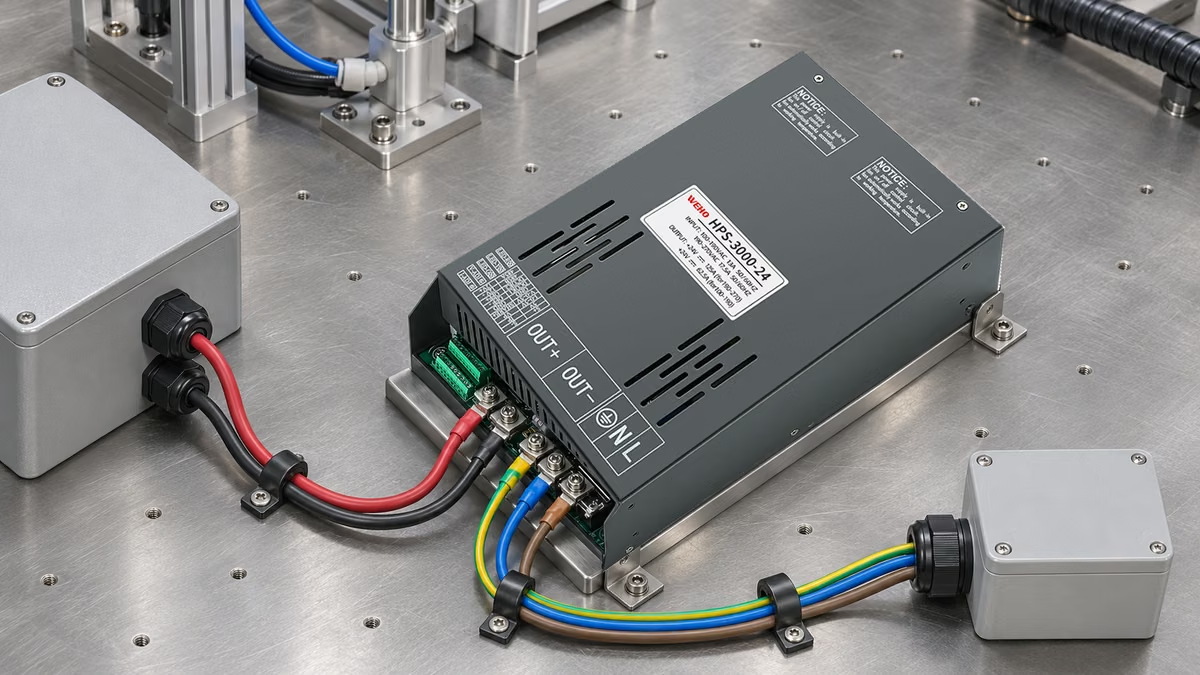
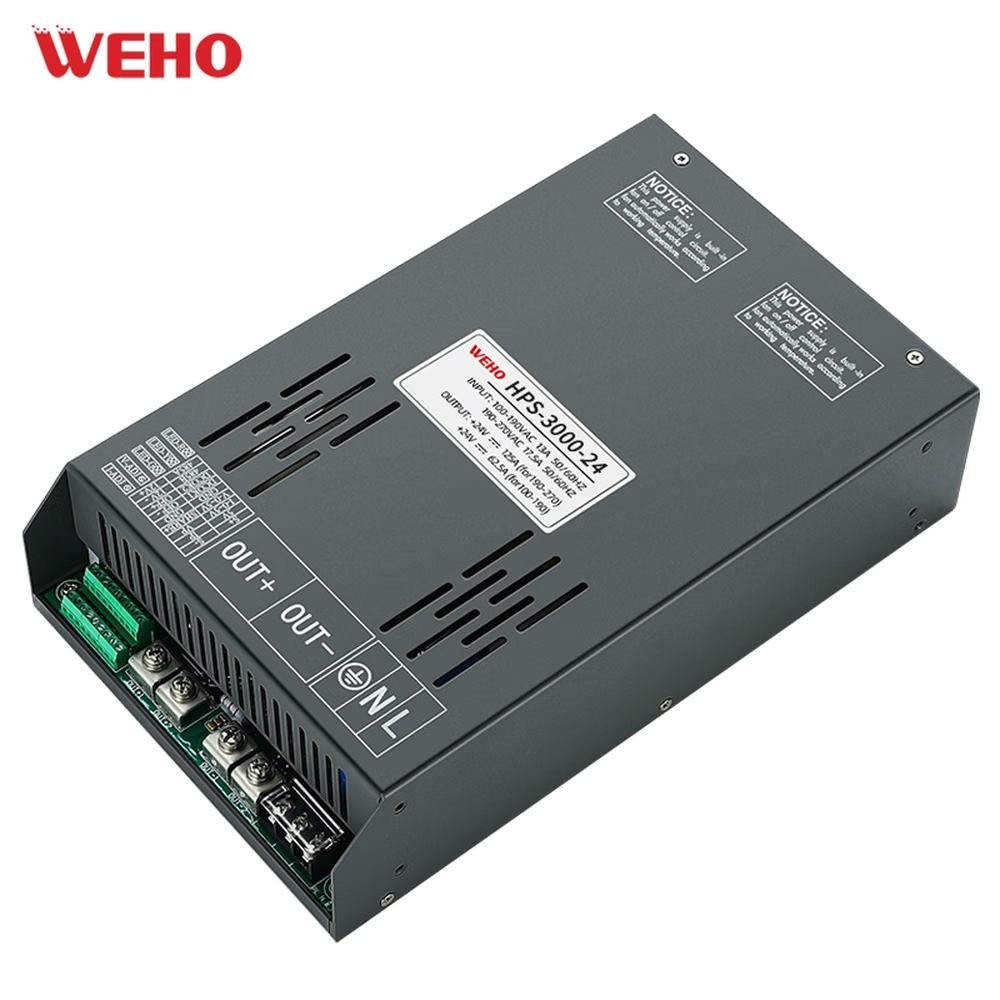
ال HPS-3000-24 adjustable power candidate makes this distinction visible. Its page publishes 0–26.4 V output adjustment, a “constant current optimum range” of 12–24 V and 0–125 A output-current adjustment. Nominal 24 V multiplied by 125 A gives 3,000 W.
These entries do not define the same boundary. The task is to obtain an attributable answer for the exact voltage/current points the process needs. This article does not establish battery charging profiles, chemistry compatibility or automatic constant-power behavior.
Turn the requirement into a list of operating points
Write each required point as voltage, current, duration and operating mode. Include the input conditions, ambient range and relevant transition between points. A process description such as “0–24 V adjustable” is incomplete when the load must also remain in controlled constant current.
For each point, calculate output power with P = V × I. This identifies obvious arithmetic conflicts, but it does not close the operating-range review. A point can be below nominal wattage while lying outside the published constant-current optimum interval.
Keep the word “optimum” intact when recording the source. It does not, by itself, define regulation accuracy, a guaranteed operating boundary or a shutdown threshold. Ask the supplier how the term applies to the offered revision and what performance is specified outside that interval.
Likewise, a current adjustment range describes an adjustable setting field; it does not prove that the maximum setting is deliverable at every voltage, input or temperature. The required combination needs evidence as a combination.
Hypothetical process-point review
Assume a hypothetical test process requests four points: 6 V at 20 A, 12 V at 100 A, 24 V at 125 A and 26 V at 110 A. The calculated powers are 120 W, 1,200 W, 3,000 W and 2,860 W respectively. These are requirement examples, not demonstrated HPS-3000 performance.
All four requested voltages lie within the listed adjustment interval, and all four requested currents are no greater than 125 A. Yet the 6 V and 26 V requests lie outside the published 12–24 V constant-current optimum interval. Those two points need explicit clarification even though their calculated powers are below 3,000 W.
| Requested point | Calculated power | Adjustment screen | CC interval screen | Disposition |
|---|---|---|---|---|
| 6 V, 20 A | 120 W | Within listed settings | Below 12 V | Request specified behavior |
| 12 V, 100 A | 1,200 W | Within listed settings | At published lower endpoint | Verify required conditions |
| 24 V, 125 A | 3,000 W | At nominal current | At published upper endpoint | Verify full-load conditions |
| 26 V, 110 A | 2,860 W | Within listed settings | Above 24 V | Request specified behavior |
Passing these initial screens means only that the request has not contradicted those particular published fields. It is not an approval of regulation accuracy, stability, thermal conditions or transitions between operating points.

Swipe horizontally on a small screen, or open the full-size diagram.
Avoid inventing a constant-power envelope
Dividing 3,000 W by a requested voltage can produce a mathematically attractive current. For example, 3,000 ÷ 26.4 ≈ 113.6 A. That number is an arithmetic quotient, not a published HPS-3000-24 current limit or an automatic foldback characteristic.
The inverse mistake is to apply 125 A throughout the voltage adjustment interval. At 26.4 V, that would be 26.4 × 125 = 3,300 W, above the nominal 3,000 W point. The calculation identifies a conflict in the assumption; it does not describe what the actual unit will do when asked to operate there.
Similarly, 12 V at 125 A calculates to 1,500 W. Being below nominal power does not establish the required accuracy or dynamic behavior at that point. Ask for the applicable voltage/current operating envelope rather than constructing one from a single wattage and a pair of endpoint settings.
| Published field | ماذا تسجل | What it does not establish | Required clarification |
|---|---|---|---|
| 0–26.4 V adjustment | Available voltage-setting interval | Full CC behavior throughout | Performance at requested voltage |
| 12–24 V CC optimum | Source’s exact wording | Accuracy or behavior outside it | Meaning and applicable limits |
| 0–125 A adjustment | Current-setting interval | 125 A at every voltage | Combined V/I envelope |
| 24 V × 125 A | 3,000 W nominal arithmetic | Automatic constant-power control | Documented regulation modes |
Input conditions must also be resolved. The page describes 50% output current for 95–190 VAC and 100% for 195–265 VAC, leaving 190–195 VAC unassigned. Do not interpolate that gap or generalize the current condition into an undocumented all-input operating curve.
The photographed nominal input marking and the page’s operating-input entries also require applicable-version confirmation. Keep the actual site input range in the inquiry rather than assuming that a familiar nominal supply label resolves every condition.
Obtain an operating-point commitment that can be tested
- List the real process points. Specify voltage, current, duration and required operating mode. Identify which points need constant-current regulation and which merely require an adjustable DC voltage. Include transitions and any load characteristic that the supplier needs to assess.
- Apply separate screening columns. Compare voltage adjustment, current adjustment, the published CC interval and calculated power independently. Mark the field that creates an open question. Do not allow a successful wattage calculation to overwrite an unresolved constant-current requirement.
- State input and environment. Provide the actual input range and relevant installation conditions. Ask how the offered revision behaves in any interval not assigned by the page. Keep the question open until the supplier supplies an applicable definition.
- Request the combined envelope. Ask for permissible voltage/current combinations, regulation accuracy, relevant duration limits and the meaning of the CC optimum interval. Ask whether protection or mode transitions affect the requested process; do not invent their curves from the table headings.
- Agree on sample acceptance. Define the sensing point, instrumentation, load and steady-state or transition requirement for each requested point. Obtain thresholds from the agreed specification. A display reaching a set value once is not evidence that the required mode and accuracy are maintained.
- Release only the covered points. Link each accepted point to the applicable document or sample record and its conditions. If another process point is added later, review it explicitly instead of inheriting approval from a different part of the adjustment range.
The result is a useful technical purchase specification: a small list of required states with evidence and acceptance criteria. It is more actionable than requesting “a fully adjustable 3 kW supply” and discovering the missing operating details during integration.
Send the required voltage/current points with the inquiry
مراجعة The HPS-3000-24 published range fields and send WEHO the required operating-point list, input range, duration, load behavior and regulation criteria. Ask for confirmation of the offered revision’s combined operating envelope and the meaning of “constant current optimum range.”
Download the voltage/current point confirmation sheet to keep range screening, power arithmetic and supplier evidence in separate fields. Its example points are hypothetical requirements; they do not certify a permitted operating envelope.
Engineering FAQ
Does 0–26.4 V adjustment guarantee constant current at 6 V?
No. The adjustment interval alone does not establish constant-current performance at 6 V. The page separately lists a 12–24 V CC optimum interval. Ask what behavior and accuracy are specified at the exact required point.
Can 125 A be used at 26.4 V?
That combination is not established by the separate adjustment fields. It calculates to 3,300 W, above the nominal 24 V × 125 A point. Obtain the applicable combined operating envelope instead of treating separate endpoints as simultaneous guarantees.
Does a point below 3,000 W automatically pass?
No. It must also satisfy the required voltage/current behavior, input, environment and duration conditions. A low-power point can lie outside the published CC optimum interval. Screen each field and resolve the actual requested combination.
Does CC optimum mean operation outside the interval is impossible?
The wording alone does not establish that conclusion. It identifies a separate published interval whose meaning needs confirmation for the offered revision. Request the specified behavior outside it without assuming either full performance or an absolute prohibition.