- A static bend-radius limit does not establish continuous-motion cable life.
- Separate an integral sensor lead from any replaceable moving extension.
- Specify stroke, cycle definition, radius, temperature and torsion together.
- Release a moving assembly only against documented cable and machine evidence.
A passing sensor signal does not qualify a moving cable
A proximity sensor can switch correctly during commissioning while its cable arrangement remains unqualified for repeated travel. The electrical check answers whether the target is detected now; the motion assessment asks whether the installed cable system can endure the required movement. Procurement needs both records before accepting the assembly for production.
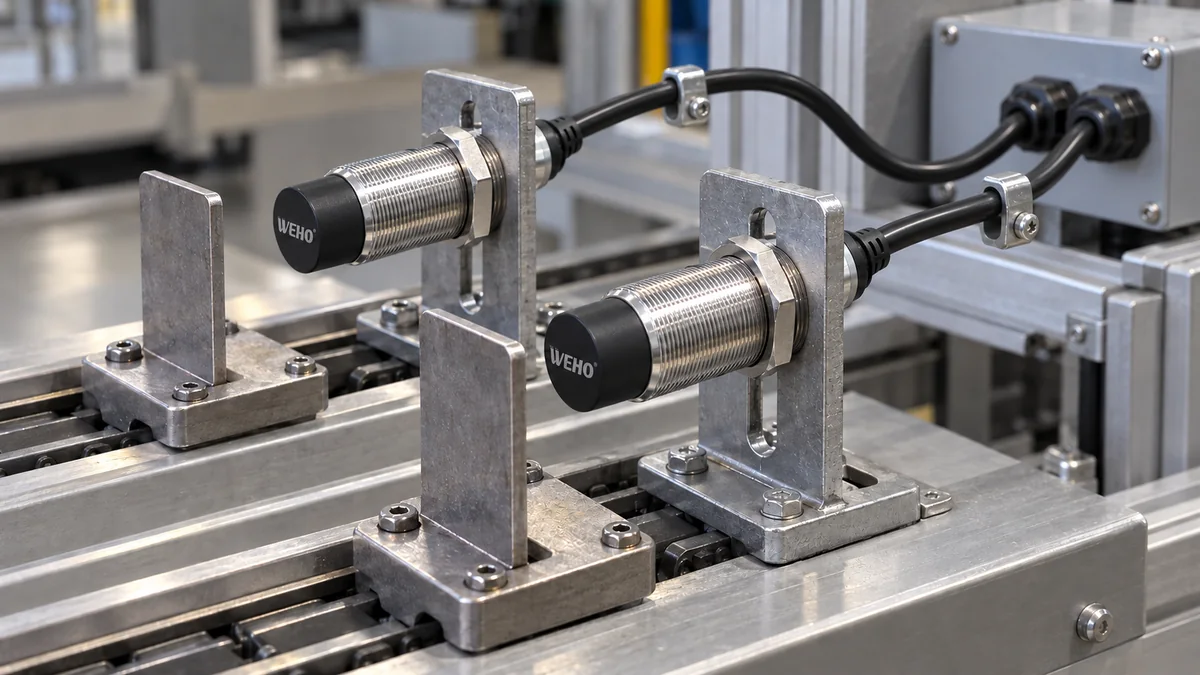
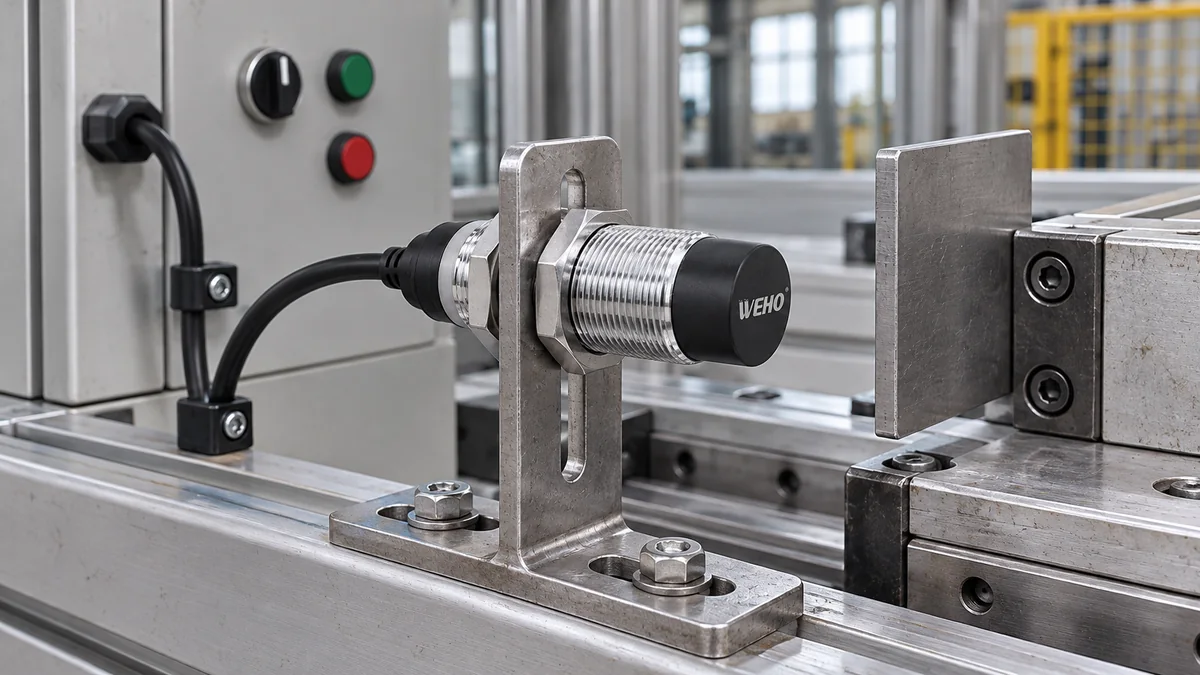
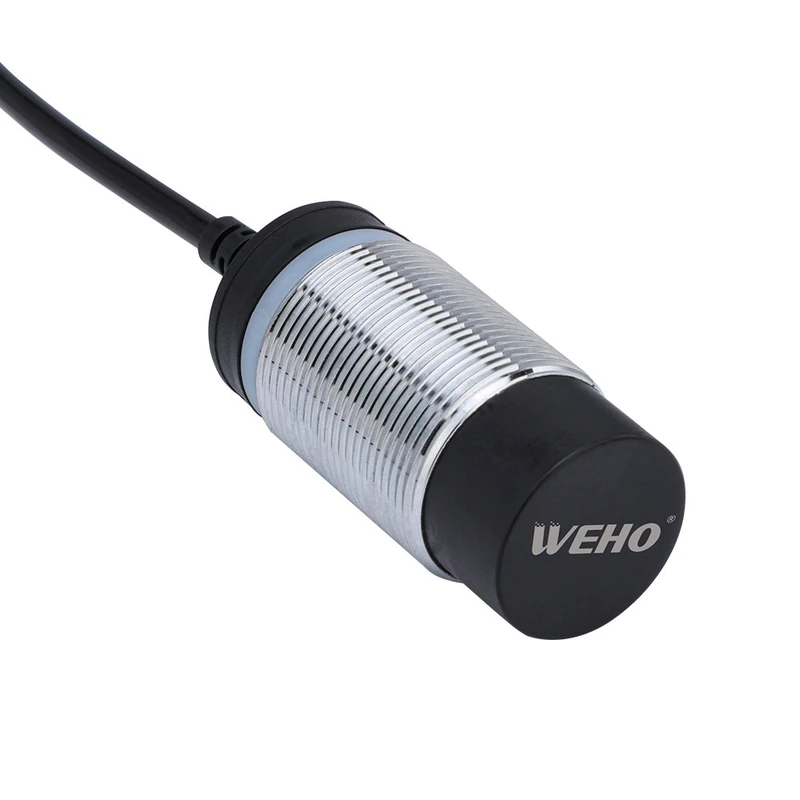
ال WEHO LJA18 long cylindrical inductive proximity switch provides the sensor-family context for this review. The family photograph shows an integral cable, but neither the photograph nor a generic family name establishes a drag-chain rating, a dynamic minimum radius or a cycle-life guarantee. Obtain the exact ordered sensor and cable information before assigning a moving duty.
Distinguish fixed, occasional and continuous movement
Cable flexibility describes more than whether a cable can be bent by hand. A fixed installation bends during assembly and then stays in place; occasional flexing and continuous carrier travel impose different duties. Igus distinguishes fixed, flexible and chain bend-radius specifications and explains why the application conditions matter to its assessment.
A static radius therefore cannot be reused as a continuous-motion limit without supporting documentation. Even two cables with the same outside diameter can have different constructions and permitted duties. HELUKABEL's bend-radius guidance lists fixed and flexing values separately for specific cable products; those values belong to those products and are not LJA18 ratings.
The measurement reference also needs agreement. A cable drawing, a carrier drawing and an installation measurement may use different geometric references, so compare the definitions before comparing numbers. Record whether the relevant radius is measured to an inside surface, cable centreline or another stated reference, rather than silently treating all radius labels as identical.
Locate the part that actually bends
An integral sensor lead may be stationary on a moving carriage if both the sensor and a suitable termination move together. A separate external cable can then accommodate travel between that carriage and the fixed cabinet. This arrangement still requires compatible terminations, environmental protection and electrical approval; it does not follow merely from adding an extension.
A sensor tail that bends at its own exit on every stroke is a different proposal. Qualifying an external extension does not qualify that integral tail or its moulded entry. Identify the moving section on the machine drawing, and keep the sensor-tail decision explicit if no suitable manufacturer evidence is available.
Convert a motion description into a checkable requirement
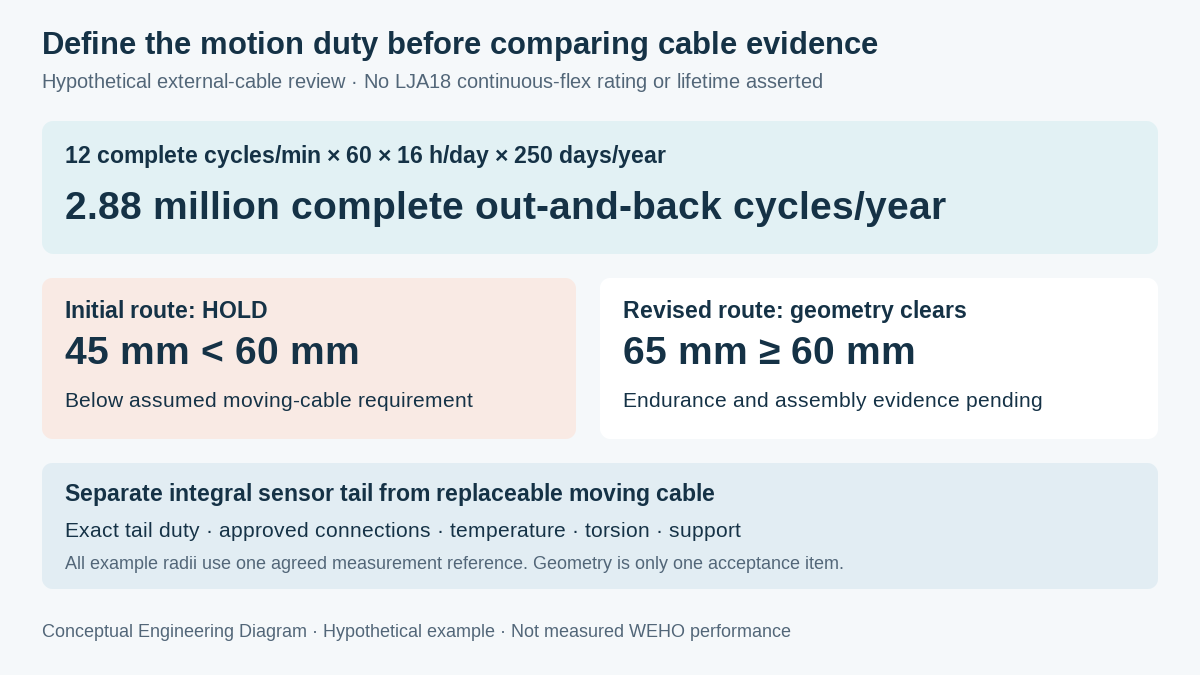
Consider a hypothetical linear axis with a 0.8 m one-way stroke, 12 complete out-and-back cycles per minute, 16 operating hours per day and 250 operating days per year. Assume this schedule is the engineering duty estimate, with no claim that any WEHO sensor or candidate cable has passed it. Define one cycle as a complete return to the starting position.
The estimated annual duty is 12 × 60 × 16 × 250 = 2,880,000 complete cycles. The corresponding travel is 2 × 0.8 × 2,880,000 = 4,608,000 m, or 4,608 km. A supplier report expressed in individual strokes would require conversion because this example has two one-way strokes per defined cycle.
Assume the machine drawing initially provides a 45 mm cable bend radius, measured using the same reference as a hypothetical external-cable requirement of 60 mm for the intended moving duty. The geometry check fails because 45 mm is below 60 mm. Neither value is a published LJA18 limit, and the example gives no cable a tested life.
An amended route providing 65 mm would clear that one geometric comparison. The larger route would not, by itself, establish 2.88 million cycles of service, compatibility with the integral lead, or suitability at the operating temperature. The engineering disposition should read “radius comparison acceptable; endurance and assembly evidence pending,” with the remaining owners named.
Swipe horizontally on a small screen, or open the full-size diagram.
| Review item | Hypothetical requirement | Initial proposal | Disposition |
|---|---|---|---|
| Duty definition | 2.88 million complete cycles/year | Cycle meaning omitted | Define out-and-back before comparison |
| External cable radius | 60 mm for assumed moving duty | 45 mm on agreed reference | Hold; route is below requirement |
| Revised route | At least assumed 60 mm | 65 mm on agreed reference | Geometry clears; endurance pending |
| Integral sensor tail | Exact permitted motion documented | No applicable evidence | Do not infer a continuous-flex rating |
| Complete assembly | Terminations and environment verified | Continuity check only | Further assembly validation required |
Put the motion conditions into the release file
Stroke count alone leaves important differences unresolved. Record travel orientation, speed, acceleration, minimum and maximum temperature, exposure to coolant or oil, and whether motion includes twist. A linear bending qualification should not silently become a torsion qualification when the machine adds a rotating joint.
Installation details can also concentrate bending at an unintended point. OMRON's industrial connector failure guide documents conductor breaks associated with local repetitive bending and advises against making a fastening point the bending fulcrum. The cited connector examples do not supply a permissible radius or endurance rating for a WEHO lead.
Build an assembly validation record before production
- Map the movement. Mark fixed anchors, moving anchors, integral sensor lead, external extension and every termination on the layout. Record the full travel envelope; the acceptance criterion is an unambiguous identification of every repeatedly bending or twisting section.
- Identify each cable. Capture exact sensor suffix, cable markings, connector part numbers and drawing revisions. Obtain the manufacturer's applicable duty and radius information; missing continuous-motion evidence remains an open item rather than an assumed pass.
- Compare the installed geometry. Inspect the complete travel under the machine builder's controlled commissioning procedure, including end positions and transitions. Record the smallest applicable radius, clearance and unwanted pull; acceptance requires compliance with each documented component limit throughout travel.
- Agree the endurance evidence. Compare the required duty with supplier test conditions and any machine validation plan. Record cycle definition, environment, sample arrangement and electrical monitoring; accept evidence only where its scope supports the proposed assembly, documenting any unresolved differences.
- Release the maintainable configuration. Preserve cable routing, fixing positions, approved parts and inspection triggers in the build record. Verify that the replacement instructions reproduce the qualified assembly; a different cable or altered anchor location requires review before substitution.
Electrical monitoring should observe the installed function as well as basic continuity. The machine team can define acceptable signal behaviour, supply conditions and fault detection within its approved validation plan. A continuity check with the axis stationary cannot close a concern that appears only during travel or at a particular bend position.
WEHO's proximity-sensor integration guide covers the separate electrical integration task. Keep output type and PLC input compatibility in the release file, but do not treat correct NPN or PNP operation as evidence of mechanical endurance. The connection and motion records support different acceptance decisions.
Choose the cable boundary before requesting a replacement
Retaining a stationary sensor tail and qualifying a replaceable moving cable can simplify maintenance where the approved connection arrangement allows it. Additional connections also add parts, space and environmental interfaces to review. Bending an integral lead directly may use fewer components, but its permitted duty still needs specific supporting evidence.
Send WEHO the exact LJA18 sensor identification, a marked movement drawing, photographs of the cable exit and terminations, and the motion schedule. State whether the request concerns an integral tail or a separate extension, and include the proposed radius reference and environmental conditions. Request confirmation of the applicable configuration before placing a repeat order.
Frequently asked questions
Does a static bend-radius specification prove a sensor cable can run in a drag chain?
No, a static bend-radius specification does not establish continuous-motion suitability. Repeated travel needs applicable cable-duty evidence and an installation that follows the relevant limits. Keep radius, cycle definition, temperature, motion and termination conditions together in the approval record.
Can a continuous-flex extension make an integral sensor tail suitable for repeated bending?
No, an extension cannot transfer its qualification to the integral sensor tail. The tail and its entry must either remain within their documented duty or receive applicable confirmation. Identify the mechanical boundary before deciding which component needs a moving-cable specification.
Is a larger cable carrier radius enough to approve the assembly?
No, a larger radius closes only the relevant geometric requirement when correctly measured. Cycle life, torsion, environment, support and electrical behaviour still require suitable evidence. Record which requirements the revised route satisfies and which remain open.
What information should accompany a moving sensor cable enquiry?
Provide exact sensor and cable identities, the moving-section drawing and a defined duty cycle. Include stroke, speed, acceleration, operating temperature, chemicals, twist and measured bend geometry. Clearly distinguish observed dimensions from assumed requirements and from manufacturer-confirmed limits.