Marine Inverter Procurement: Loads, Location and Shore-Power Boundaries

For a boat builder or refit contractor, selecting an inverter starts with the vessel’s AC distribution and installation environment—not just the highest wattage on a label. Specify the loads, battery operating window, source-transfer arrangement and required marine documentation before approving a model for repeated installation.
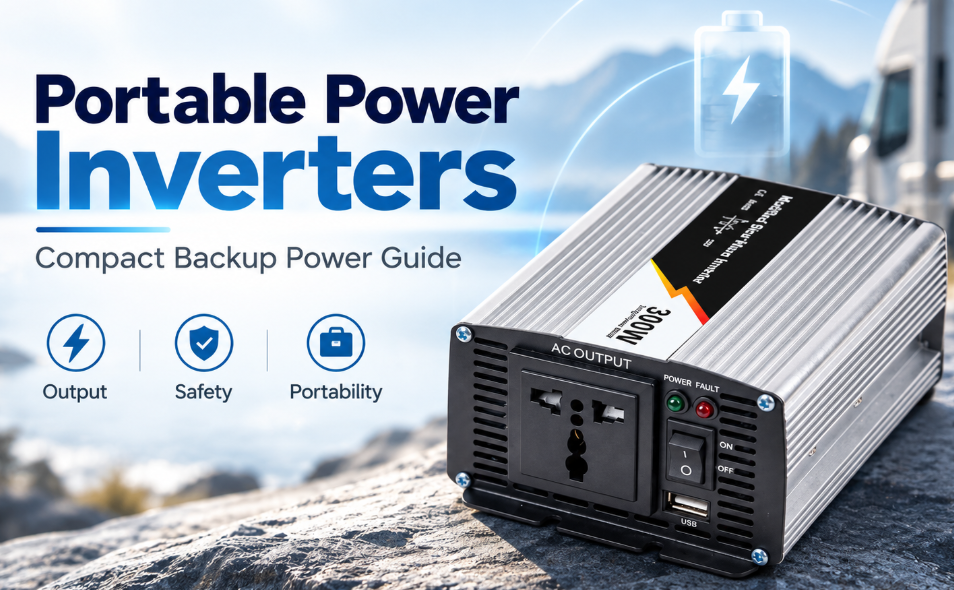
The WHP-1000W-B provides a concrete electrical and mechanical example, not a declaration of marine suitability. The photographed unit is marked 12 V, pure sine wave, 1000 W and surge power 2000 W. The available product sheet does not establish marine certification, ignition protection, salt-spray performance or automatic shore-power transfer.
Write the load schedule in operating modes
Separate essential navigation and communications equipment from convenience loads. Identify which devices already accept the vessel’s DC supply; converting DC to AC and back may add equipment without solving the actual interface requirement. For AC-only loads, record continuous watts, startup behavior, power factor where relevant, run time and simultaneous combinations.
The WHP sheet lists several AC output-voltage and frequency options. Treat these as order selections, not a user-adjustable universal output. The photographed socket shape does not identify the supplied voltage. Freeze the AC voltage, frequency and approved connector configuration in the purchase specification and acceptance report.
| Procurement input | Why it changes the decision |
|---|---|
| House-battery voltage at charge and discharge limits | A nominal 12 V label alone does not describe the voltage at the inverter under load. |
| Load combinations and starting events | A 2000 W peak marking has no documented duration in this sheet and cannot guarantee every motor start. |
| Required operating hours | Battery usable energy, conversion losses and standby consumption all affect endurance. |
| Shore power, generator and inverter sources | The AC distribution design must prevent unintended source interconnection. |

Qualify the location before freezing the bracket
Use a dry, accessible, ventilated equipment space with the source-supported mounting arrangement and unobstructed cooling paths. Do not treat an open finned case as a waterproof enclosure. Assess vibration, condensation, salt exposure, cable restraint and service access for the actual vessel.
দ referenced marine inverter installation instructions illustrate how equipment location, ventilation, battery separation and grounding depend on the vessel architecture. They cover the specified equipment only; their clearances, protection settings and approvals must not be transferred to a WHP product. Obtain the applicable installation evidence for the actual unit and vessel.
The matching WHP sheet gives a 296 × 180 × 78 mm envelope. Allow additional space for the actual connectors, cable bends and maintenance; the envelope is not an installation-clearance schedule. The source photographs show original end mounting flanges. Do not substitute the end-plate assembly screws for equipment mounting points.

Keep AC source selection and protective design separate
An inverter is not automatically an inverter/charger or a transfer switch. Ask the vessel electrical designer to define shore/inverter isolation, protective-earth and neutral arrangements, overcurrent protection and residual-current protection for the intended jurisdiction and vessel type. Do not backfeed a shore inlet or connect independent AC sources together through an improvised cord.
For the sample review, request the exact offered model and revision, output option, mounting instructions and applicable compliance documents. Arrange acceptance checks under the approved vessel electrical design: DC voltage at the inverter during the worst permitted load, AC behavior with actual appliances, temperature in the intended compartment and correct source-selection/protection behavior. A successful bench demonstration does not establish approval for an engine space or a classified location.

Questions before a fleet or OEM order
Does pure sine wave mean marine approved?
No. Waveform describes an electrical characteristic. Environmental, ignition-protection and vessel installation requirements are separate evidence questions.
Can the 12 V sample be substituted into a 24 V boat?
No. Confirm the exact DC input option and operating range. A similar case or a common product family does not make input variants interchangeable.
Request a vessel-specific quotation
Use the WEHO product range to identify the proposed inverter, then send an RFQ with the vessel application: battery range, AC voltage/frequency, load schedule, required hours, compartment conditions, source-selection design, required approvals, target quantity and delivery destination. Request a sample and controlled revision documents before committing to a repeated installation.