Accept a REACH/SVHC declaration only when its product scope, substance-list date and supporting material evidence cover the driver you are buying. A supplier logo, an electrical specification or a document headed “REACH compliant” does not settle those questions.
For an LED luminaire procurement team, the decision is whether the evidence can support the project’s material-compliance file. This guide uses WEHO HLG-150-24 as an identifiable product example. It does not assert that a model-specific REACH declaration or test report has been supplied.
Start with the purchased article and revision
The HLG-150 product page lists a 24 V, 6.3 A version, while the official product photograph shows an HLG-150-24 label marked 24 V, 6.25 A and 150 W. Keep these source entries separate and confirm the controlled rating for the delivered revision. Record the full order code, label photograph, manufacturer identity and delivered revision. Add any customized leads, connectors or housing treatment to the purchase description. The electrical rating helps identify the item; it does not demonstrate the composition of its solder, coating or cables.
Obtain a declaration that names the covered model or gives an unambiguous model list. A family statement may be usable when the supplier explains the shared construction and any exceptions. Do not silently extend a statement for one driver to a different voltage option or accessory kit.
Understand the declaration’s specific claim
ECHA’s supply-chain communication guidance explains that Article 33 communication is triggered when an article contains a Candidate List substance above 0.1% by weight. Professional recipients must receive sufficient safe-use information, including at least the substance name. ECHA’s guidance on substances in articles also explains that the threshold applies to each article within a complex object, rather than automatically to the total weight of the assembled product.
A declaration should therefore state what was assessed and what the conclusion means. Distinguish a Candidate List screening statement, information about a substance above the threshold, and claims addressing other REACH obligations. A document addressing one question is not automatically a complete answer to every material-compliance requirement in the contract.
Build a scope record procurement can review
| Evidence field | Useful supplier answer | Reason to return the document |
|---|---|---|
| Product coverage | Exact HLG-150-24 code, relevant construction revision and listed accessories. | Only a company name or a different product family. |
| Substance scope | Dated Candidate List reference and stated assessment coverage. | An undated “all substances” sentence without a defined list. |
| Assessment basis | Material declarations, supplier data or test-report identifiers tied to the relevant articles. | A test result for an unidentified sample. |
| Exceptions and safe use | Identified substances and applicable information, or a clearly bounded below-threshold conclusion. | An unconditional conclusion with no scope or exceptions. |
| Change control | Owner and process for notifying material or construction changes. | No way to tell whether later deliveries remain covered. |
A cable change can make the evidence incomplete
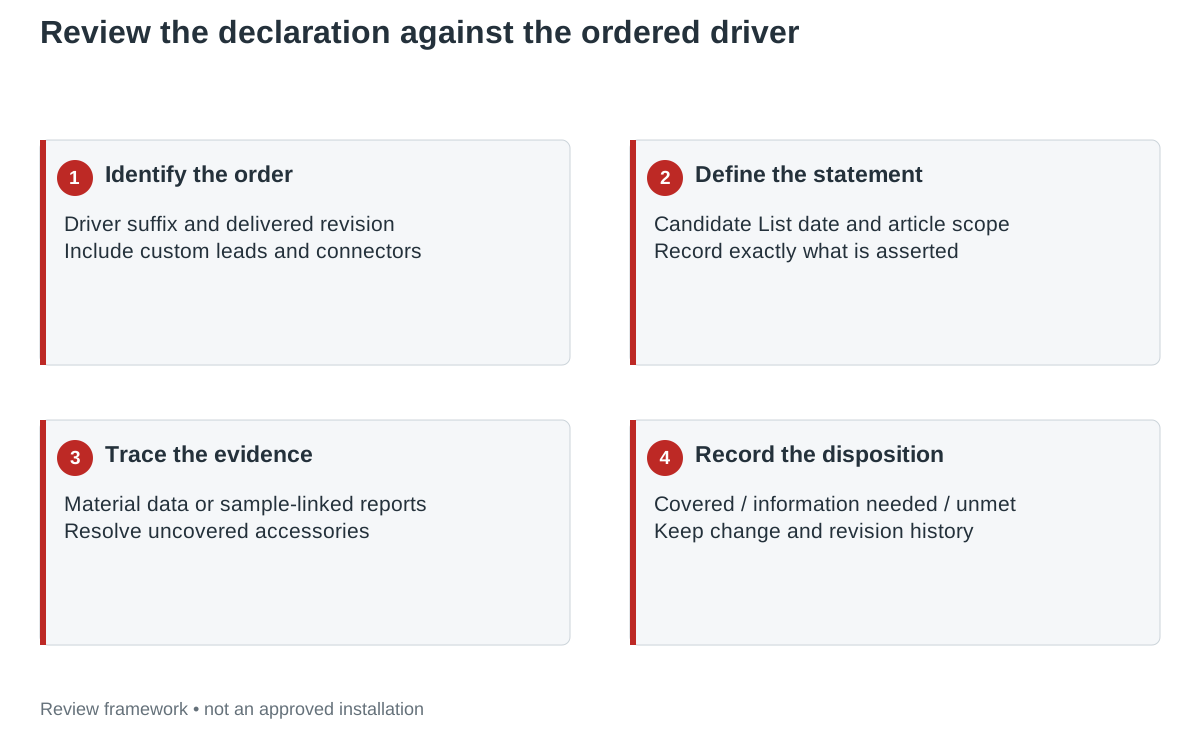
Illustrative procurement example: a luminaire maker orders an HLG-150-24 with an added cable connector. The declaration names the driver family, but its accessory list covers only the standard leads. The team has electrical information for the driver and a separate connector drawing, yet no material statement for the connector assembly.
The correct disposition is to request the missing connector coverage and the supplier’s explanation of the combined scope. It is not to declare the driver noncompliant, and it is not to treat the driver’s weight as a way to dilute an unassessed small component. Record the connector code and revision so the follow-up can resolve a specific gap.
If the supplier provides a later declaration, compare the model list and assessment basis as well as the signature date. A recently signed document can still reference an older screening list. Conversely, a material report’s age alone does not identify which component or substance needs further assessment.
Keep material evidence separate from electrical approvals
Store the material declaration alongside the order specification and sample identity. Keep RoHS, electrical safety, electromagnetic compatibility and ingress-protection evidence in their appropriate records. One document can reference another, but a CE mark or a waterproof housing does not answer the SVHC scope question.
For the HLG-150 order, use the same product identity and delivered revision across the material record, electrical specification and purchase documents. If different documents cover different revisions or accessory sets, ask the supplier to identify the applicable combination. Resolve each project requirement on its own evidence; do not use a material statement to approve electrical or mechanical suitability.
Make a documented disposition before the next delivery
Assign the record one of three practical states: covered for the specified purchase, additional information required, or a contract requirement not met. Give each open item an owner and a specific document request. Preserve earlier versions so a replacement statement does not erase what was relied upon for a previous delivery.
Recheck the scope when the order code, material construction, source of an accessory or project requirement changes. Confirm which Candidate List update the next declaration addresses. Use the blank declaration-scope worksheet to keep that decision repeatable without presenting an unverified statement as a WEHO product qualification.
Use the project record
Open the blank LED driver REACH/SVHC declaration scope record to record your conditions, evidence and decisions. The worksheet contains no pre-approved result.
Request the declaration for your exact LED driver order
Send WEHO the HLG-150-24 order configuration, destination-market requirements, accessory list and required document date. Request a declaration identifying the covered product revision, assessment scope and any applicable substance information.