













| Especificación | C-60 - 5 años | N º 60 - 12 | C-60 y 15 | N º 60 - 24 |
| Tensión de salida CC, corriente | 5V 0 y 12A | 12V 0 y 5A | 15V0 y 4A | 24V0 y 2.5A |
| Ola y ruido | 75 mVp-P | 100mVp-p | 100mVp-p | 100mVp-p |
| Estabilidad del cable de entrada | ±0,5% | ±0,5% | ±0,5% | ±0,5% |
| Estabilidad de carga | ±1% | ±0,5% | ±0,5% | ±0,5% |
| Eficiencia | 72% | 78% | 79% | 82% |
| Rango ajustable para voltaje CC | ±10% | ±10% | ±10% | ±10% |
| Rango de voltaje de entrada | 90~132VAC/180~264VAC por interruptor 254~370VDC 47~63Hz | |||
| Corriente de impacto | Corriente de arranque en frío 15A/115VAC 30A/230VAC | |||
| Protección contra sobrecarga | 105%~150%corta la salida, recuperación automática | |||
| Protección contra sobretensión | 115% ~ 135% shut down O/P voltage, re-power on to recover | |||
| Configurar, levantarse, mantener el tiempo de actividad | 200ms, 100ms, 20ms/230VAC a plena carga | |||
| Voltaje de soporte | I/P-O/P:1,5 kV I/P-FG:1,5 kV O/P-FG:0,5 kV 1 minuto | |||
| Resistencia de aislamiento | I/P-O/P I/P-FG O/P-FG: 500 VCC/100 MΩ | |||
| Temperatura de trabajo | -10℃~+50℃ | |||
| Dimensión | Tamaño 159 × 98 × 38mm | |||
| Peso | 0.5kg | |||
| Embalaje | 34 × 32 × 24CM/30PCS/15 kg | |||

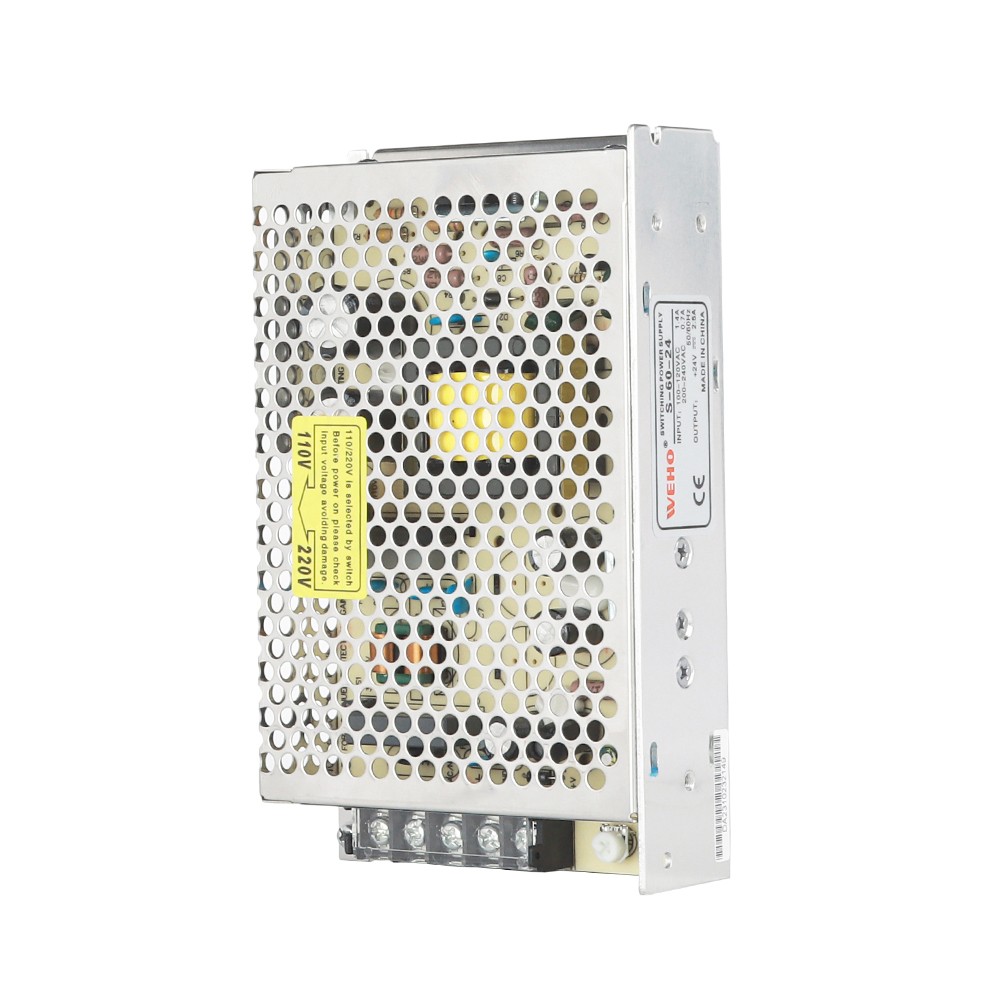
Serie S-60W fuente de alimentación de conmutación simple normal
WEHO S-60 is a 60W-designated single-output family for compatible equipment-interface, display and monitoring electronics. Select a 5V, 12V, 15V or 24V model with printed current ranges of 0~12A, 0~5A, 0~4A or 0~2.5A respectively. It uses manual 90~132VAC/180~264VAC selection, with 254~370VDC also specified, in a 159×98×38mm enclosure. Assess the exact model’s startup demand, ripple and thermal conditions for the assembly; provide the required voltage and load profile for selection.
Si tiene alguna pregunta, no dude en contactarnos en Correo electrónico: [email protected]
Envíenos un correo electrónico [email protected]
- Descripción
Why Choose the S-60?
Choose from the four documented variants
This S-60 sheet lists 5V, 12V, 15V and 24V outputs as separate models. Match the connected board’s voltage and load requirements to one exact column. The four columns describe alternative single-output models, not simultaneous rails.
Assess upstream switching at the stated line voltage
Cold-start current is 15A at 115VAC and 30A at 230VAC. Use the applicable input condition when assessing upstream switching and equipment startup. Validate protective-device coordination and the actual electronic load; these transient entries are not continuous input-current ratings.
Distinguish the 5V regulation requirement
All four columns list ±0.5% line stability, but S-60-5 has ±1% load stability while the other versions list ±0.5%. Check the actual logic-board tolerance and supply wiring. A higher current range does not remove regulation, ripple or connector requirements.
Assess an enclosure match without assuming electrical equivalence
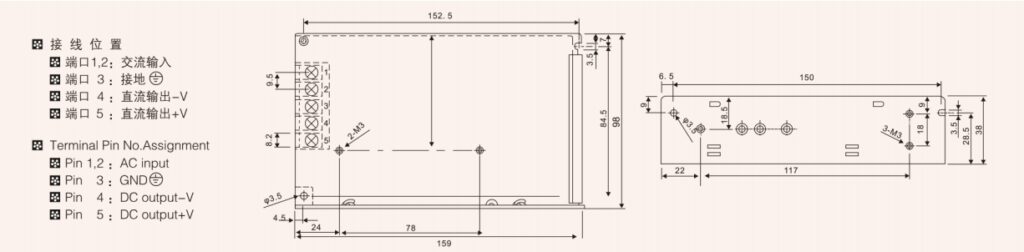
The outline is 159×98×38mm and mass is 0.5kg. Verify mounting, mains segregation, terminal markings and cooling for the delivered unit. A dimensional match does not prove compatible fault response, startup current, continuous output or field replacement approval.
S-60 Features
Exact output columns and range endpoints
S-60-5 lists 5V 0~12A; S-60-12 lists 12V 0~5A; S-60-15 lists 15V 0~4A; S-60-24 lists 24V 0~2.5A. The printed zero lower bounds do not independently establish no-load regulation, and the range endpoints do not define the complete continuous operating envelope.
Voltage adjustment with output-specific ripple
Each version lists ±10% DC adjustment. Ripple is 75mVp-p at 5V and 100mVp-p at 12V, 15V and 24V. Check the load’s voltage limits and noise tolerance in the complete assembly. These entries do not establish constant-current, dimming or battery-charging capability.
Input selector and three timing entries
The AC bands are 90~132VAC/180~264VAC by switch, with 254~370VDC and 47~63Hz also printed. Setup, rise and hold-up are 200ms, 100ms and 20ms at 230VAC and full load. Confirm the selector setting and delivered-unit connections before energizing.
Protection responses without a fault-duty promise
Overload at 105%~150% cuts off output and recovers automatically. Overvoltage at 115%~135% shuts down output and requires re-powering. Keep the restart behavior separate from continuous-load qualification, branch protection and safe equipment restart.
Typical Service Conditions
Protect a bottle-inspection status cabinet
A bottle-inspection status cabinet may evaluate an accepted S-60 output for compatible local interface and indication electronics. Keep moisture and cleaning spray away from the electrical section. Inspection illumination, conveyors and reject actuators require separately qualified loads and supplies.
Assess thermal exposure in a film-splicer console
A film-splicer console should separate the supply from heater zones and evaluate actual compartment temperature. Verify its compatible electronic load and restart sequence. Splice heaters, transport drives and tension control are not qualified by this power-supply selection.
Control wiring in a powder-dosing display panel
A powder-dosing display panel needs a protected electrical area, contamination control and verified signal routing. Consider S-60 only for compatible local display and communication electronics. Metering drives, hazardous dust suitability and dosing accuracy need independent engineering.
Check startup in an optical-comparator interface rack
An optical-comparator interface rack needs measurement of boot demand, ripple tolerance and reset behavior at the actual boards. A selected S-60 may supply only an accepted electronic load. Optical emission, motion axes and dimensional accuracy remain separately validated functions.
Potential S-60 Applications
Industrial label-verification console
Evaluate an exact S-60 variant for compatible verification-interface and display electronics in a protected cabinet. Confirm voltage, demand and noise. Imaging illumination, label transport and verification performance require their own supplies and application validation.
Conveyor zone-status gateway
A zone-status gateway may assess a qualified S-60 output for accepted communication and status electronics. Verify each connected load and branch protection. Conveyor motors, brakes, emergency stops and safety communication are not established by the supply specification.
Spring-load test display station
Consider a selected S-60 model for compatible local logic and display boards. Load-cell excitation, a calibrated measurement reference and the mechanical test actuator need separate qualification. The power supply does not establish force accuracy or test-machine safety.
Industrial flow-pulse totalizer
A flow-pulse totalizer may evaluate an accepted output for compatible counter, display and interface electronics. Confirm voltage and interruption behavior, and keep the compartment dry. Sensor excitation, metering calibration, valves and process protection remain independent system requirements.
S-60 Technical FAQs
Which exact output models and current ranges are listed?
S-60-5 lists 5V 0~12A; S-60-12 lists 12V 0~5A; S-60-15 lists 15V 0~4A; S-60-24 lists 24V 0~2.5A. They are alternative single-output models, not four simultaneous rails.
Does the 60W designation approve every continuous operating point?
The family designation and printed current ranges are separate entries. Do not calculate a replacement continuous wattage from their endpoints or assume maximum output at every input and temperature. Confirm the ordered suffix’s continuous and startup duty; the printed zero lower bounds do not independently establish minimum-load or no-load acceptance.
Is the AC input automatically selected?
The sheet states 90~132VAC/180~264VAC by switch, plus 254~370VDC and 47~63Hz. Select the correct AC band before energizing; this is not automatic range selection. Confirm separate DC-input connection instructions before DC use.
What does the voltage-adjustment entry establish?
Each model lists ±10% DC-voltage adjustment. It does not establish regulated-current output, dimming, arbitrary programmable operation or battery charging. Confirm the adjustment procedure, connected load voltage limits and accepted operating envelope before using a changed setting.
What ripple and line/load stability apply to each output?
S-60-5: 75mVp-p; S-60-12: 100mVp-p; S-60-15: 100mVp-p; S-60-24: 100mVp-p. All four list ±0.5% line stability; the 5V version lists ±1% load stability and the other outputs ±0.5%. No ripple measurement bandwidth or wiring method is specified by these entries.
Which efficiencies and cold-start values belong to this model?
Efficiencies in S-60-5, S-60-12, S-60-15, S-60-24 order are 72%, 78%, 79%, 82%. Cold-start current is 15A/115VAC and 30A/230VAC. Efficiency depends on the selected output; each cold-start value applies to its stated input voltage and is not a continuous input-current rating.
How does overload protection recover?
The overload entry is 105%~150%, cutting off the output with automatic recovery. This is not a continuous overload allowance or a replacement for cable and branch protection. Evaluate the connected electronics’ behavior during repeated power loss and recovery as part of the equipment design.
Does overvoltage shutdown recover automatically?
The overvoltage entry is 115%~135%, shutting down the output voltage and requiring re-powering to recover. Keep this separate from automatic overload recovery. Safe restart and downstream protection need their own equipment-level verification.
Which setup, rise and hold-up values and conditions are specified?
Setup, rise and hold-up are 200ms, 100ms and 20ms at 230VAC and full load. The stated input and full-load conditions apply to this timing entry. Full-load timing does not establish full load throughout the temperature range or identical response at every input and load.
What working temperature, dimensions and mass are listed?
The values are -10°C~+50°C, 159×98×38mm and 0.5kg. Check actual mounting, terminal access, service clearance and local thermal conditions. These entries do not provide an ingress rating, humidity specification or complete full-load derating curve.
What withstand and isolation-resistance entries are printed?
The withstand row lists I/P-O/P 1.5kV, I/P-FG 1.5kV and O/P-FG 0.5kV for 1 minute, without an AC/DC qualifier. Isolation resistance is listed as 500VDC/100MΩ for the named input/output/frame-ground pairs. These component test entries do not establish certification scope or finished-equipment approval.
What terminal order is shown, and can it be transferred between models?
The S-60 legend labels pins 1 and 2 as AC input, pin 3 as GND, pin 4 as DC output-V and pin 5 as DC output+V. Confirm the exact delivered unit, terminal markings and connection instructions before wiring, including a proposed DC-input application. Similar enclosures do not authorize transferring another model’s wiring.
PRODUCTOS RELACIONADOS


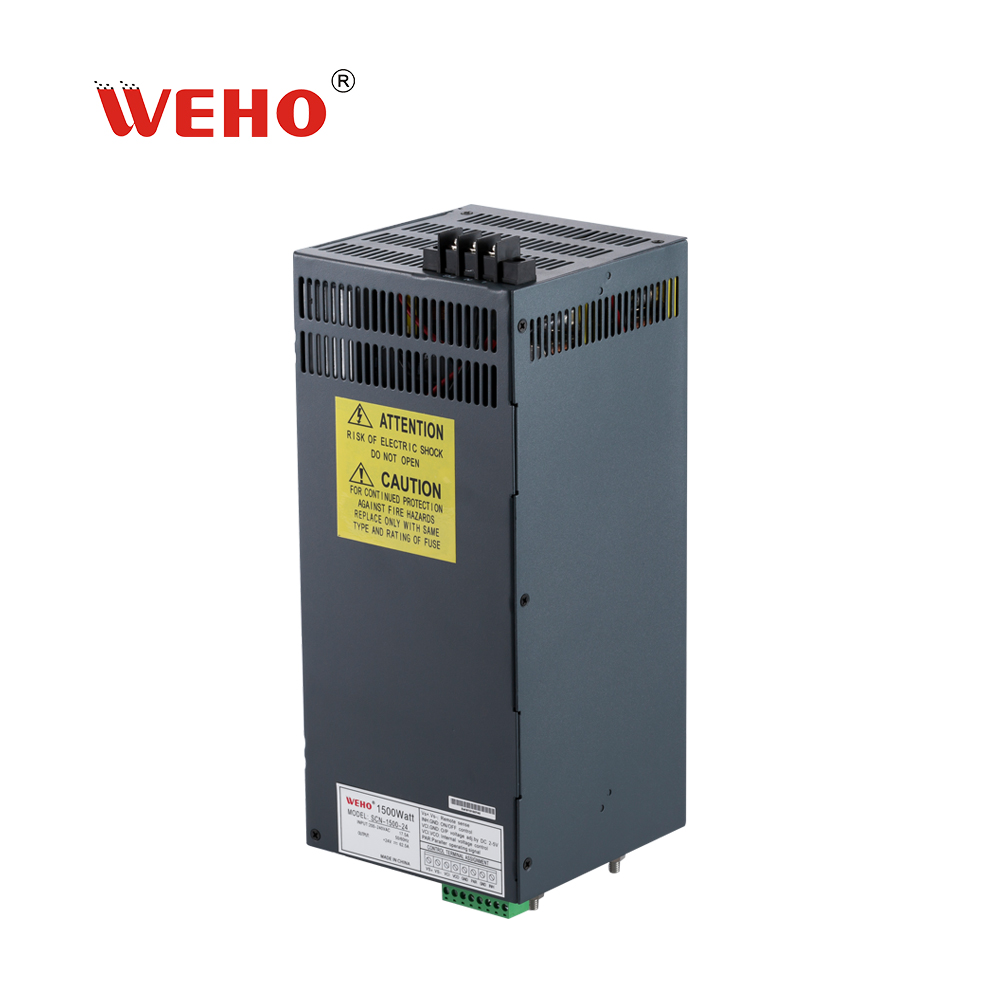
¿Cuáles son los mejores productos de fuentes de alimentación para su empresa?
Impulsa tu negocio con productos de suministro de energía de calidad WEHO.
Pregúntale a un experto