













| Especificación | S-250-5 | S-250-12 | S-250-15 | S-250-24 | S-250-36 | S-250-48 |
| Tensión de salida CC, corriente | 5V 0 ~ 45A | 12V 0 ~ 20A | 15V 0 ~ 16A | 24V 0 ~ 10A | 36V 0 ~ 6.7A | 48V 0 ~ 5A |
| Ola y ruido | 150mVp-p | 150mVp-p | 150mVp-p | 150mVp-p | 200mVp-p | 240mVp-p |
| Estabilidad del cable de entrada | ±2% | ±1% | ±1% | ±1% | ±1% | ±1% |
| Estabilidad de carga | ±2% | ±1% | ±1% | ±1% | ±1% | ±1% |
| Eficiencia | 74% | 79% | 79% | 81.5% | 84% | 84% |
| Rango ajustable para voltaje CC | ±10% | ±10% | ±10% | ±10% | ±10% | ±10% |
| Rango de voltaje de entrada | 90 ~ 132VAC/180 ~ 264VAC by switch 254 ~ 370VDC 47 ~ 63Hz | |||||
| Corriente de impacto | Corriente de arranque en frío 25A/115VAC 50A/230VAC | |||||
| Protección contra sobrecarga | 105% ~ 135% cut off the output, automatic recovery | |||||
| Protección contra sobretensión | 115% ~ 150% shut down O/P voltage, re-power on to recover | |||||
| Preparar, levantarse, esperar el tiempo | 200ms, 50ms, 16ms/230VAC at full load | |||||
| Voltaje de soporte | I/P-O/P: 1.5kV; I/P-FG: 1.5kV; O/P-FG: 0.5kV; 1 minute | |||||
| Resistencia de aislamiento | I/P-O/P, I/P-FG, O/P-FG: 500 VCC/100 MΩ | |||||
| Temperatura de trabajo | -10°C ~ +50°C | |||||
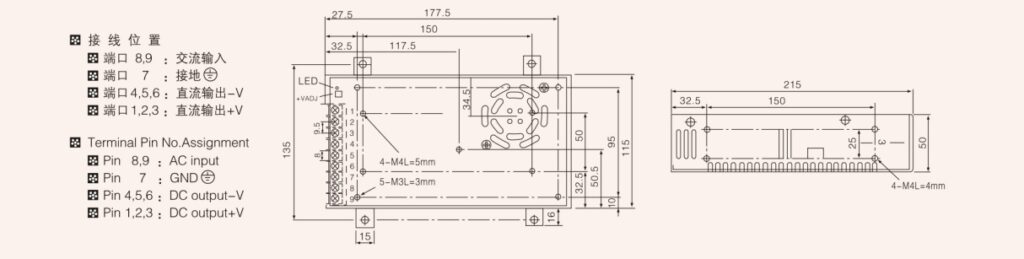
| Dimensión | 215 × 115 × 50mm | |||||
| Peso | 0.95kg | |||||
| Embalaje | 45.5 × 31.5 × 26CM/20PCS/19kg | |||||

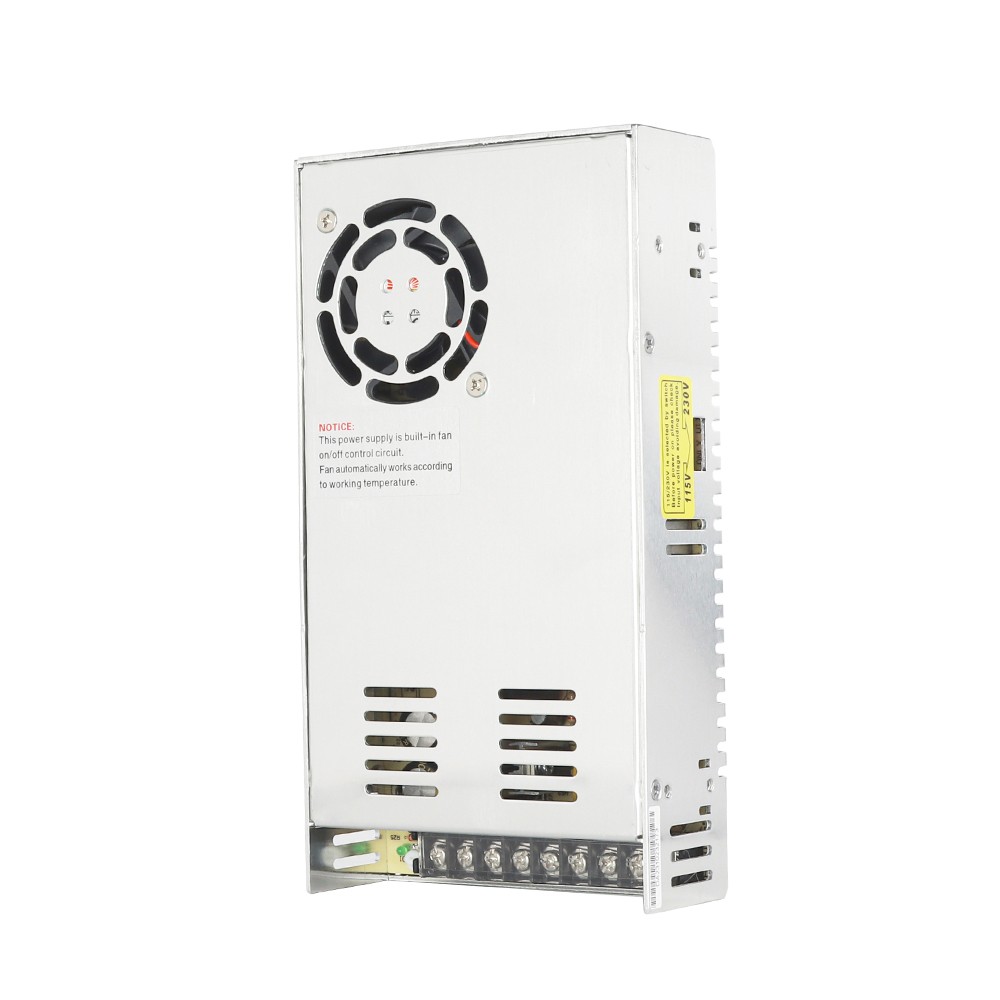
Serie S-250W fuente de alimentación de conmutación simple normal
WEHO S-250 is a single-output supply family for builders comparing local DC power options for machine interfaces and communication electronics. S-250 has separate 5V, 12V, 15V, 24V, 36V and 48V output variants. The listed body dimensions are 215×115×50mm. AC input is 90~132VAC/180~264VAC by switch; the same input row also lists 254~370VDC and 47~63Hz. Its suffix-specific current, ripple and stability entries are useful when the same machine platform contains different electronic board sets. Specify the required output, real load duty and installed thermal arrangement before ordering; the family number alone is not an output-selection rule.
Si tiene alguna pregunta, no dude en contactarnos en Correo electrónico: [email protected]
Envíenos un correo electrónico [email protected]
- Descripción
Why Choose S-250?
Match the machine-interface board set
S-250 has separate 5V, 12V, 15V, 24V, 36V and 48V output variants. The separate suffixes allow an equipment specification to name its required rail explicitly, instead of assuming one supply output fits every control panel.
Plan space in a machine-service compartment
The listed body dimensions are 215×115×50mm. The listed weight is 0.95kg. Check these figures when arranging a guarded finishing station or carton machine, then reserve additional space for supported wiring, maintenance and heat removal.
Make input selection explicit
AC input is 90~132VAC/180~264VAC by switch; the same input row also lists 254~370VDC and 47~63Hz. For a carton erector, the incoming supply and selector setting must be resolved independently of the logic-board output choice; automatic AC range selection is not stated.
Plan different restart paths
Overload protection is listed at 105%~135% with output cutoff and automatic recovery. Overvoltage protection is listed at 115%~150%; the output shuts down and requires re-powering to recover. A feeder or tube-forming interface must distinguish a recovering overload from an overvoltage event that needs re-powering. The protection entries do not establish machine safety.
S-250 Features and Selection Details
Current ranges tied to exact suffixes
The output table lists S-250-5: 5V, 0~45A; S-250-12: 12V, 0~20A; S-250-15: 15V, 0~16A; S-250-24: 24V, 0~10A; S-250-36: 36V, 0~6.7A; S-250-48: 48V, 0~5A. Each range belongs to its own output column. The family power summary does not replace suffix-level current and continuous-duty confirmation.
Different ripple entries at the higher outputs
The wave-and-noise entries are S-250-5: 150mVp-p; S-250-12: 150mVp-p; S-250-15: 150mVp-p; S-250-24: 150mVp-p; S-250-36: 200mVp-p; S-250-48: 240mVp-p. Use the appropriate column when assessing communication and display electronics. No measurement bandwidth is specified, and these figures do not prove precision sensor compatibility.
A distinct stability entry for the lowest-voltage model
The line/load-stability entries are S-250-5: line ±2%, load ±2%; S-250-12: line ±1%, load ±1%; S-250-15: line ±1%, load ±1%; S-250-24: line ±1%, load ±1%; S-250-36: line ±1%, load ±1%; S-250-48: line ±1%, load ±1%. Compare the selected column with the board’s tolerances; stability and voltage-adjustment range describe different parameters.
Rail setting and source-specific efficiency
Each S-250 output column lists a ±10% DC-voltage adjustment range. The efficiency entries are S-250-5: 74%; S-250-12: 79%; S-250-15: 79%; S-250-24: 81.5%; S-250-36: 84%; S-250-48: 84%. Set a compatible rail without treating the adjustment as a current-control function. The efficiency row has no typical/full-load qualifier and cannot establish enclosure cooling or a continuous output guarantee.
Typical S-250 Service Conditions
Contamination control at an abrasive belt station
An abrasive belt finishing station may evaluate S-250 for compatible local display and diagnostic-interface boards. The listed working-temperature range is -10°C~+50°C. Isolate the electrical compartment from abrasive dust and verify actual temperature and heat removal. Belt drives and dust extraction are separately powered; no dust-hazard suitability is implied.
Supply selection at a carton erector
A carton erector may assess a selected S-250 output for compatible recipe-interface and communication boards. AC input is 90~132VAC/180~264VAC by switch; the same input row also lists 254~370VDC and 47~63Hz. Check the selector and incoming supply before energizing. Mechanical erection, adhesive heating and protective controls require independent qualification.
Repeated starts at a tube end-forming press
A tube end-forming press may consider S-250 for compatible job-memory and interface electronics. Cold-start current is listed as 25A at 115VAC; 50A at 230VAC. Assess restart frequency, upstream protection and real electronic demand. Hydraulic power, forming actuators and press protection do not belong to this proposed rail.
State recovery in a vacuum membrane laminator
A vacuum membrane laminator may evaluate S-250 for compatible cycle-display and communications boards. Setup, rise and hold-up times are 200ms, 50ms and 16ms, respectively, at 230VAC and full load. Test how those boards respond to interruptions during the intended cycle. Vacuum generation, heating and laminate-process control need separate power and validation.
Potential S-250 Equipment Applications
Enclosed laser marking workstation
An enclosed laser marking workstation may evaluate an exact S-250 variant for compatible job-entry and local communication boards. Confirm voltage, ripple tolerance and startup demand. The laser source, motion axes, cooling and protective enclosure interlocks remain independently powered and qualified; no marking performance is claimed.
Gravimetric material feeder
A gravimetric material feeder may assess S-250 for compatible recipe-display and data-interface electronics in a protected bay. Verify the selected suffix and actual load. Feed motors, calibrated weighing excitation and dosing accuracy require separate specifications, and material dust must not be treated as an approved environment.
Cable braiding machine
A cable braiding machine may consider a selected S-250 output for compatible operator-status and communication boards. Check wiring support, vibration exposure and local cooling. Carrier drives, take-up motors and braid-tension regulation are separate systems; the proposed electronic role does not establish production capability.
Fabric inspection table
A fabric inspection table may evaluate an exact S-250 suffix for compatible count-logging and operator-interface electronics. Match the rail and interruption behavior to the board set. Inspection lighting, fabric transport and defect-detection accuracy require independent power and design.
S-250 Technical FAQs
Which output variants and current ranges are documented for S-250?
The output table lists S-250-5: 5V, 0~45A; S-250-12: 12V, 0~20A; S-250-15: 15V, 0~16A; S-250-24: 24V, 0~10A; S-250-36: 36V, 0~6.7A; S-250-48: 48V, 0~5A. The summary states 250W, while S-250-5 is listed at 5V with a 0~45A current range. The current limits are suffix-specific. A zero lower bound is not no-load regulation proof, and the family summary is not a universal continuous rating.
Which input ranges and selection method are stated for S-250?
AC input is 90~132VAC/180~264VAC by switch; the same input row also lists 254~370VDC and 47~63Hz. The AC bands are selected by switch, not automatically. Confirm the intended DC operating case and the markings on the delivered version before connection.
Which cold-start currents are listed for S-250, and under what inputs?
Cold-start current is listed as 25A at 115VAC; 50A at 230VAC. The cold-start figures describe the input event, not the output rail or a continuous input-current rating. Repeated machine restarts and branch protection need separate assessment.
How do the wave-and-noise entries vary across S-250 outputs?
The wave-and-noise entries are S-250-5: 150mVp-p; S-250-12: 150mVp-p; S-250-15: 150mVp-p; S-250-24: 150mVp-p; S-250-36: 200mVp-p; S-250-48: 240mVp-p. Higher-output suffixes do not all share the same ripple entry. No test bandwidth is stated, so board compatibility must be checked without inventing a measurement condition.
Which line and load stability values belong to each S-250 suffix?
The line/load-stability entries are S-250-5: line ±2%, load ±2%; S-250-12: line ±1%, load ±1%; S-250-15: line ±1%, load ±1%; S-250-24: line ±1%, load ±1%; S-250-36: line ±1%, load ±1%; S-250-48: line ±1%, load ±1%. The lowest-voltage column has its own stability values. Use the 5V model’s own stability entries when assessing its load; these percentages are not its DC adjustment range.
What do the DC adjustment and efficiency entries establish for S-250?
Each S-250 output column lists a ±10% DC-voltage adjustment range. The efficiency entries are S-250-5: 74%; S-250-12: 79%; S-250-15: 79%; S-250-24: 81.5%; S-250-36: 84%; S-250-48: 84%. No typical or full-load condition is printed for these efficiency entries. Voltage adjustment is not a constant-current, charging or dimming function.
How does the documented S-250 overload response recover?
Overload protection is listed at 105%~135% with output cutoff and automatic recovery. Automatic recovery follows output cutoff in the overload row. It does not make the supply a normal constant-current source or qualify the machine protective system.
How does the documented S-250 overvoltage response recover?
Overvoltage protection is listed at 115%~150%; the output shuts down and requires re-powering to recover. This restart requirement differs from overload recovery. The machine-interface design must tolerate the stopped rail rather than assuming uninterrupted control power.
What are the S-250 setup, rise and hold-up times and test condition?
Setup, rise and hold-up times are 200ms, 50ms and 16ms, respectively, at 230VAC and full load. The hold-up figure has the same printed input/full-load condition as the setup and rise figures. It does not establish battery backup or performance at every line voltage.
Which working temperature, body dimensions and weight are listed for S-250?
The listed working-temperature range is -10°C~+50°C. The listed body dimensions are 215×115×50mm. The listed weight is 0.95kg. These are body and environmental entries, not required clearances or a full-load derating curve. Assess the real enclosure, heat removal and wiring space.
Which isolation and withstand test entries are stated for S-250?
The isolation-resistance row lists 500VDC/100MΩ for I/P-O/P, I/P-FG and O/P-FG. Withstand entries are I/P-O/P 1.5kV, I/P-FG 1.5kV and O/P-FG 0.5kV for 1 minute, without a printed AC/DC qualifier. No AC/DC test-voltage qualifier is stated for these kV entries. They do not establish a certification, ingress rating or system-level isolation design.
What does the S-250 terminal legend establish before wiring?
The 9-pin drawing legend identifies pins 8,9 AC input; pins 7 GND; pins 4,5,6 DC output-V; pins 1,2,3 DC output+V. The generic legend does not establish the wiring of the delivered suffix. Verify the delivered markings, conductor arrangement, bonding and upstream protection before connection.
PRODUCTOS RELACIONADOS


¿Cuáles son los mejores productos de fuentes de alimentación para su empresa?
Impulsa tu negocio con productos de suministro de energía de calidad WEHO.
Pregúntale a un experto