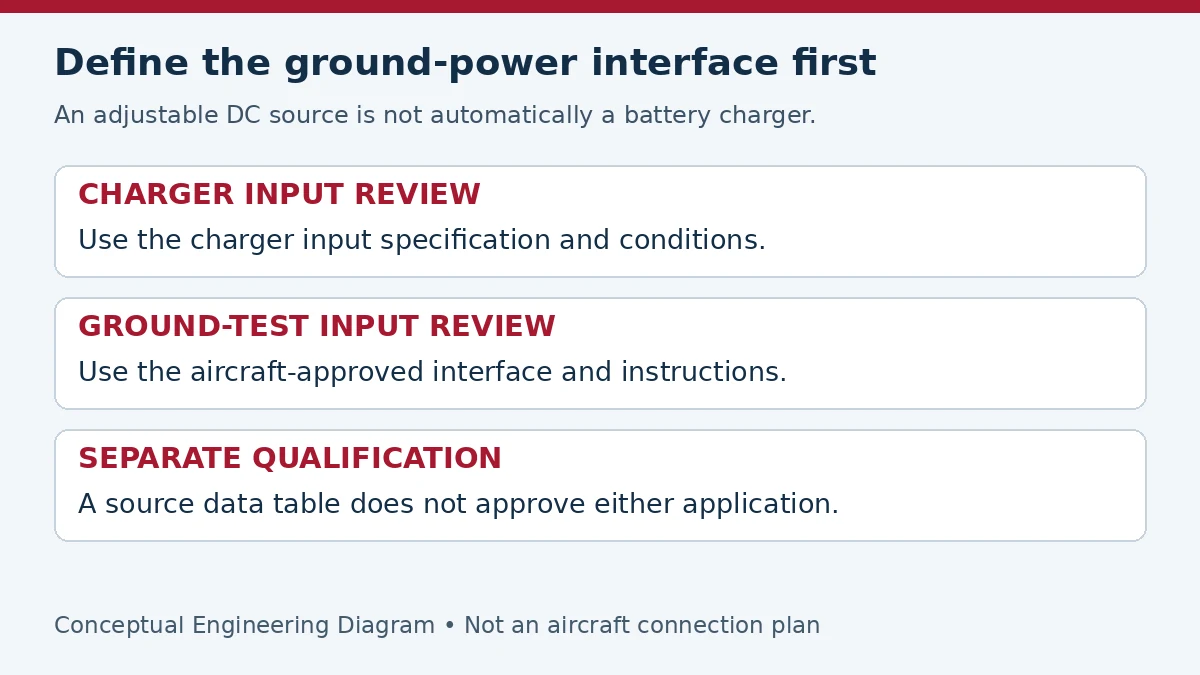
Select a UAV ground power source from the documented input requirements of the equipment it will feed—not from the aircraft battery’s nominal voltage alone. First distinguish a DC source feeding a qualified charger from a source proposed for an aircraft-approved ground-test interface. Adjustable output and sufficient watts do not automatically establish a battery charger or aircraft-compatible ground power unit.
This guide is for equipment builders preparing a source specification and evidence request. It does not authorize direct battery connection, propeller operation, a charging procedure or a change to an aircraft’s approved support equipment. The aircraft, battery and charger manufacturers’ applicable instructions remain necessary for the intended operation.
Is the source feeding a charger or a ground-test input?
If the intended arrangement uses an external charger, begin with the charger’s DC-input specification. Establish its permitted input-voltage range, maximum demand, startup requirements and operating restrictions. The upstream source is being considered for that charger input. It does not replace the charger’s battery-specific control and protective functions merely because its output can be adjusted.
For ground testing, obtain the aircraft or equipment manufacturer’s supported input interface and permitted operating conditions. Do not assume the battery terminals are an approved external-power input. Identify the required voltage limits, current profile, connection arrangement and any relevant interlock or protection requirements before evaluating a source.
Keep these two scopes distinct in the purchase inquiry. “Power for a drone” leaves essential information unresolved and can lead to a quote based only on nominal watts. State what the source will connect to and which document establishes that interface. Where no approved interface information is available, do not turn a generic supply table into application approval.
How should voltage and current demand be calculated?
Use the powered equipment’s input requirement rather than transferring battery charge current directly to the source. Different voltages and conversion losses make those separate quantities. If the charger documentation specifies DC-input current, use that value with its conditions; if it specifies only another quantity, obtain the information needed to establish source-side demand.
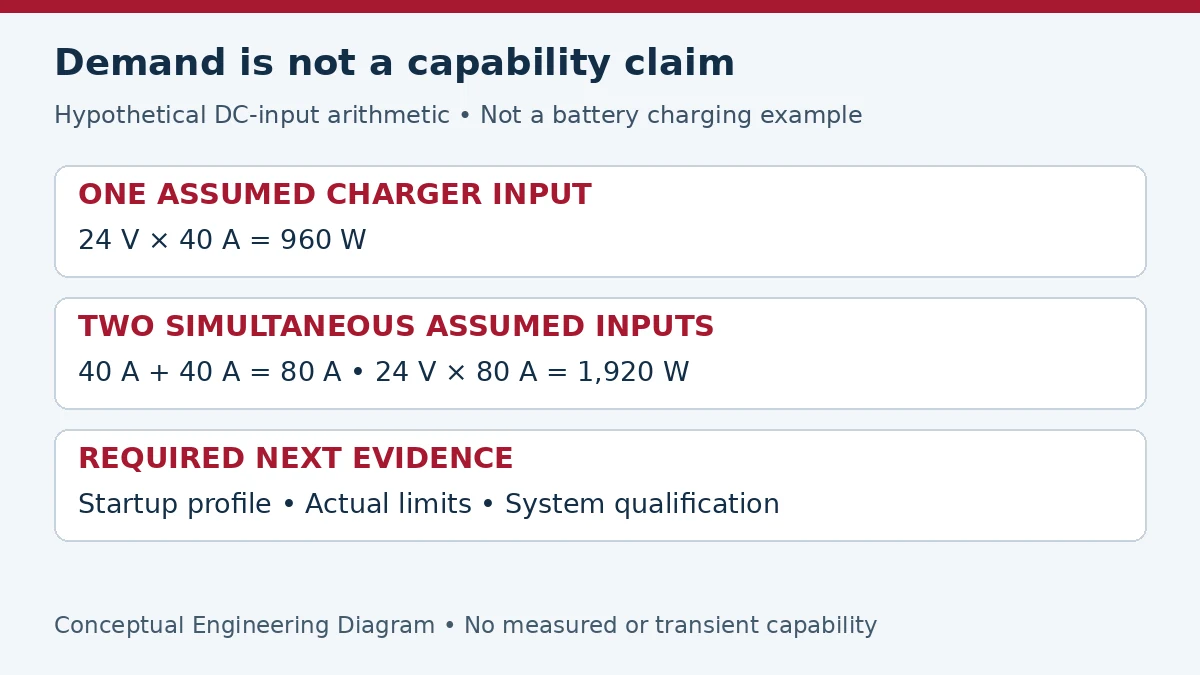
Hypothetical DC-input example. Assume a charger specification calls for 24 V DC and 40 A at its input for a defined operating state. That is 24 × 40 = 960 W of output demand at the upstream source terminals, before separately considering distribution losses. It is not a claim about a battery’s charging voltage, charge current or energy capacity.
If two identical assumed charger inputs draw that demand simultaneously, their sum is 80 A and 1,920 W at the stated voltage. These are assumed steady-state demands, not an inrush specification or evidence that a named source can operate both chargers. Document whether the actual chargers can reach maximum demand together rather than relying on average use.
Record startup amplitude and duration, load steps, permitted voltage excursion and the acceptance method separately. Do not invent a universal reserve percentage or use a source’s overload-protection threshold as a guaranteed transient operating range. The selected source’s documented behavior must cover the required load profile under the actual conditions.
What conditions can change the available source output?
Check the actual AC supply and the selected product’s input requirements. Do not describe all high-power supplies as universal-input equipment. For example, the cited WEHO SE-3000 family documentation lists 180–264 V AC input, not a general 95–265 V AC range. Confirm the applicable revision and installation conditions for the supplied model.
را WEHO SP-6000 family page separates 95–190 V AC at 50% output current from 195–265 V AC at 100% output current. Those are table entries, but the same page’s Features and FAQ give different input descriptions. Treat the applicable input range and derating as pending engineering confirmation. None of these conflicting descriptions is used here to qualify a source, and the table is not permission to assume full current throughout the input range. Do not extrapolate the operating behavior between listed ranges or transfer this input specification to another family.
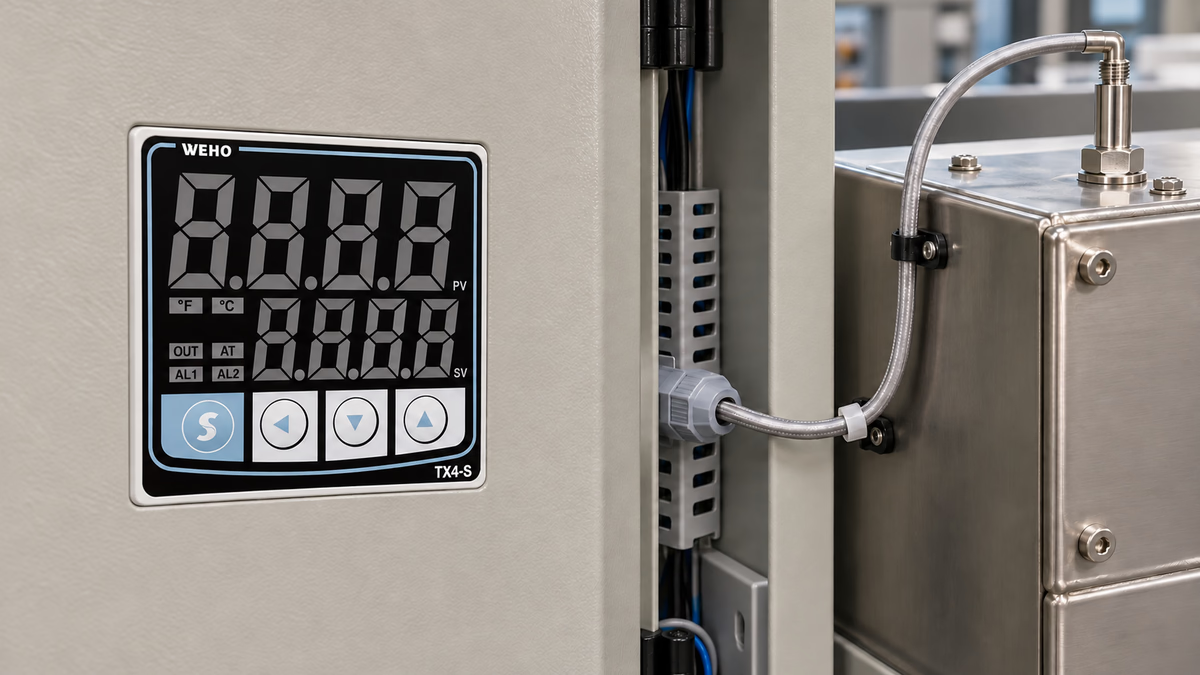
Also resolve cooling, enclosure, contamination exposure, transport and physical installation for the complete ground equipment. A bench source’s enclosure appearance does not establish an outdoor or mobile-system rating. Obtain the applicable limits and installation instructions rather than inferring them from a photograph or a family wattage title.
What can the available WEHO documents establish?
Use a family page to locate relevant documentation, not as proof that every suffix has the same output or application approval. Compare the exact suffix and document revision. The SE-3000 PDF and product HTML contain a current-value disagreement for SE-3000-12. The PDF also has a model-header inconsistency. This guide therefore does not select that suffix using either disputed current value.
Similarly, the SED-10000 family page and its linked PDF disagree on SED-10000-24 current. Request corrected, applicable documentation rather than choosing the higher number. No suffix in this guide is represented as an approved UAV source or an equivalent replacement for aircraft support equipment.
| Document reference | What needs checking | Boundary in this guide |
|---|---|---|
| SE-3000 family | Exact suffix, applicable PDF revision and conflicting current entry | No disputed current used for selection |
| SP-6000 family | Input-dependent output current and exact-suffix specifications | No same-page official PDF located in this review |
| SED-10000 family | Applicable revision and conflicting -24 current entry | No disputed current used for selection |
| Complete ground equipment | Charger or aircraft input approval and system qualification | Not established by a source family page |
Do not generalize an efficiency value from one suffix across the family. Likewise, a communication feature listing is not a complete command, fault-state or aircraft-interlock specification. Request the applicable protocol and system integration information when the project depends on those functions.
For a remotely controlled source, include the intended command range, power-up state, loss-of-communication behavior and method of confirming the actual output in the evidence request. An interface name alone does not specify those functions. Do not assume that communication loss produces the output state required by the aircraft or charger; that must be established for the particular equipment and integration.
Preserve the applicable documents with the delivered unit identification. If the supplier later clarifies a conflicting table, record which hardware and revision the clarification covers. A revised family webpage does not automatically establish that an earlier purchased unit has changed, and a previous project’s acceptance record does not automatically cover a new load or installation.
What should the builder provide before qualification?
Prepare the exact powered-interface identification, required operating voltage/current profile, simultaneous loads, input-supply conditions and physical installation. Attach the charger or aircraft instructions establishing the permitted interface. Add the proposed source suffix and document revisions, with every unresolved conflict identified for engineering confirmation.
Separate source checks from system acceptance. A source-terminal reading cannot alone establish the voltage at the powered equipment during startup, and a successful no-load power-up does not qualify the intended load profile. The responsible engineering team should define suitable controlled verification and acceptance criteria from the actual equipment requirements.
Use the WEHO contact page to request the applicable source documents and clarification. This guide makes no claim about universal certification, completed factory or aircraft tests, customer installations, stock or response times. Those statements require their own evidence and do not replace the interface review.
Ground-power selection FAQ
Can I select the source from battery nominal voltage?
Not by itself. Establish the actual charger input or the aircraft-approved ground-test interface. Battery voltage is not a complete specification for the external source or a charging procedure.
Is an adjustable supply automatically a battery charger?
No. Adjustable output does not establish battery-specific control, protection or an approved charging arrangement. This guide considers source documentation, not a replacement for the applicable charger instructions.
Do all three WEHO families accept the same AC input?
Do not assume so. The cited SE-3000 and SP-6000 pages list different conditions. Check the exact model’s applicable documentation, including any input-dependent output limitation.
Which current value should I choose when HTML and PDF disagree?
Neither disputed value is used here to approve a selection. Request corrected documentation for the exact suffix and applicable revision, then evaluate it against the actual load requirement.
Does enough nominal wattage prove UAV compatibility?
No. The interface, voltage limits, current profile, protection behavior, installation and system approval still require evidence. The assumed load arithmetic in this article is not an application qualification.