











Quick réponse: A DIN rail power supply is chosen mainly by output voltage, continuous wattage, and form factor. For most industrial automation panels, a 24V DC unit with 20–30% power headroom above peak load is the reliable choice. Compact loads suit a slim HDR unit; larger 24V loads suit a higher-power NDR unit.
What Is a DIN Rail Power Supply?
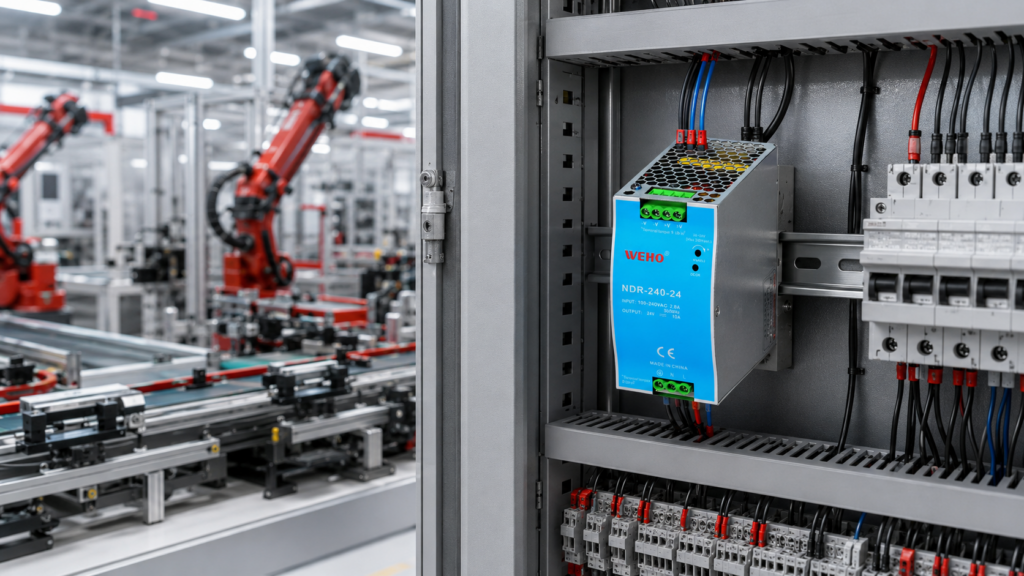
A DIN rail power supply is an AC-to-DC switching power supply that clips onto a standard 35 mm (TS-35) DIN rail inside a control cabinet. It converts AC mains into a regulated, isolated DC output — most often 24V — to power PLCs, sensors, relays, and actuators.
The DIN rail form factor is what makes it “industrial”: it mounts alongside breakers and terminal blocks, saves panel space, and is quick to service. The 35 mm rail itself is standardized under EN 60715.
How Do You Choose a DIN Rail Power Supply?
Match the supply to the load and the panel, not just the price. Seven factors decide the right unit:
- Output voltage. 24V DC is the automation default; 12V and 48V are also common for specific devices.
- Continuous current / wattage. Add up every device on the rail, then add headroom (see sizing below).
- Form factor and panel width. A slim housing saves rail space in a crowded cabinet.
- Input phase. Single-phase for most panels; three-phase for large machinery and higher power.
- Operating temperature and derating. Cabinets get hot; check the derating curve at your ambient temperature.
- Protections. Over-voltage, over-current, short-circuit, and over-temperature protection are essential for unattended equipment.
- Certifications. Confirm the certifications your target market requires before you buy.
Which WEHO DIN Rail Series Fits Your Panel?
WEHO’s DIN rail range covers economical, slim, and high-power needs. Use this comparison to shortlist a series, then open the series page for exact model specs.
| Series | Profile | Example power | Idéal pour |
|---|---|---|---|
| DR | Economical, basic single output | DR-30 / 45 / 60 (30–60W) | Simple, low-power or budget panels |
| EDR | Economical, slim, higher power | up to ~150W | Cost-sensitive builds needing more power |
| MDR | Standard mid-range | mid power | General-purpose automation |
| HDR | Ultra-slim / compact | up to 150W (HDR-150) | Space-constrained cabinets |
| NDR | High-power workhorse | NDR-240 / 480 / 960 (240–960W) | Larger 24V loads, whole-panel supply |
For a compact machine panel, a slim HDR unit saves rail width. For a full cabinet driving many 24V devices, an NDR unit gives the current headroom you need.

How Much Power (Wattage) Do You Need?
Total the continuous draw of every device on the rail — PLC, I/O, sensors, relays, HMI — then size above it. The common rule is 20–30% headroom over peak load.
Headroom covers inrush current at startup, future additions, and derating in a hot cabinet. A supply running at 100% load all day runs hotter and ages faster.
Example: if your devices draw 8A continuously at 24V (about 192W), a 240W unit such as an NDR-240 leaves sensible margin rather than running at the edge.
Why Is 24V the Standard for Automation?
A 24V DIN rail power supply is the default because most industrial controls — PLCs, I/O modules, proximity sensors, solenoid valves — are built around 24V DC. Standardizing on 24V simplifies wiring and spares.
12V appears in some sensor and communication devices, and 48V in higher-power or long-distance runs, but 24V remains the backbone of the control panel.
Single-Phase or Three-Phase Input?
Most panels run on single-phase AC, which every standard DIN rail series covers. Three-phase input becomes worthwhile at higher power, where it balances load across phases and suits large machinery.
If your system needs several hundred watts or more of stable 24V, ask about higher-power and three-phase options rather than paralleling many small units.
Mounting, Protection and Safety
- Rail and spacing. Use a 35 mm (TS-35) rail and leave clearance above and below for airflow.
- Derating. Reduce expected load in hot cabinets per the datasheet curve.
- Protection. Confirm over-voltage, over-current, short-circuit, and over-temperature protection.
- Wiring. Use correct wire gauge and torque terminals to spec; keep DC and AC wiring tidy and separated.
What Certifications Should It Have?
Check that the supply carries the marks your market and application require. WEHO DIN rail power supplies are manufactured under ISO9001 and carry CE, RoHS, FCC, and CCC. Every unit is 100% high-temperature full-load tested, with a 99.7% qualified rate.
Questions fréquemment posées
What is a DIN rail power supply used for?
It converts AC mains into a regulated DC output (usually 24V) to power PLCs, sensors, relays, and actuators inside an industrial control cabinet, mounted on a 35 mm DIN rail.
What voltage does a DIN rail power supply output?
Most commonly 24V DC, the automation standard. 12V and 48V versions are also available for specific devices.
How do I size a DIN rail power supply?
Add the continuous draw of all connected devices, then add 20–30% headroom for inrush, future load, and heat. Avoid running continuously at 100%.
What is the difference between the DR, HDR, and NDR series?
DR is the economical low-power option, HDR is ultra-slim for tight panels, and NDR is the high-power workhorse (240–960W) for larger 24V loads.
Can a DIN rail power supply run on three-phase power?
Single-phase covers most panels. Three-phase input is used at higher power to balance load and suit large machinery.
What certifications should an industrial DIN rail power supply have?
Look for the marks your market requires. WEHO units are built under ISO9001 and carry CE, RoHS, FCC, and CCC.
Points clés à retenir
- Choose a DIN rail power supply by output voltage, wattage, and form factor — 24V is the automation default.
- Size with 20–30% headroom over peak load; don’t run at 100% continuously.
- Use a slim HDR unit for tight panels and a high-power NDR unit for larger 24V loads.
- Confirm protections and the certifications your market requires (CE, RoHS, FCC, CCC, ISO9001).
- Mount on a 35 mm (TS-35) rail with airflow clearance and derate for hot cabinets.
Specifying DIN rail power for an automation project? Compare WEHO’s DIN rail power supply range (DR, HDR, MDR, EDR, NDR), or contact the WEHO team at [email protected] or via the contact page for OEM/ODM support.