













Last Updated: 2026-08-31
access control power supply selection depends on lock voltage, normal and peak current, controller and reader loads, cable distance, fire-release behavior, and required backup time. Size the DC source and battery path together, protect each branch, and verify voltage at the farthest lock during release and secure events.
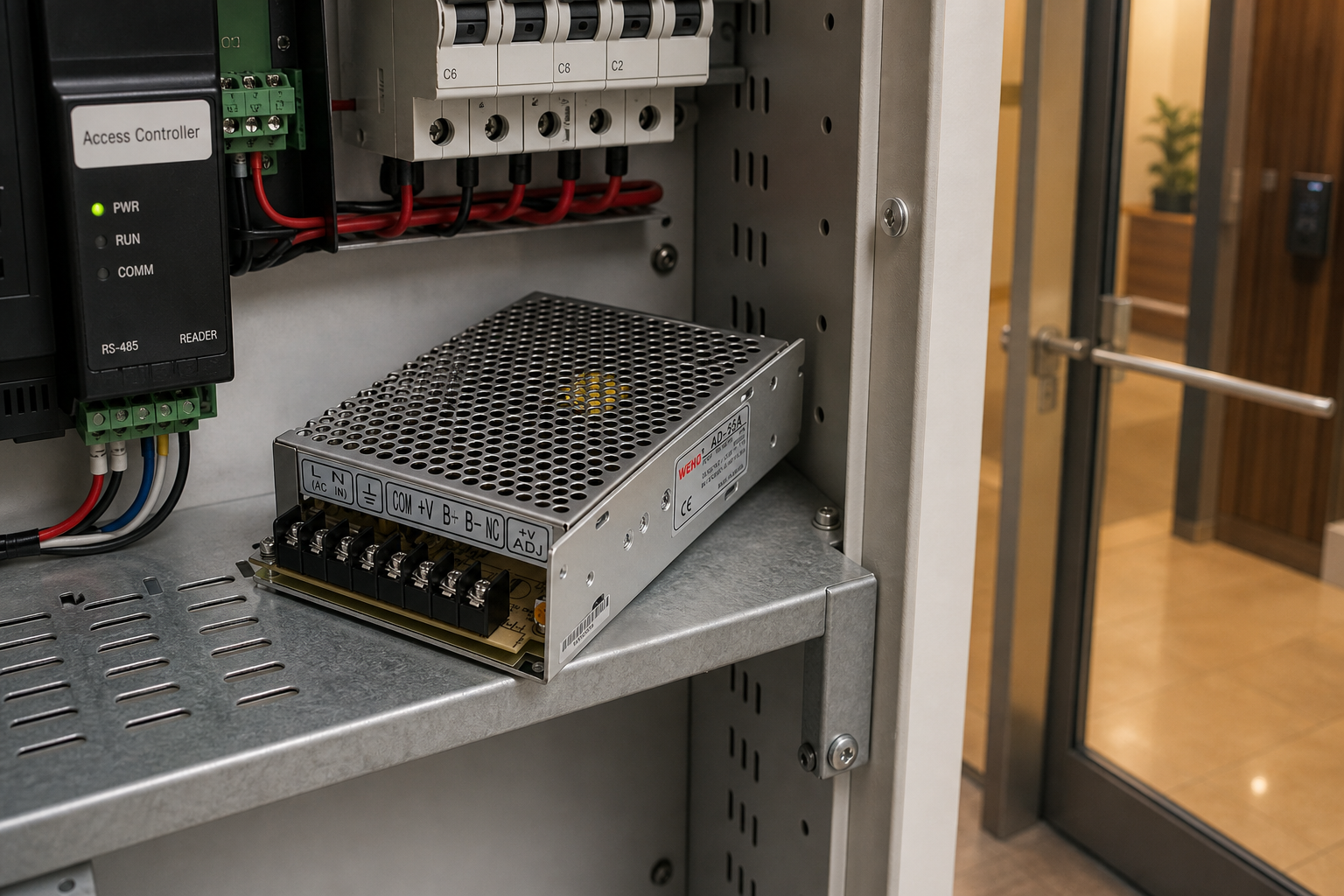
access control power supply selection starts with the door hardware
Un access control power supply must match the electrical behavior of the lock and every device sharing the DC bus. List the electric strike, magnetic lock, electrified latch, controller, reader, request-to-exit device, door position switch, relay, sounder, and any auxiliary interface. Record voltage, normal current, peak current, duty cycle, cable length, and whether the load is energized when the door is secure or released.
Fail-safe and fail-secure hardware behave differently during a power loss. That behavior is part of the door and life-safety design, not a choice made by the power supply alone. Confirm the approved door sequence, fire-alarm interface, emergency release requirement, and local code before selecting the electrical architecture.
Do not add incompatible lock types to one estimate without checking how they operate. A magnetic lock may remain energized for long periods, while a strike or latch may draw current only during an unlock event. The maximum simultaneous condition should be documented for every controlled opening.
Calculate continuous current and switching peaks
Add all loads that can operate together. Include the controller and readers, then add the lock current for the required secure or release state. Check short peaks from relays, sounders, and electrified hardware separately. A supply that meets the average current can still allow the voltage to collapse during a switching event.
Apply the exact product’s documented derating for temperature, input range, ventilation, and installation. Add a practical margin for component tolerance and planned expansion, but avoid replacing a distribution problem with an oversized source. Branch wiring and protective devices must still match the connected conductors and loads.
Measure voltage at the farthest lock under its highest current state. Long cable runs and small conductors can cause slow operation, chatter, incomplete release, or unreliable relocking even when the supply terminal voltage looks normal.
Plan battery backup and release behavior together

If the system must operate during an AC outage, calculate backup energy from the full standby load, the lock duty state, controller and reader consumption, battery condition, temperature, conversion losses, and the required operating time. A battery ampere-hour label is not a guaranteed delivered runtime under every condition.
The charger and battery path must be compatible with the selected battery chemistry and system design. Battery protection, low-voltage behavior, supervision, replacement interval, and alarm reporting should be specified. Do not connect a battery to an ordinary DC output unless the product is explicitly designed and documented for charging and backup operation.
Fire-alarm release and emergency egress behavior require project-specific review. The correct action can depend on lock type, building use, door hardware, and applicable codes. The power supply should support the approved sequence; it should not be used to invent that sequence.
Use a security power family designed for the application

The approved WEHO Security Power Supply category is the relevant landing page for access-control and backup-capable product families. The WEHO AD-55 product page is a representative charger-style supply reference. Confirm the exact output variant, battery requirements, current ratings, terminals, indicators, protection behavior, and installation instructions before use.
For additional architecture context, compare the existing WEHO guides on security power supplies for access control in commercial buildings et battery backup power for security systems. These related pages address broader system questions; this article focuses on selection and verification at the door-system level.
Distribution, wiring, and protection

Use protected branches so a fault at one door does not unnecessarily disable every opening. Label each branch with the door, voltage, polarity, protective device, cable route, and expected load. Keep AC mains separated from low-voltage access-control and communication wiring, and provide protective grounding where required.
Verify conductor size against current, distance, installation method, and acceptable voltage drop. Observe polarity at locks, controllers, batteries, and auxiliary relays. Qualified personnel should complete installation with incoming power isolated and should follow the lock, controller, fire interface, and power-supply documentation.
Avoid routing low-voltage lock wiring alongside sources of electrical noise when separation is available. Check suppression requirements for inductive hardware using the door-hardware manufacturer’s instructions; an incorrectly selected suppression device can affect release time or damage control contacts.
Commission every operating state

Test normal access, denied access, unlock commands, relocking, request-to-exit, door-held and forced-door conditions, AC failure, battery operation, battery-low indication, restored AC, and the approved emergency-release sequence. Measure voltage at the power supply and at the farthest lock during the highest-current event.
Record load current, battery voltage, ambient temperature, branch protection, cable distance, and test results. Repeat the backup test after the battery has reached its documented charge state. A system that works on the bench can fail at the door if cable drop, battery condition, or simultaneous lock operation was not included.
Common access control power mistakes
- Selecting from total wattage without checking lock state, peak current, or cable voltage drop.
- Assuming fail-safe or fail-secure behavior without confirming the approved door sequence.
- Connecting a backup battery to a supply not designed for battery charging.
- Using one unprotected output branch for many doors.
- Testing only at the power supply instead of at the farthest lock.
- Omitting fire release, AC failure, battery-low, and recovery tests from commissioning.
FAQ
Comment dimensionner une alimentation électrique de contrôle d'accès?
Ajoutez le contrôleur, les lecteurs, les serrures, les relais et les accessoires qui peuvent fonctionner ensemble. Vérifiez les pics de commutation de verrouillage, la chute de tension du câble, la dégradation ambiante, la charge de secours et une marge de service pratique.
Quelle est la différence entre les serrures Fail-Safe et Fail-Secure?
Une serrure de sécurité intégrée se libère lorsque l'alimentation est coupée, tandis qu 'une serrure de sécurité intégrée reste généralement sécurisée lorsque l'alimentation est coupée. La porte approuvée et la conception de sécurité des personnes déterminent le comportement requis.
Une alimentation DC ordinaire peut-elle charger la batterie de secours?
Utilisez uniquement un produit explicitement conçu et documenté pour la fonction de charge et de secours de la batterie sélectionnée, y compris la tension, la chimie, la protection et le comportement de supervision compatibles.
Pourquoi une serrure électrique claquette-t-elle ou se libère-t-elle lentement?
Les causes possibles comprennent une chute de tension du câble, un courant de crête insuffisant, des bornes desserrées, un conducteur sous-dimensionné, une suppression incorrecte ou une branche partagée perturbée par une autre charge.
Comment le backup runtime est-il calculé?
Use the full standby current, the lock state during an outage, controller and reader loads, required duration, battery condition, temperature, conversion losses, and the battery manufacturer’s usable-capacity guidance.
What should be tested before handing over the door system?
Test normal access, unlock and relock, request-to-exit, AC failure, battery operation, battery-low indication, restored AC, branch faults, and the approved emergency-release sequence.
Points clés à retenir
- Size an access control power supply from the actual locks, controllers, readers, and simultaneous operating states.
- Verify fail-safe/fail-secure and emergency-release behavior with the approved door and life-safety design.
- Calculate battery backup using the full standby load, lock duty, losses, temperature, and required time.
- Protect and label door branches, then measure voltage at the farthest lock under load.
- Commission normal, fault, AC-loss, battery, and recovery states before handover.
Conclusion
Un fiable access control power supply supports the complete door sequence under normal power, switching peaks, cable drop, and backup operation. Correct selection begins with the hardware schedule and ends with measured performance at each door.
Review the WEHO Security Power Supply category ou contact WEHO with the lock types, voltage, current, door count, cable distances, backup time, battery requirements, and release sequence. You can also email [email protected] for product matching.
Review the relevant WEHO product category, email [email protected], or contact WEHO with the input voltage, output load, ambient temperature, and installation details.