EN 61347 for LED Drivers: An OEM Evidence Checklist
For an OEM lighting order, “EN 61347” should start a document review, not end one. Ask which exact controlgear model, construction revision and standard edition a report covers, then check the conditions under which that component may be incorporated into the finished luminaire. A logo on a housing, an attractive sample or a product-family description is not a substitute for that evidence.
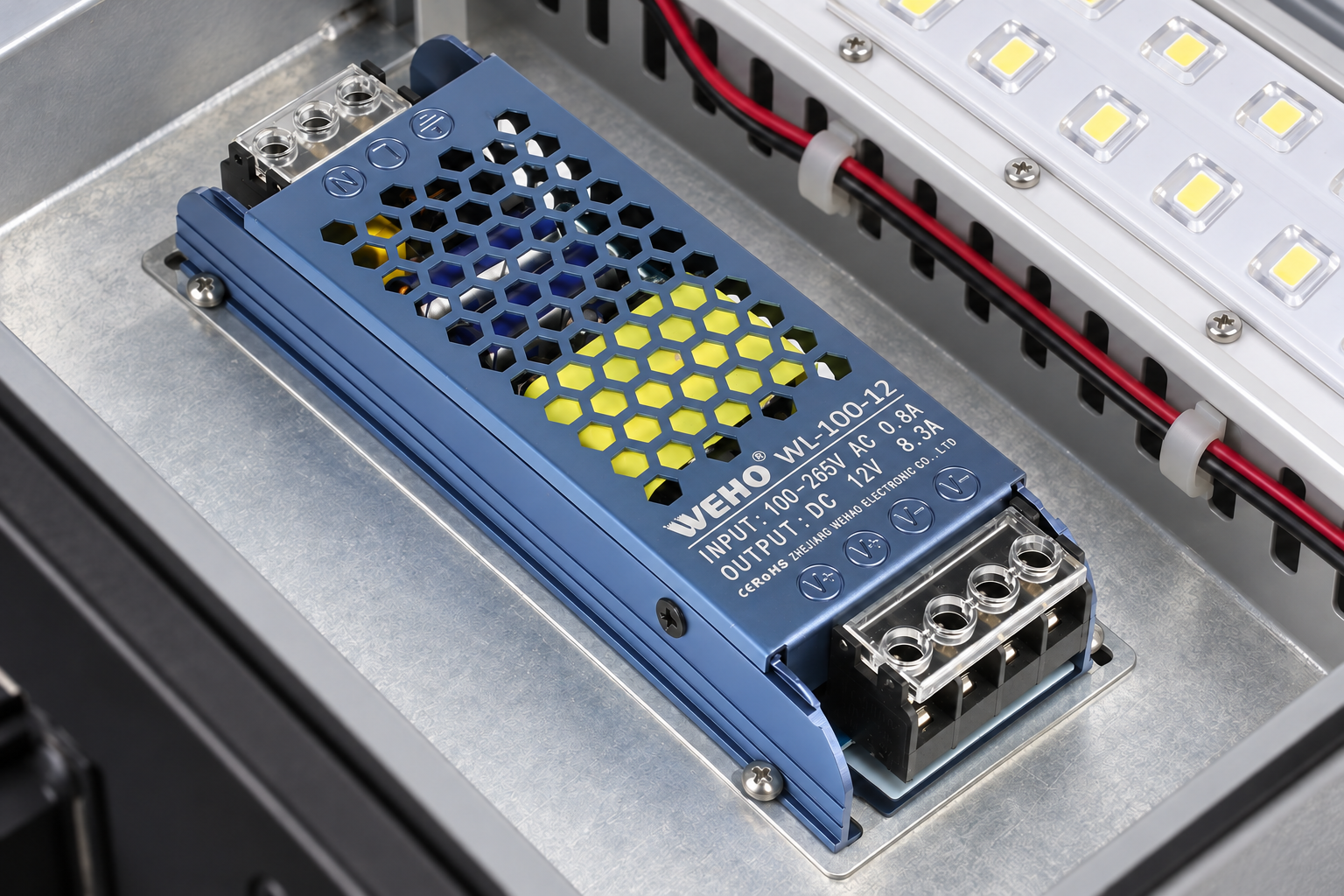
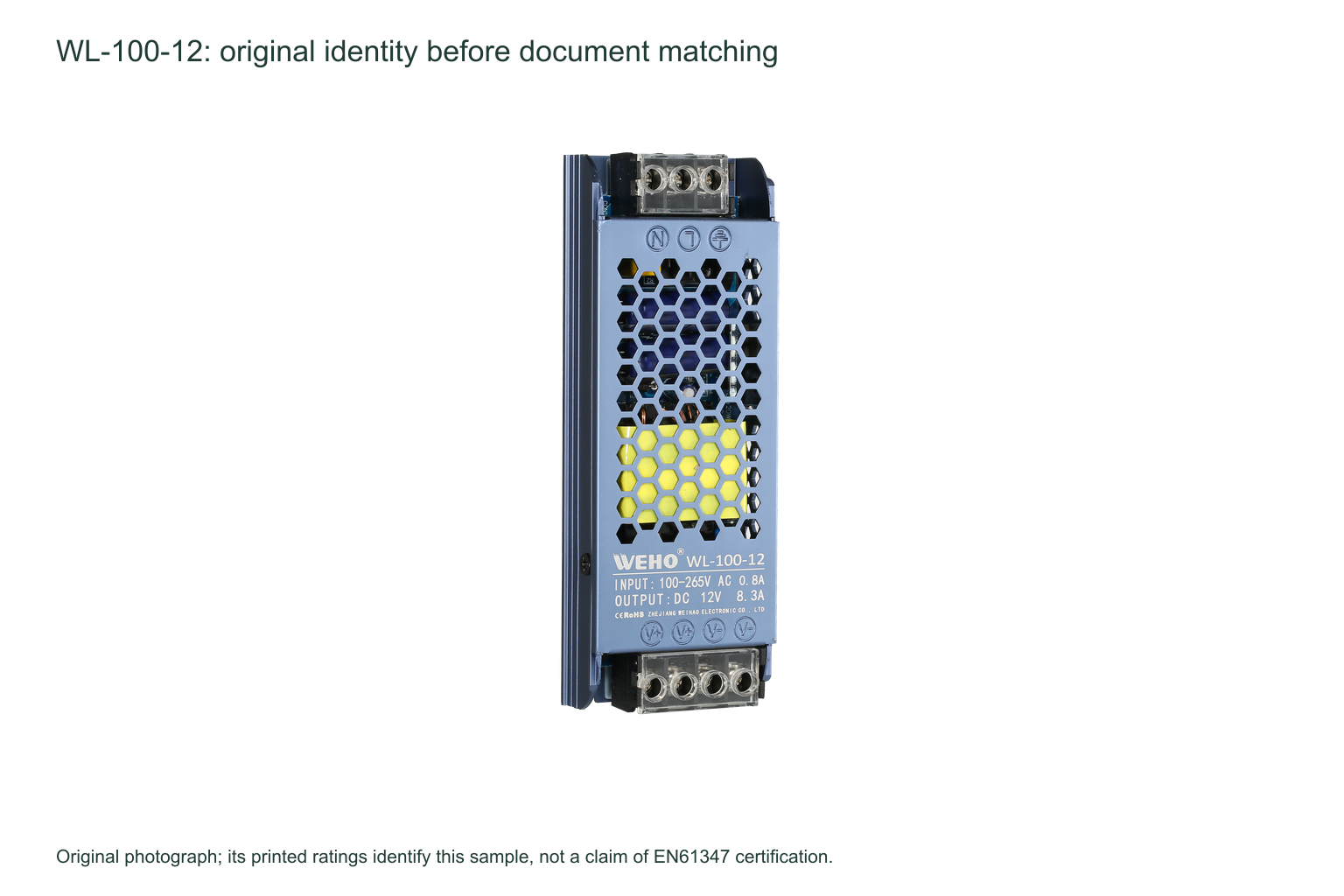
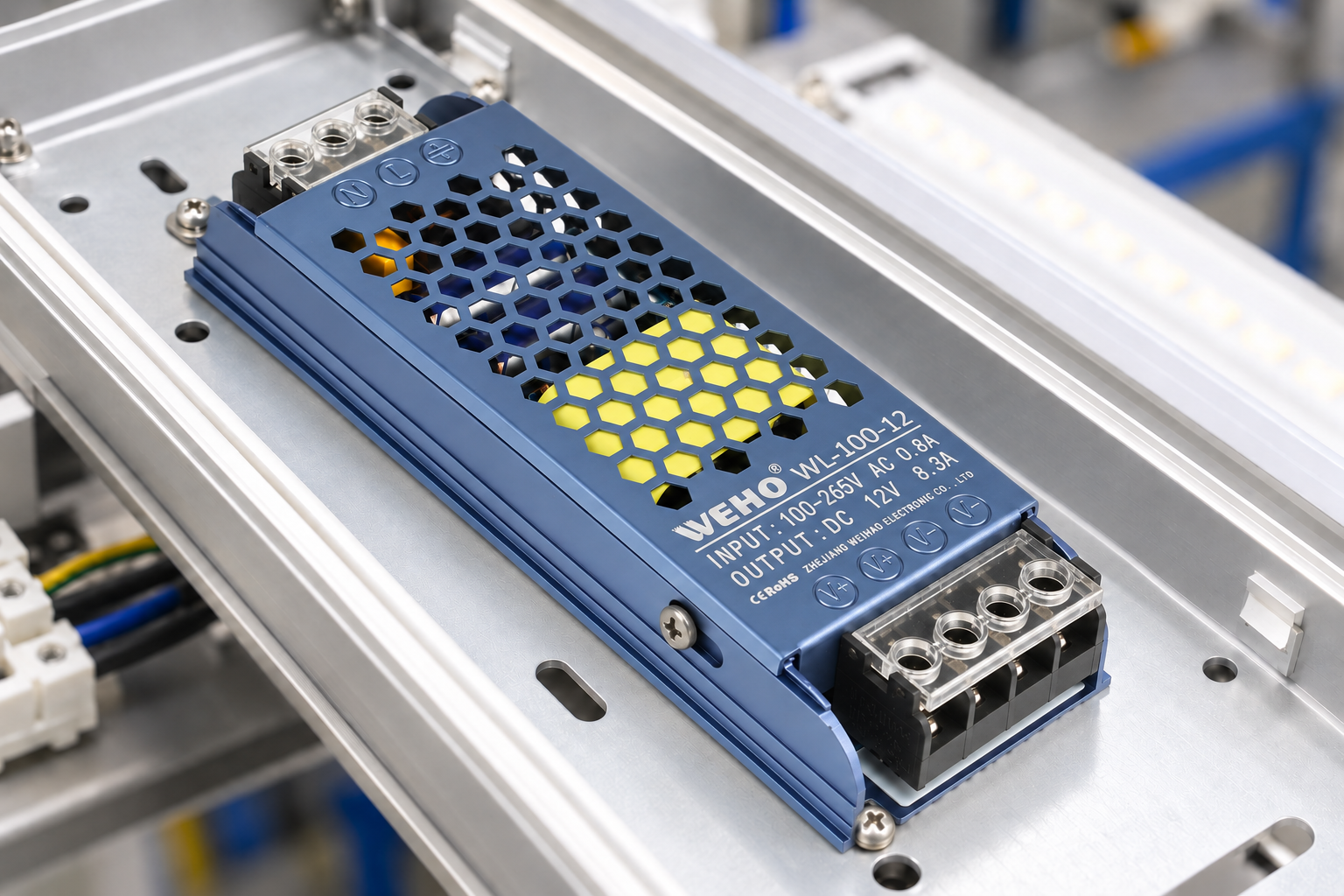
The WL-100-12 is a useful example of why identification matters. Its photographed label states DC 12 V, 8.3 A output and 100–265 VAC, 0.8 A input. The available source package does not establish a matching EN 61347 report for that sample. This article therefore explains the purchasing checks; it does not present the photographed unit as certified to the standard.
Specify the applicable document set
The publisher describes IEC 61347-2-13:2024 as the particular safety requirements for electronic controlgear for LED light sources. BSI lists the corresponding BS EN IEC 61347-2-13:2024 et le general requirements in BS EN IEC 61347-1:2024. These publisher summaries identify scope and editions; they do not provide a full compliance assessment of any WEHO product.
Ask the project’s responsible engineer or assessment body which edition and conformity route apply to the destination and finished product. Do not assume that the newest catalogue entry is automatically the required edition for every order. Safety documentation also does not establish dimming quality, flicker, lifetime or other performance requirements unless those are separately supported.
Connect the paperwork to the delivered unit
| Purchasing check | Evidence to request | What would block acceptance |
|---|---|---|
| Exact identity | Full model, ratings, label artwork and construction revision | A similar family name with a different output or enclosure |
| Report coverage | Report number, issuer, tested models, editions and relevant conditions | A certificate image without a way to establish its scope |
| Installation conditions | Required enclosure, earthing, terminals, thermal limits and mounting instructions | Conditions that the intended luminaire cannot meet |
| Series production | Agreed approved sample and change-notification process | Unannounced changes to materials, protection or identification |
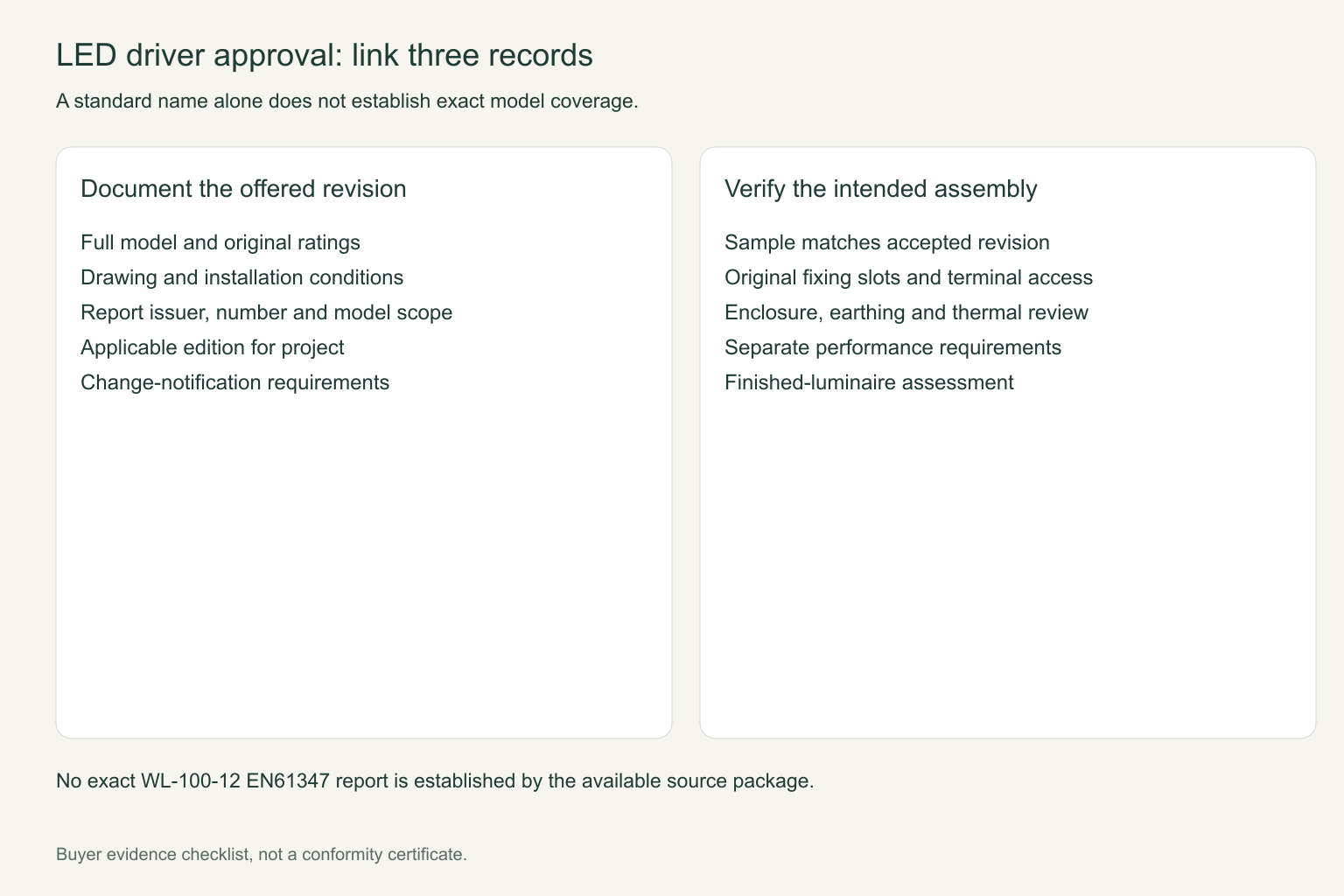
A buyer need not reproduce laboratory work to make this check useful. The aim is to prevent a report for one variant from being attached to a quotation for another. If a distributor supplies the documents, request a traceable connection to the manufacturer and exact offered revision.
Keep the WL-100-12 example revision-specific
The original photographs show a narrow blue ventilated chassis, three guarded AC terminals at one end and four DC terminals at the other. The matching drawing gives a 138 × 50 mm footprint and two diagonally opposed factory fixing slots. This is chassis mounting, not a DIN-rail product. Installation drawings should preserve access to the terminal guards and ventilation rather than treating the small footprint as the complete space requirement.
There are material document differences to resolve before releasing a batch. The archived drawing/header and dimension table disagree on height, at 23 and 24 mm. The current product page also lists different electrical figures from the photographed 8.3 A sample. Do not average these values or silently substitute one source for the other. Request the drawing, rating label and report applicable to the actual units being quoted.
Use sample acceptance to test the purchasing specification
Agree a sample checklist before placing the larger order: identity and artwork match, mechanical fit, terminal access, protective enclosure, earthing arrangement where applicable, and the relevant thermal and electrical checks in the intended luminaire. Record the sample revision and test conditions. A successful fit or illuminated LED strip alone does not establish safety-standard compliance.
If the supplier proposes a replacement driver later, revisit both the application and the document coverage. Equal nominal output voltage does not prove equivalent construction, protective functions or installation conditions. Keep approval of the component separate from assessment of the complete luminaire.
Questions for the RFQ
Send the destination market, luminaire type, input supply, required output, enclosure arrangement, thermal environment and expected document set. Ask for the offered revision’s drawings and label photograph together with any applicable report and its scope. Request clarification of the WL source differences before committing a fabrication drawing. WEHO’s WL product information provides a starting point for the enquiry; the order should identify the exact accepted version.
Buyer FAQ
Does the CE marking prove a particular EN 61347 test report exists?
No. Ask for the relevant conformity documentation and the specific report or other evidence being relied on. Verify its model coverage and conditions rather than inferring them from the mark alone.
Can an approved power supply make the whole luminaire approved?
Not by itself. The finished assembly still needs the applicable assessment, including how the supply is installed and used. The component’s documented conditions remain part of that review.