A programmable AC source, also called a programmable AC power supply, controls the AC conditions applied to equipment under test. An AC-DC power supply converts an AC input into a DC output for its load. When an OEM needs to evaluate an industrial supply across input conditions, these devices usually occupy different places in the test system.
On this page
The equipment-selection decision begins with the test stimulus: what voltage, frequency, waveform or timing must reach the supply input? An adjustable DC output on an industrial supply does not create a programmable AC input stimulus. Equally, the presence of a DC mode on a laboratory AC source does not make it the same product as the installed industrial supply.
Assign the three functional roles
Keysight describes programmable AC sources as instruments providing controlled voltage, frequency and waveform conditions to a device under test. Available features vary by model. For a power supply input test, the industrial AC-DC unit is the DUT, and its output load is a separate part of the setup.
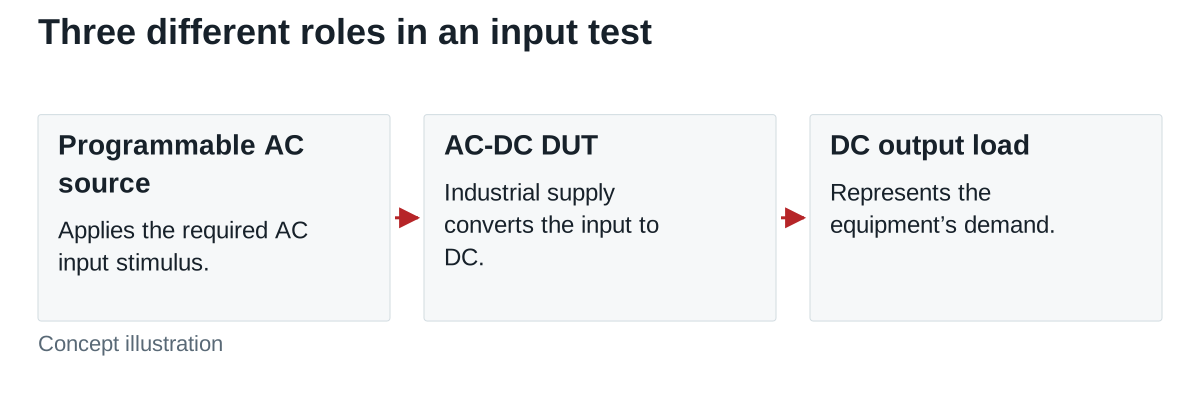
| Role | What it controls or does | Information needed |
|---|---|---|
| Programmable AC source | Applies the specified input stimulus | Voltage/frequency coverage, phases, current and power envelope, waveform and sequence capability |
| AC-DC supply under test | Converts the applied AC into its DC output | Exact model, input limits, load conditions and acceptance requirements |
| DC output load | Represents the demand on that output | Load control behavior, static/dynamic demand, operating limits and measurement points |
Define the functional roles before selecting catalog items. WEHO industrial power supplies should not be assumed to offer the voltage-waveform generation, analysis or sequence functions of laboratory AC test equipment. Any feature claim needs exact model documentation.
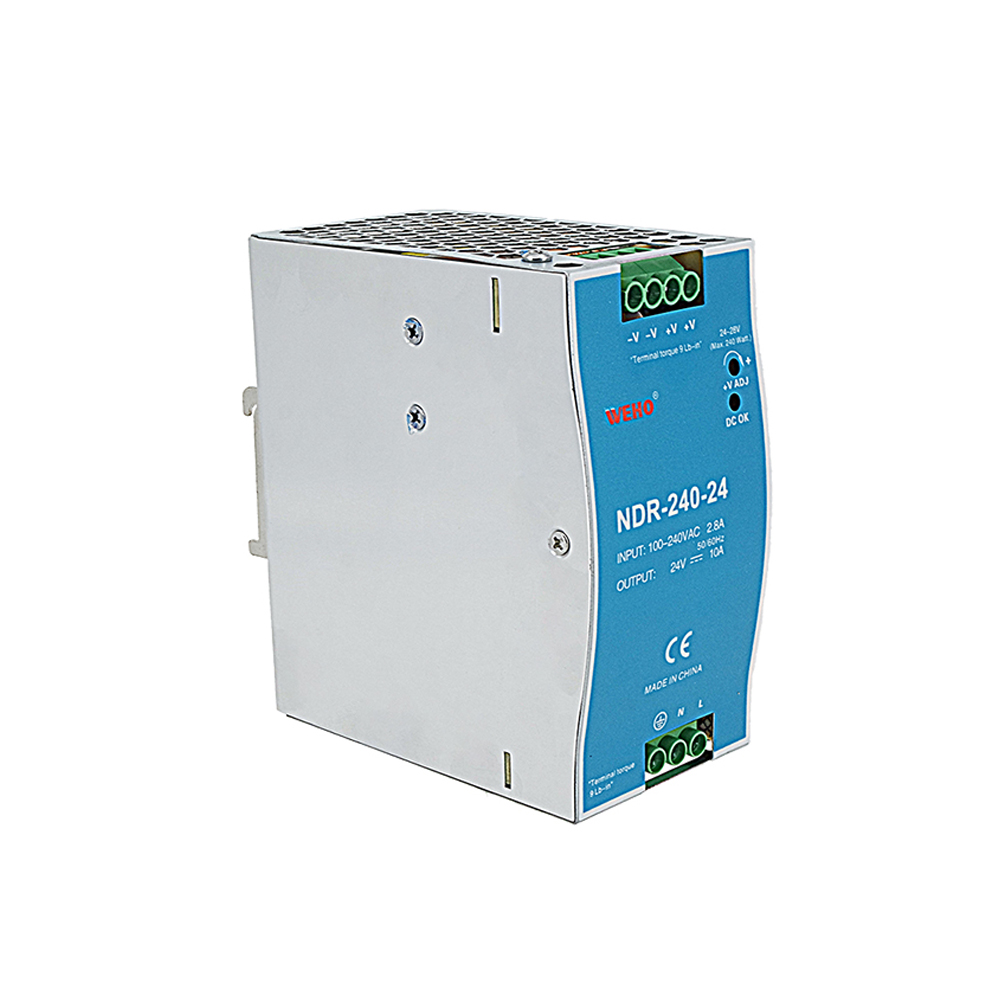
A product such as the WEHO NDR-240-24 occupies the AC-DC DUT role between the AC source and the output load. Its model specification identifies the power supply being evaluated; it does not make the unit an AC stimulus generator. The 90% efficiency and 0.80 power factor used later remain hypothetical, not NDR-240-24 measurements.

Write the input stimulus as a test requirement
For a steady input-range evaluation, specify the voltage points, frequency, load and stabilization conditions. For an interruption or disturbance evaluation, also specify the initial and final levels, transition timing, duration, repetition and any required phase relationship. A source with the right maximum voltage may still lack the sequence control needed for that test.
Distinguish a development test from a formal compliance test. A programmable waveform can help investigate a product, but selecting a source does not establish compliance with an immunity standard. A formal assessment needs the applicable test edition, required generator characteristics, configuration and competent interpretation.
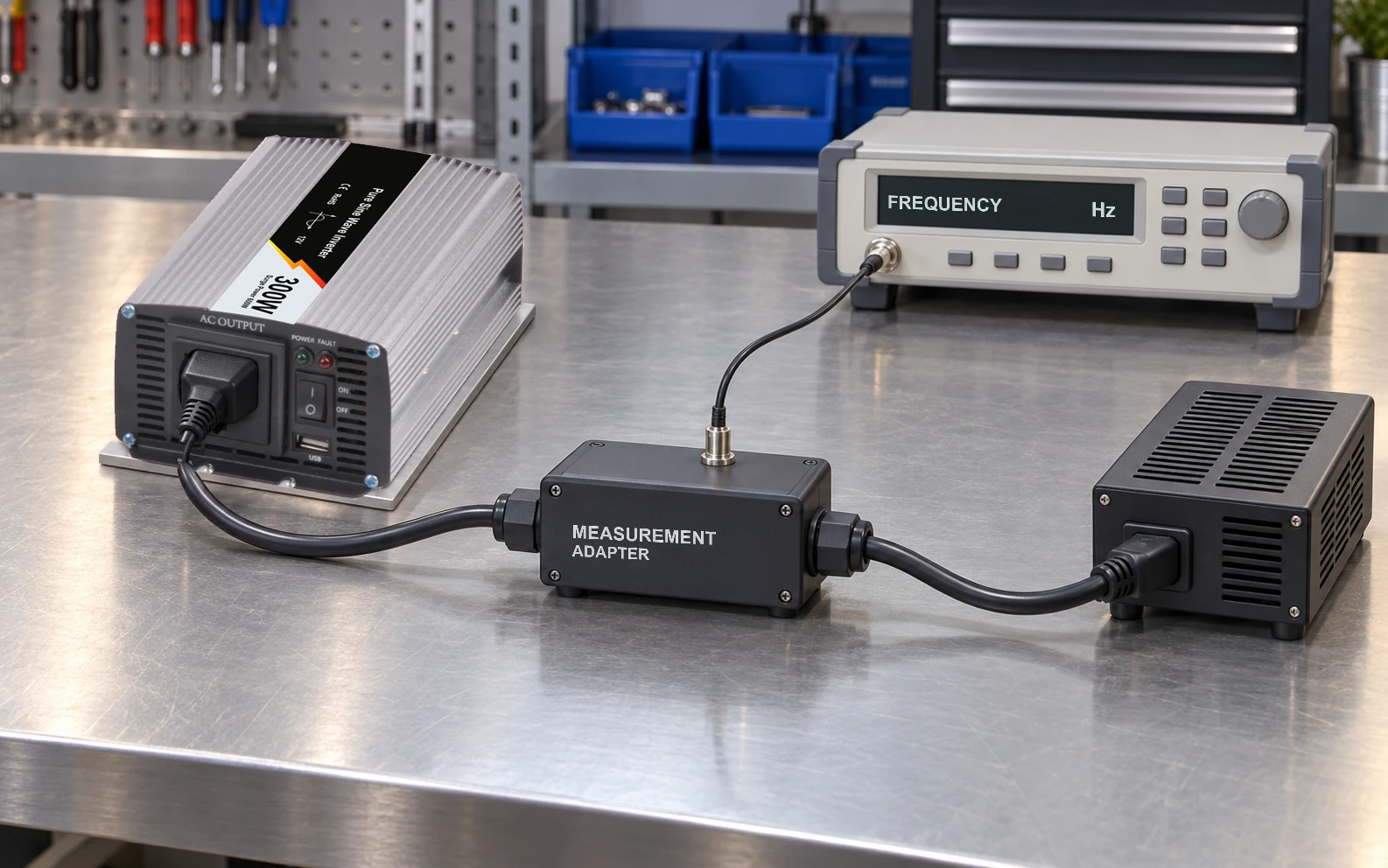
Decide which input quantities must be measured at the DUT. A source display describes the instrument’s measurement point and functions; it does not automatically prove that an identical waveform reached the DUT terminals. The laboratory should account for the interconnection and measurement arrangement in the test record.
Calculate steady watts, VA and current separately
DC output watts alone are insufficient for sizing the AC stimulus. Use measured or documented efficiency and power factor at the relevant operating point. TDK-Lambda’s PFC explanation distinguishes real input power from apparent power and describes the non-sinusoidal current demand possible with switching supplies.
Consider a hypothetical single-phase DUT delivering 240 W DC. Assume 90% efficiency and a true power factor of 0.80 at the operating point:
- Real input power = 240 W / 0.90 = 266.7 W, rounded.
- Apparent input power = 266.7 W / 0.80 = 333.3 VA, rounded.
- At 100 V RMS, input RMS current = 333.3 VA / 100 V = 3.33 A, rounded.
If the same assumed efficiency and power factor applied at 230 V RMS, the calculated current would be about 1.45 A. In an actual supply those quantities can change with voltage and load, so this comparison is arithmetic under declared assumptions, not a WEHO input-current specification.
The example establishes only a steady operating point. It does not specify source headroom, startup peak capability or a suitable instrument model. Evaluate every required input/load point against the source’s documented operating envelope, including range changes and any applicable derating.
Keep startup peak capability separate from continuous VA
A switching supply can present a short input-current demand that differs from its steady RMS current. Check repetitive input-current peaks separately from turn-on inrush; neither is specified by RMS current alone. Compare the required peak, duration and repetition with the source’s permissible output behavior. Do not substitute a front-panel peak-current measurement capability for a peak-current delivery rating.
Le Keysight AC6900 source datasheet is an example of why complete tables and footnotes matter: available current depends on voltage range and phase configuration, and some frequency conditions require derating. Those instrument-specific values cannot be transferred to another source.
If the source limits current or its output voltage collapses during startup, the resulting failure cannot automatically be assigned to the DUT. Keep the actual source-output waveform and limit status with the DUT traces. A source limitation may itself be part of an intentional test, but it must match the approved stimulus rather than appear accidentally.
Check special capabilities only when the DUT needs them
Confirm single-phase or multiphase operation from the DUT and test requirements. For a multiphase test, phase relationships and per-phase limits matter alongside total power. Confirm arbitrary waveform, harmonic generation, DC offset or AC-plus-DC capability individually; these functions are not implied by the word “programmable.”
Also identify whether the DUT can return energy toward the source in the planned condition. If it can, the source’s ability to absorb or regenerate that energy needs explicit verification. A source-only instrument must not be assumed to sink reverse power. This check concerns the actual DUT behavior, not an assertion that a conventional WEHO AC-DC supply regenerates.
Give the laboratory a task-based selection brief
Keep a concise brief containing the DUT model, required stimulus matrix, output-load profile, steady W/VA/current calculations, startup demands and measurement needs. Add any phase, waveform or reverse-energy requirement and the applicable acceptance criteria.
Select a source only after that brief maps to documented instrument capabilities. Hold the selection where a required dynamic or peak condition is unknown. During testing, retain the instrument model, firmware, settings, limit events and achieved stimulus so another engineer can assess whether the result answers the intended question.
Send WEHO the industrial supply model, input conditions, output-load profile and acceptance requirements to discuss the DUT documentation needed for your validation plan.