- Photoelectric repeat accuracy applies to stated, repeated conditions; changing the target creates a different comparison.
- Keep same-target switching scatter separate from shifts caused by a new finish, angle or optical geometry.
- Retain grouped raw positions before calculating the full accepted target envelope.
- A component's repeatability claim cannot replace application validation across the actual production sample set.
Decide which variation the specification describes
A photoelectric sensor can repeat closely on one target while switching at a different position on another. The OEM question is whether its accepted target set stays within the required positional window. A catalogue repeat-accuracy value cannot answer that question unless the application's changes match the stated specification conditions.
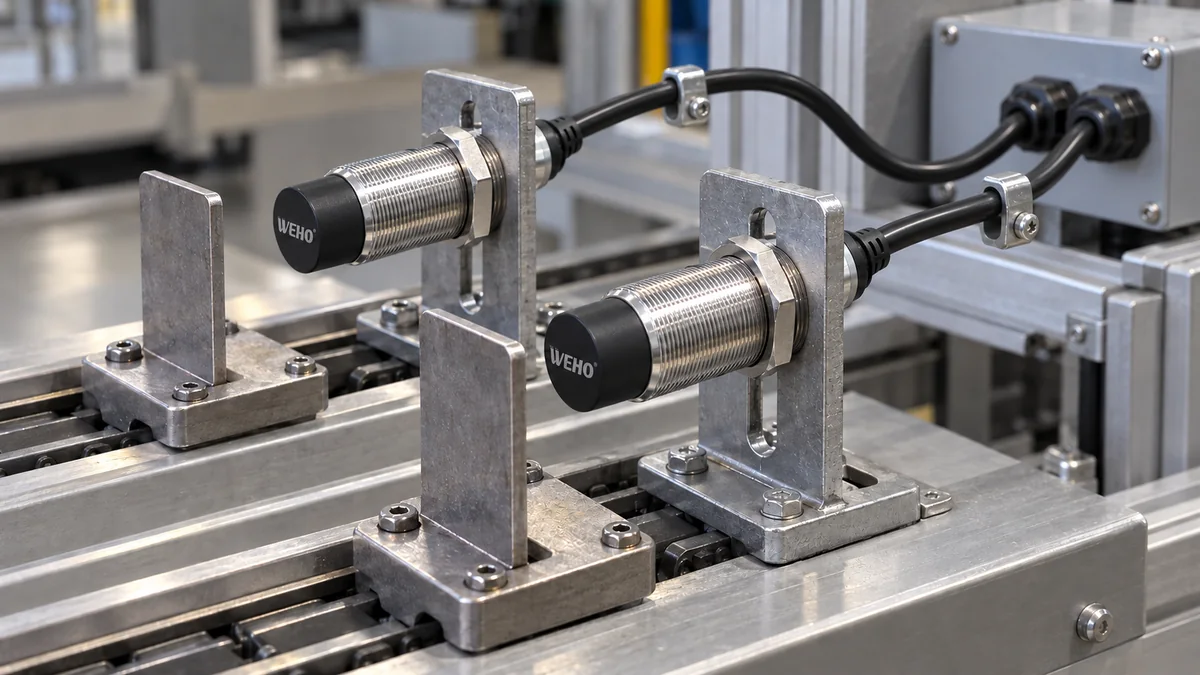
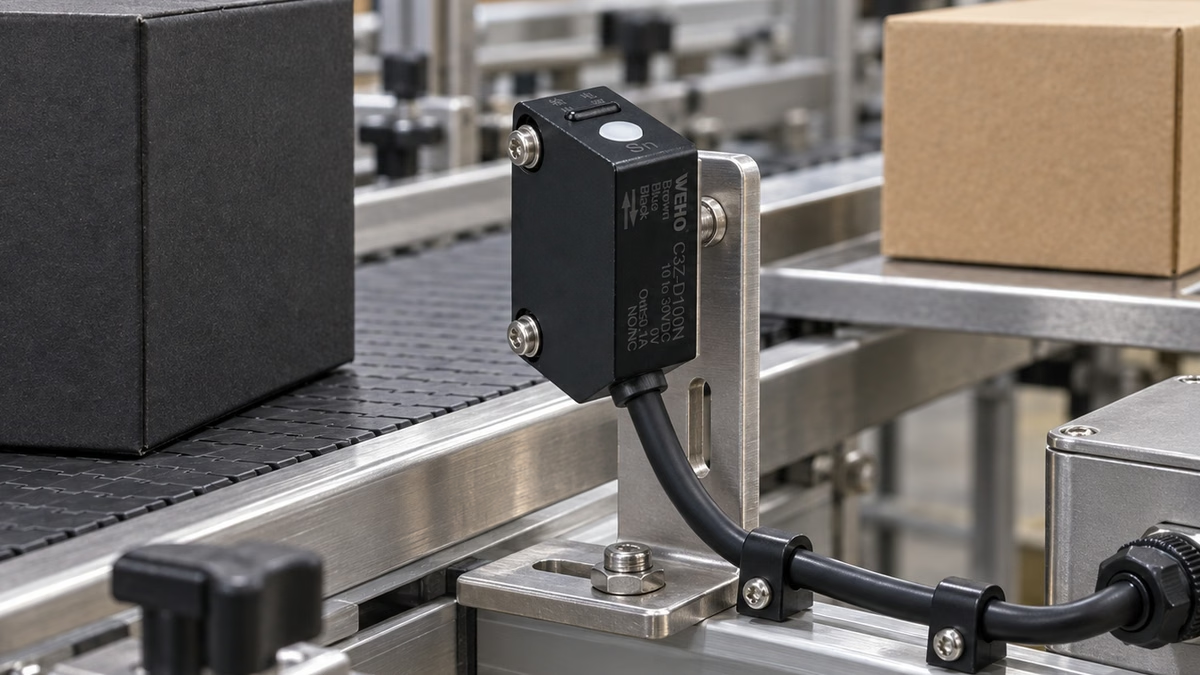
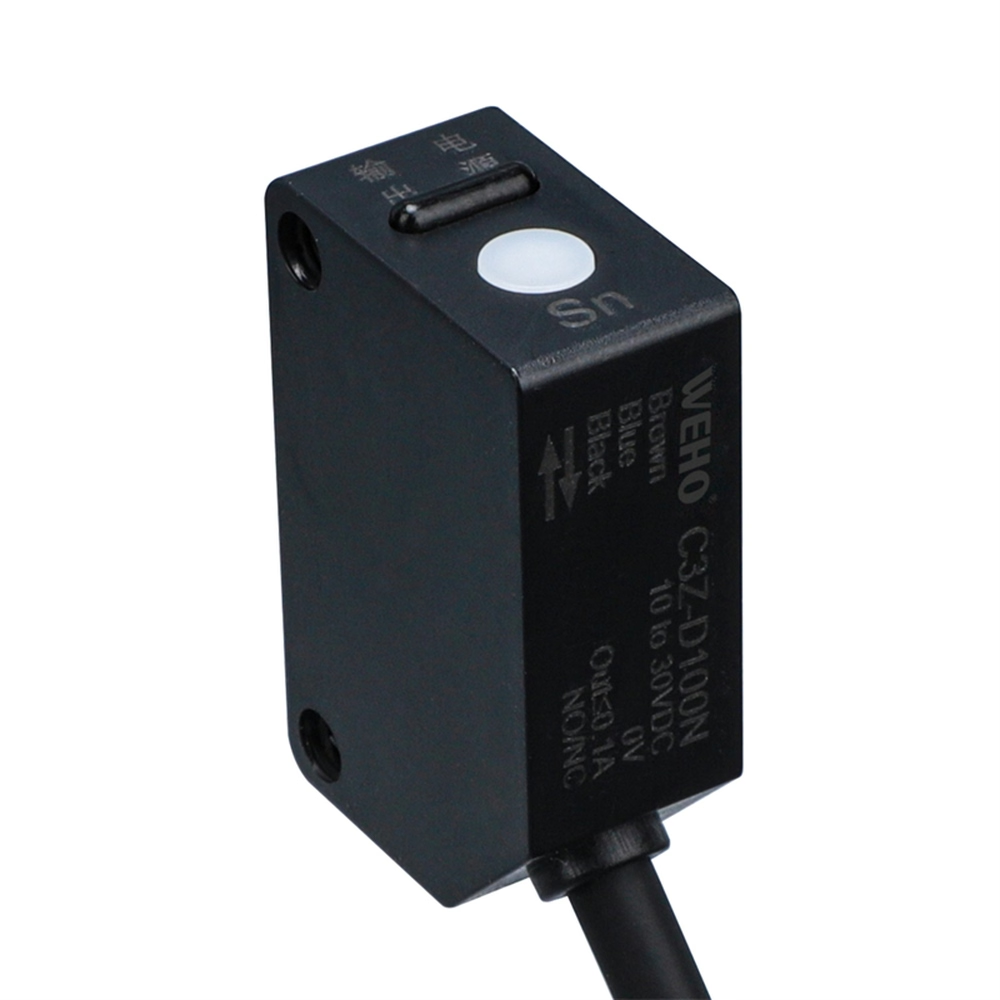
그만큼 WEHO C3Z-D100 product information identifies the diffuse-reflective C3Z-D100N option used as this article's product context. Confirm the actual variant and applicable documents before evaluating the optical task. No repeat-accuracy number is inferred from the product photograph, model name or published reference range.
Define the measured event before collecting data. A physical switching position at a fixed fixture datum is different from the time at which a PLC program records the event. Keep receiving-input filtering and motion-related delay separate when the task is to understand the optical switching-position distribution.
Read the conditions behind repeat accuracy
OMRON's photoelectric repeat-accuracy FAQ defines the comparison with voltage, temperature, sensing distance, target and target angle held constant. Its reference figures are not C3Z specifications. The useful distinction is that a changed target does not remain a repetition of the original condition.
Banner's Key Specifications for Discrete Applications similarly separates repeated measurement under the same conditions from the target variation encountered in an application. A repeatability result should therefore identify what stayed constant. Otherwise, a reader cannot tell whether a quoted spread includes colour, angle, position or other changes.
For a diffuse sensor, the target is part of the optical arrangement because the receiver uses light returned from that target. OMRON's photoelectric terminology guide ties the diffuse reference distance to a specified standard object. That condition does not establish equivalent behavior on every production finish or size.
A published component figure and an OEM sample study can both be useful without describing the same quantity. Keep the manufacturer's stated definition intact, then define the application study separately. Do not widen the meaning of “repeat accuracy” to include every variation simply because all results appear on one chart.
Calculate grouped scatter and the target envelope
Consider a hypothetical position study, not measured C3Z-D100N performance. One sensor remains at a fixed setting, and a target edge approaches along the same path. The position coordinate is measured from a fixture datum; it is not the sensor-to-target distance or a claimed range limit.
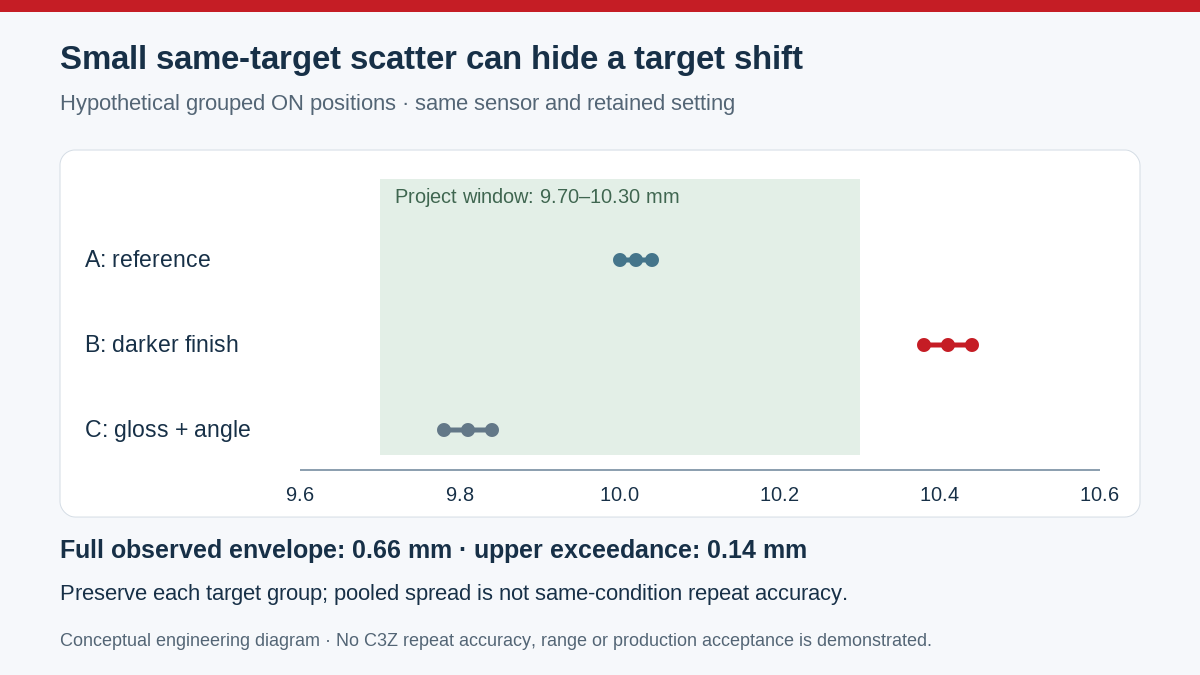
The project accepts switching coordinates from 9.70 to 10.30 mm. Three separately identified sample conditions are evaluated without changing the sensor setting. Assume the measurement method is suitable for the illustrated distinction; an actual release would require its documented uncertainty and decision rule.
| Hypothetical sample group | Three ON positions | Mean and observed range | Inside project window? |
|---|---|---|---|
| A: reference matte sample | 10.00, 10.04, 10.02 mm | 10.02 mm; range 0.04 mm | All three observations |
| B: darker production finish | 10.38, 10.44, 10.41 mm | 10.41 mm; range 0.06 mm | No observations |
| C: glossy sample at defined angle | 9.78, 9.84, 9.81 mm | 9.81 mm; range 0.06 mm | All three observations |
Group B's mean is (10.38 + 10.44 + 10.41) ÷ 3 = 10.41 mm. Its within-group range is 10.44 − 10.38 = 0.06 mm, while its mean shift from A is 10.41 − 10.02 = 0.39 mm. The small within-group range does not remove the changed operating position.
Across all three groups, the observed envelope is 9.78 to 10.44 mm. Its width is 10.44 − 9.78 = 0.66 mm, and its upper observation exceeds the project's 10.30 mm bound by 0.14 mm. Pooling every position into a single “repeatability” result would conceal which target condition caused the acceptance problem.
Swipe horizontally on a small screen, or open the full-size diagram.
Group C changes both finish and angle, so this table cannot isolate either cause. A follow-up comparison would hold one constant while changing the other. That distinction prevents a sample study from producing an unsupported claim that colour, gloss or angle alone explains an observed shift.
Three readings per condition are deliberately insufficient to establish a guaranteed distribution or production limit. The example demonstrates the arithmetic and grouping only. An actual study needs enough representative samples and repetitions for its intended claim, including conditions near the least favourable accepted configuration.
Preserve the optical configuration while comparing targets
Record target dimensions, material, finish, angle and background separately from its identifying name. A label such as “dark carton” can cover many constructions. Retain sample identifiers or a controlled material specification so the comparison can be repeated after procurement changes a supplier.
Keep the sensor's setting fixed when the requirement is to handle all products without adjustment. If a recipe permits different settings for different targets, record the setting with each group and qualify the changeover process. A successful result after retuning does not demonstrate performance at the original common setting.
Bracket movement, cable pull and target support changes can move the optical relationship. Check the fixture before interpreting a shift as an optical property. A measured difference can be real while its proposed explanation remains unproven.
그만큼 WEHO paper-and-label sample guide establishes the broader present/absent acceptance task. Add grouped position evidence when the process also needs a bounded switching coordinate. Correct detection and acceptable position are separate release requirements.
Avoid three misleading summaries
“Repeatable within 0.06 mm” is incomplete if the report omits which target and conditions produced that range. “All targets detected” is incomplete if some switch outside the machine's required position window. “Average position acceptable” can hide an unacceptable subgroup or an extreme observation.
Use a report that preserves the group identity, individual values and declared statistic. Distinguish an observed range from a manufacturer's tolerance, a standard deviation and an uncertainty interval. Those quantities cannot be interchanged by changing the label on a column.
- Define the positional task. Record datum, motion path, output transition and required window. Accept the definition only when the physical position and electrical event are unambiguous.
- Freeze the reference condition. Identify the sensor, setting, supply, target and environment. Measure repeated positions within that condition before introducing a changed target.
- Create controlled target groups. Record each finish, angle, dimension and background condition. Retain changes explicitly, using matched comparisons where a particular cause is being investigated.
- Calculate both results. Report within-group scatter and between-group position shifts, then compare the complete accepted-target envelope with project limits. Keep raw data and the measurement decision rule with the summary.
- Release the application recipe. Link sensor identity, settings, target specification and accepted window. Repeat affected checks after a new material, mounting or recipe change.
Send WEHO the target and position requirement
에 대한 C3Z-D100N application inquiry, provide the exact label, representative sample descriptions, background and required switching-position window. State whether one retained setting must cover every target. Ask for applicable model-specific repeat-accuracy conditions and a supported sample evaluation before approving production.
Frequently asked questions
Does repeat accuracy include different target colours automatically?
No. The applicable specification conditions determine its scope. A changed colour or finish should be treated as a separate target condition unless the manufacturer explicitly includes that variation.
Can a sensor be repeatable and still miss the position window?
Yes. Closely clustered observations can remain shifted outside the required window. Compare the group location as well as its scatter with the actual equipment requirement.
Should every target result be pooled into one repeatability number?
No. Preserve groups so that within-condition scatter remains distinguishable from target-dependent shifts. A combined envelope can support application acceptance, but it should not be relabelled as a same-condition repeatability specification.
Does retuning for each sample prove a common setting works?
No. Retuning creates different configurations. If the machine permits recipes, qualify each recipe and its changeover; otherwise, evaluate the full target set at the required retained setting.