A standby-power comparison needs a defined equipment mode, a complete data record and the applicable measurement method. A stable-looking meter display or one favorable average cannot establish that a cyclic low-power mode was represented correctly.
- Identify the actual non-active mode and governing procedure.
- Preserve cycles, missing records and out-of-range flags.
- Keep illustrative averaging separate from standardized stability assessment.
- Record the standard edition rather than relabeling an older method.
1. Define the equipment mode before measuring watts
An OEM buyer comparing low-power operation needs to know what the equipment is doing. An unloaded supply, an idle controller and an equipment standby mode are different boundaries. Record enabled functions, connected accessories and the way the selected mode was entered before comparing a reported power value.
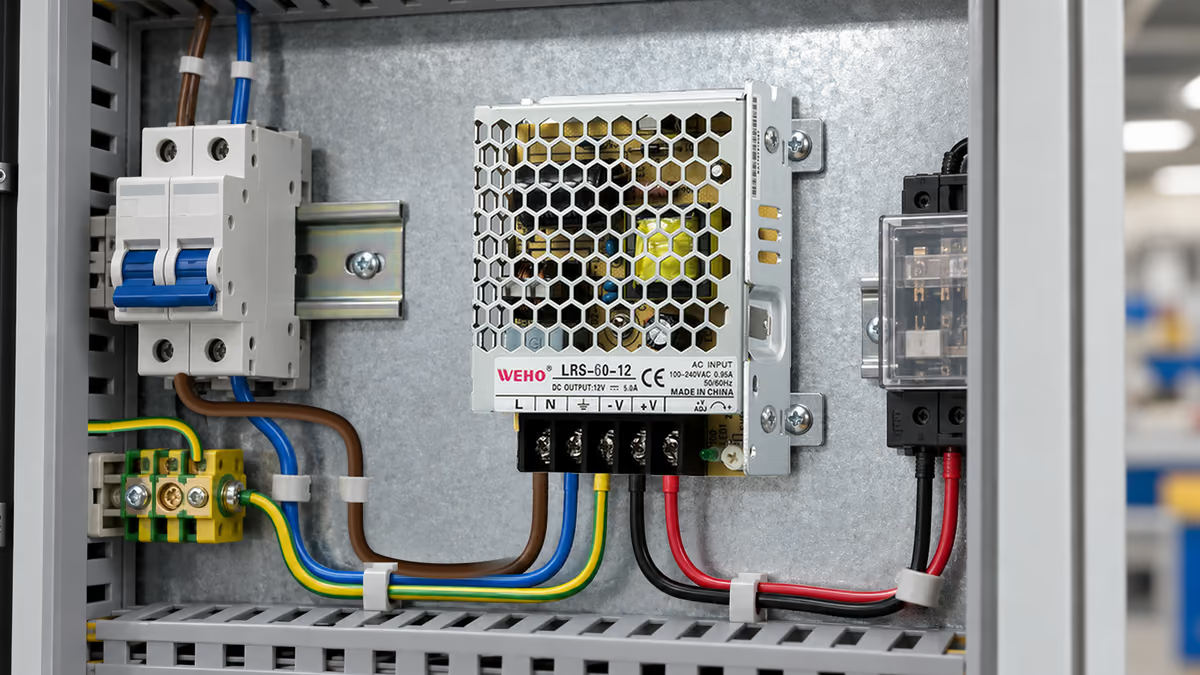
그만큼 WEHO LRS-60-12 product reference identifies one source within that equipment. It does not define the assembled product's mode or establish its input-power record. Ask for applicable exact-model information while the equipment owner defines which functions and loads belong inside the measurement boundary.
IEC 62301:2026 covers standby and other specified non-active power measurements and reporting. Its official overview separates active operation and other out-of-scope conditions. Determine whether the actual equipment and required mode are covered rather than applying the standard name to any low wattage reading.
The same overview directs lighting non-active measurements to their separate framework. IEC 63103:2020 specifically addresses lighting equipment. Product-specific procedures can define relevant operating conditions, so the applicable document set should be part of the purchasing question.
2. Check the edition and the claimed method
The 2026 IEC overview identifies substantial changes from the previous edition. These include data-logging requirements, treatment of data loss and out-of-range records, revised stability assessment and a moving-average alternative. That published change summary is useful for checking a report's stated method; it is not the complete normative procedure.
그만큼 official 2011 edition overview remains a historical reference, not a source of thresholds to rename as 2026 requirements. A report prepared under an older edition should identify that edition honestly. The responsible team must determine which edition and product procedure the project actually requires.
This guide supplies a data-review worksheet, not an implementation of the revised standard. Use the applicable authorized procedure and laboratory method for its sampling, stability, cyclic-load and uncertainty rules. No rolling-window size or numerical acceptance threshold in the illustrative example below is a standard requirement.
| Record field | What to retain | Question it resolves | Verification owner |
|---|---|---|---|
| Mode | Enabled functions, accessories and activation steps | Was the intended equipment state measured? | Equipment owner |
| 방법 | Standard edition, applicable product procedure and analysis version | Which rules govern the result? | Test owner |
| Raw record | Power values, timestamps, range flags and missing-data indicators | Is the analyzed interval complete? | Laboratory |
| Validity | Applied stability/cycle checks and uncertainty evidence | Is this interval suitable under that method? | Responsible reviewer |
Do not erase a range warning after selecting a more convenient display scale. Retain the original instrument state and determine whether the affected interval is usable. A later valid record can replace an invalid attempt, but the data history should not disguise how that replacement was obtained.
3. Recalculate an explicitly illustrative cyclic record
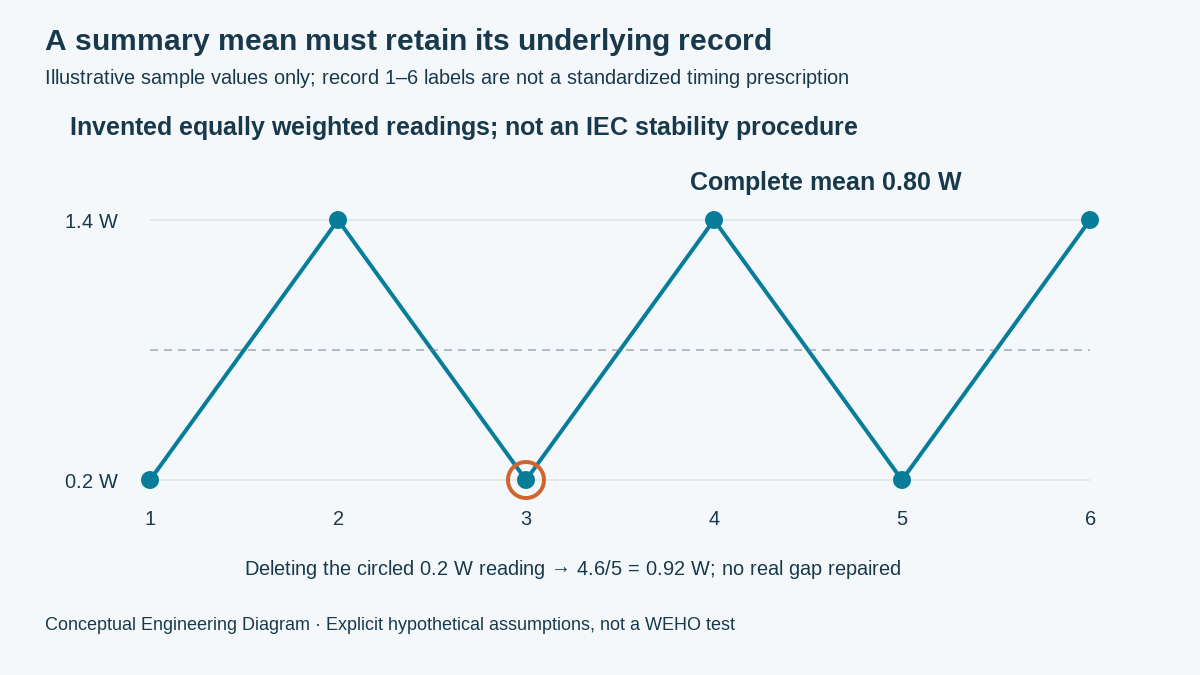
Assume six equally weighted power readings of 0.2, 1.4, 0.2, 1.4, 0.2 and 1.4 W at successive observation points. The values are invented and represent a repeating two-level pattern. Their arithmetic mean is (0.2 + 1.4 + 0.2 + 1.4 + 0.2 + 1.4)/6 = 0.8 W.
Now apply an arbitrary three-reading moving average solely to inspect this invented sequence. The four successive averages are 0.6, 1.0, 0.6 and 1.0 W. A single six-reading mean hides that variation; the moving averages reveal dependence on where this chosen window falls in the cycle.
Those four numbers do not declare stability or instability under IEC 62301. The sequence is too small and its chosen window is not a normative algorithm. The independent conclusion is only that a reported mean needs its underlying time record and applicable analysis to explain a cyclic mode.
Swipe horizontally on a small screen, or open the full-size diagram.
Delete the third reading and average only the five remaining values. Their sum is 4.6 W, so the resulting arithmetic mean is 4.6/5 = 0.92 W. That is 0.12 W, or 15%, above the original example's complete-record mean, even though the underlying hypothetical pattern has not changed.
Filling the missing position with zero creates another incorrect representation of the known original example. The six-position mean becomes 4.6/6 ≈ 0.7667 W. A zero is a claimed measurement value, while a missing sample is absent information; neither replacement nor deletion reconstructs the unavailable observation in a real test.
4. Review the raw record before accepting the summary
Keep analysis operations reproducible. Identify the selected interval, exclusion rules, range changes, time weighting and software revision. For irregular timestamps, an ordinary equally weighted mean may differ from an appropriate time-weighted calculation; use the method required by the actual test rather than assume the simple example applies.
The existing standby energy-budget article concerns power and time assigned to equipment states. This article addresses the validity and interpretation of the power record used before such budgeting. A carefully calculated annual energy figure cannot repair an unsuitable input-power measurement.
| Illustrative treatment | Calculation | Displayed mean | Interpretation |
|---|---|---|---|
| Complete invented sequence | 4.8 W ÷ 6 readings | 0.8000 W | Reference arithmetic example only |
| Third reading deleted | 4.6 W ÷ 5 readings | 0.9200 W | Different representation; lost observation |
| Third position filled with zero | 4.6 W ÷ 6 positions | 0.7667 W | Invented replacement value |
| Three-reading moving inspection | Four overlapping windows | 0.6; 1.0; 0.6; 1.0 W | No standardized stability disposition inferred |
A low current range also needs appropriate peak headroom and uncertainty for the actual waveform. Record the instrument and input arrangement instead of comparing only its display resolution. This is especially relevant when intermittent operating states produce short high-current portions within a small average demand.
Do not quietly discard a cycle because it looks like an inconvenient outlier. Determine whether it is an expected product function, an external disturbance, an instrument limitation or an incorrectly entered mode. The analysis rule and evidence should support that decision before the selected interval is released.
5. Produce a usable measurement record
- Identify the mode. Record the equipment configuration, enabled functions and activation sequence. Verify that the mode matches the applicable product procedure and purchasing requirement.
- Select the method. Record the standard edition, analysis implementation and relevant instrument settings. Verify the actual procedure rather than copying a threshold from a different edition or product group.
- Preserve the data. Record timestamps, power readings, range status and gaps. Verify that the interval used for the result satisfies the method's data-integrity conditions.
- Assess the interval. Record cycle coverage, stability analysis and uncertainty under the applicable procedure. Verify that a cyclic record has not been reduced to an unsupported favorable snapshot.
- Release a bounded result. Record the accepted interval, method, configuration and unresolved limitations. Verify that another reviewer can reproduce the reported calculation from the retained evidence.
A comparison between laboratories also needs the same mode description and boundary. An accessory powered separately in one test but from the DUT in another can change the input-power result. Treat that configuration difference as an engineering question rather than attributing every discrepancy to the supply.
6. Request the actual low-power conditions
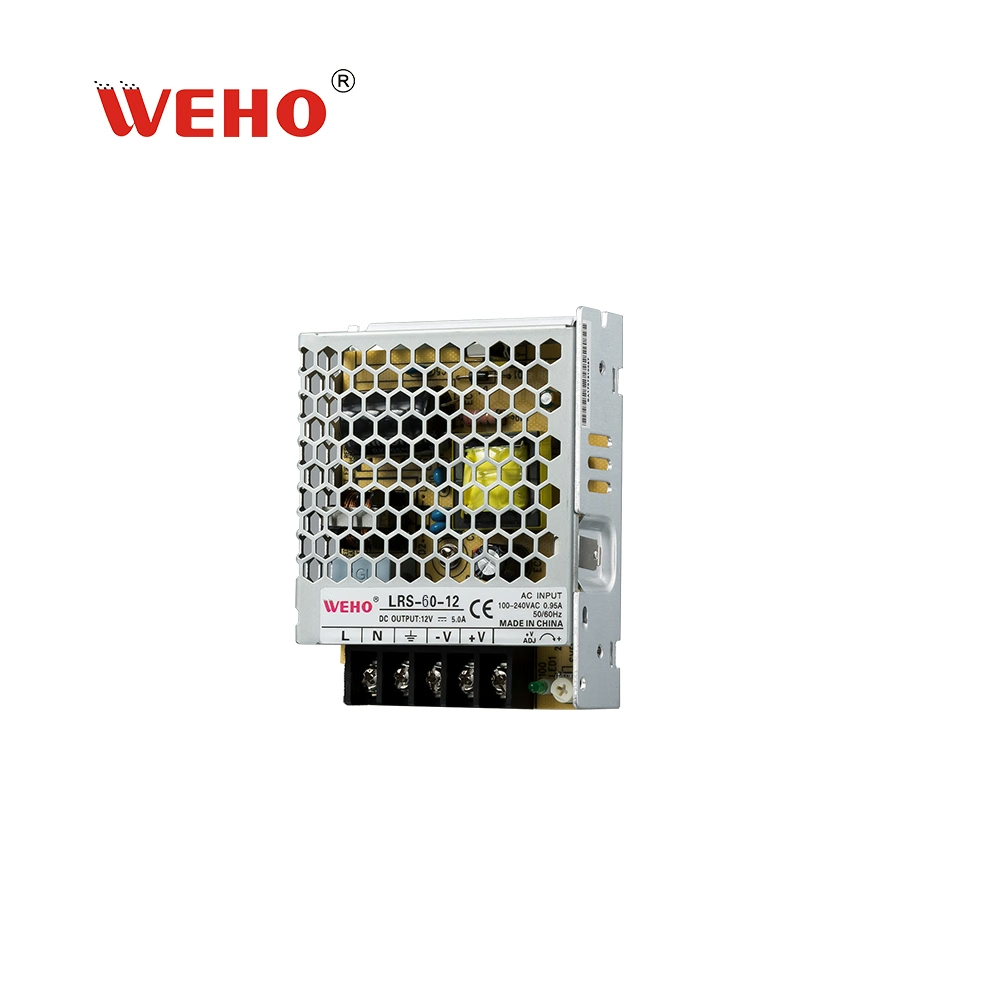
For an LRS-60-12 equipment-power review, send the exact model, equipment mode, connected loads, input conditions and intended measurement boundary. Include the raw record, applicable procedure, reported result and any missing-data or range flags. Ask for matching product information while retaining responsibility for the complete equipment's method and acceptance decision.
7. Engineering FAQ
Does an unloaded supply define the equipment's standby mode?
No. The equipment's functions and connected loads define its mode. Identify that state and the applicable procedure before using a supply-level reading as an equipment result.
Is the three-reading window a 2026 IEC stability method?
No. It is an arbitrary illustration of window dependence. Apply the actual authorized procedure for a standardized stability or cyclic-load assessment.
Can a missing power reading be replaced with zero?
Not as an unrecorded assumption. Zero is a numerical observation, while a gap is missing information. Follow the applicable data-validity procedure and preserve the original record.
Does IEC 62301 specify a universal maximum standby wattage?
No. The official scope describes measurement and reporting rather than a universal power-consumption limit. Obtain the applicable product or project limit separately.