By WEHO
PID integral settings must be transferred with their units and algorithm definition. Reset time and reset rate are reciprocal quantities, so increasing one weakens integral action while increasing the other strengthens it under the corresponding model. Convert the documented meaning first, then verify the receiving loop.
- Preserve time versus rate units.
- Check the PID equation as well.
- Validate the transferred response.
Identify what the tuning sheet actually specifies
An OEM replacing a temperature controller may receive a commissioning sheet containing only P, I and D numbers. That sheet is incomplete when the old and new instruments use different time bases or PID forms. A numerically identical I entry can produce a different integral contribution or even move its strength in the wrong direction.
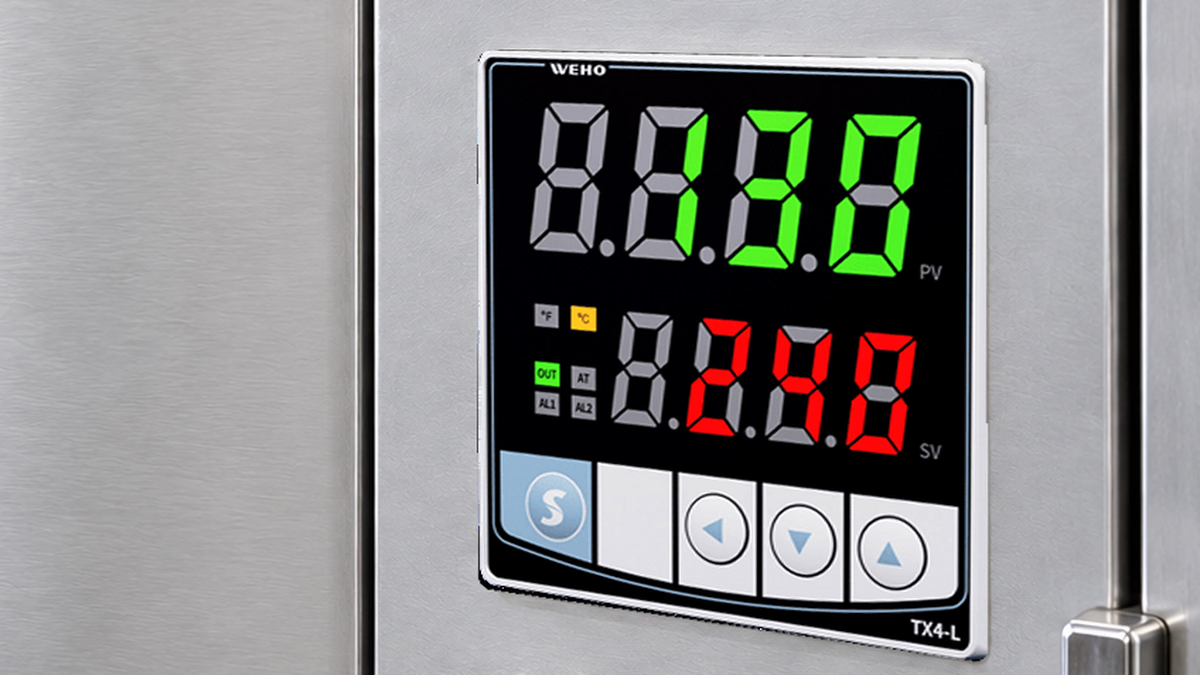
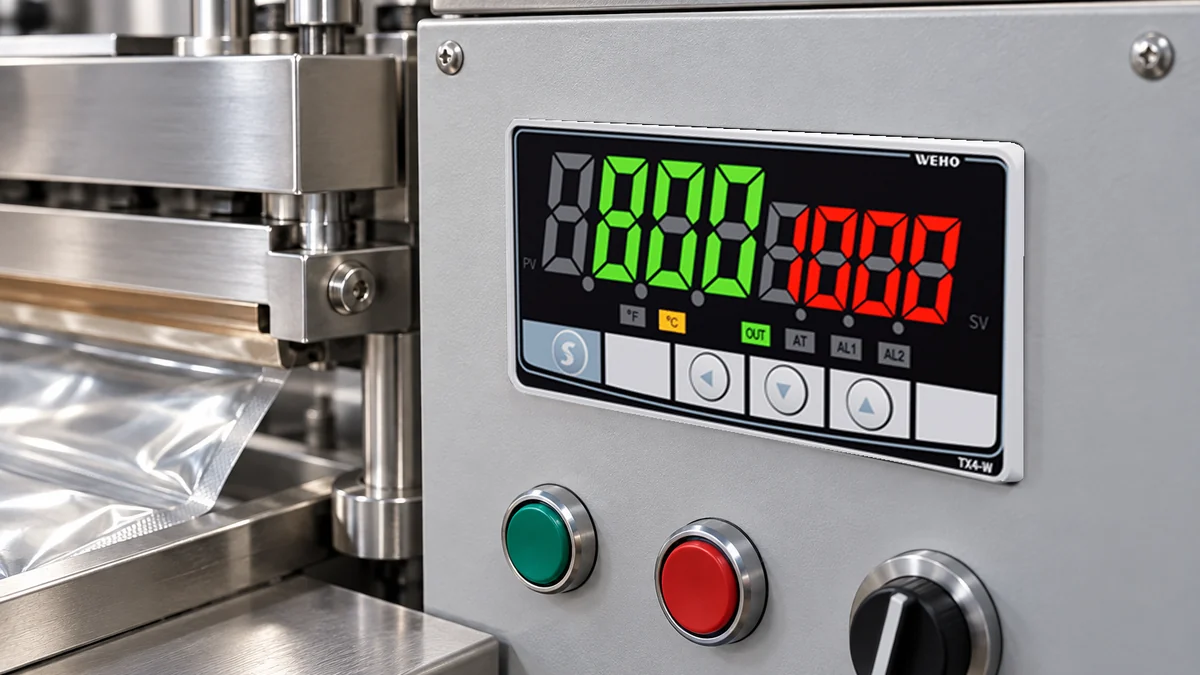
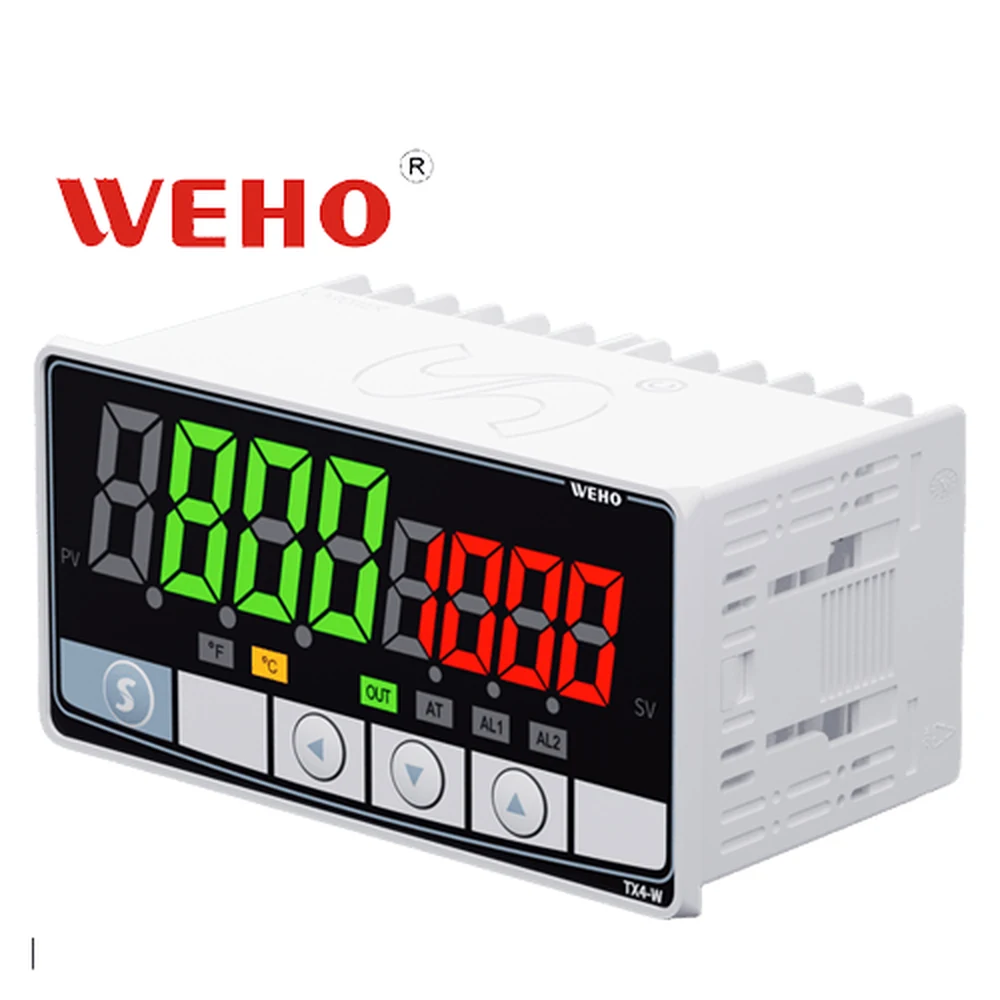
그만큼 TX4-W temperature-controller documentation entry identifies the intended unit for a configuration enquiry. Confirm the applicable instructions and revision before entering any converted value. The front-panel artwork does not establish the internal equation, the time basis or an accepted tuning result.
The purchasing output should be a parameter-transfer record with original meaning, conversion, receiving meaning and validation. It should preserve the source controller's identity and the state in which the tuning was accepted. A historical number without the connected sensor, actuator and process condition is a weak starting point for replacement approval.
Separate reciprocal units from different PID forms
For a dependent PI form, write u = Kc × (e + integral(e dt)/Ti), with any bias or limits identified separately. Ti is integral time. For a constant nonzero error and no limiting, the integral contribution grows at Kc × e/Ti. A shorter Ti therefore produces a faster integral ramp within this stated form.
Some instruments describe the reciprocal quantity R = 1/Ti as reset rate. The Watlow D8 user guide explicitly contrasts seconds per repeat with repeats per minute. Its conversion discussion also cautions that implementations can differ, so unit conversion alone does not prove equivalent controller behavior.
그만큼 NPTEL process-control lesson explains integral time and its reciprocal reset-rate interpretation. These sources support the distinction, not a universal tuning range or a recommended TX4-W value. Keep any example setting separate from an actual process recommendation.
A parallel PI form, u = Kp × e + Ki × integral(e dt), uses an integral coefficient Ki. Under compatible scaling, Ki = Kc/Ti for the dependent form above. Simply applying 1/Ti is insufficient when the proportional factor or error/output units differ. Obtain the actual equations and scaling rather than inferring them from the letters on a menu.
Work a hypothetical conversion and output check
Assume an old tuning record specifies Ti = 120 s per repeat. This equals 2.0 min per repeat. Its reciprocal reset rate is R = 1/2.0 = 0.50 repeats per minute, or 1/120 = 0.008333 repeats per second. These are equivalent expressions of the stated time quantity.
For an assumed dependent PI implementation, let Kc = 2 output percentage points per °C and hold e = 3 °C constant. The immediate proportional contribution is 2 × 3 = 6 percentage points. The integral ramp is 2 × 3/120 = 0.05 percentage points per second, giving another 6 points after 120 s if no limit or other term intervenes.
If someone enters 120 into a receiving reset-rate field expressed in repeats per minute, the implied time becomes 60/120 = 0.50 s per repeat. That is 240 times faster than the original 120 s value under this ideal comparison. The example illustrates a unit error; it is not permission to run that setting on equipment.
Swipe to view the complete diagram, or open full size.

Swipe table horizontally when needed.
| Assumed representation | Equivalent value | Units | Required condition |
|---|---|---|---|
| Integral time | 120 | s per repeat | Time interpretation confirmed |
| Integral time | 2.0 | min per repeat | Same definition and scaling |
| Reset rate | 0.50 | repeats per min | Reciprocal-time definition |
| Parallel coefficient | 0.016667 | output percentage points/(°C·s) | Kc = 2 points/°C in the stated form |
The final row comes from Ki = 2/120. It is not a dimensionless reset-rate value. Retain enough numerical precision for the receiving field and record any rounding separately. If the instrument accepts only discrete increments, assess the actual accepted setting rather than claiming the entered target was reproduced exactly.
Build a controlled parameter-transfer sequence
- Preserve the old controller's complete configuration and source instructions. Record the parameter names, units, algorithm form and input/output scaling. Verify whether the accepted tuning sheet corresponds to the installed revision and current process.
- Obtain the receiving controller's applicable definition. Record its time base, field limits and special codes. Verify what zero or disabled means; do not apply a reciprocal conversion to a value that represents an instruction rather than a finite time.
- Convert each physical quantity explicitly. Record the equation, units and result. Verify the arithmetic independently, keeping the proportional gain or band, integral quantity and derivative quantity as separate fields.
- Compare control structure and supporting functions. Record any differences in limiting, manual behavior, filtering or setpoint treatment that the documentation identifies. Verify which differences prevent a claim of mathematical equivalence even after units match.
- Evaluate the permitted configuration through the machine's commissioning procedure. Record setpoint, temperature, output and relevant disturbances. Verify the actual process requirement without changing several unrelated tuning or hardware variables at once.
- Release the receiving configuration with its readback and acceptance evidence. Retain the original record and conversion history. Reassess the affected response if the sensor, actuator or thermal operating region changes later.
The process team should define output permission, stop conditions and independent protection throughout the evaluation. A theoretical constant-error demonstration is suitable for an appropriate simulation or approved test arrangement; it is not a reason to force a production heater into an unrestricted error condition.
Interpret discrepancies beyond the I numeral
If a converted setting gives a different response, preserve the trace before retuning. The discrepancy may come from a different PID form, error scaling, actuator cycle or process state. A conversion worksheet is intended to expose those differences, not guarantee that they are absent.
Consider an assumed replacement with matching integral time but a proportional gain twice the original value in a dependent form. The integral ramp also doubles for the same constant error because Kc multiplies the integral term. Correctly converting seconds to minutes cannot resolve that separate gain mismatch.
Now consider an implementation with a parallel coefficient and the same displayed I numeral as a dependent controller. The coefficient may carry different units and omit the outside proportional multiplier. Without its equation, the sheet cannot establish equivalence, even if the two instruments both describe their algorithms as PID.
Special values deserve particular attention. A field value of zero may disable integral action, select a mode or have another documented meaning. It cannot be treated as a finite time and inverted. Keep the semantic value in the record and obtain the receiving implementation's corresponding supported behavior.
A steady final temperature is only one validation result. Review disturbance recovery, overshoot and output behavior under the required operating states. Two configurations can eventually reach setpoint while behaving differently during a short production stage. Preserve the relevant timing and limits with the accepted outcome.
Send the unit definitions with the controller enquiry
Use the TX4-W configuration reference for enquiries to identify the intended instrument. Send WEHO the application record with the old parameter sheet, its units and equation, the connected sensor and output device, and the required loop behavior. Ask which definitions and settings apply to the ordered revision.
Avoid requesting a replacement that merely accepts the same three numbers. The useful requirement is a documented configuration and an agreed evaluation of the actual process. Keep that installed acceptance separate from the supplier's confirmation of available parameter fields.
Engineering FAQ
Does a larger integral setting always mean stronger action?
No. A larger integral time reduces the ramp rate in the stated dependent form, while a larger reciprocal reset rate increases it. Identify the physical quantity and implementation first.
What reset rate corresponds to 120 seconds per repeat?
It corresponds to 0.50 repeats per minute under the reciprocal-time definition. Confirm that the receiving field uses that definition before entering the value.
Is unit conversion enough to guarantee equivalent tuning?
No. PID form, scaling, limiting, filtering and connected process behavior can differ. Use the conversion as one part of a documented transfer and commissioning assessment.
Can a zero integral value be inverted?
No. Determine its documented meaning first. If it disables integral action or selects a special mode, transfer that behavior through the receiving controller's supported configuration instead of performing a reciprocal calculation.