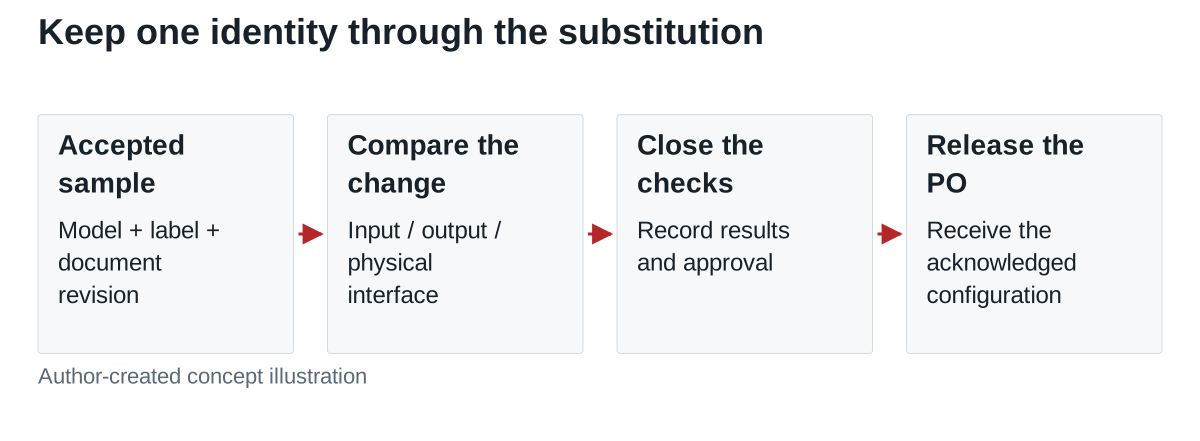
Approve a 24V LED driver substitute against the exact model, AC input and output identity that the lighting assembly has already accepted. A matching “24 V” description is only one field. Keep the document revision, physical label and retained sample connected so purchasing and production can identify the same configuration.
On this page
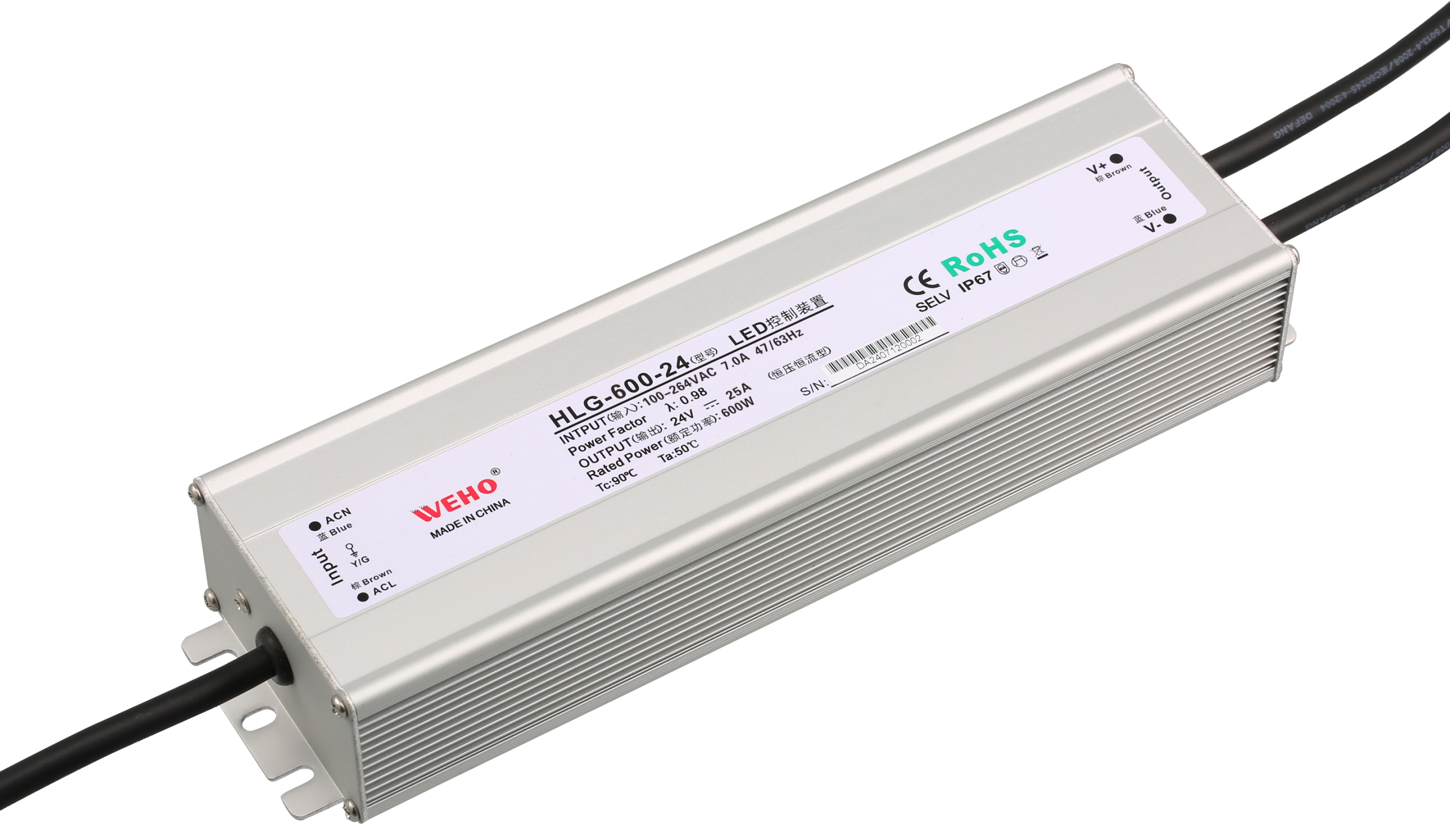
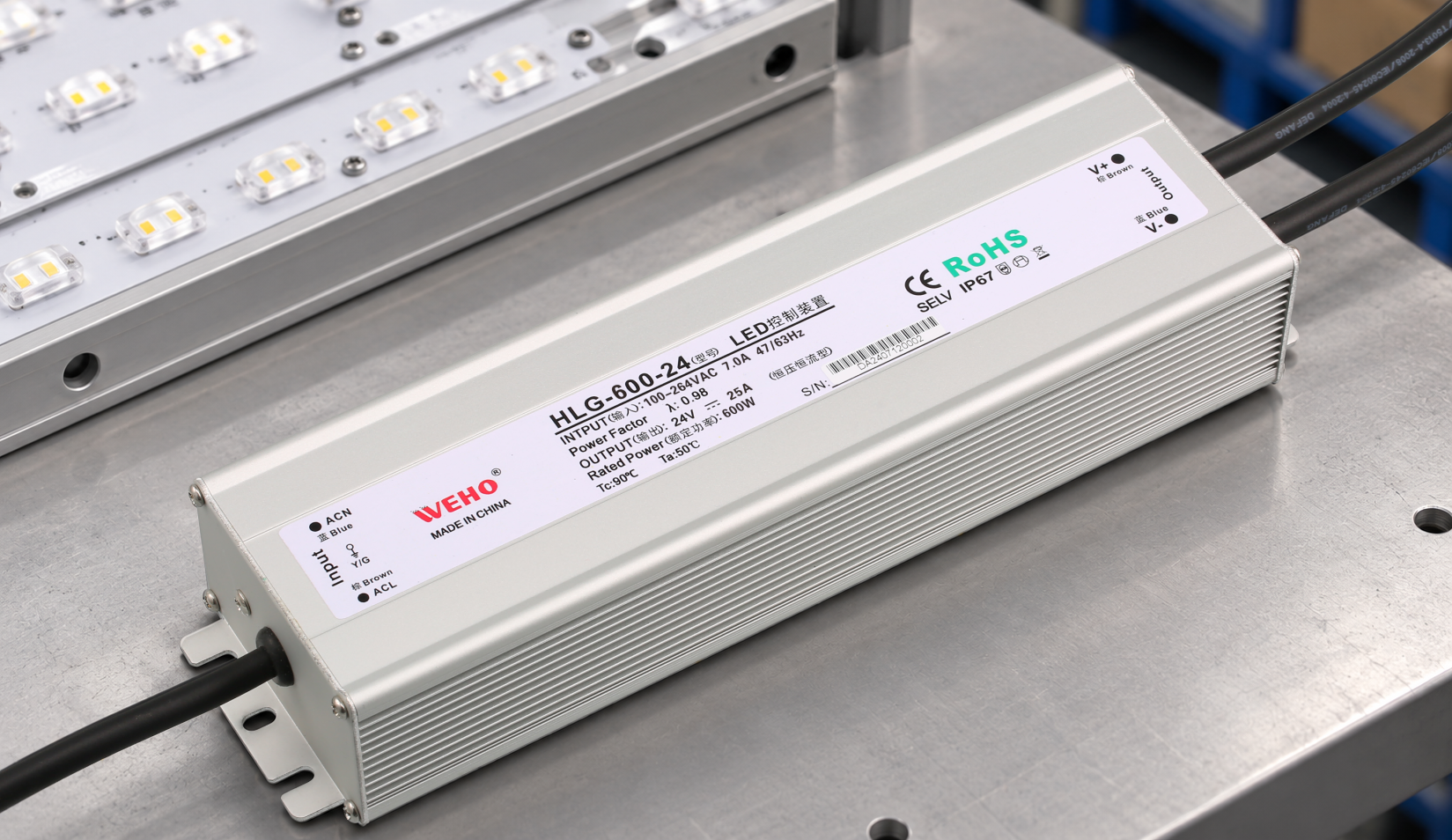
The working example is the WEHO HLG-600-24 shown in the original product photograph. The task is to create a usable substitution record for an OEM order, rather than choose a new lighting architecture or assume that every HLG variant has the same controls.
Start from the label that belongs to the sample
The photographed HLG-600-24 is marked as a constant-voltage model, with 24 V, 25 A output and 600 W rated power. Its label shows 100–264 VAC, 7.0 A input, a frequency marking written as 47/63 Hz, and temperature markings of tc: 90°C and ta: 50°C. Record those markings faithfully, then match them to the applicable specification; the label alone does not establish the complete temperature/derating envelope.
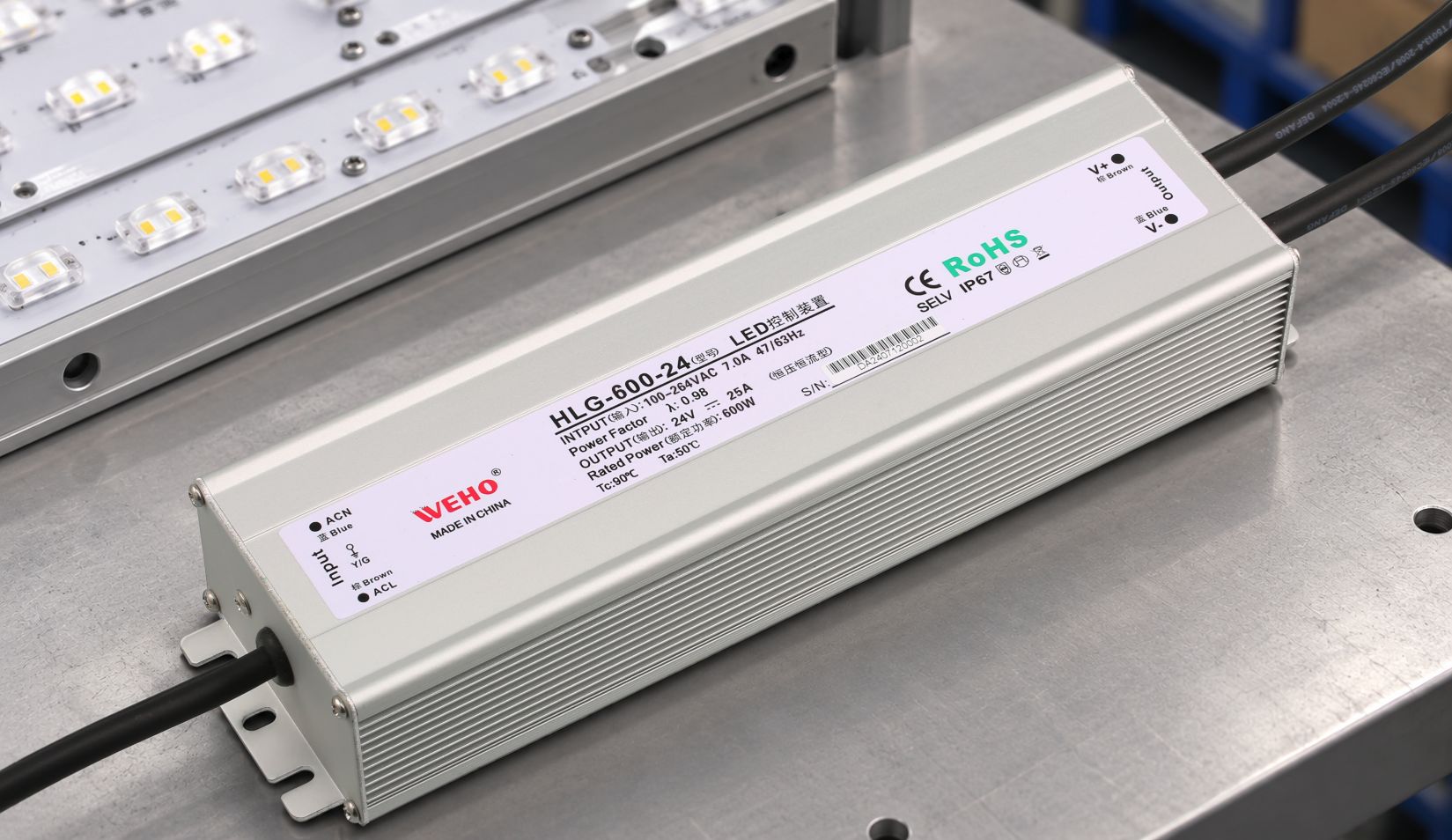
The HLG-600 individual product page is the product destination to include in the enquiry. The specimen photograph provides identity evidence; the applicable specification must establish tolerances, allowed loading and operation at the project’s actual AC and thermal conditions. Do not expand a nominal label into an unrestricted operating envelope.
Freeze one substitution record before the PO changes
Use the following table as an attachment to the approved BOM. Complete the baseline column from the accepted product and documents. Ask the supplier to enter the proposed configuration and mark every difference. A blank cell remains an open engineering action, even if the commercial quotation says “equivalent.”
| Controlled field | Accepted baseline | Substitution decision |
|---|---|---|
| Full identity | WEHO HLG-600-24; supplier item and BOM number | Record the complete proposed model, suffix and manufacturer |
| Applicable revision | Specification, drawing and label revision linked to sample ID | Supplier identifies changes and confirms which documents apply |
| Input AC | Label markings plus approved input/derating specification | Compare the actual site range and frequency; resolve different limits |
| Output identity | 24 V constant voltage; approved voltage tolerance and load conditions | Confirm the same receiver supply method and permitted voltage window |
| Current and power | 25 A / 600 W label; conditioned capacity from applicable documents | Compare usable capacity at the required conditions, not the series name |
| Physical interface | Accepted outline, fixing points, cable exits and connection drawing | Mark each mechanical or harness difference requiring review |
| Photographic evidence | Readable label, whole enclosure and connector/cable views | Link new photographs to the actual proposed unit |
| Accepted sample | Sample ID, results, date and approving owner | Define targeted checks and retain the approved replacement specimen |
Separate a matching voltage from matching capacity
Hypothetical PO check: a proposed replacement is marked 24 V, 20 A. Multiplication gives 24 × 20 = 480 W. The photographed HLG-600-24 label gives 24 × 25 = 600 W. The proposed nominal current is 5 A lower; its nominal power is 120 W lower.
That calculation identifies a difference to review. It does not prove that either unit can continuously supply its nominal power at the installation temperature or lowest AC input. Compare both applicable conditioned specifications with the project’s load record. If that record requires 22 A continuously, a 20 A nominal candidate already fails the stated current requirement before thermal qualification.
Keep the load identity attached as well. A product described only as a “24 V driver” must still provide the approved constant-voltage supply method. Do not accept a different regulation mode, added control requirement or changed startup behavior merely because 24 V appears somewhere in its specification.
Use photographs to close a specific change
The whole-product view shows the actual housing, mounting ears and cable exits; the label view identifies the specimen. Both are useful. A marketing render showing another voltage variant cannot close the model field, and a close label crop cannot establish the installation interface.
When a supplier sends a revised label or enclosure photograph, attach it to a change entry. State the old field, new field, affected drawing and necessary check. For example, a changed cable exit requires harness-routing review; a changed input range requires source-condition review. An unchanged case does not close an electrical change.
Release and receive the same configuration
Send WEHO the completed HLG-600-24 substitution baseline and request acknowledgement of the exact ordered configuration. Identify any pending specification revision and the sample against which acceptance will be performed. Keep commercial quantity and delivery terms in the same order, while assigning technical closure to a named reviewer.
At receipt, compare the delivered label and configuration with the acknowledged record. Route unexplained differences to review before the unit enters production. The result is a traceable substitution decision: the 24 V description, actual input/output identity, photographs and accepted sample all refer to the same supplied assembly.