Key Engineering Takeaways
- A hot workpiece temperature and the sensor's operating environment are separate qualification inputs.
- Record local air, sensor-body and cable exposure through the complete machine cycle.
- An acceptable room-temperature metal-target check does not approve a hot-target installation.
- Treat an ordinary LJA18 family photograph as product identification, not a high-temperature qualification.
1. Define which temperature the application actually presents
A sensor near hot metal needs an exposure record that separates the target temperature from the conditions experienced by the sensor assembly. The workpiece may be much hotter than the surrounding air, while the sensor body, connector and cable can experience different temperatures. One number called “application temperature” is inadequate for a supplier decision.
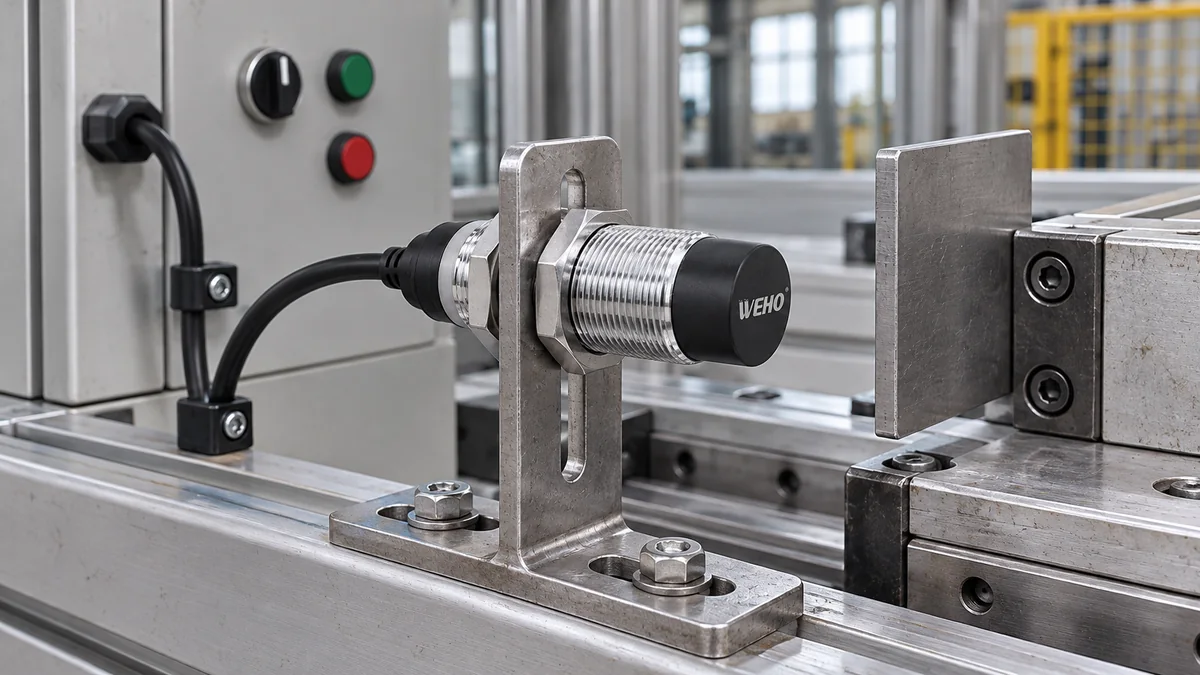
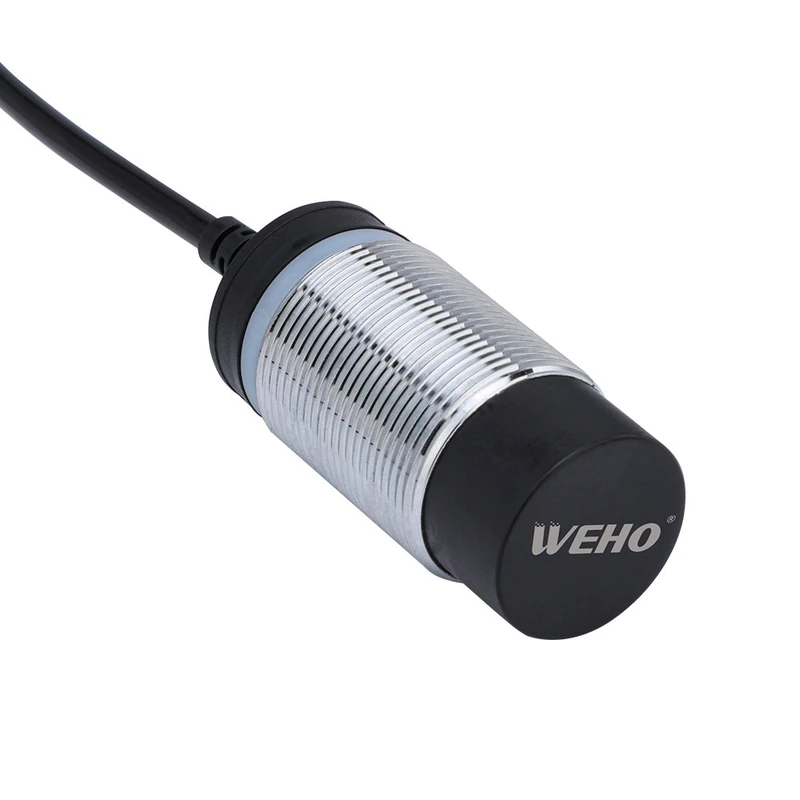
The WEHO LJA18 inductive proximity switch family is the ordinary product reference in this discussion. The illustrated family identity does not establish a complete suffix, a high-temperature rating or suitability for the example below. Request the actual ordered configuration and its applicable environmental limits before proposing an installation.
2. Separate target conditions from sensor exposure
An inductive sensor evaluates a conductive target through its sensing field. Target material, size, shape and the installation geometry therefore belong in the detection record. Manufacturer guidance identifies those influences separately from environmental selection; a target's being metallic does not establish that every practical target and environment will be detected reliably. ifm inductive technology overview
Sensor operating temperature is another boundary. OMRON describes changed switching behavior and possible failure when proximity sensors operate above their specified temperature range. The relevant lesson is to remain within the applicable product conditions; OMRON's characteristic behavior and limits are not specifications for a WEHO model. OMRON high-temperature proximity-sensor FAQ
Record workpiece surface temperature and how it was established. Separately record nearby air, sensor body, mounting structure, connector and cable conditions using appropriate measurement methods. These locations answer different questions. A nearby air reading cannot alone establish the hottest component temperature, and a body-surface reading cannot automatically be substituted for a manufacturer's defined ambient-temperature condition.
The application also has a time dimension. Document production rate, hot dwell, pauses, startup and the most demanding sustained sequence expected in service. A brief demonstration with one workpiece provides a narrower exposure than repeated operation. State the intended production envelope explicitly rather than calling the initial demonstration a full thermal qualification.
3. Work through a hypothetical cycle record
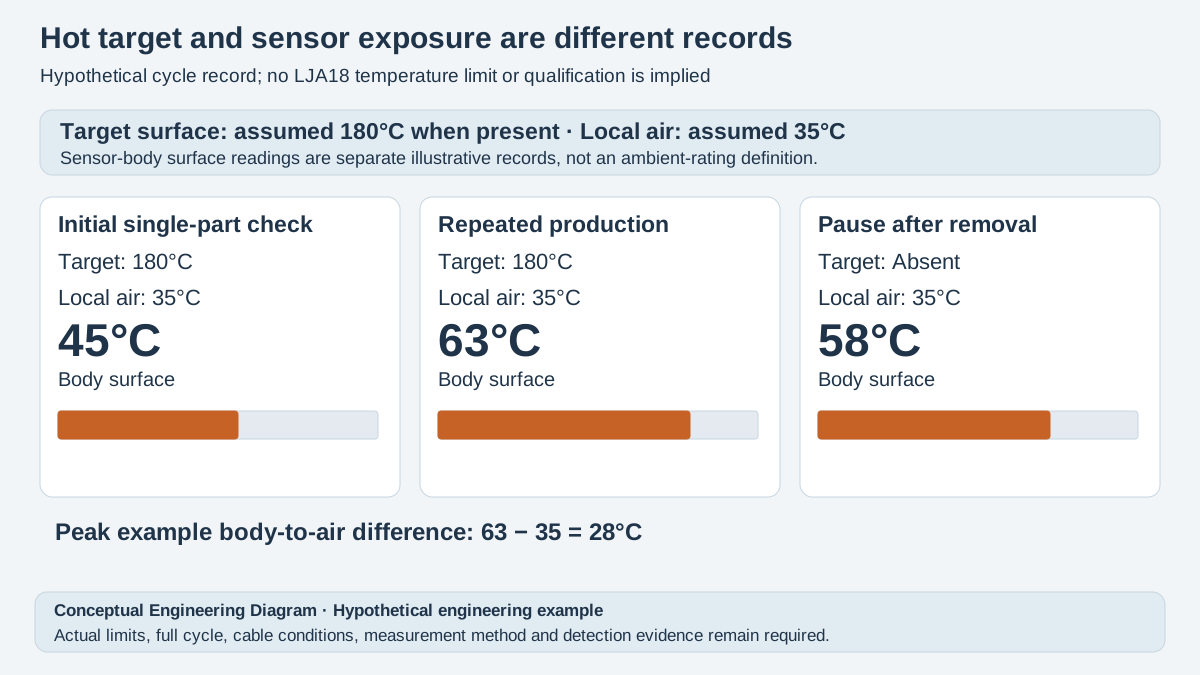
Consider an invented fixture holding a metal target whose surface is assumed to reach 180°C. The local air is assumed to remain at 35°C in three recorded states. A hypothetical observer obtains sensor-body surface readings of 45°C, 63°C and 58°C using a method appropriate to that surface. These are example records, not WEHO measurements, thermal predictions or allowed operating temperatures.
The maximum recorded body-to-air difference is 63 − 35 = 28°C. The maximum hypothetical body reading occurs during the accumulated exposure of repeated production, rather than the initial single-part check. This arithmetic illustrates why selecting only the coolest observation can conceal the condition that needs review; it does not calculate an internal component temperature.
| Assumed machine state | Target surface | Local air / body surface | Qualification implication |
|---|---|---|---|
| Initial single-part check | 180°C | 35°C / 45°C | Limited initial exposure only |
| Repeated production sequence | 180°C | 35°C / 63°C | Highest example body observation |
| Pause after target removal | Absent | 35°C / 58°C | Assembly remains warm after detection task |
| Actual product limit | Supplier confirmation needed | Not established here | Approval remains open |
Swipe horizontally on a small screen, or open the full-size diagram.
The correct decision is “not yet qualified,” even if the example output appears stable. The record has no verified suffix-specific operating condition, cable exposure limit, measurement uncertainty or acceptance criterion. It also lacks evidence for detection across the required hot-target material and dimensional variations. Stable behavior in these three assumed observations would not fill those documentation gaps.
Do not compare 63°C with an unrelated manufacturer's maximum temperature to declare a margin. Obtain the applicable limit and its definition for the actual assembly. Include uncertainty and the remaining untested production conditions in the decision; the hottest reading on a short trial is not automatically the lifetime maximum exposure.
4. Define the evidence needed for an engineering release
A hot-target evaluation needs both environmental and detection evidence. State the target alloy, dimensions and surface condition, together with the physical relationship between the target and the active face. A room-temperature plate check addresses only the recorded target and conditions. It does not characterize the same assembly after repeated exposure to hot workpieces.
Supplier selection guidance calls for environmental temperature, sensing-object conditions and surrounding objects to be considered in combination. Use that framework to ask a specific question about an actual installation, rather than requesting a universal “hot metal sensor” recommendation with no geometry or cycle information. OMRON proximity-sensor selection overview
| Evidence boundary | Required record | Supplier question | Release condition |
|---|---|---|---|
| Sensor assembly | Full code, face, cable and connector | Which environmental limits apply? | Exact assembly documented |
| Thermal exposure | Locations, methods, cycles and uncertainty | Does this represent the specified operating condition? | Relevant limits and full cycle covered |
| Detection task | Actual alloy, geometry and output observations | What application verification is required? | Required present/absent states demonstrated |
| Installation change | Mount, barrier, cooling or routing revision | Which checks must be repeated? | Changed configuration requalified |
A proposed heat barrier or relocated bracket can change more than temperature. Metal near an inductive sensing face can affect detection, so a thermal improvement requires renewed geometric and functional checks. Manufacturer precautions explicitly identify surrounding metal as a detection influence; do not accept an added metal shield using thermal measurements alone. OMRON proximity-sensor installation precautions
5. Qualify the installation through the operating envelope
- Identify the actual assembly. Record the full sensor code, cable and connector construction and relevant supplier documentation. Verify that the supplied evidence covers the actual configuration rather than a visually similar family photograph.
- Map the exposure locations. Record target, air, body, mounting and cable measurement positions and methods. Verify that each reading is compared with the correct defined condition, with measurement uncertainty retained.
- Define representative cycles. Record startup, continuous production, maximum dwell, pauses and foreseeable slowdowns. Verify that the trial includes the most demanding authorized operating sequence instead of only a single cold-start observation.
- Check detection in the thermal states. Record target identity and required present/absent observations at the relevant conditions. Verify reset as well as detection, without allowing a visually steady indicator to replace the required receiving-system evidence.
- Review the configuration and close gaps. Record applicable limits, results, unresolved conditions and any bracket or shielding revision. Verify the revised arrangement before approval and identify changes that require a repeat evaluation.
Temperature measurement itself needs a defensible method. A reflective metal body can complicate infrared surface readings, and an attached probe can introduce its own installation effects. Retain the method and its limitations instead of reporting unexplained decimal precision. An uncertain exposure measurement should produce an open engineering question rather than a fabricated safety margin.
The intended output of this work is a defined application boundary. If the supplier cannot establish an applicable assembly or the proposed location exceeds its conditions, revise the installation or select a documented alternative. Do not convert the absence of an observed malfunction into an unrestricted high-temperature capability claim.
6. Send WEHO a complete hot-target application record
Send WEHO the target alloy and drawing, surface-temperature evidence, mounting photographs and cycle record alongside the exact LJA18 family product inquiry. Include separate air, body and cable observations and identify which limits remain unknown. The ordinary product images identify the family; they do not show a completed hot-target qualification.
The next action is to obtain suffix-specific environmental definitions, agree on a representative trial and document the detection criteria. Release only the recorded configuration and operating envelope, and reopen the review after changes to hot dwell, production rate, shielding, mounting or cable routing.
7. Frequently asked questions
Does a 180°C workpiece require a sensor rated for 180°C ambient?
The workpiece temperature alone does not determine the required sensor ambient rating. Establish the sensor assembly's actual exposure and the manufacturer's definitions, while separately confirming that the hot target and installation meet the detection requirements.
Can I use a nearby air reading as the sensor body's temperature?
No, a nearby air reading and a sensor-body surface reading describe different locations and conditions. Record both where relevant, and ask the supplier how the measured conditions relate to the assembly's specified operating boundary.
Does stable switching during one hot-part test prove suitability?
No, one stable demonstration establishes only the behavior observed under its recorded conditions. Qualification also needs applicable product limits, representative repeated exposure, measurement evidence and the required detection and reset checks.
Do the LJA18 family pictures establish high-temperature capability?
No, the ordinary LJA18 family pictures establish product context rather than high-temperature qualification. Confirm the full ordered code and applicable documentation before selecting a model for an installation near hot metal.