- Coolant compatibility depends on the actual fluid formulation, concentration, temperature and exposed material grades.
- Inspect the cable jacket, seals, sensing face and joints separately; one resistant component does not qualify the assembly.
- Use controlled material observations and complete-assembly checks with predefined criteria, rather than relying on an IP marking alone.
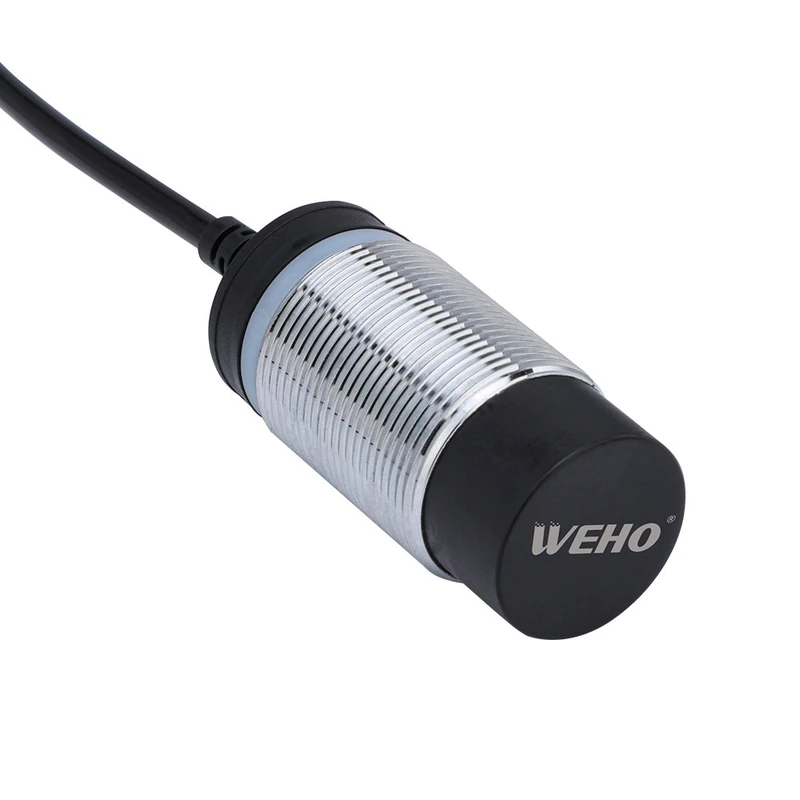
- The LJA18 image identifies an ordinary sensor family; it does not demonstrate compatibility with any cutting oil or coolant.
Define the chemical exposure before selecting the sensor
A machine changes coolant supplier while retaining the same sensor and nominal mixing percentage. The metal body still looks sound, but the cable entry or jacket behaves differently after exposure. A purchasing review needs to identify the fluid/material combination rather than treating “oil-resistant” as a complete specification.
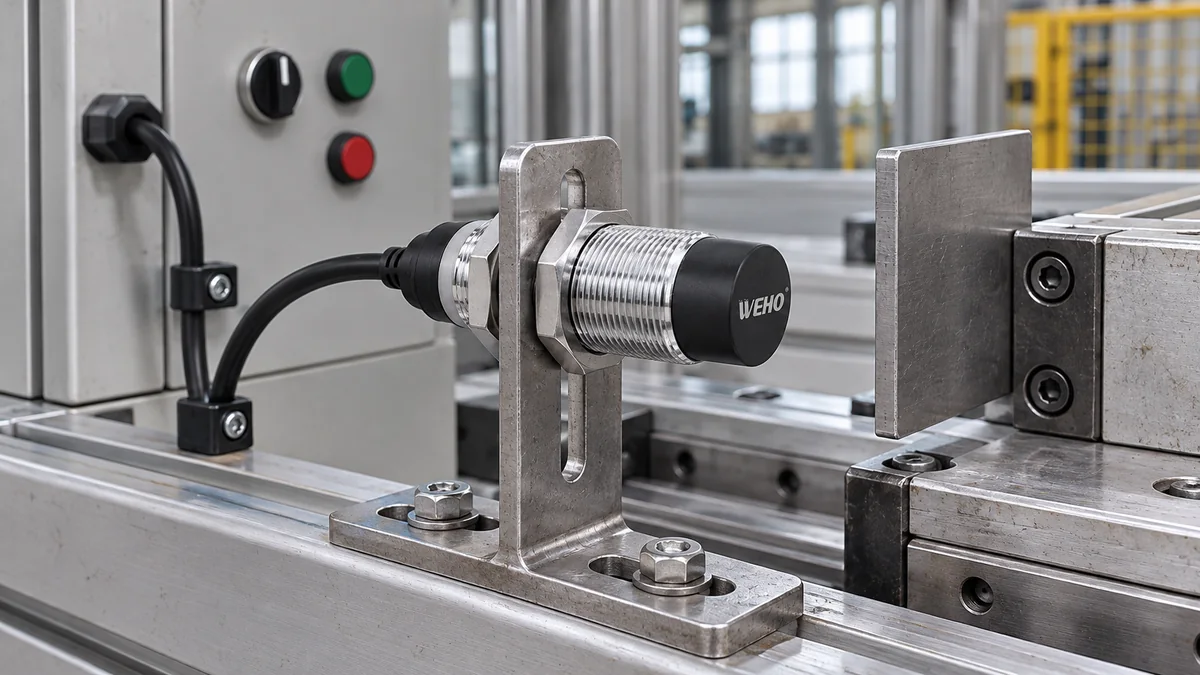
The WEHO LJA18 inductive sensor family is the product-identity reference for this review. Its photograph shows an ordinary metal-target application, without chemical exposure. The actual ordered sensor's jacket compound, seals and fluid compatibility remain questions for applicable documentation and project qualification.
Identify every material that the fluid can reach
The exposed system can include a cable jacket, cable-entry seal, sensing-face polymer, adhesive, connector seal and housing finish. A compatibility statement limited to the metal shell leaves the other interfaces unresolved. Record which component and surface each statement actually covers.
OMRON's proximity-sensor precautions distinguish environmental and chemical conditions from ordinary sensing functions. Apply such guidance within its stated product scope. It supports asking specific exposure questions, rather than transferring another manufacturer's environmental suitability to LJA18.
A generic polymer name is a starting point, not a complete material identity. Compound formulation, additives and processing can matter, while seals also depend on their installed compression and interface geometry. Request the grade or controlled material specification available for the actual assembly; do not infer it from jacket color or a family photograph.
Keep the fluid formulation and use conditions together
Record the coolant's exact product name, revision and working concentration, including how that concentration is determined. Keep the permitted operating range, temperature and exposure pattern with the fluid identity. A neat oil, a water-mixed coolant and a cleaning fluid should not be grouped into one unspecified “oil” exposure.
The working mixture can differ from the concentrate listed on a purchase order. Maintenance additions, water quality, contamination and cleaning operations can also alter what reaches the sensor. Define the combinations the project must cover rather than assuming one fresh mixture represents every service state.
OMRON's E2E NEXT brochure presents cutting-oil-related cable deterioration and an identified cable construction used for its own sensors. Those examples do not establish that all PUR fails, all PVC succeeds or a WEHO jacket uses either formulation. Preserve the named-product and test-condition boundaries.
Work a hypothetical material and assembly review
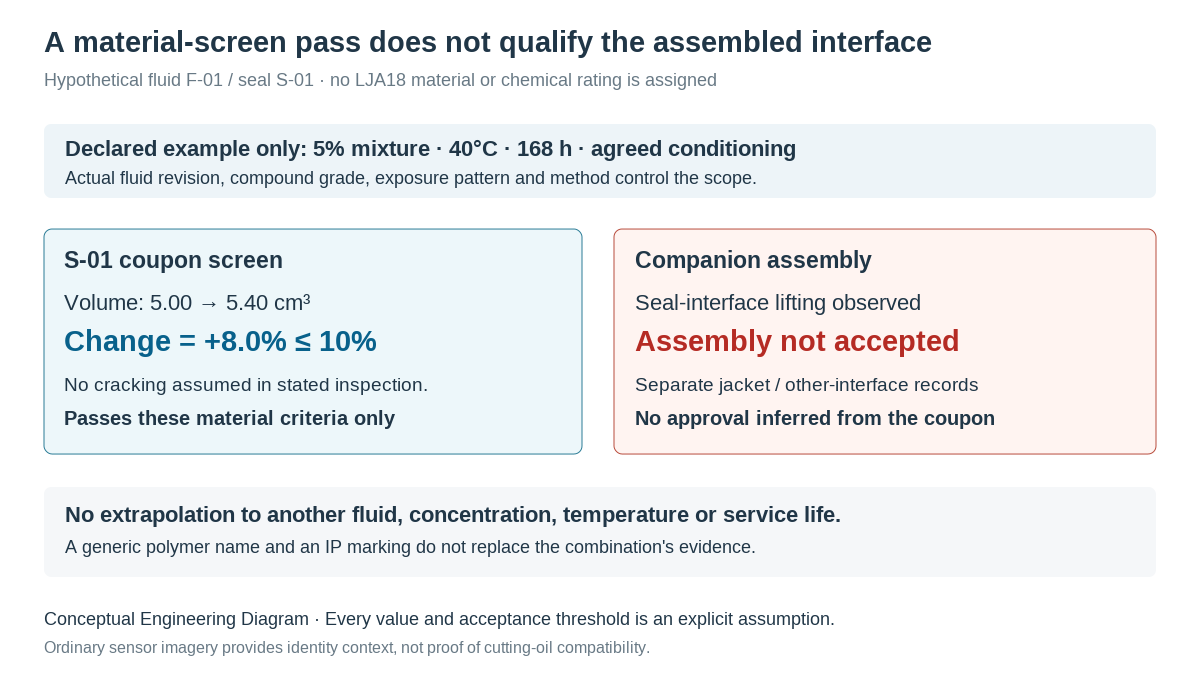
Assume a fictional project evaluates fluid F-01 at a specified 5% working concentration, 40°C exposure and 168-hour duration under an agreed procedure. The test record identifies seal compound S-01 and jacket compound J-01 separately. These names and conditions are hypothetical; neither compound is claimed to be used in LJA18.
After the procedure's stated conditioning step, an S-01 coupon has an assumed initial volume of 5.00 cm³ and final volume of 5.40 cm³. Its volume change is (5.40 − 5.00)/5.00 × 100 = 8.0%. An assumed mass change from 10.00 g to 10.40 g is 4.0%.
The fictional material screen allows at most 10% volume increase and requires no visible cracking under its defined inspection. Assume the coupon meets both conditions. That is a pass of this specific material-screen requirement, not proof of assembly sealing, service life or a production-population bound.
| Item | Assumed observation | Agreed criterion | Disposition |
|---|---|---|---|
| S-01 coupon volume | 5.00 → 5.40 cm³; +8.0% | Increase ≤10% | Pass this material screen |
| S-01 visible condition | No cracking in stated inspection | No cracking | Pass this inspection scope |
| Complete cable-entry assembly | Seal-interface lifting observed | No lifting; agreed leak check passes | Assembly not accepted |
| J-01 jacket and other interfaces | Separate records required | Material-specific criteria | Do not infer from S-01 |
The hypothetical assembly fails because the accepted coupon screen does not establish the installed interface's behavior. A seal can remain intact as a sample while its assembled geometry or interface changes enough to matter. Keep the material and assembly conclusions separate rather than averaging their results into one score.
Swipe horizontally on a small screen, or open the full-size diagram.
The example also cannot be extended from 5% to 10% concentration, from 40°C to a higher temperature or from 168 hours to a service lifetime without evidence. Chemical effects do not have a universal linear acceleration factor. Use an applicable qualification model or retain those conditions as unverified.
Mass and volume observations should have a defined measurement and conditioning basis. Fluid retained on the surface, absorbed fluid and material loss can affect what a value means. Record the actual method and uncertainty instead of treating an unexplained before/after difference as a complete chemical diagnosis.
Compare material statements with the complete connection system
ifm's connection-technology material overview lists cable and seal materials separately and associates resistance information with identified product lines and fluids. That structure is useful for a request to a supplier. Its listed combinations are not an approval for another sensor or a fluid with a similar trade description.
An ingress-protection marking alone does not establish compatibility with the actual coolant chemistry. The project still needs material and interface evidence under its exposure conditions. Likewise, an initially successful switching check does not prove that the jacket or seal will retain its properties over the required service period.
| Question | Specify | Evidence to retain | Unsupported extension |
|---|---|---|---|
| Which fluid? | Exact formulation and working mixture | Product/revision and mixture record | Every product called cutting oil |
| Which materials? | Actual jacket, seals and interfaces | Controlled grades and assembly identity | All compounds with one polymer name |
| Which exposure? | Temperature, duration and contact pattern | Applicable test conditions | Unqualified service lifetime |
| Which acceptance? | Material changes and assembly function | Separate criteria and dispositions | One coupon qualifies everything |
A fluid change, cable substitution or seal-material revision can invalidate an earlier combination's evidence. Include those changes in the equipment's review process. A replacement that retains the same external shape may still require a chemical-compatibility assessment if its exposed materials differ.
Build an exposure-specific qualification record
- Identify the complete combination. Record ordered sensor, cable/connector assembly, exposed material specifications and fluid revision. Confirm what is known and leave unavailable material details explicit rather than guessing from appearance.
- Define the service envelope. Record concentration range, temperatures, contact pattern, cleaning fluids and relevant service changes. Accept the envelope only when it describes the actual materials' exposure, not just the machine room's average condition.
- Agree the evaluation method. Record manufacturer information, sample preparation, conditioning, measurements and criteria for each material and assembled interface. Follow applicable handling and equipment procedures; the hypothetical exposure above is not a test prescription.
- Evaluate materials and assemblies. Retain observations of swelling, cracking, softening, hardening or interface changes, together with required electrical and sealing checks. Do not infer all materials' behavior from one coupon or remove a failure because switching still works.
- Freeze and maintain the approved scope. Record the accepted combination, limits, inspection actions and changes requiring review. Continue to distinguish a laboratory screen, an assembly acceptance and service observations rather than claiming an unsupported lifetime guarantee.
For the broader geometry and environment context, see the WEHO inductive-sensor application discussion. This article's decision concerns chemical/material compatibility. Metal-chip detection and ordinary position-sensing performance require separate evidence and do not close that decision.
Send the fluid and material questions to WEHO
Use the LJA18 family compatibility enquiry with the exact ordered configuration, coolant identity, working concentration and exposure temperatures. Include available material specifications and the project's acceptance requirements. Ask what documentation applies to the actual jacket and seals without assuming an ordinary family photo demonstrates oil resistance.
Engineering FAQ
Does an IP67 marking prove coolant compatibility?
No, an ingress-protection marking alone does not establish compatibility with a selected coolant formulation. Check the actual exposed materials, mixture, temperature and complete assembly conditions separately.
Can one polymer name determine resistance to every cutting oil?
No, a generic polymer name is insufficient. Compound formulation, fluid chemistry and exposure conditions can change the result. Obtain evidence for the actual material grade and fluid combination.
Does a passed seal coupon qualify the sensor assembly?
No, a coupon result does not automatically qualify the installed interfaces or other materials. Apply separate assembly criteria and retain any sealing or electrical failures. The worked example illustrates that distinction.
Can a coolant or cable change reuse the old approval unchanged?
No, a changed combination requires a scope review. Check whether the existing evidence covers the new formulation, material and service conditions before retaining the previous disposition.