A scope's saved record count is not automatically the number of power events that occurred. Trigger holdoff, acquisition duration and rearming can exclude events before they become separate records, even when the displayed waveform looks stable.
- Define whether the requirement concerns events, triggers or records.
- Read the actual instrument's holdoff timing semantics.
- Include acquisition and rearm behavior in the coverage check.
- Compare source-event timestamps with retained acquisition timestamps.
1. Decide what the event count must prove
An OEM validation engineer may capture repeated load changes and find fewer voltage-dip records than expected. The difference does not immediately establish that the equipment ignored those commands. First determine whether the acquisition configuration was able to recognize each required event as a new trigger.
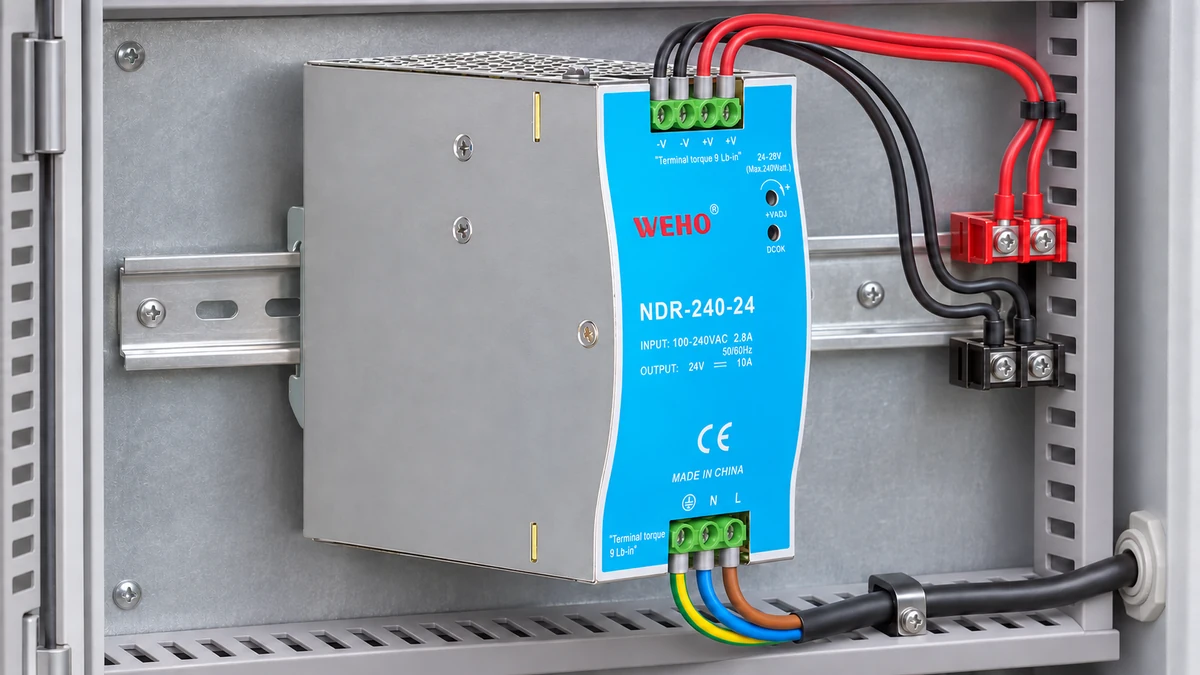
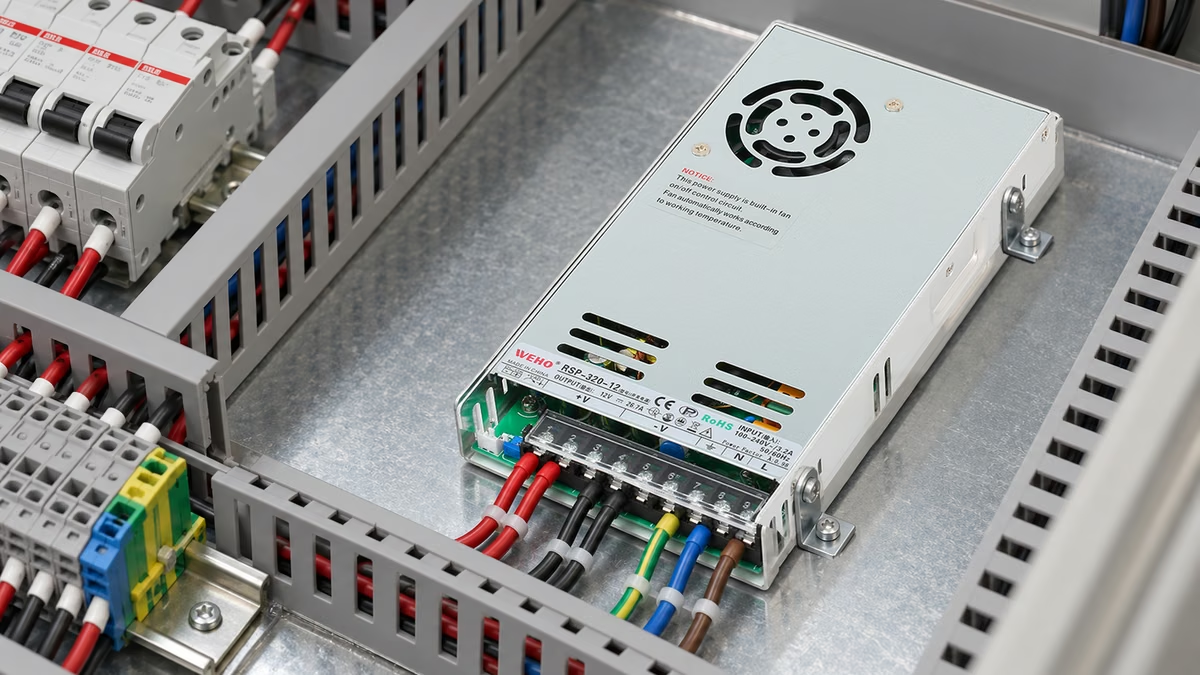
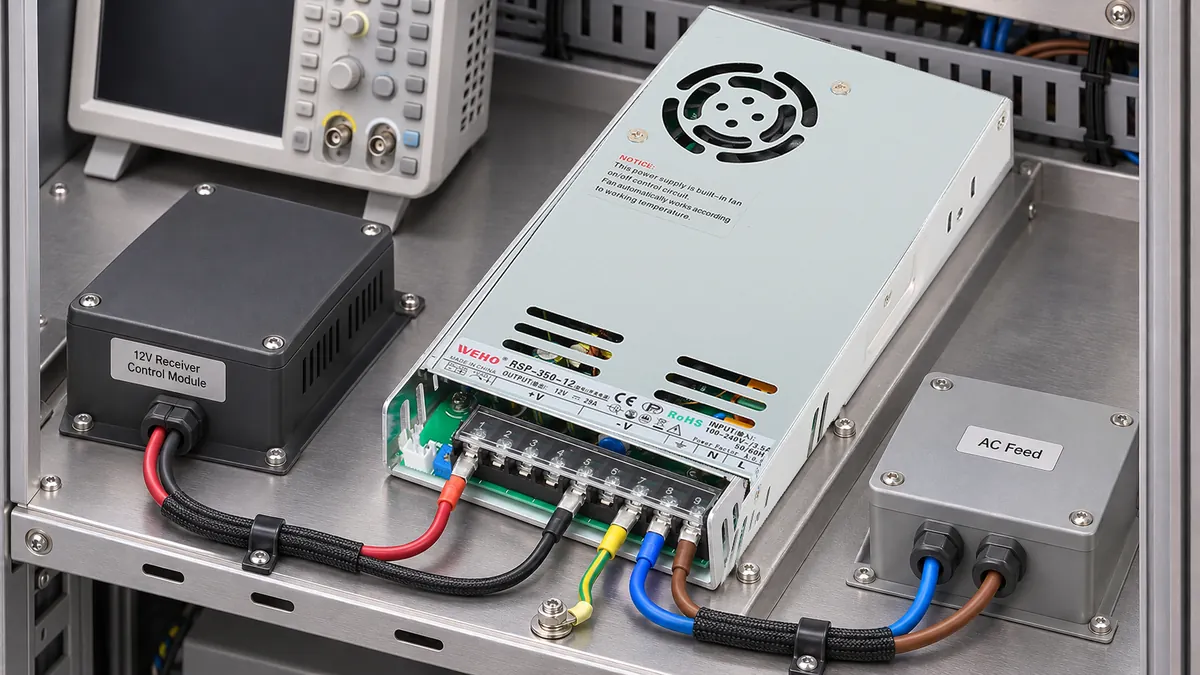
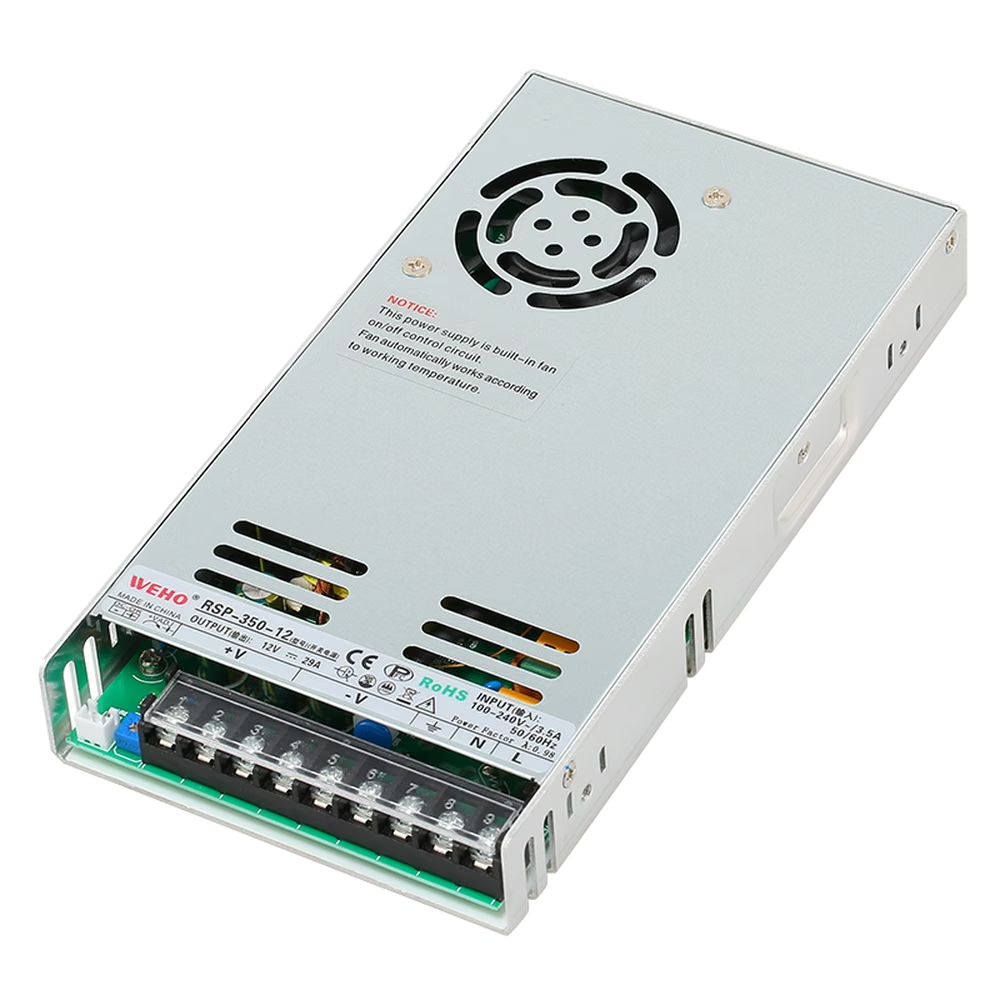
The WEHO RSP-350-12 product reference identifies one source in the equipment context. The acquisition example below describes a hypothetical external instrument configuration. It does not establish the supply's transient response, the number of actual faults or the event-detection performance of a named oscilloscope.
The Tektronix TDS3000 manual describes holdoff as inhibiting recognition of new trigger events in its documented timing sequence. Holdoff can deliberately stabilize a complex waveform display. The same behavior can make a configuration unsuitable for counting every repeated event unless its coverage is checked.
2. Distinguish three timing boundaries
A physical event is an occurrence in the equipment or stimulus. A recognized trigger is an instrument decision based on its enabled conditions. A retained record is the acquired data saved around that decision. One record can contain several physical pulses, and a pulse during an inhibited interval may produce no new record.
Holdoff timing is instrument- and mode-specific. Keysight's holdoff-style documentation distinguishes conventional time-after-trigger holdoff from conditions requiring the input to remain above or below a level. A numerical holdoff value is incomplete without its selected style and definition.
Rearming is another boundary. Spectrum Instrumentation's rearm explanation describes the interval between a segment ending and readiness for another segment in its digitizers, including platform-dependent conditions. Do not use one instrument family's minimum number as a universal scope specification.
| Boundary | Required record | Possible exclusion | Verification |
|---|---|---|---|
| Physical stimulus | Independent event count and timestamps | Command may not create the assumed event | Observe actual stimulus |
| Trigger eligibility | Condition, holdoff style and timing origin | Event arrives while trigger is inhibited | Reproduce controlled spacing |
| Acquisition | Record duration and channel settings | New trigger cannot create another record | Check actual mode behavior |
| Rearm and storage | Readiness, segment count and timestamps | Event arrives before readiness or after stop | Compare records with independent events |
3. Recalculate an explicitly assumed holdoff timeline
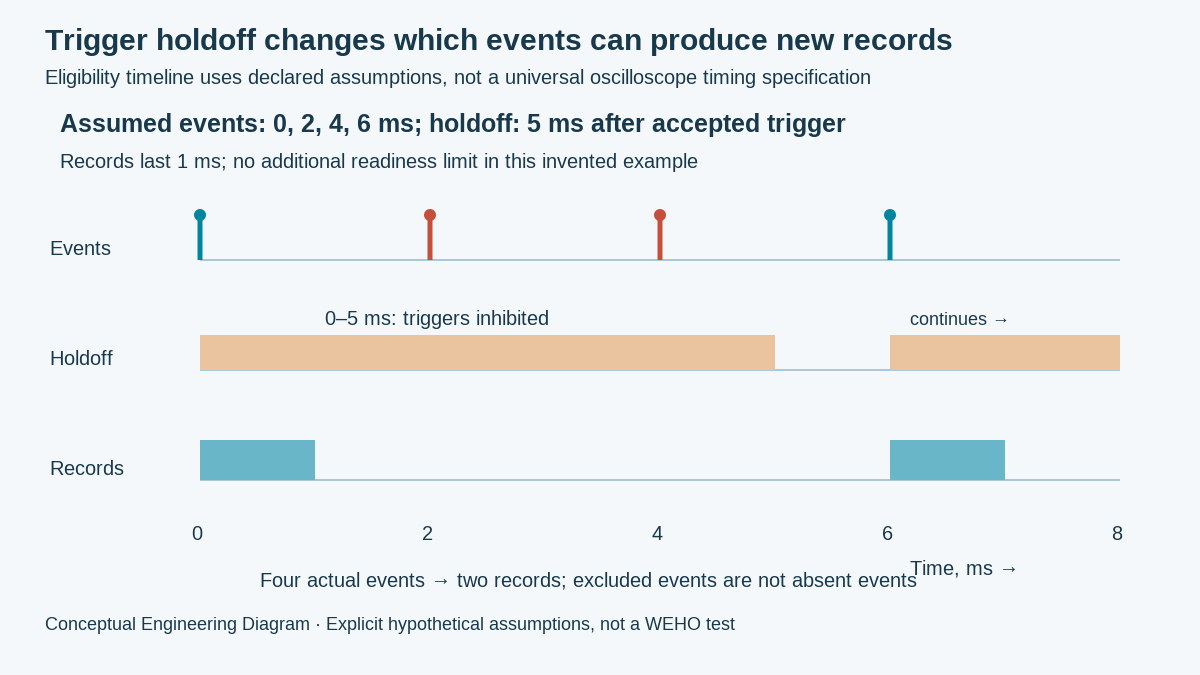
Assume four actual stimulus events occur at 0, 2, 4 and 6 ms. Each satisfies the chosen trigger condition when triggering is enabled. Assume a conventional 5 ms holdoff beginning at an accepted trigger, a 1 ms record beginning at that trigger and no additional limiting rearm delay for this initial example.
The event at 0 ms is accepted and starts the declared holdoff interval from 0 to 5 ms. The events at 2 and 4 ms occur inside that interval and cannot generate new triggers under these assumptions. The 6 ms event occurs after holdoff ends and can produce the next record.
The result is four physical events but two accepted triggers and two one-millisecond records. Because the record beginning at 0 ms ends at 1 ms, it does not include the 2 or 4 ms events either. Their absence from the saved records says nothing about whether the stimulus actually occurred.
Swipe horizontally on a small screen, or open the full-size diagram.
The accepted record count is 2/4 = 50% of the known event count in this invented four-event sequence. That arithmetic is not a statistical detection probability or an instrument performance specification. It simply identifies deterministic exclusions caused by the selected assumed timeline.
If holdoff were reduced to an invented 1.5 ms from each accepted trigger, with the same 1 ms records and readiness achieved before each next event, all four events could trigger. The conditional readiness statement matters: a longer acquisition or additional dead time could still prevent complete capture despite the shorter holdoff.
| Stimulus time | Assumed trigger state | New record? | Reason |
|---|---|---|---|
| 0 ms | Eligible before first event | Yes, 0–1 ms | Starts 5 ms holdoff |
| 2 ms | Inhibited | No | Inside 0–5 ms interval |
| 4 ms | Inhibited | No | Inside 0–5 ms interval |
| 6 ms | Eligible under declared assumptions | Yes, 6–7 ms | Previous holdoff ended |
This example deliberately avoids events exactly on the holdoff boundary. Actual instruments can have trigger qualification, timing quantization and mode-dependent readiness rules. Resolve close-boundary behavior from the selected instrument's documentation and a controlled verification rather than using rounded diagram coordinates as a guaranteed timing margin.
4. Segmented memory still needs a coverage check
Segmented acquisition can preserve many short records while avoiding long inactive intervals. It does not establish that every event was recognized or that all periods between segments were observed. Record the segment length, trigger configuration, supported acquisition mode and behavior when the chosen segment count is reached.
Keysight's segmented-acquisition documentation describes segment boundaries and warns that partial pulses can be excluded from its pulse metrics. The retained waveform, detected pulse table and segment count are therefore different evidence objects. Use the object that answers the actual validation requirement.
Pretrigger coverage determines how much lead-in is retained within an accepted record. Increasing pretrigger coverage cannot by itself recover events for which no separate acquisition was started. Establish trigger eligibility first, then verify the useful window around each accepted trigger.
Similarly, a stable averaged trace can combine already acquired events without preserving the exceptional event of interest. Averaging and holdoff act at different stages. Keep individual records and acquisition-state evidence when the requirement concerns rare excursions, event-by-event behavior or maximum observed deviation.
5. Compare independent event and acquisition timestamps
Use a known event source or an appropriately independent observation to establish what actually occurred. A software command log may establish requested commands without proving that the physical pulse occurred at exactly that time. Identify the measured event boundary and timestamp uncertainty before calculating coverage.
A regular burst is particularly useful for exposing intentional exclusions. Vary the spacing across the required range and compare the independent event timestamps with acquisition timestamps. Do not infer the fastest reliable event rate from a favorable sequence alone; verify the actual channels, record length and acquisition mode used in the intended test.
6. Release an event-coverage record
- Define the counted object. Record whether the requirement concerns physical events, triggers, records or pulses visible within records. Verify that the chosen count answers the equipment question.
- Record the trigger rules. Save condition, mode, holdoff style, timing origin and value. Verify the actual instrument documentation instead of assuming a generic timing equation.
- Bound acquisition readiness. Record sample rate, record duration, segmentation and stop behavior. Verify the relevant rearm and trigger-ready conditions for that configuration.
- Apply known events. Record independent stimulus timestamps and saved acquisition timestamps. Verify coverage at the required event spacings and retain unmatched events as explicit evidence.
- Release the usable configuration. Record accepted settings, demonstrated spacing range and unresolved blind intervals. Verify that later changes in channels, memory or processing trigger an appropriate coverage review.
A report can honestly state that two records were captured from four known events without claiming a two-event equipment history. That distinction helps the receiving engineering team decide whether the acquisition is adequate or needs a different trigger strategy or recording method.
7. Request the actual transient and acquisition context
For an RSP-350-12 transient review, provide input and load states, receiver requirements, independent event timing and original acquisition files. Include holdoff, record length and readiness information. Request matching product documentation while preserving the evidence needed to distinguish equipment behavior from acquisition exclusions.
Frequently Asked Questions
Does the saved record count equal the number of physical events?
No. Trigger inhibition, acquisition readiness and storage conditions can exclude events. An independent event record is needed before treating saved acquisitions as an occurrence count.
Does reducing holdoff guarantee every repeated event is captured?
No. Acquisition duration, rearming, trigger qualification and stop conditions can still limit coverage. Verify the complete configuration at the required event spacing.
Can segmented memory prove there were no missed events?
No. Segmentation organizes retained data, while trigger and readiness conditions determine which events can start records. Compare independent timestamps and account for the applicable gaps.
Does this example characterize RSP-350-12 transient behavior?
No. It illustrates a hypothetical acquisition timeline. Supply behavior requires actual input, load and voltage/current evidence collected with an appropriate verified measurement configuration.