By WEHO
Temperature ramp acceptance must identify whether the requirement applies to the working setpoint, the measured process or the product itself. A correctly changing command does not establish the same process rate. Record the relevant signals together and define the evaluation interval before approving a ramp-dependent recipe.
- Distinguish target, working SV and PV.
- State the rate and interval.
- Verify restart and endpoint behavior.
Define which temperature must follow the ramp
An OEM may request a rise of two degrees per minute without specifying the signal. The program target, the working setpoint supplied to a controller, its measured process value and an independent product temperature can follow different trajectories. An acceptance report must say which one the requirement concerns.
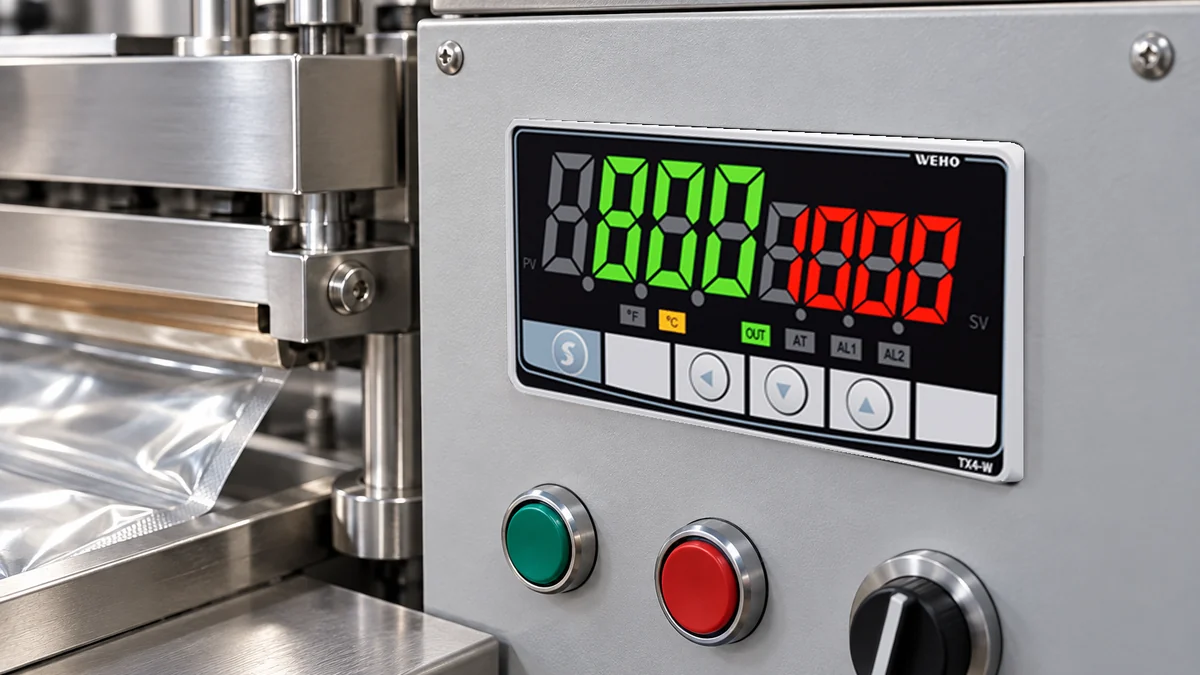
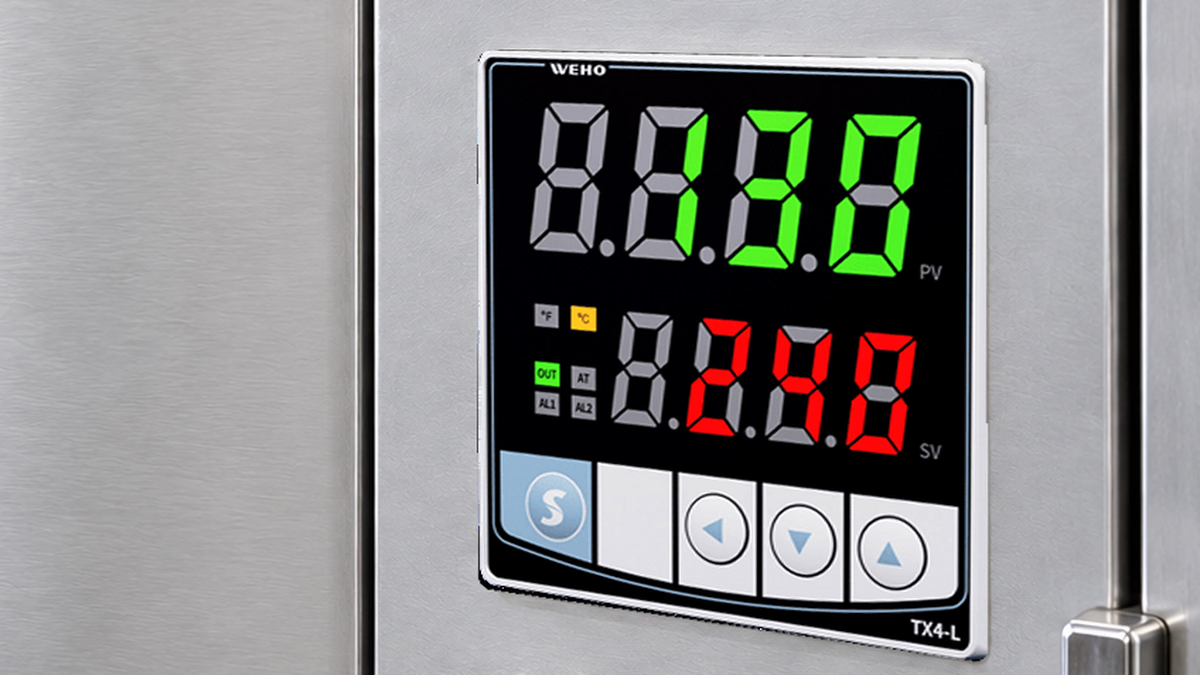
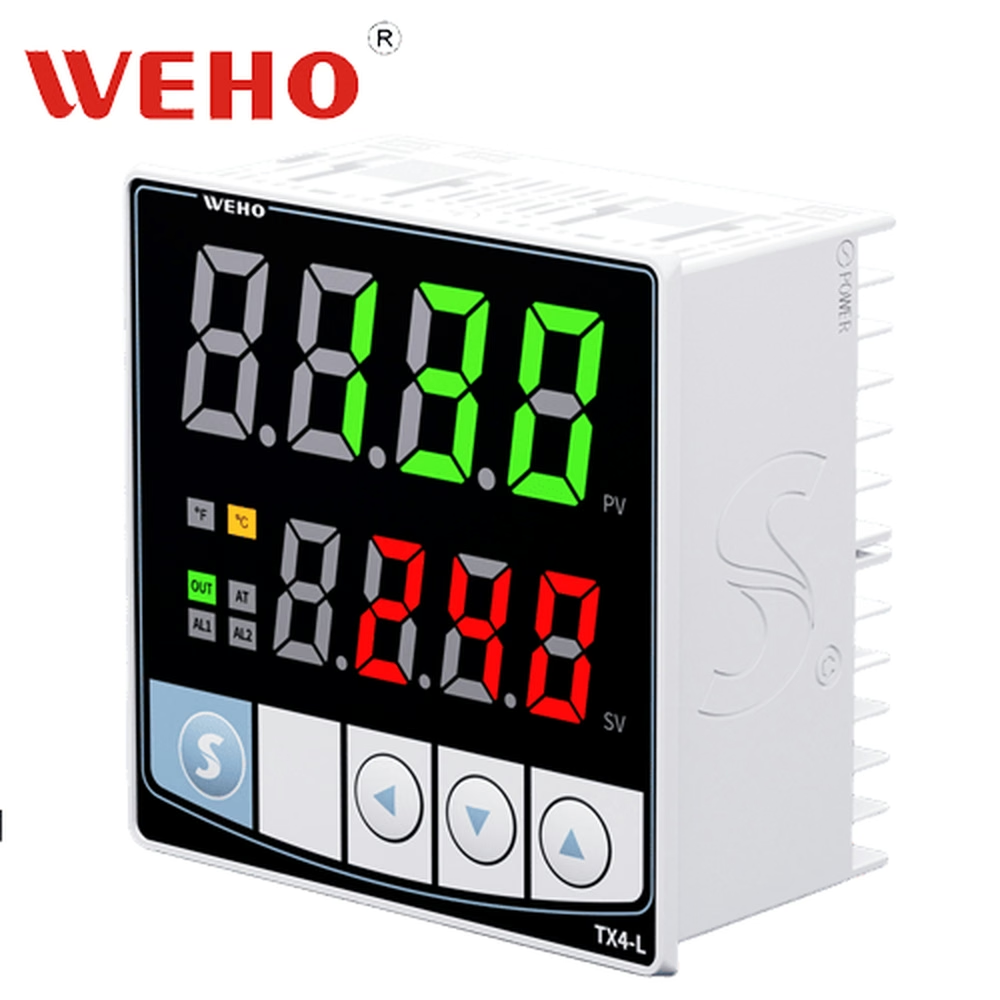
The TX4-L panel-controller reference identifies the instrument context here. This article does not establish a TX4-L ramp program, setpoint-rate limiter or data-export feature. Confirm the complete architecture, including any external program source, before requesting a particular ramp behavior.
The useful output is a signal-specific ramp record. It includes starting condition, target, working command, measured response, time basis and the point at which acceptance changes from ramping to holding. The machine's process requirement should define these fields before the first trial.
Keep rate limiting separate from available heating power
A setpoint-rate limit changes the requested trajectory. A power limit constrains an actuator's available demand. They can both slow heating, but they do not define the same behavior. Changes in load or heat loss can change the process rate under a fixed power limit.
Eurotherm's ramp-and-soak discussion distinguishes limiting startup power from controlling a setpoint ramp. The EPC3000 user guide further distinguishes target and working setpoints and documents implementation-specific rate and servo behavior. Those features belong to the cited equipment; they must not be assumed for TX4-L.
A ramp requirement also needs a direction. A heated process with passive cooling may track an upward request differently from a downward request. Preserve the relevant heating or cooling arrangement and load instead of treating a positive and negative rate of equal magnitude as interchangeable evidence.
Starting conditions matter too. Beginning from a warm process can shorten the distance to target and change the available heat balance. Define whether the ramp starts at an existing working setpoint, the measured PV or another documented initial value. Do not infer that behavior from a menu value alone.
Work a hypothetical command and process comparison
Assume a target of 180 °C, a starting working setpoint of 60 °C and a constant command ramp of 2 °C/min. The required command change is 180 − 60 = 120 °C. Its ideal ramp duration is 120/2 = 60 min, provided no hold, limit change or interruption modifies the trajectory.
At 15 min, the hypothetical working setpoint is 60 + 2 × 15 = 90 °C. At 30 min it is 120 °C, and at 60 min it reaches 180 °C. These are command values. No assumption has yet established the process temperature at those times.
Now assume an illustrative process record with PV = 84 °C at 15 min and PV = 111 °C at 30 min. Its average rate over that interval is (111 − 84)/(30 − 15) = 1.8 °C/min. The command rate remains 2 °C/min, while the PV lags working SV by 6 °C and 9 °C at the two endpoints.
Swipe to view the complete diagram, or open full size.

This endpoint slope does not describe every short interval between the two observations. A nonlinear trace can share the same average. If the requirement limits instantaneous or short-window rate, define that calculation method and acquire adequate time-resolved evidence instead of accepting a two-point average as a complete rate history.
Swipe table horizontally when needed.
| Quantity in the example | Value | What it establishes | What remains separate |
|---|---|---|---|
| Command rate | 2 °C/min | Specified working-SV slope | Actual process tracking |
| Ideal command duration | 60 min | 120 °C change at stated rate | Product reaching target |
| PV average, 15–30 min | 1.8 °C/min | Endpoint interval slope | Short-window rate variation |
| PV lag at 30 min | 9 °C | Working-SV minus PV | Product-to-PV temperature difference |
Build the ramp acceptance procedure around recorded signals
- Identify the actual program source, controller, sensor and any independent product measurement. Record exact revisions and input/output configurations. Verify which device creates the working setpoint and whether the required ramp function is documented for that arrangement.
- Define starting temperature, target, direction, rate units and operating load. Record the required evaluation interval and any permitted tracking error. Verify that the requirement applies to a named signal and that its tolerances come from the process specification.
- Establish a common time basis for working SV, PV and required product measurements. Record acquisition settings and signal definitions. Verify that a delayed or averaged exported value has not been substituted for the signal used by the control loop.
- Execute the permitted sequence under the machine's commissioning procedure. Record saturation, holds, operator changes and disturbances. Verify the command trajectory independently of the process response before interpreting a tracking discrepancy.
- Evaluate the required rate and tracking criteria using the stated method. Retain the complete trace with marked intervals. Verify endpoint, overshoot and hold-entry behavior separately, rather than stopping the record when the working setpoint first reaches its target.
- Check relevant interruption and restart states through the approved procedure. Record retained target, resumed working setpoint and output permission. Verify the behavior required by the recipe without assuming that every controller resumes from the same starting signal.
Preserve the equipment's independent protective functions and permitted thermal limits. A ramp can control a normal process request, but it does not establish an independent high-limit function. Qualified personnel and the machine procedure should govern any change that can energize heaters or cooling equipment.
Interpret a missed rate without hiding the limiting mechanism
If the working setpoint follows the required ramp while PV falls increasingly behind, inspect the actual output and process state. The actuator may be limited, the load may have changed or the heat path may require more time. A larger target does not by itself establish a faster permissible process rise.
If working SV itself pauses or changes slope, investigate the program state and documented rate logic. A hold, revised target or restart behavior can change the command trajectory. Label the actual state rather than averaging across it until the resulting number resembles the requested rate.
Consider a hypothetical command that rises 40 °C in the first 20 min, pauses for 10 min and then rises another 40 °C in 20 min. The active ramps are each 2 °C/min, but the total 80 °C change over 50 min averages 1.6 °C/min. Both statements are arithmetically correct and answer different acceptance questions.
Product temperature creates a further boundary. A control sensor can reach the working setpoint while a large workpiece remains cooler internally. If the specification concerns the workpiece, retain the appropriate product measurement and hold criterion. Do not relabel the panel PV as product temperature without evidence connecting the two.
Finally, preserve the transition to holding. The end of the command ramp can change the requested slope abruptly, while the process still contains stored thermal energy. Record the ensuing behavior for the period required by the process, with the acceptance rule stated before evaluating the result.
Send a signal-specific ramp requirement to WEHO
Use the TX4-L configuration documentation entry to identify the proposed unit. Send WEHO the application record with the actual program architecture, sensor, output interface, starting condition and required working-SV and PV behavior. Ask whether the exact configuration supports the requested function and what external equipment, if any, forms part of the design.
Include the rate units and a sample acceptance trace where available. A request for a two-degree ramp becomes actionable when it names the signal, time unit, load and restart requirement. Keep the controller capability enquiry separate from the machine's final recipe and product acceptance.
Engineering FAQ
Does a 2 °C/min setting prove the process heats at 2 °C/min?
No. The setting may define a command trajectory. Actual process and product temperatures depend on heat delivery, losses, load and measurement location; verify the signal named in the requirement.
Is limiting heater power equivalent to limiting setpoint rate?
No. Power limiting constrains the actuator, while rate limiting shapes a requested trajectory. Their effects can differ as load and heat losses change.
Can two endpoint readings prove the entire ramp rate?
They establish an average over that interval. A requirement for short-window or maximum rate needs an appropriate calculation method and time-resolved record.
Does the TX4-L image demonstrate a ramp program?
No. It shows the controller form in an application illustration. Confirm the ordered configuration and complete program architecture before assigning ramp functions.