













Last Updated: 2026-08-30
24v led driver selection should begin with the LED load’s required voltage, total wattage, wiring distance, installation environment, and dimming or control needs. For strip and sign lighting, confirm constant-voltage compatibility, add realistic load margin, account for cable voltage drop, and choose environmental protection suitable for the mounting location.
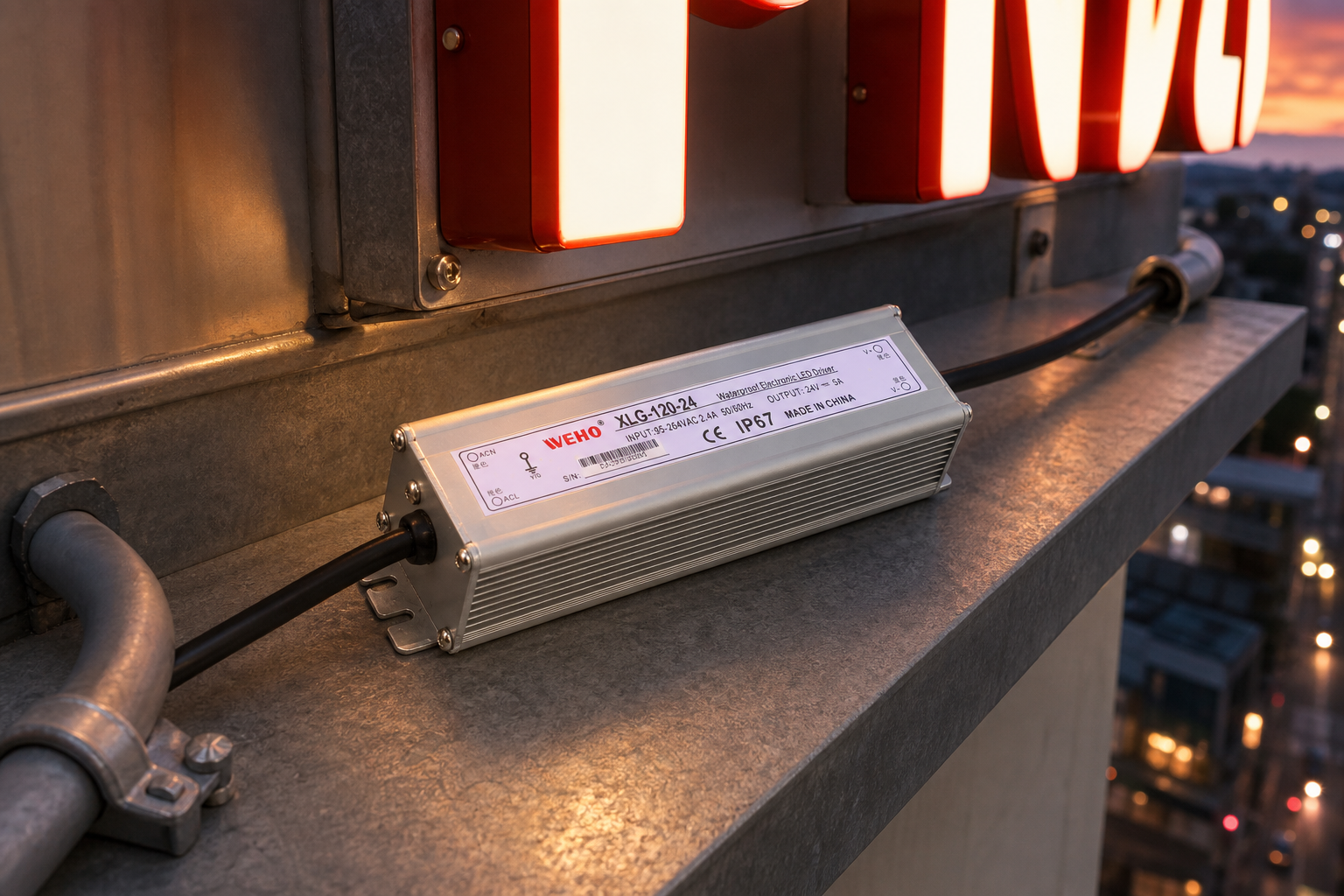
24v led driver selection begins with the lighting load
A 24v led driver should be selected from a written load schedule. List every connected load, its operating current, startup behavior, cable distance, duty cycle, and acceptable input-voltage range. A nameplate total is useful, but the design should use the maximum credible condition that the panel or lighting system will actually see.
For control panels, include PLC CPUs, remote I/O, industrial switches, sensors, relays, small actuators, HMI devices, and any branch that remains energized during maintenance. For lighting systems, include every strip segment, sign module, channel, and controller that shares the same output. Keep spare circuits separate from connected load unless they are already committed.
The 24v led driver must also be checked against ambient temperature, enclosure heat, input voltage, mounting orientation, airflow, and wiring voltage drop. A comfortable bench rating can become marginal in a sealed cabinet, outdoor sign box, or long cable run.
Match constant-voltage strips and sign modules correctly

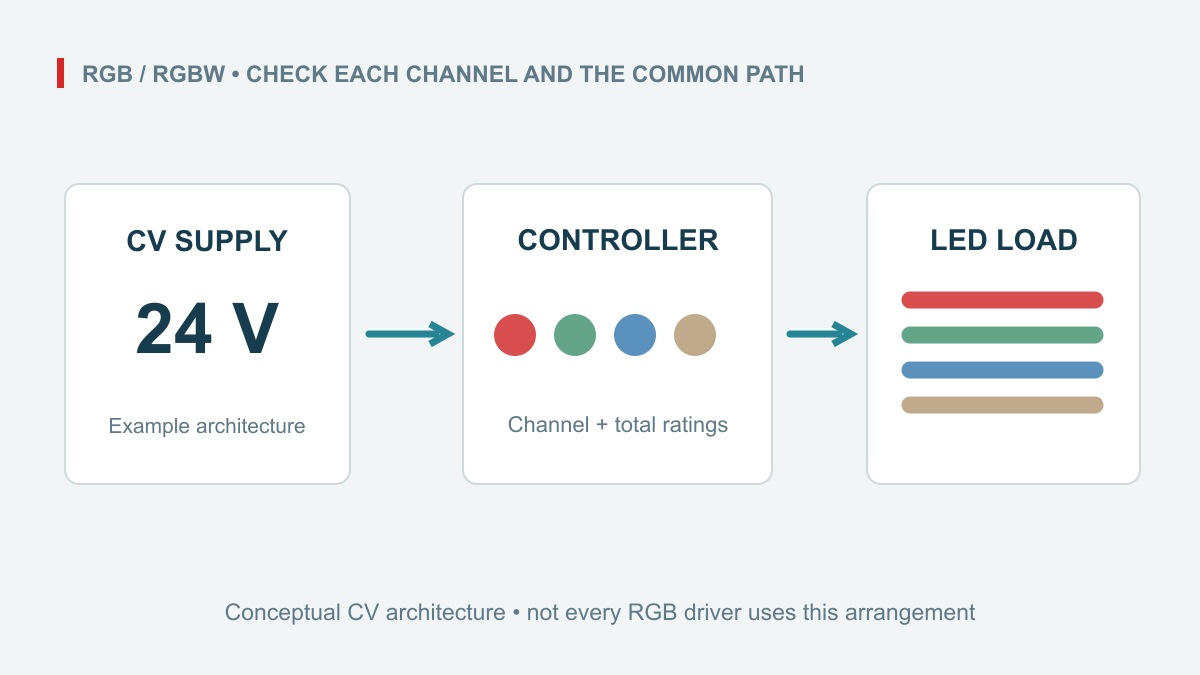
Confirm whether the load needs a regulated 24 V constant-voltage output, a constant-current output, or a different charger-style profile. These output types are not interchangeable. Incorrect matching can cause unstable operation, poor light output, nuisance protection trips, or equipment damage.
Calculate continuous wattage and current, then add only a practical service margin. Oversizing without checking minimum-load behavior, branch protection, terminal capacity, and physical space can create new problems. Undersizing shortens margin for heat, startup current, and future load growth.
For long DC runs, estimate voltage drop and verify the voltage at the load during operation. The supply output terminals may read correctly while the far end of the cable is outside the equipment’s permitted range. Use suitable conductor size, protected branches, and clean terminations.
Use approved WEHO LED driver links

Start from the approved WEHO product category when comparing product families. The selected model should match the required output type, voltage or current range, power level, mounting method, environmental protection, and installation constraints.
The approved representative product reference for this topic is this WEHO product page. Treat it as a product-matching starting point, not as a substitute for checking the exact model datasheet, output variant, wiring diagram, derating information, and installation instructions.
For broader background, compare the related WEHO guide here: supporting WEHO Blog reference. Use internal references to clarify selection logic, but use confirmed product documentation for final electrical values.
Installation checks for outdoor and indoor lighting

Installation should be performed by qualified personnel with incoming power isolated and verified safe. Keep AC input wiring separated from low-voltage DC wiring, provide protective grounding where required, use terminals within their rated conductor range, and protect each branch according to the system design.
Mount the product where heat can leave the enclosure. Do not cover vents, pack wiring tightly around the case, or place heat-sensitive components directly against hot surfaces. Outdoor or damp locations require a product and enclosure approach suitable for the exposure; never infer protection from appearance alone.
Label input, output, polarity, branch protection, and the controlled load. Before energizing the full system, inspect polarity, tightening, strain relief, insulation clearance, and the route from source to load. Record input voltage, output voltage, load current, ambient temperature, and any abnormal sound, heat, or protection behavior.
Testing before handover

- Selecting by wattage alone without checking voltage, current mode, and derating.
- Ignoring startup current, future connected load, or cable voltage drop.
- Using one shared output branch where separate protected branches are needed.
- Mounting the supply where heat, dust, water, or service access has not been considered.
- Assuming a product page example proves a model is suitable for every installation.
Często zadawane pytania
How do I size a 24v led driver?
Add the connected load, check startup or peak demand, then apply the selected model’s documented derating for temperature, input range, mounting, cooling, and installation conditions.
Why is cable voltage drop important?
A supply can show the correct voltage at its terminals while the remote load receives less voltage. Long runs, small conductors, high current, and shared branches should be checked under real load.
Can I choose by wattage only?
No. Wattage is only one gate. Output type, voltage or current range, environmental protection, branch protection, terminals, cooling, and compliance requirements must also match the installation.
What WEHO facts can be used for supplier evaluation?
WEHO was founded in 2007, offers 1000+ models, performs 100% high-temperature full-load testing, reports 99.7% yield, and lists ISO9001, CE, RoHS, FCC, and CCC.
What should be recorded during commissioning?
Record input voltage, output voltage at the load, operating current, ambient temperature, load state, branch protection behavior, and any abnormal heat, sound, or protection indication.
When should I contact WEHO before selecting a model?
Contact WEHO when the load has high startup current, outdoor exposure, long cable runs, dimming or control requirements, tight enclosure temperature, or unclear output-mode requirements.
Kluczowe dania na wynos
- Build the load schedule before selecting a 24v led driver.
- Confirm output type, rating, derating, wiring distance, branch protection, and environment together.
- Use approved WEHO category and product links, then verify the exact model documentation.
- Keep installation checks practical: polarity, terminals, airflow, grounding, branch protection, and measured output.
- Record commissioning measurements so later service work has a baseline.
Wniosek
A reliable 24v led driver choice comes from load evidence, installation conditions, and verified product documentation. The right model is the one that keeps the load inside its permitted range after heat, wiring, protection, startup behavior, and service access are considered.
Review the WEHO product category Lub contact WEHO with input voltage, output load, ambient temperature, wiring distance, enclosure details, and control requirements. You can also email [email protected] for product matching.
Review the relevant WEHO product category, email [email protected], or contact WEHO with the input voltage, output load, ambient temperature, and installation details.