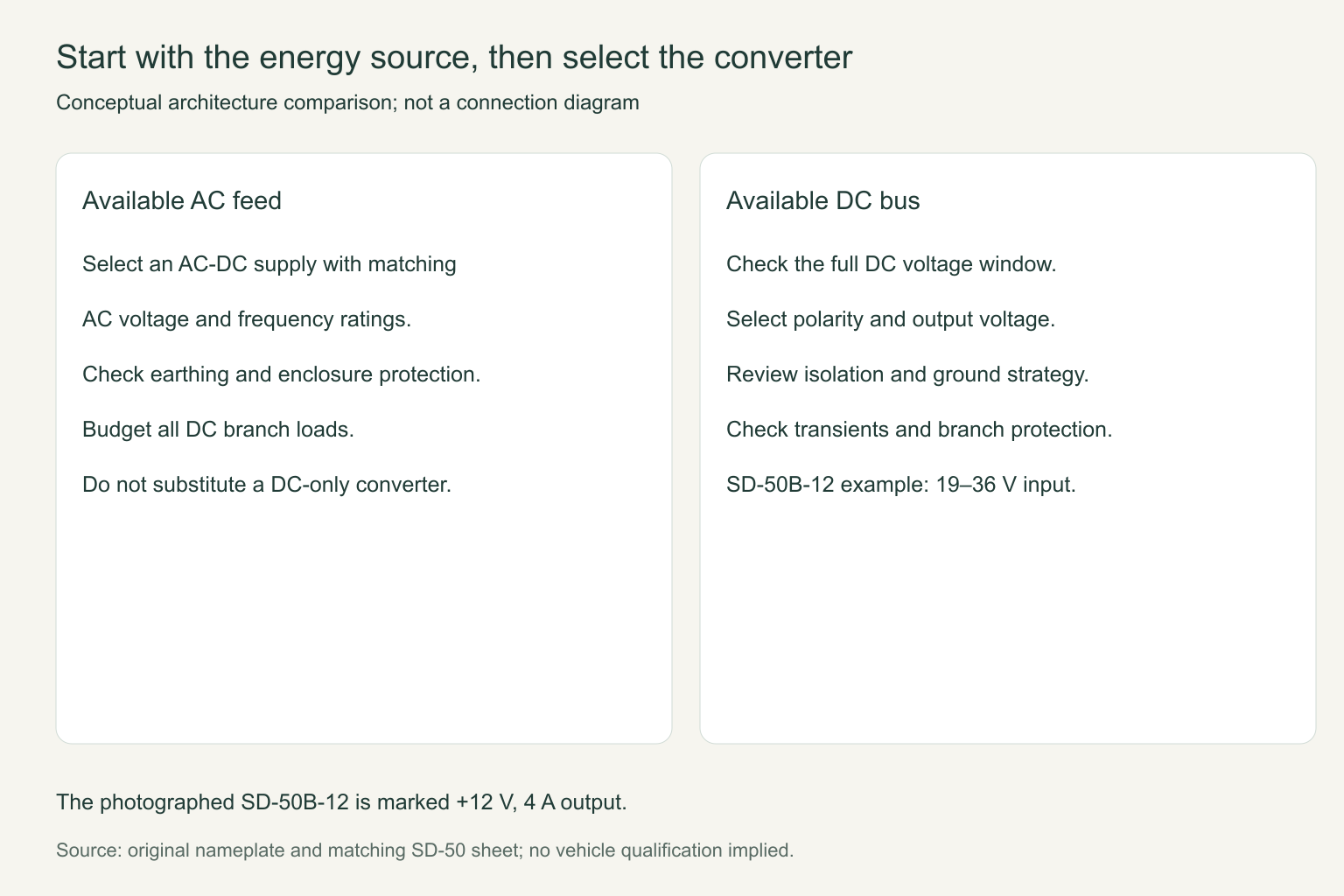
An AC-input power supply and a DC-input converter may both deliver 12 V, but they are not interchangeable. Start with the source available inside the equipment: utility AC requires an appropriately rated AC-DC supply; an existing DC bus usually calls for a DC-DC converter whose entire input window matches that bus. The output rating is only half of the selection.
Identify the feed before choosing the output
Record whether the incoming feed is AC or DC, its nominal value, minimum and maximum operating values, and the disturbances expected at that point. A cabinet marked “24 V” might contain a regulated supply, a battery, a charging battery or a distribution branch with considerable cable drop. Those are different input conditions even though the nominal voltage is the same.
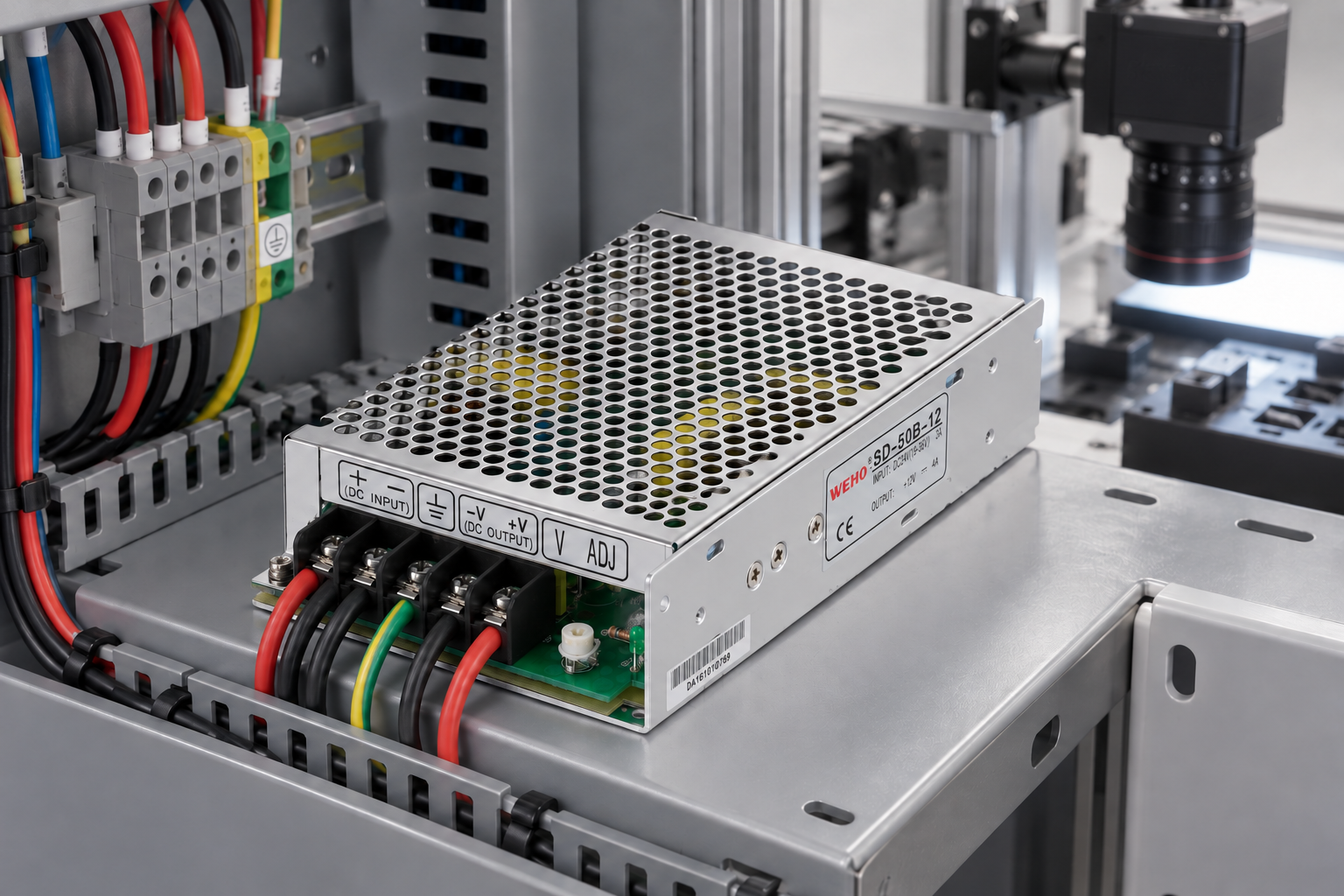
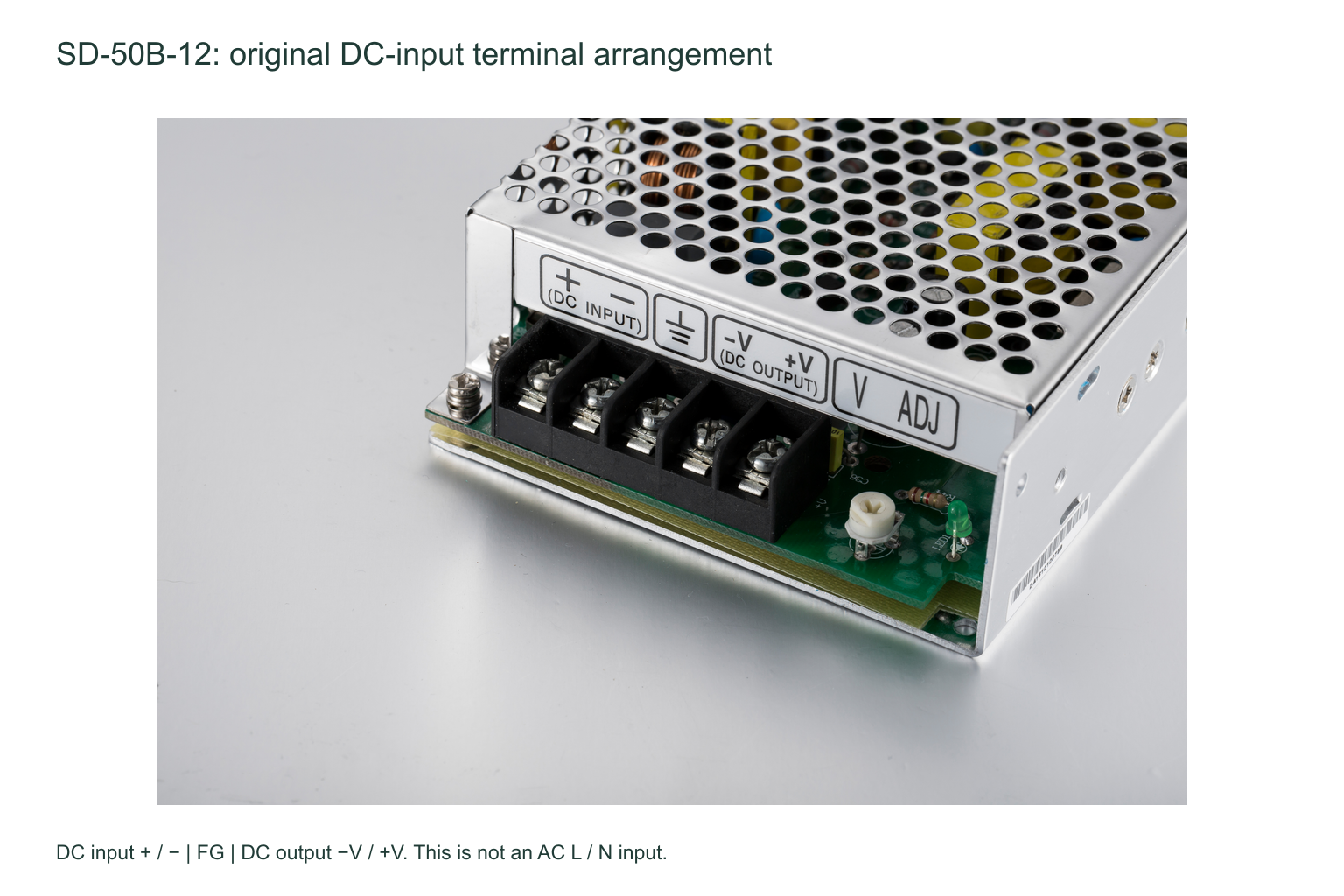
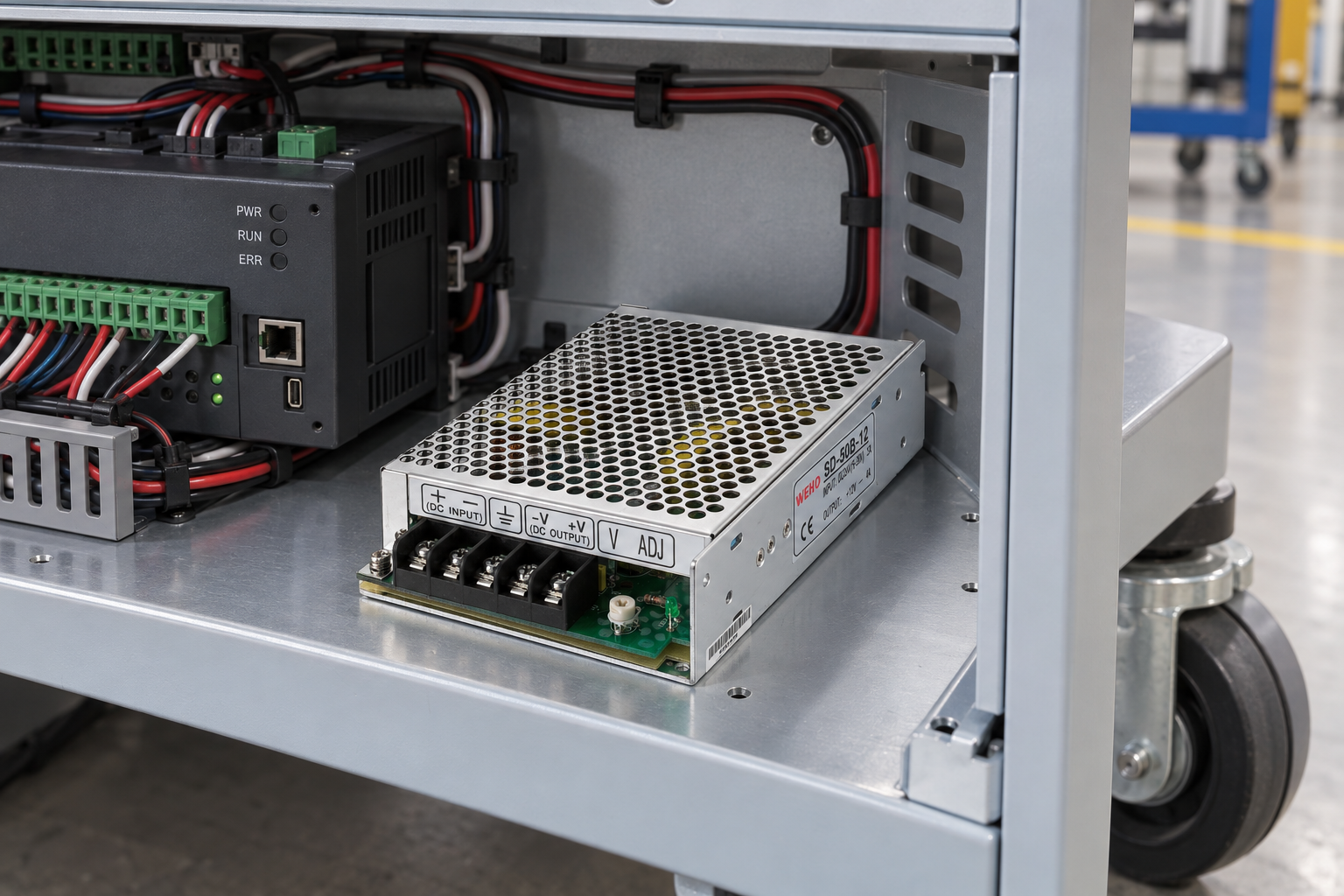
The photographed WEHO SD-50B-12 is a concrete DC-input example. Its original nameplate states DC 24 V input with a 19–36 V range and +12 V, 4 A output. Its front terminals identify DC input positive and negative, frame ground, then DC output negative and positive. There is no AC L/N input on this model. Applying mains AC to it is not a way to obtain 12 V.
When an AC-DC stage makes sense
If the machine receives AC at its electrical enclosure, a suitable AC-DC supply can create the main low-voltage control bus. Match the actual AC voltage and frequency, environmental limits, required protective measures and total branch load. Where multiple voltages are needed, compare separate AC-DC supplies with one central DC bus followed by local DC-DC stages.
A central bus can simplify distribution, but it also concentrates responsibility in the upstream supply. Include every downstream converter’s input demand and startup behaviour in the bus budget. Do not add only the advertised output wattages and assume there are no conversion losses or simultaneous-start effects.
When a DC-DC stage is the better fit
For equipment that already has an appropriate DC source, a local converter can provide a different regulated voltage without an unnecessary DC-to-AC-to-DC round trip. It may also provide an isolation boundary when its documented design meets the system requirement. Neither voltage conversion nor isolation should be assumed from a metal enclosure alone.
For the SD-50 family, input letters matter: the matching sheet lists A at 9.2–18 V, B at 19–36 V and C at 36–72 V. The 19–36 V window belongs to the B input version. A 48 V bus is not acceptable simply because the product name contains “SD-50,” and a deeply discharged 24 V battery can fall outside the B window.
Review polarity and grounding as separate decisions
The input negative terminal, output negative terminal and FG marking have different roles. Wire to the exact terminal diagram. A system designer must decide whether and where a signal reference, chassis and protective conductor should be bonded; a product photograph cannot establish the equipment’s grounding strategy.
The SD-50 documentation includes dielectric withstand test values. Such a test describes an insulation verification condition. It does not mean that the converter can operate from that AC test voltage, nor does it automatically establish a complete safety isolation classification for the finished machine.
Use the label of the supplied unit for the load budget
The original SD-50B-12 shown here is marked 4 A at 12 V. The associated family sheet lists 4.2 A in its 12 V output column. For this photographed revision, use the lower 4 A nameplate limit until the manufacturer confirms a different rating in writing. Do not silently change the label or assume another revision’s allowance.
Then review temperature, ventilation, startup demand and duty cycle. A receiver’s “12 V” label alone does not reveal its maximum current or transient tolerance. If the receiver has a motor, heater or capacitive input, capture the relevant demand rather than selecting solely from its steady-state average.
Compare the complete conversion path
For a fair architecture comparison, list every conversion stage and protection device between source and load. Cascaded efficiencies multiply: two hypothetical stages at 90% and 85% would yield 76.5% combined efficiency at those particular operating points. This arithmetic is not an SD-50 efficiency claim. Real efficiency changes with input, load and temperature.
Also compare service access and failure behaviour. One central source feeding several converters differs from independent AC-fed branches when a source or branch fails. Decide which functions must remain available, which faults need isolation, and how technicians can disconnect an affected branch safely.
Frequently asked questions
Can AC-input and DC-input supplies be exchanged if both output 12 V?
No. Their input types and operating windows must match the available source. A shared output voltage does not make their input circuits interchangeable.
Can the SD-50B-12 run from a 48 V bus?
No. The photographed B-input version is marked 19–36 V. A 48 V source requires an appropriately rated input version, with its complete operating envelope checked separately.
What to include in an input-selection enquiry
Send the available source type and measured or specified voltage envelope, required output voltage and current, startup demand, ambient conditions, grounding requirements and enclosure arrangement. For mobile machinery, include the applicable transient and vibration requirements rather than assuming a general industrial converter is vehicle-qualified.
Compare the WEHO SD DC-DC range and the SD-50 family sheet, then ask WEHO to confirm the exact input/output version. The useful purchasing question is not simply “Can it deliver 12 V?” It is “Can this exact version accept my source under every intended operating condition?”