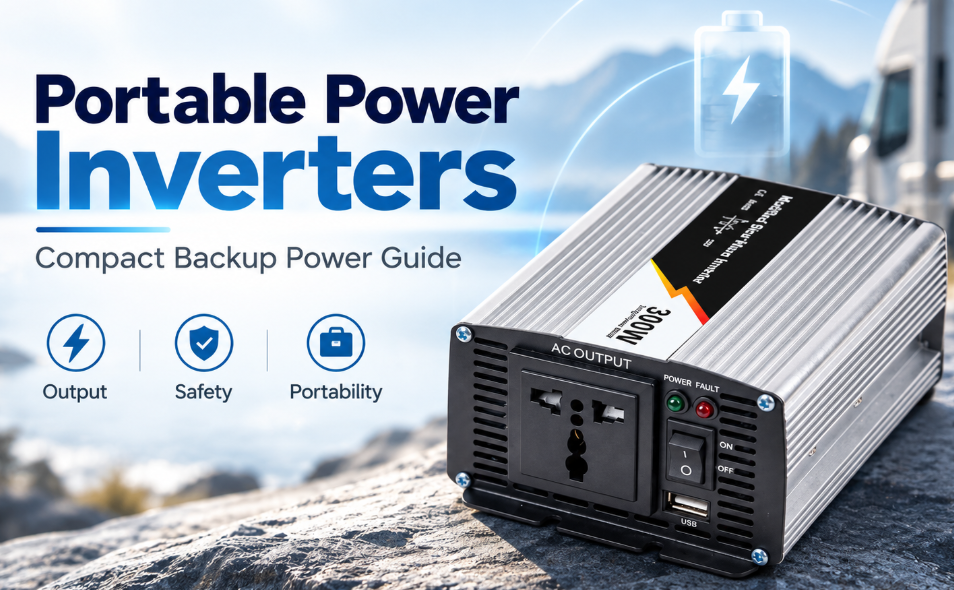
If an inverter runs with no load but shuts down when equipment starts, do not assume that the inverter is defective—or that a larger fuse will solve it. Check the DC voltage at its input during the event, the load’s startup demand, and the thermal conditions. Different faults can produce the same red warning light.
First distinguish immediate from delayed shutdown
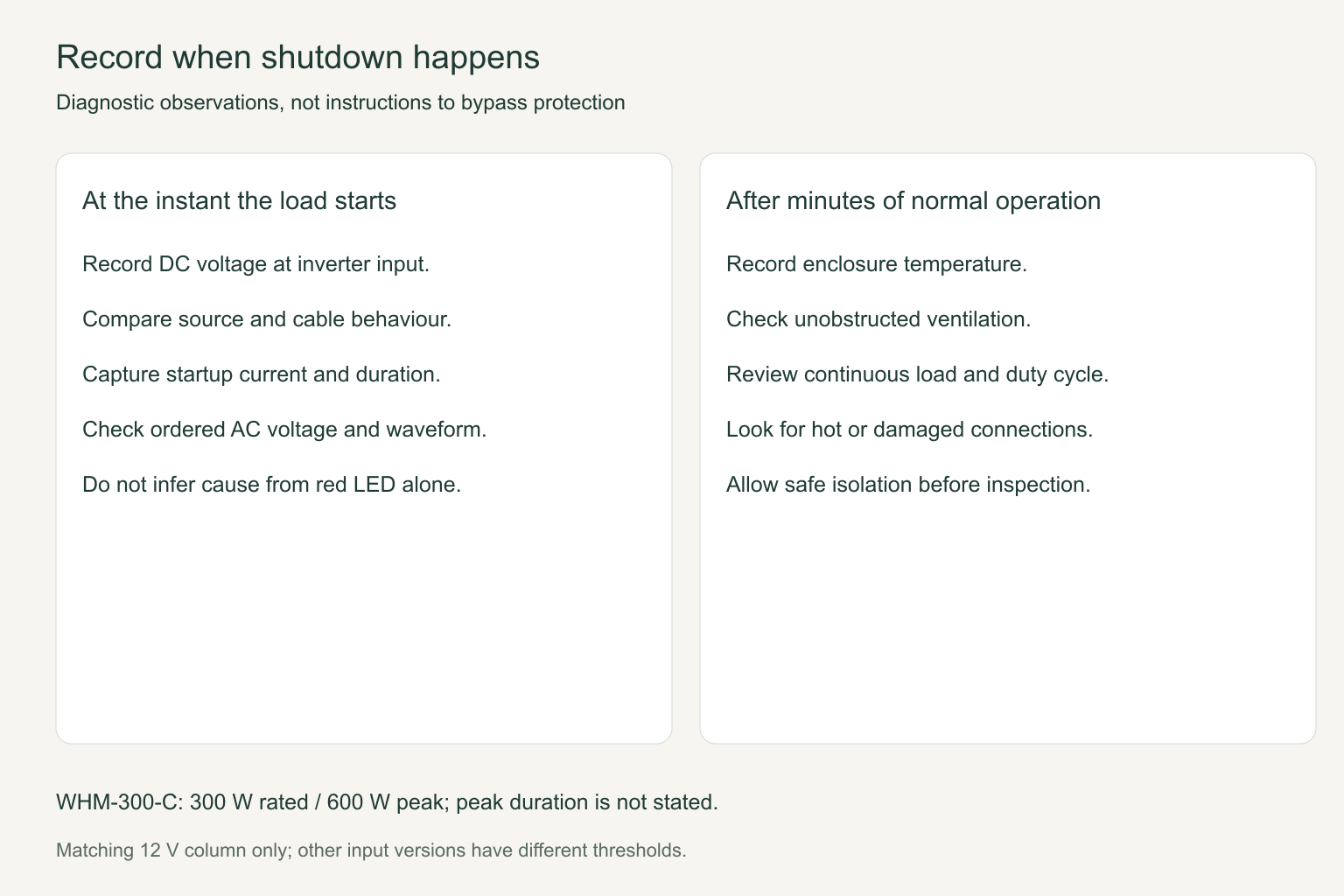
A shutdown exactly when a load starts directs attention toward startup demand, input-voltage collapse and a possible load fault. A shutdown after several minutes makes accumulated heat, continuous loading or a warming connection worth investigating. These are starting points for measurements, not verdicts.
Record the elapsed time, connected equipment, other loads sharing the battery, audible alarms and indicator sequence. Note whether the inverter recovers after removing the load, after charging the battery or only after cooling. Stop if cables, terminals or the case show damage, unusual smell or overheating; have a qualified technician isolate and inspect the system.
Measure the voltage where the inverter receives it
A battery can show an apparently reasonable voltage at rest yet deliver a lower voltage when current rises. Cable and connection resistance create additional drop between the source and inverter. The useful diagnostic comparison is the source voltage and inverter-terminal voltage during the same load event, measured with suitable equipment by someone qualified to work on the installation.
The matching WHM-300-C sheet provides a specific example. For its 12 V version, it lists a low-voltage alarm at 10.5 ± 0.5 V and low-voltage protection at 10 ± 0.5 V. The low-voltage recovery figure is 12.3 ± 0.5 V. Those are protection characteristics, not recommended battery operating targets, and their tolerances matter.
If the source stays within its permitted range but the inverter input falls markedly, investigate the cable route, terminations and protection devices. If both fall, investigate the source’s state of charge, capacity and current-delivery capability. Do not diagnose a battery from one unloaded voltage reading.
Compare startup demand with more than the peak number
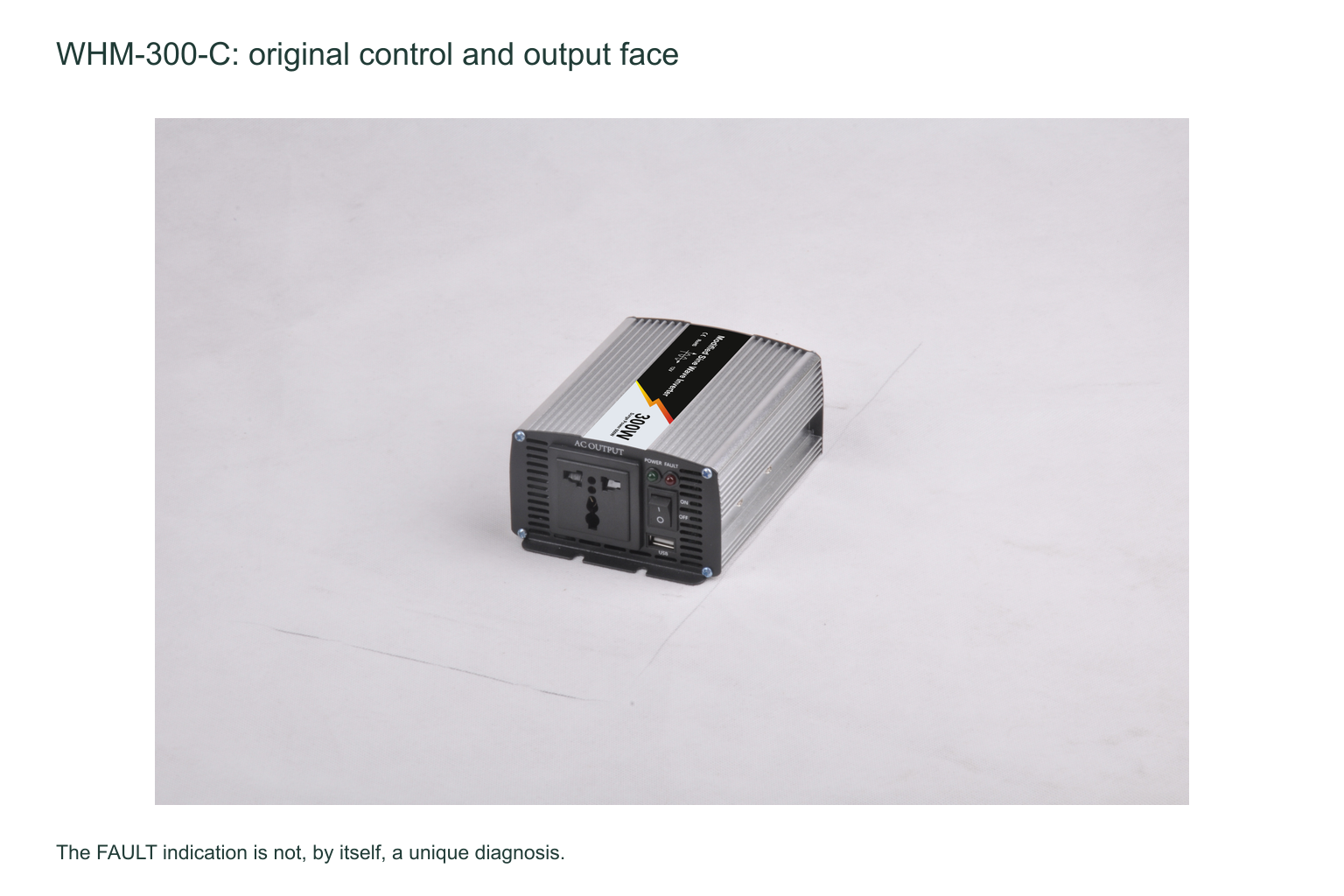
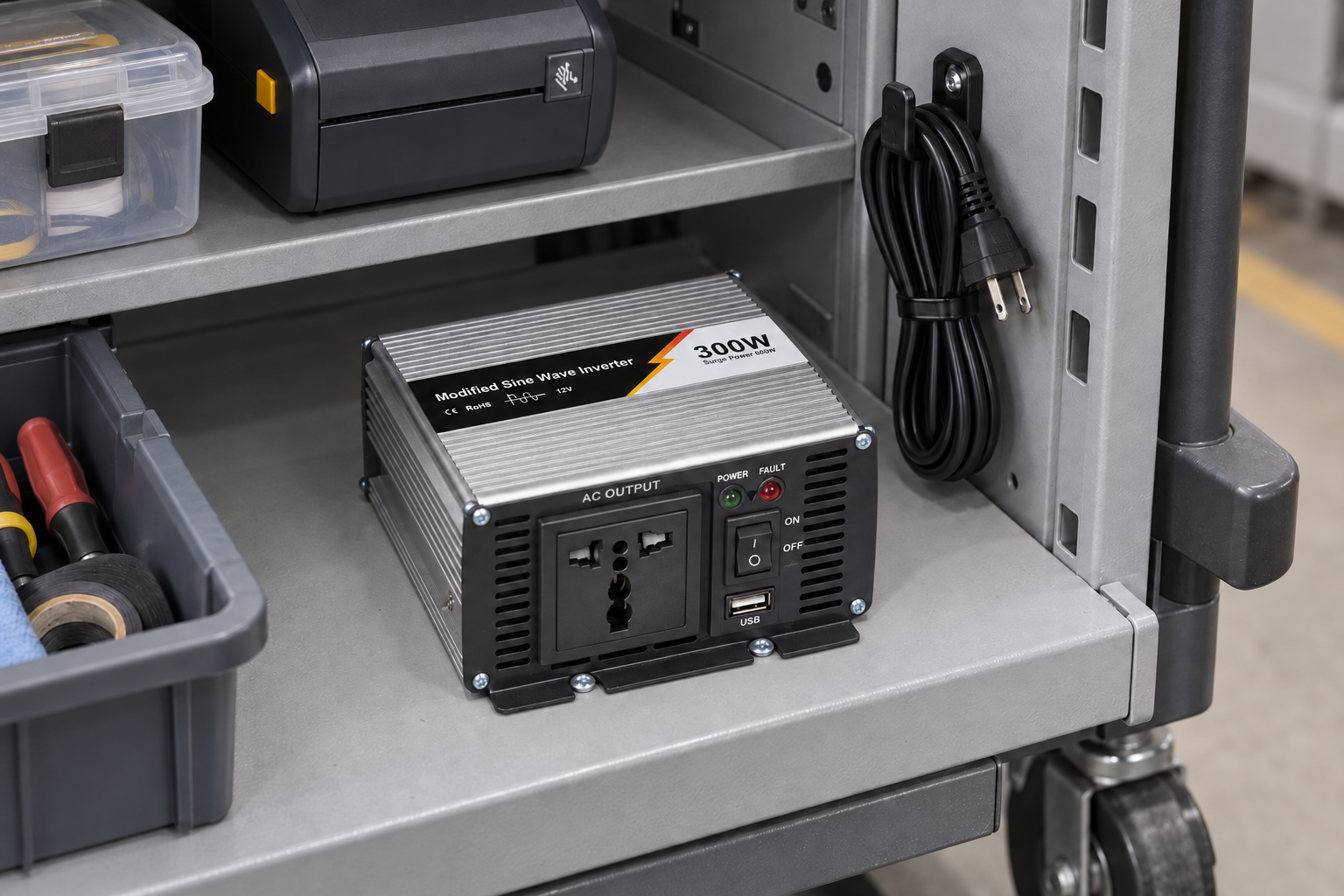
The WHM-300-C is listed at 300 W rated output and 600 W peak. The available sheet does not specify how long that peak can be sustained. A load that needs 500 W briefly is therefore not automatically compatible: its demand duration, power factor, waveform requirements and repetition rate still matter.
This model produces a modified sine waveform. Equipment designed for another waveform may behave differently even when its label wattage appears modest. Confirm the appliance manufacturer’s requirements and the ordered AC output voltage and frequency. Do not infer them solely from the socket’s shape.
Test conditions should be controlled. Remove unrelated loads, inspect the suspect load with power isolated, then follow the manufacturers’ approved diagnostic procedure. A known compatible reference load can help distinguish a system issue from a specific appliance issue, but improvised mains loads and exposed live tests are not appropriate shortcuts.
Do not overlook high input voltage
Charging conditions can be relevant too. For the matching 12 V column, the sheet lists high-voltage protection at 15.5 ± 0.5 V and recovery at 14.8 ± 0.5 V. Compare the charger’s entire voltage profile with the ordered inverter input range. An alarm during charging should not automatically be labelled “low battery.”
For delayed faults, inspect heat and duty cycle
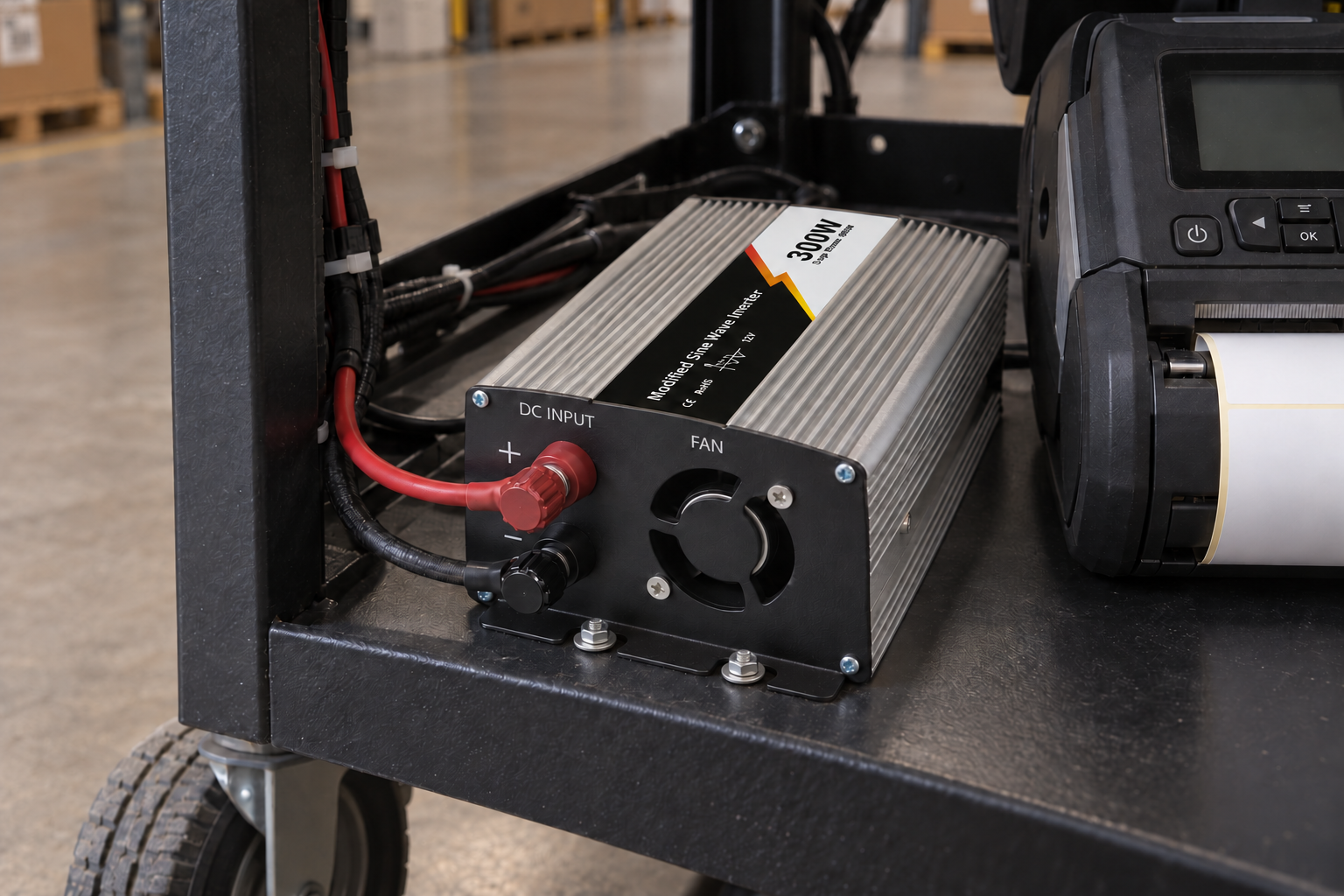
Keep the source-supported ventilation openings clear and prevent hot exhaust from recirculating in the compartment. Check the surrounding enclosure, not only the room temperature. A rating available under suitable ventilation does not establish the same output inside a tightly packed cart with another heat-producing device.
The sheet describes overtemperature protection and intelligent air cooling, but a running fan is not proof of adequate cooling. Likewise, a fan that is not running at a particular light-load moment does not, by itself, establish a fault. Follow the exact model’s operating instructions and inspect mechanically only after safe isolation.
Frequently asked questions
Does a 600 W peak rating guarantee that my load will start?
No. The peak duration is not stated in the matching sheet. The load’s startup demand, duration, waveform requirements and DC source capability must also be compatible.
Will a larger fuse stop load-related shutdowns?
Not as a valid diagnostic fix. A fuse change cannot correct low input voltage, unsuitable startup demand or overheating, and it can leave wiring inadequately protected. Use the specified protection and address the cause.
Use recovery as evidence, not permission to keep retrying
Repeatedly resetting a unit into the same fault can heat connections and obscure the original symptom. Protection is there to limit an abnormal condition, not to serve as a routine control strategy. Never increase a fuse rating, bypass an alarm or defeat a shutdown simply to keep the load running.
A useful service report contains the full inverter model and input version, battery and charger details, load identification, startup and steady-state measurements, input voltage during the fault, enclosure temperature and the exact alarm sequence. Include photographs of the unchanged label and installation.
Review the WEHO product range e send those observations to WEHO for model-specific guidance. A clear event record is more valuable than the statement “the inverter trips,” because it separates source, distribution, load and thermal causes before parts are replaced.