Key Engineering Takeaways
- Two outlets on one inverter do not establish permission to connect two inverter outputs together.
- Matching nominal voltage and frequency does not prove phase synchronization, load sharing or parallel protection.
- Treat independent sources as separate until the exact products and system have documented approval for the proposed topology.
- For a WHP-4000 inquiry, specify whether the requirement is one source, source selection or approved parallel operation.
Why is the topology decision important before ordering?
Connecting independently generated AC sources together can create a source-to-source current path before any useful load is supplied. A buyer who needs more capacity or continuity must first decide whether the project needs a larger single source, controlled source selection or a specifically engineered parallel system.
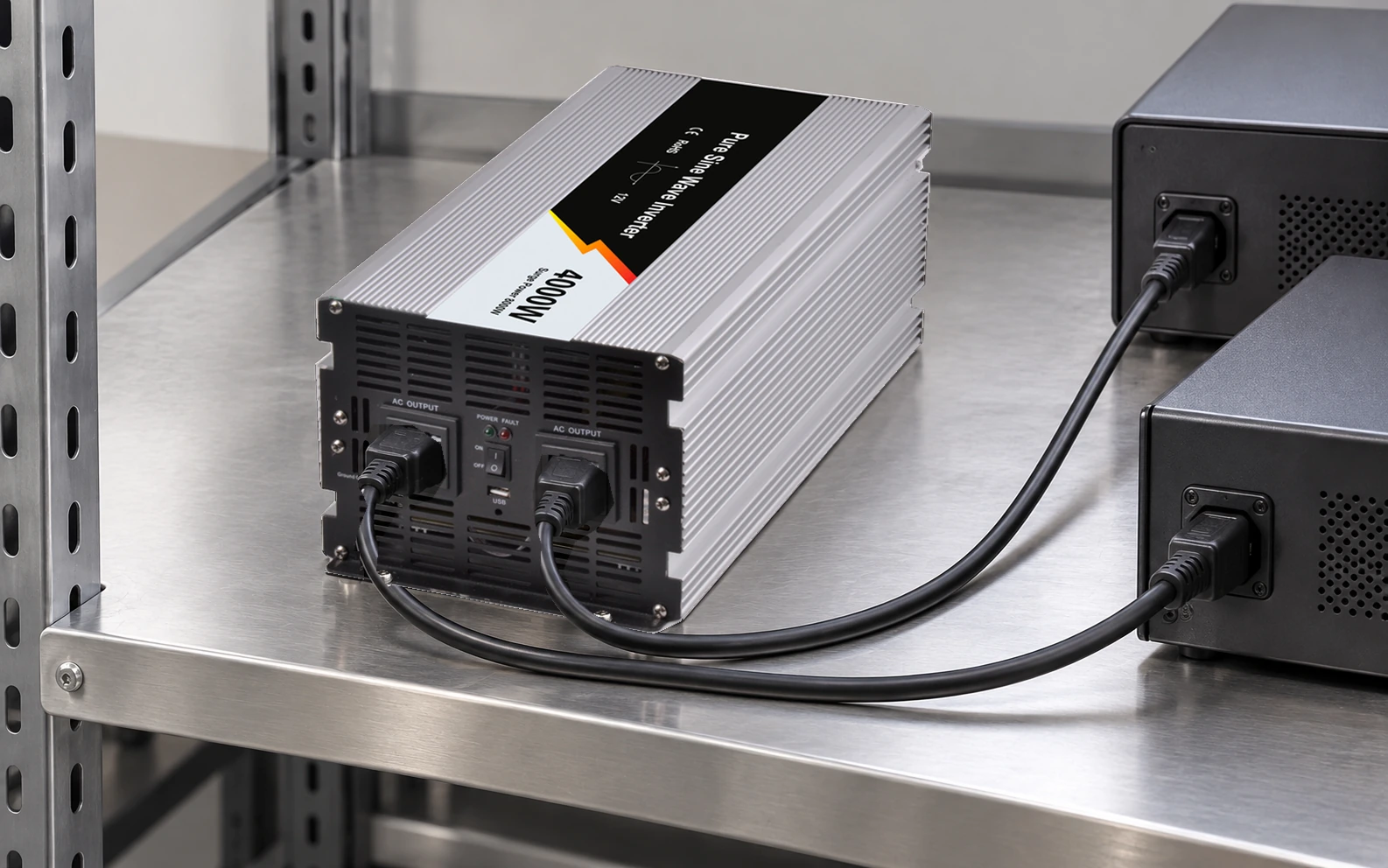
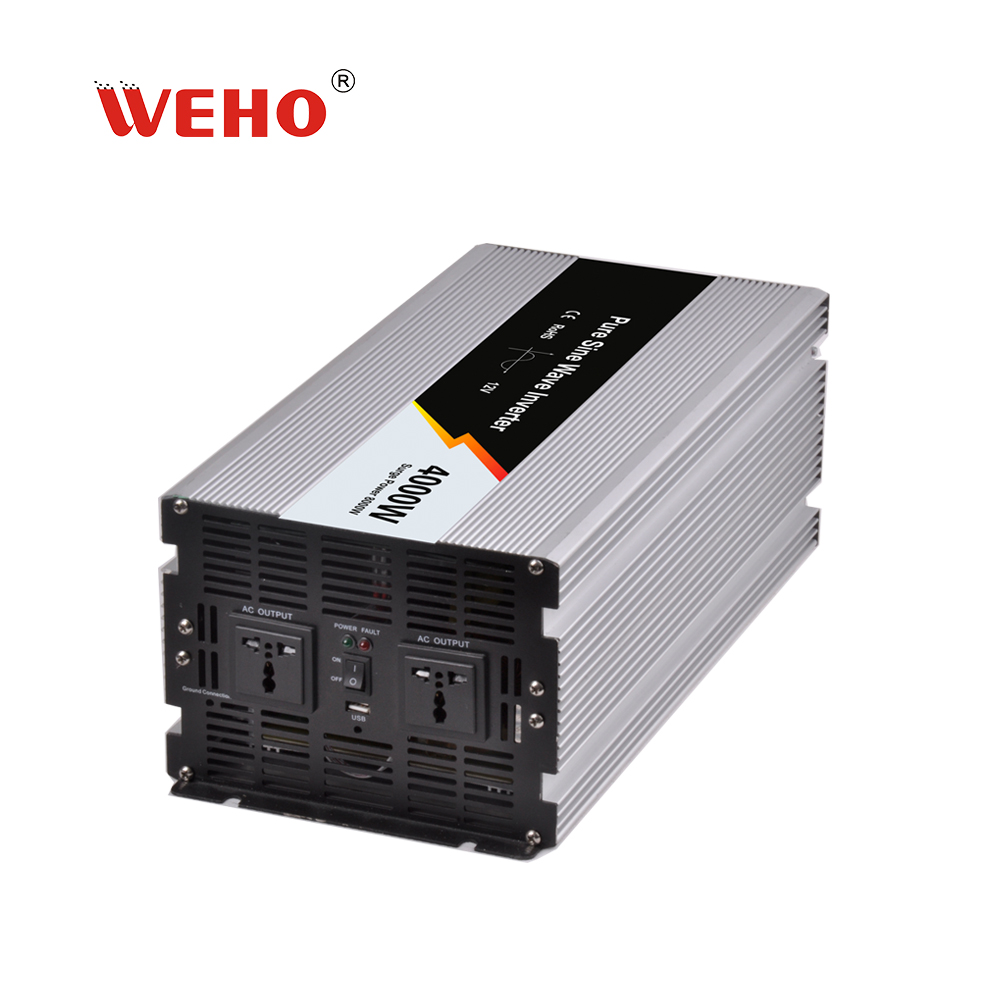
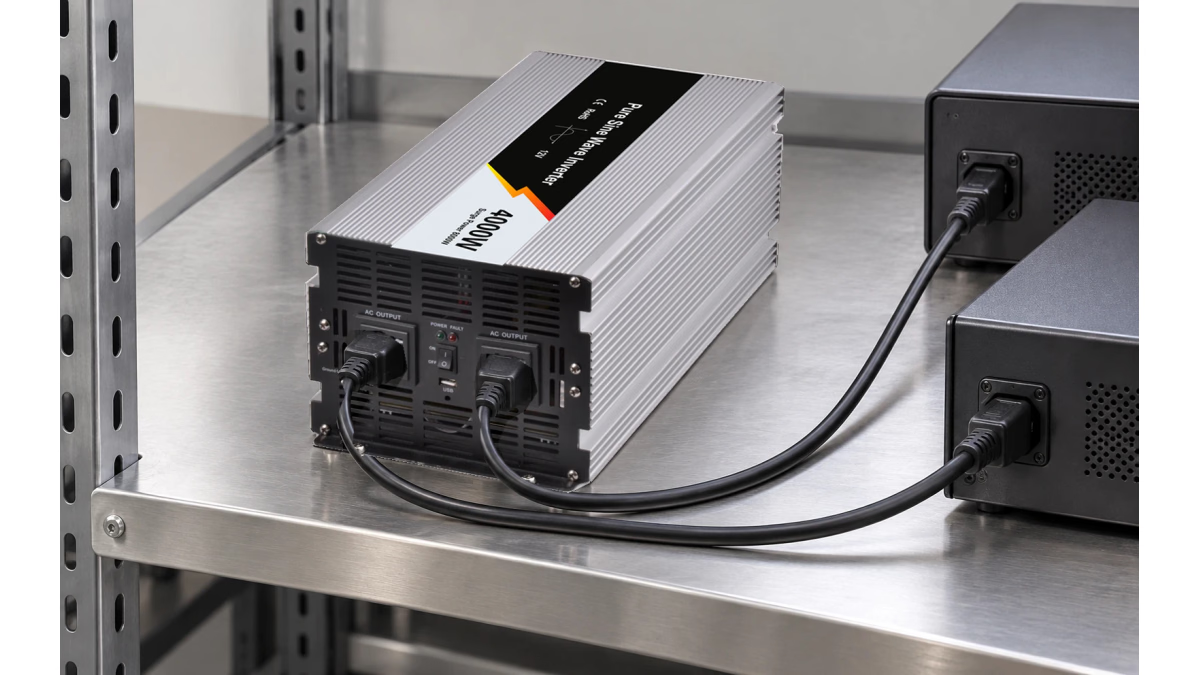
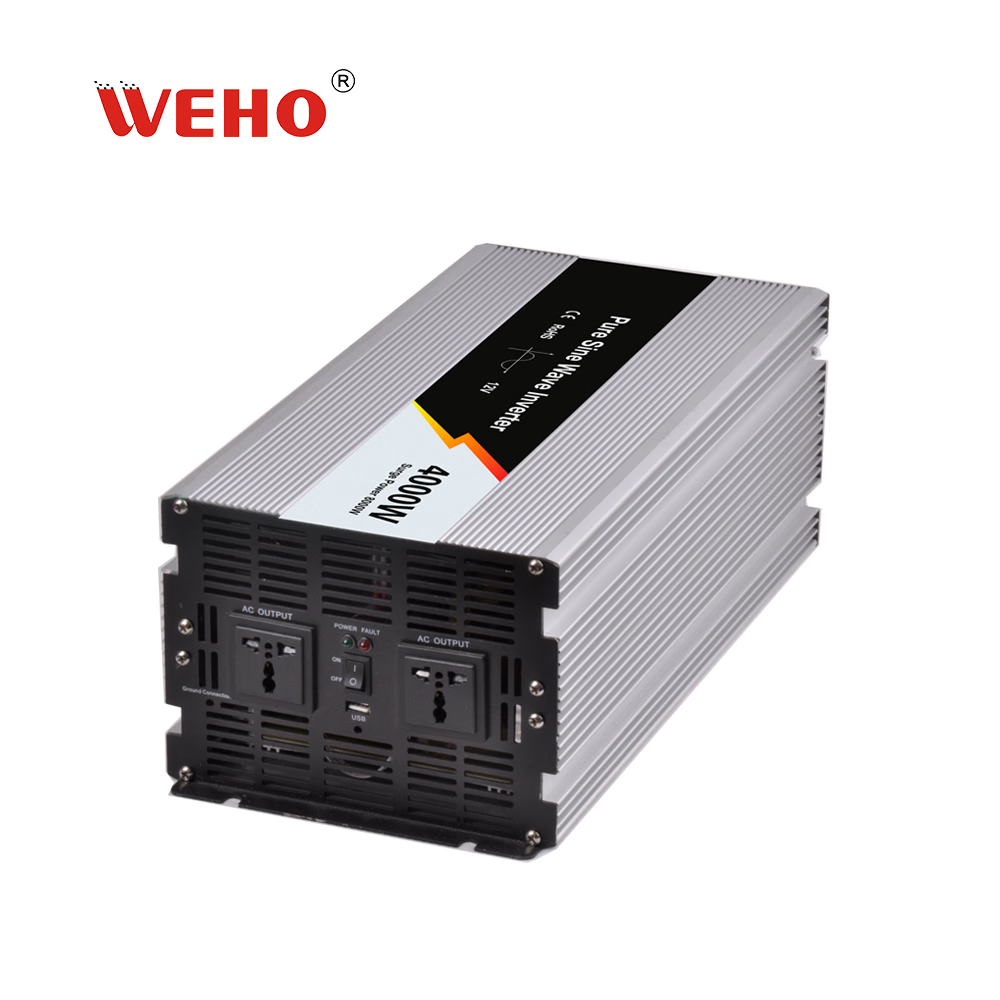
The WEHO WHP-4000 family page identifies a pure-sine inverter family. It does not establish a synchronized multi-inverter parallel architecture. The presence of multiple visible outlets is an interface observation, not a statement about linking separate units.
This article helps an OEM write the topology requirement and review the evidence. It does not provide instructions to join output conductors, modify an inverter or build a transfer circuit.
What electrical model explains the difference?
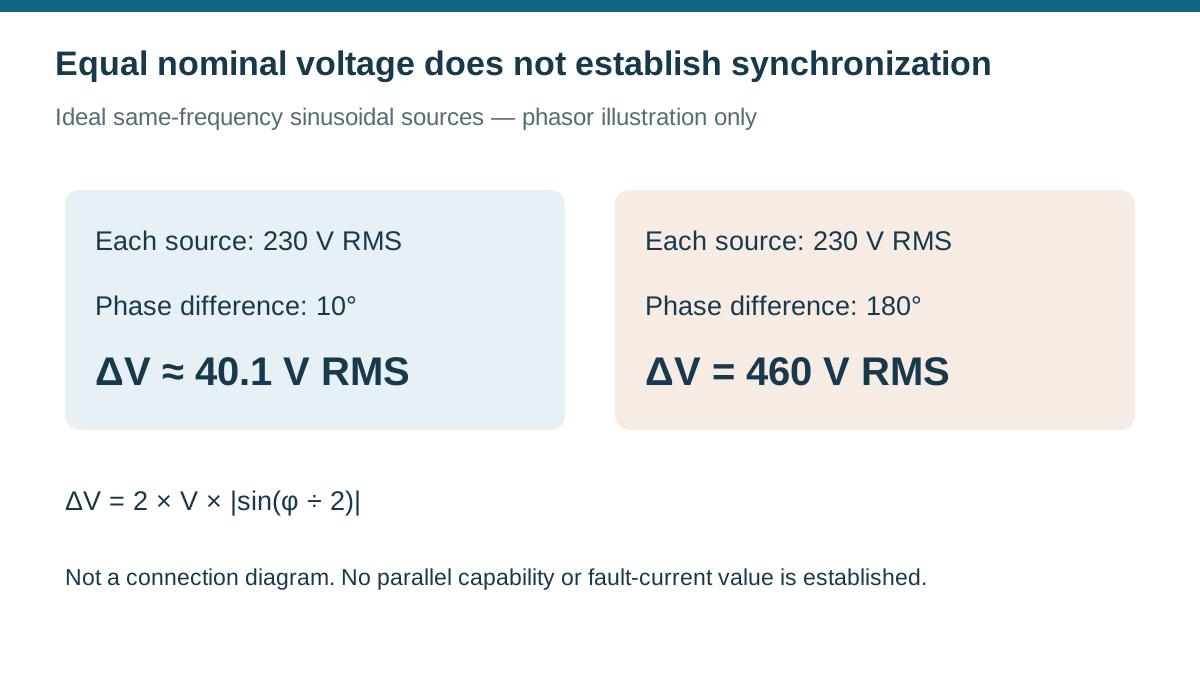
For an illustrative pair of ideal sinusoidal sources, equal RMS voltage and equal frequency still leave their relative phase unspecified. The instantaneous difference between the two source waveforms can drive circulating current if an unintended low-impedance path connects them.
For two same-frequency ideal sources of equal RMS magnitude V and phase difference φ, the RMS difference voltage is ΔV = 2 × V × |sin(φ ÷ 2)|. This is a phasor illustration, not a WEHO circuit model or a permissible connection condition.
Hypothetical phase example
Assume two independent ideal 230 V RMS sources differ by 10°. The difference magnitude is 2 × 230 × sin(5°), or about 40.1 V RMS. At 180°, the difference becomes 460 V RMS, despite each individual source measuring 230 V against its own reference.
The resulting current cannot be calculated from this voltage alone. Source impedances, wiring, control actions, protection and changing phase all matter. Dividing by an invented small resistance would imply a particular fault current that this example cannot establish.
Likewise, two front-panel frequency readings of 50.0 Hz do not demonstrate a common phase reference. Display resolution and measurement interval can conceal a difference. Even sources that align briefly can drift without an appropriate synchronization mechanism.
Synchronization is only one requirement
A parallel architecture also needs defined load sharing, startup coordination, behavior when one unit stops, fault isolation and the relevant protection and earthing design. A matching phase at one instant does not establish these functions.
An example of an actually documented parallel-capable architecture can be seen in Victron's VE.Bus parallel and three-phase system guidance. Its product-specific requirements are evidence of what that architecture requires; they are not permission to apply it to a WEHO inverter or to combine different brands.
Keep the topology specification separate from the ordinary choice of DC input voltage. Matching battery nominal voltage does not create AC synchronization, and a common battery bank does not by itself authorize output paralleling.
Which architecture should the buyer specify?
Describe the intended source relationship before asking for a wattage quote. The alternatives below solve different problems and require different product and system evidence.
| Requirement | Source relationship | Evidence needed | Do not infer |
|---|---|---|---|
| Several loads from one unit | One inverter, multiple branches | Total capacity, outlet and branch requirements | Capacity multiplied by socket count |
| Alternative supply sources | One selected source at a time | Approved source-selection and transition design | A plug adapter provides isolation |
| Shared AC capacity | Sources intentionally operate together | Exact parallel-capable architecture and protection | Equal voltage proves compatibility |
| Service continuity | Project-defined fault and recovery states | Failure behavior and acceptable interruption | More units automatically provide redundancy |
A source-selection requirement must also define whether interruption is allowed and how the load behaves when supply returns. It should not be called uninterrupted or redundant without the relevant system evidence. Where an architecture allows closed-transition or temporary overlap, that overlap requires its own engineered conditions rather than a casual assumption that both sources can be on together.
For one inverter with several loads, the ordinary simultaneous-load budget remains necessary. This is a separate question from joining independent AC outputs. Document each task under its own heading in the purchase specification so an outlet-count discussion cannot be mistaken for a parallel-system approval.
How should the topology review proceed?
Use a design review and document check before any energized integration. Qualified electrical personnel should handle the eventual installation and verification under the applicable system design and local requirements.
- Draw the intended operating modes as a functional diagram. Identify each source and which loads it can supply. Do not turn the sketch into an improvised field wiring diagram.
- Name the purpose of the second source. Additional capacity, maintenance availability and shorter interruption are distinct requirements. Record the load's allowable interruption and restart behavior.
- Request explicit model- and revision-specific support for the intended source relationship. A general pure-sine description, matching wattage or a photograph of two sockets is insufficient.
- Review the complete architecture where parallel operation is proposed. Include synchronization, communication, load sharing, protection, isolation and behavior with one unit unavailable. Do not copy another manufacturer's configuration values.
- Confirm the approved source-selection design if sources will remain independent. The project needs defined prevention of unintended source connection and the applicable neutral/earth treatment; neither follows from an inverter's outlet shape.
- Preserve the decision in the released system documents. If the supplier provides no supported parallel architecture for the offered products, select a different documented architecture or revise the source strategy before ordering.
A useful review outcome can therefore be “one specified inverter supplies the defined load,” rather than “two units should probably work together.” Another valid outcome is a different supplier-supported parallel platform. The engineering purpose is to resolve the required behavior, not to force an unsupported product combination.
During later acceptance, verify the approved mode transitions and protection behavior using the equipment's documented procedures. A no-load voltage check alone cannot verify current sharing, fault response or service continuity. Do not attempt an output-to-output trial to discover whether ordinary stand-alone products happen to synchronize.
What should the WEHO inquiry contain?
Send the AC load schedule, required DC input, output voltage/frequency and source relationship with the WHP-4000 family inquiry. State whether the project seeks one source, mutually selected sources or a documented parallel system.
Ask WEHO to identify the offered architecture and its relevant current documentation. Do not describe a stand-alone family as parallel-capable unless the exact proposed arrangement is supported. This keeps the purchasing discussion tied to the project's behavior rather than an attractive but incomplete sum of rated watts.
Engineering FAQ
Can two inverter outputs be connected because both say 230 V?
No. Equal nominal voltage does not establish synchronization or permission to operate together. Use only a documented architecture for the exact products and system; do not test compatibility by joining stand-alone outputs.
Does a second socket add another inverter's rated power?
No. Socket count does not multiply a unit's overall capacity. Outlet and branch limits still need their own evidence, and independent-source paralleling is an additional, separate topology question.
Is a shared battery enough to synchronize two inverters?
No. A shared DC source does not by itself establish the AC controls, phase relationship or protection required for parallel operation. The supported AC architecture must be explicitly documented.
Is source selection the same as parallel operation?
No. Source selection supplies the load from the intended selected source; parallel operation intentionally combines sources under a supported architecture. Transition overlap, if proposed, needs its own approved design and verification.