Outdoor Power Supply Corrosion: Why an IP Rating Is Not a Salt-Spray Qualification
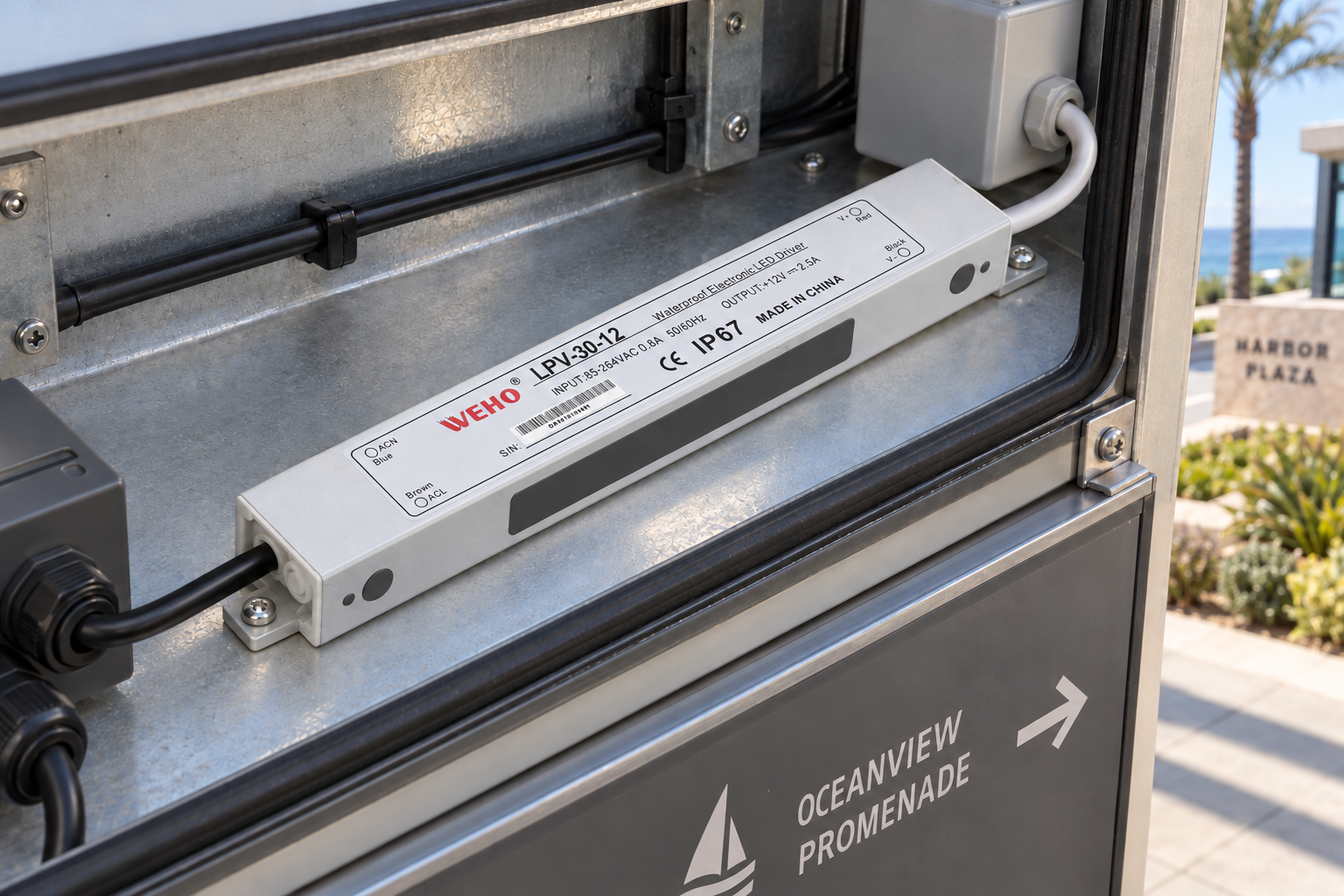
An IP rating is not a salt-spray qualification. It describes enclosure protection under defined conditions; it does not establish how a power supply, its mounting hardware or its cable interfaces will resist a salt-laden atmosphere over time. For an outdoor project, specify the exposure and the required corrosion evidence separately from the ingress-protection requirement.
This distinction matters for coastal signage, sheltered lighting and equipment near roads or process areas where corrosive contamination may be present. A product described as waterproof may be a candidate for the electrical task, but that word is not a complete environmental specification.
Ask two different environmental questions
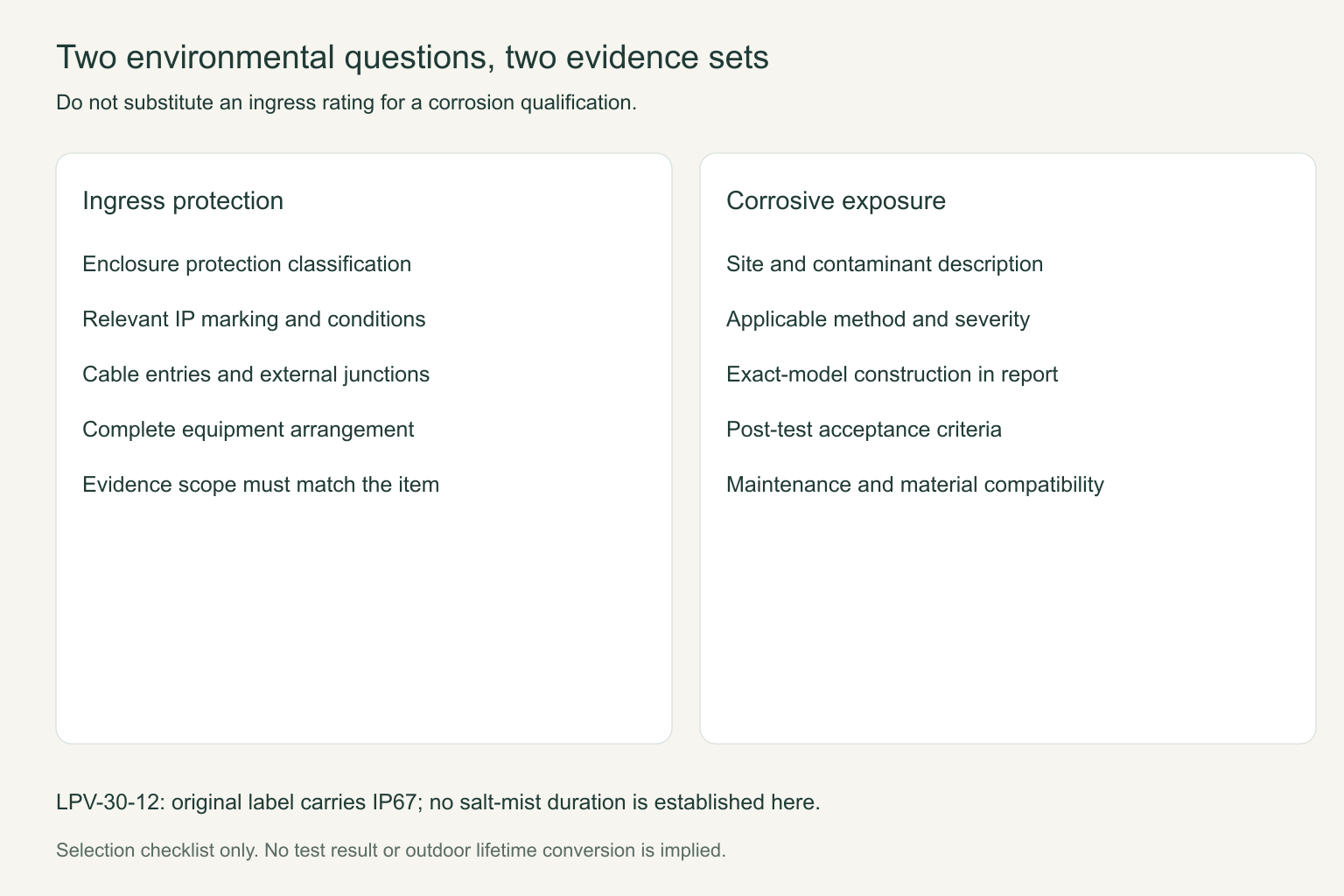
The first question is whether the enclosure provides the required protection against ingress. IEC 60529 addresses the classification of protection provided by enclosures. The second question is whether the materials and assembly are suitable for the project’s corrosive exposure. IEC 60068-2-52, for example, addresses cyclic salt-mist testing of components or equipment exposed to a salt-laden atmosphere. These are different evidence categories; citing one does not demonstrate compliance with the other.
Do not select a test duration by copying a competitor’s headline. Ask which method, severity, exposure sequence and acceptance criteria are relevant to the project. A report must identify the tested model and construction. A result for a different case material, connector or cable-exit design may not answer the question for the delivered assembly.
Describe the site before requesting a corrosion claim
| Project detail | Why procurement needs it |
|---|---|
| Location and exposure | Distinguishes a sheltered inland compartment from a salt-laden coastal environment |
| Water and cleaning | Identifies spray, condensation, cleaning chemicals and any immersion requirement |
| Mounting and interfaces | Includes brackets, fasteners, cable entries and junctions, not just the power supply case |
| Operating conditions | Records load, local temperature, enclosure ventilation and duty cycle |
| Acceptance evidence | Defines the requested test method, exact construction and post-test checks |
| Техническое обслуживание | Determines how seals, fasteners and cable jackets can be inspected or replaced |
These details turn a broad request for an “outdoor power supply” into something a supplier can review. They also prevent the driver from being selected independently of the cabinet, cables and installation hardware that will share its environment.
What the LPV-30-12 reference establishes
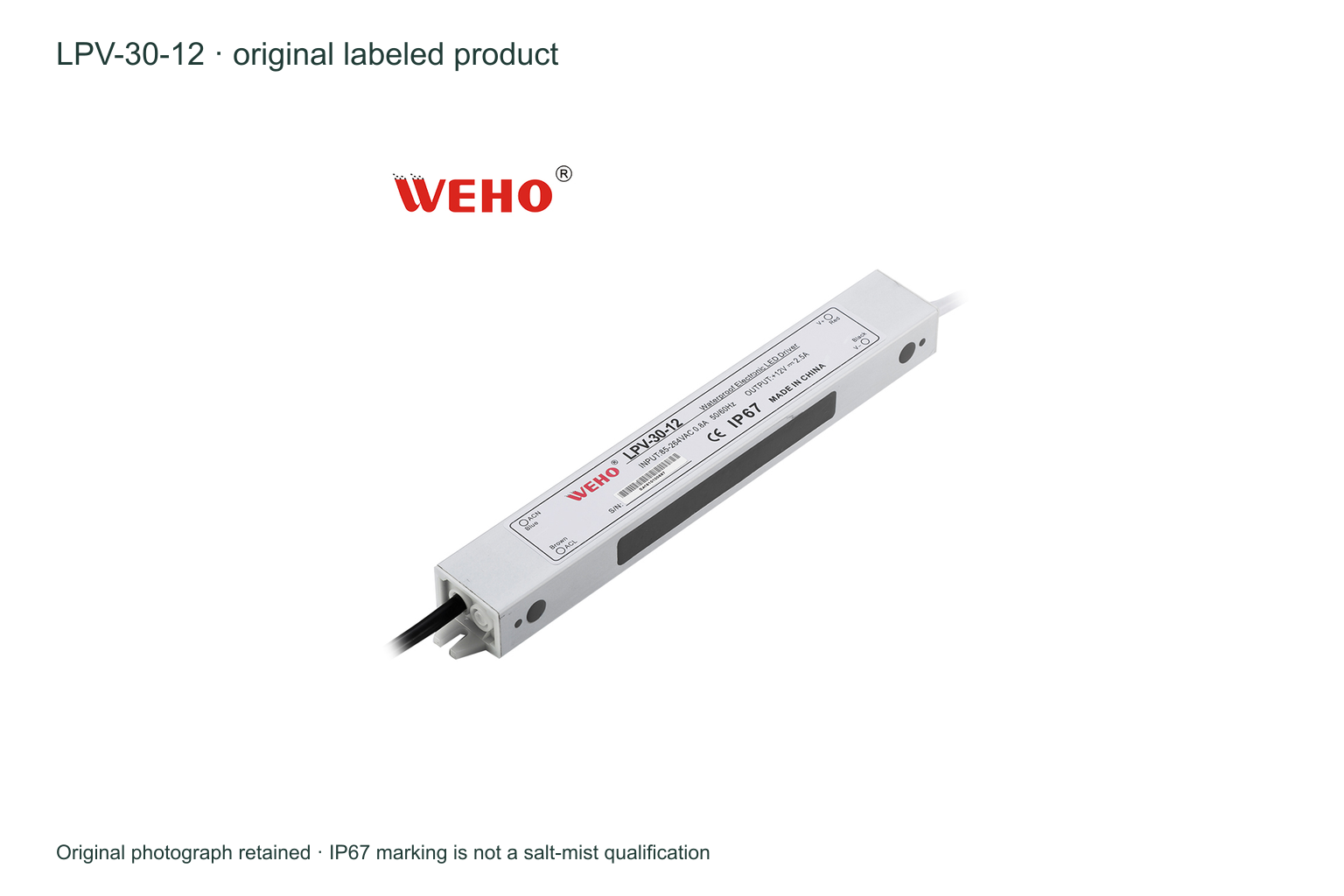
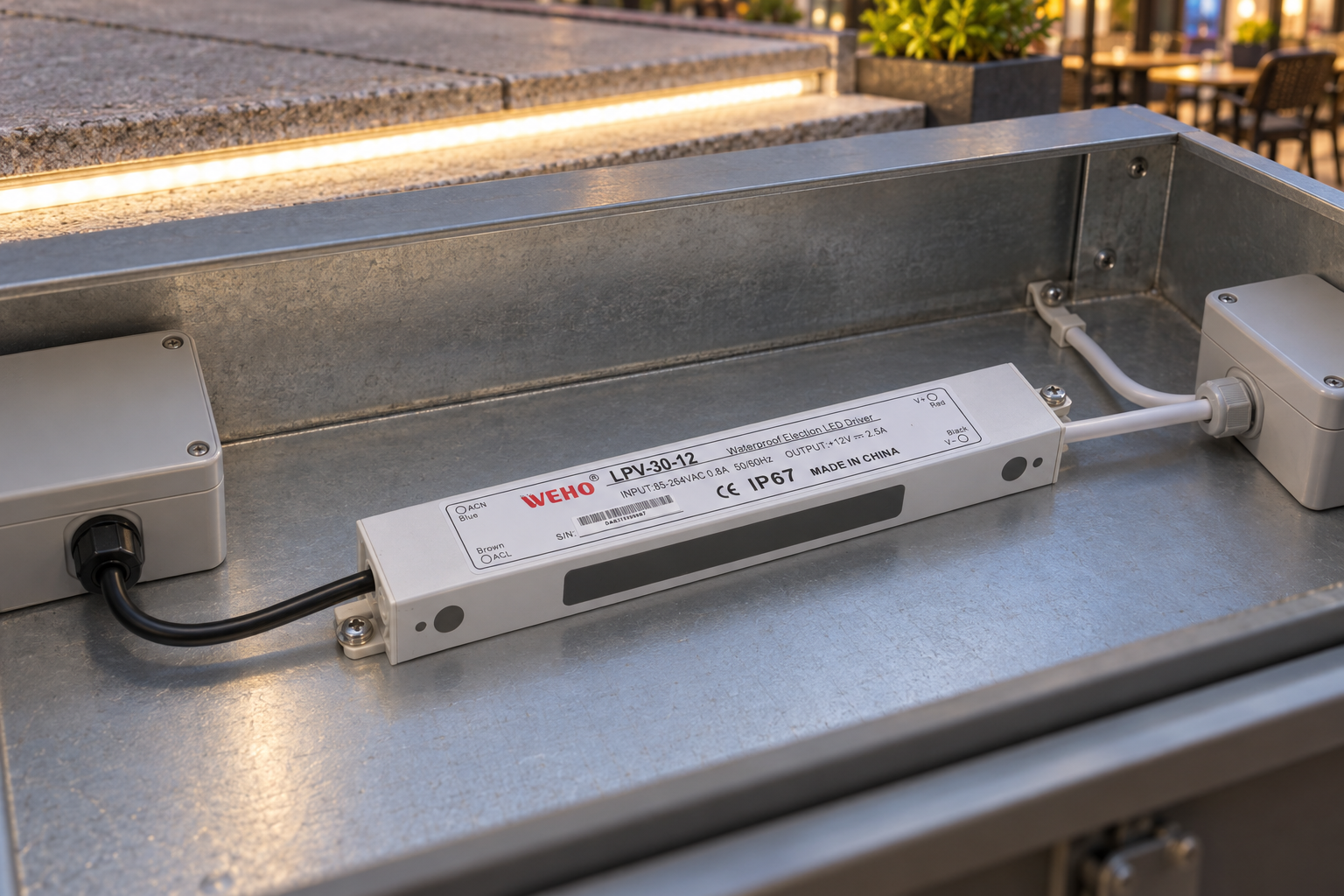
А WEHO LPV-30 family includes the LPV-30-12, a 12 V, 2.5 A, 30 W model. The referenced unit is a slim enclosed driver with factory cable leads at opposite ends and an original slotted mounting provision at each end. Its original label carries an IP67 marking.
Those details support identification and interface planning. They do not provide an exact-model salt-mist report. No corrosion-test duration or coastal service-life value is established by the material used for this example. Consequently, this article does not describe the LPV-30-12 as marine-certified, salt-spray qualified or approved for every coastal installation.
Before selecting it for a corrosive site, request the applicable environmental evidence for the delivered revision. Keep an unresolved requirement open rather than converting the IP marking into an unsupported corrosion claim. Where a project specification requires a particular qualification, obtain the matching report or choose another documented solution.
Review the complete installation, not only the driver
The power supply case is only one exposed surface. Include the fastening hardware, mounting plate, cable jackets, entry fittings and external junction boxes in the environmental review. Ask the relevant suppliers to confirm material and chemical compatibility. Do not assume that a familiar-looking plated screw, rubber seal or cable jacket is suitable for the site’s cleaning or salt exposure.
Use the original mounting provisions and protect the factory cable exits from mechanical loads. Avoid modifying the housing or adding a coating without manufacturer approval: a change intended to improve corrosion resistance can also affect heat transfer, seals, labels or serviceability. Select the enclosure and placement as part of the equipment design, with access for the maintenance that the project requires.
Make the supplier response auditable
A useful response identifies the full model, construction revision and scope of the evidence. If a test report is supplied, check whether it covers the actual power supply or only a material sample. Also check the condition of the item during testing, the exposure method and the functional or visual criteria used afterward. A photograph of a clean unit after an unspecified test is not equivalent to a documented qualification.
Document any conditions attached to the supplier’s recommendation, such as sheltered installation, additional enclosure protection or particular cable accessories. Those conditions should reach the installer and maintenance team, not remain only in an email to purchasing.
Frequently asked questions
Does IP67 mean saltwater cannot damage the product?
No. Do not treat an ingress-protection marking as proof of corrosion resistance or chemical compatibility. Salt-laden exposure needs its own suitability review and supporting evidence.
Can a salt-mist test result be converted directly into years outdoors?
Not from the test duration alone. A service-life claim needs a supported relationship to the actual construction, environment, operating conditions and acceptance definition. This article provides no such conversion.
Should a buyer request coating as the only solution?
No. First define the exposure and required outcome. Any coating choice must be compatible with the product and its thermal, sealing and maintenance requirements; it should not be improvised after delivery.
Prepare a specific outdoor power supply enquiry
Send the lighting load, electrical supply, site description, enclosure drawing, cleaning conditions and required environmental qualification to ВЕОЗ. Ask which claims are supported for the exact proposed model and which require additional evaluation. That creates a clear procurement decision without confusing water protection with corrosion resistance.