Key Engineering Takeaways
- Calculate inverter conversion efficiency from corresponding input and output measurements over the same operating interval.
- State whether DC cable loss and AC distribution loss belong inside the chosen boundary.
- A brief load change can corrupt a ratio made from two unrelated display readings.
- Evaluate the ordered WHP-1500 variant; a maximum-efficiency listing does not describe every operating point.
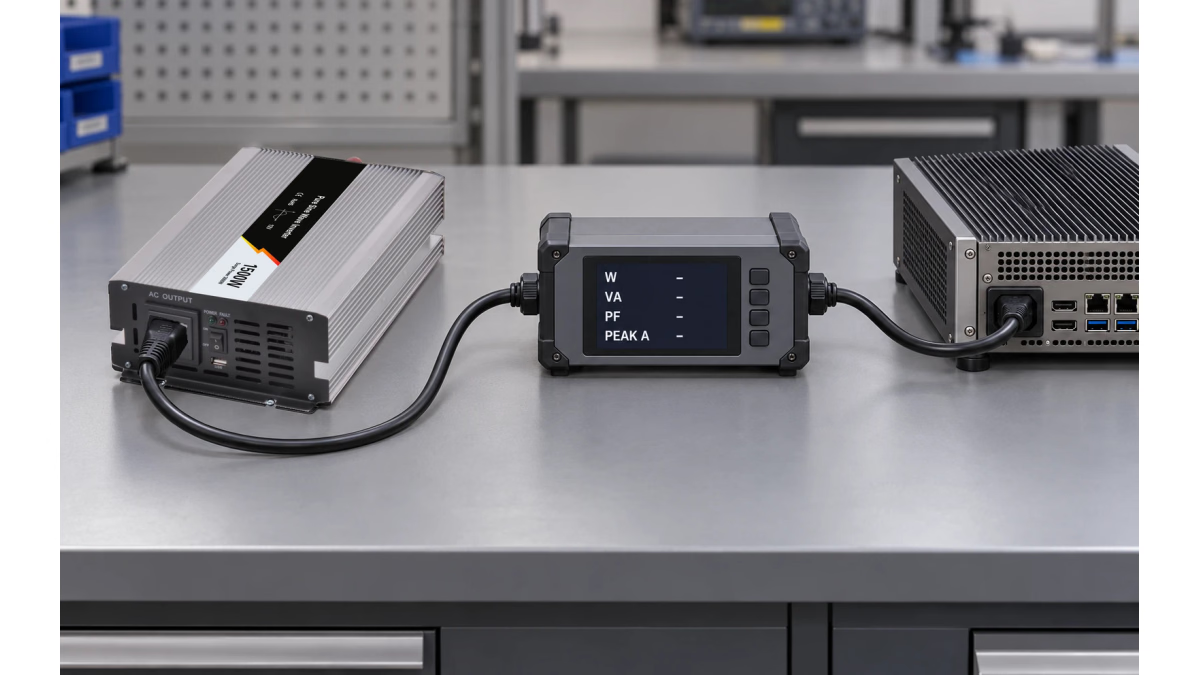
Why can a calculated efficiency look better than the product?
An efficiency result can be wrong even when both instruments are functioning. If the DC reading describes one load state and the AC reading describes another, their ratio is not the inverter's conversion efficiency.
An OEM comparing samples needs a repeatable operating-point record, rather than a photograph of two favorable displays. The decision is whether the candidate satisfies the project's energy and heat budget under defined conditions. That requires matching measurement boundaries and time intervals before comparing numbers.
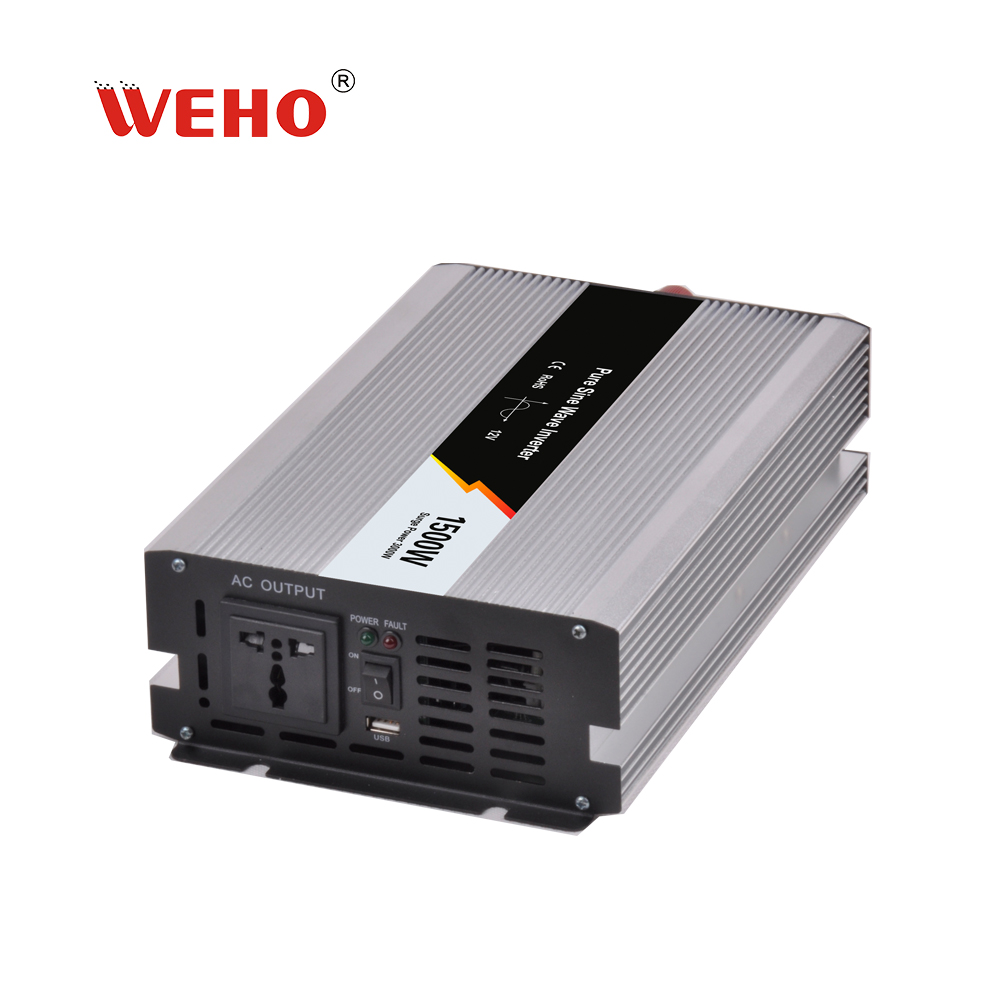
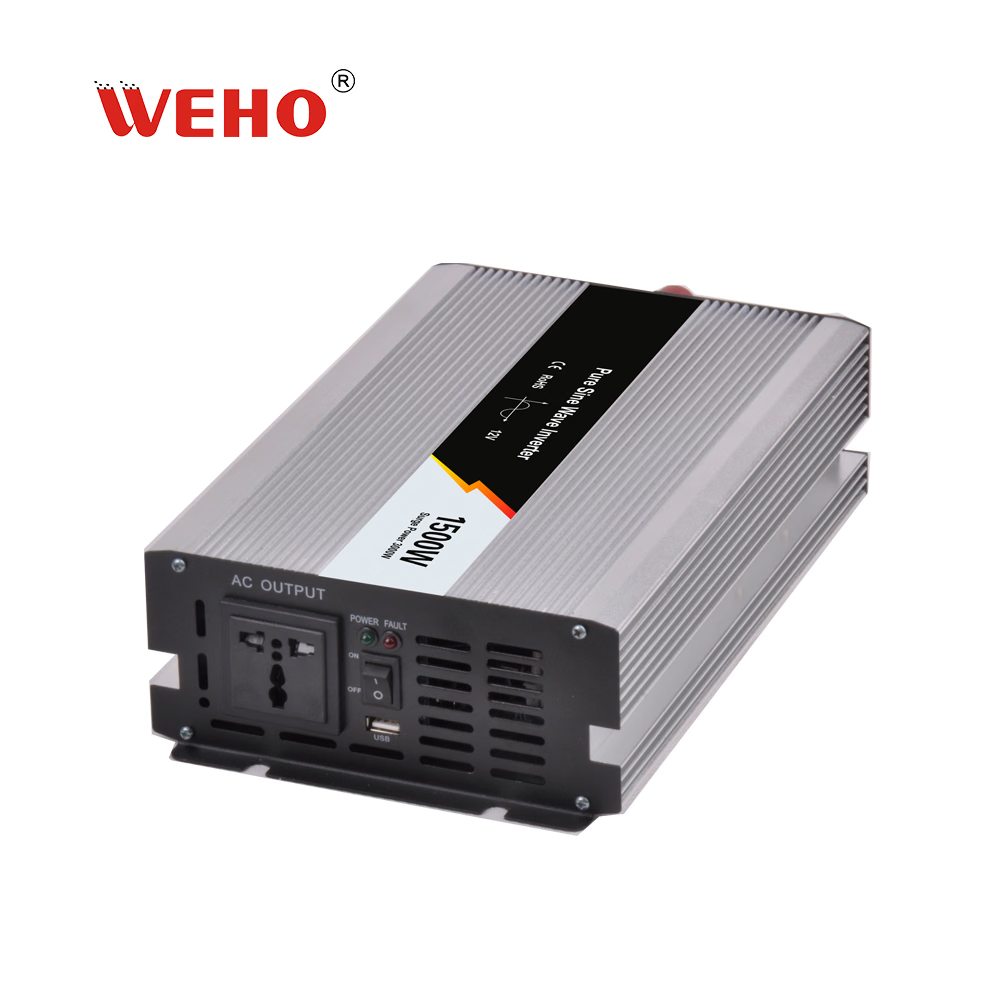
А WEHO WHP-1500 family page identifies a pure-sine inverter family with multiple DC and AC configurations. Its listed maximum efficiency is not an efficiency curve for a particular battery voltage, load waveform and enclosure temperature. Confirm the actual ordered variant and test its relevant operating points.
How should the efficiency calculation be defined?
For a stable, defined operating point, conversion efficiency is η = PAC,out ÷ PDC,in × 100%. For varying power over a selected interval, use the corresponding energy ratio: η = EAC,out ÷ EDC,in × 100%.
Both quantities must use the same interval and compatible electrical boundaries. AC real power requires an appropriate power measurement; RMS voltage multiplied by RMS current gives apparent power, which is not generally real power. DC power should also be measured appropriately when voltage or current varies.
Hypothetical matched-window example
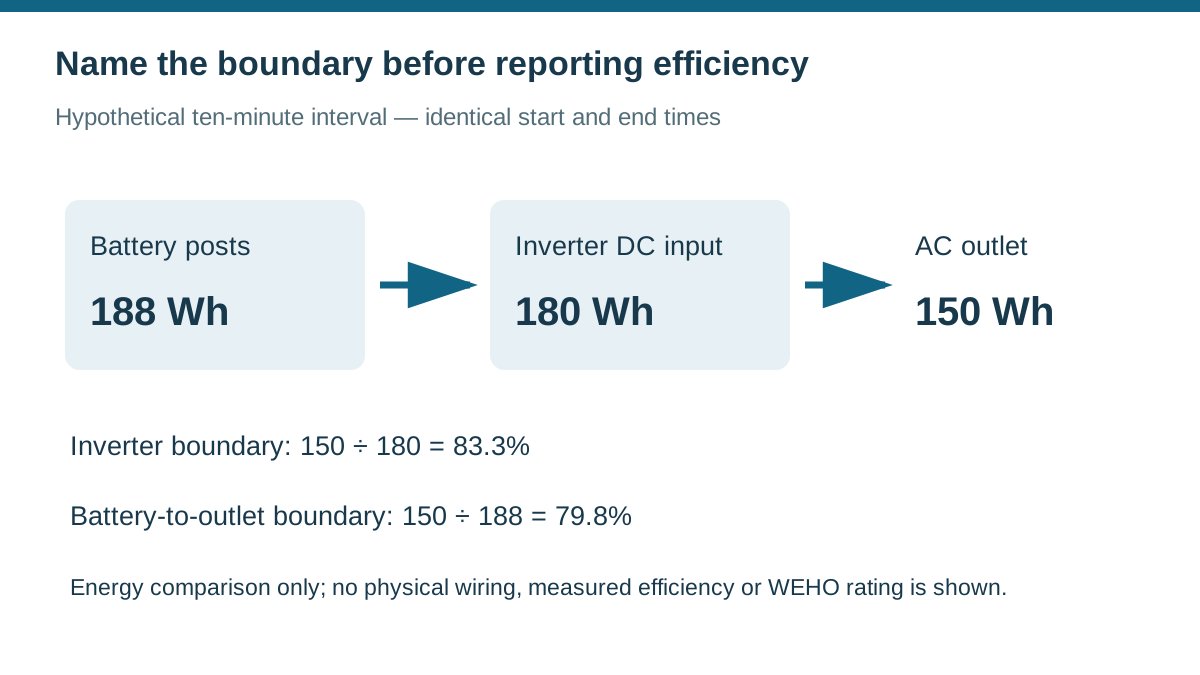
Assume a ten-minute evaluation interval delivers 150 Wh at the inverter's AC outlet while 180 Wh enters at its DC terminals. The interval-average conversion efficiency is 150 ÷ 180 × 100% = 83.3%. The difference is 30 Wh across that boundary during the interval.
A separate battery-terminal measurement records 188 Wh for the same ten minutes. The battery-to-outlet result is 150 ÷ 188 × 100% = 79.8%. The difference between 188 Wh and 180 Wh is 8 Wh assigned to the intervening DC path and any included branches, subject to measurement uncertainty and a correct boundary map.
These two efficiencies answer different questions. Neither number is a WHP-1500 measurement or a promised rating; the example shows why naming the boundary changes the result. The 8 Wh should not be called inverter loss when it was measured outside the inverter input terminals.
Why unrelated readings can fail
Suppose an AC display holds a reading of 900 W from the previous high-load state while a faster DC display has already fallen to 500 W. Dividing 900 by 500 produces 180%. That ratio identifies a timing or interpretation problem; it does not demonstrate energy creation or a superior inverter.
А Yokogawa power measurement fundamentals explain real and apparent power measurement. The project still needs instrument ranges, waveform capability and the actual DC/AC measurement arrangement. A theoretical definition cannot verify a particular test setup.
What belongs in the operating-point matrix?
Build a matrix around the actual load states and expected battery conditions. A single maximum-efficiency number cannot replace it, and a nominal wattage match does not define an instrument's useful range.
| Элемент | Record | Check before comparison | Decision served |
|---|---|---|---|
| DC boundary | Battery posts or inverter input | Included conductors and auxiliary branches | System versus converter efficiency |
| AC boundary | Outlet or load inlet | Cable and distribution inclusion | Delivered useful energy |
| Time window | Start, end and integration settings | Clock offset, reset and missing intervals | Valid numerator and denominator |
| Operating state | Load duty, DC voltage and temperature | Stable point or stated transient interval | Comparable sample result |
| Measurement quality | Ranges, method and uncertainty | Suitability for actual waveforms | Whether a difference is meaningful |
If two candidate results differ by less than the applicable combined uncertainty, do not rank the products from the displayed decimals alone. Review the uncertainty budget, the repeatability of the load and the significance of the difference to the application. More decimal places do not establish better evidence.
Keep no-load consumption as a separately named result when it matters to the duty. At zero useful AC output, the normal output/input efficiency ratio is not a helpful purchase metric. Record the actual input consumption and operating state rather than inventing a flattering efficiency percentage.
How should the test be executed?
Have qualified test personnel establish a protected, correctly rated measurement setup. Do not insert general-purpose meters or exposed probes into a high-energy battery or mains circuit on the basis of this article; follow the equipment and laboratory procedures.
- Draw the measurement boundary. Identify every path entering or leaving it, including auxiliary loads and the DC conductors. Confirm that a bypass path cannot create unrecorded energy flow.
- Record the exact sample configuration. Note inverter identity, ordered DC voltage, AC output voltage/frequency and the load program. The WHP input-voltage selection guide covers a different purchase decision and should not be used to infer this sample's configuration.
- Select measurement ranges and methods for the actual waveforms. Keep the instrument models, calibration status where applicable, wiring boundary and integration settings with the test record.
- Establish a common measurement interval. Use supported synchronization or event alignment, and document residual timing differences. Resetting two counters manually at visibly different times is not synchronization.
- Run the chosen operating points. Retain the full interval, temperatures and any changes in fan or load state. A warm-up procedure must be defined by the project's test plan rather than an invented universal waiting time.
- Reconcile anomalies before publishing a result. A negative loss, an efficiency above 100% or an unexplained step change calls for a boundary, timing and instrument review first.
For cyclic equipment, consider complete operating cycles as well as short operating-point checks. If one run includes a startup event and another begins afterward, their energy ratios are not directly comparable. State which duty the reported result represents.
Also separate the acceptance result from a diagnosis. An elevated battery-to-load loss may come from conductors or other system elements. Comparing the two defined boundaries can locate where investigation should continue without attributing every watt to the inverter.
What should a supplier evaluation request include?
Send WEHO the exact WHP-1500 candidate, battery operating range, load duty, measurement boundaries and required energy or thermal outcome. Include the planned operating points and uncertainty expectations instead of asking only for a headline efficiency.
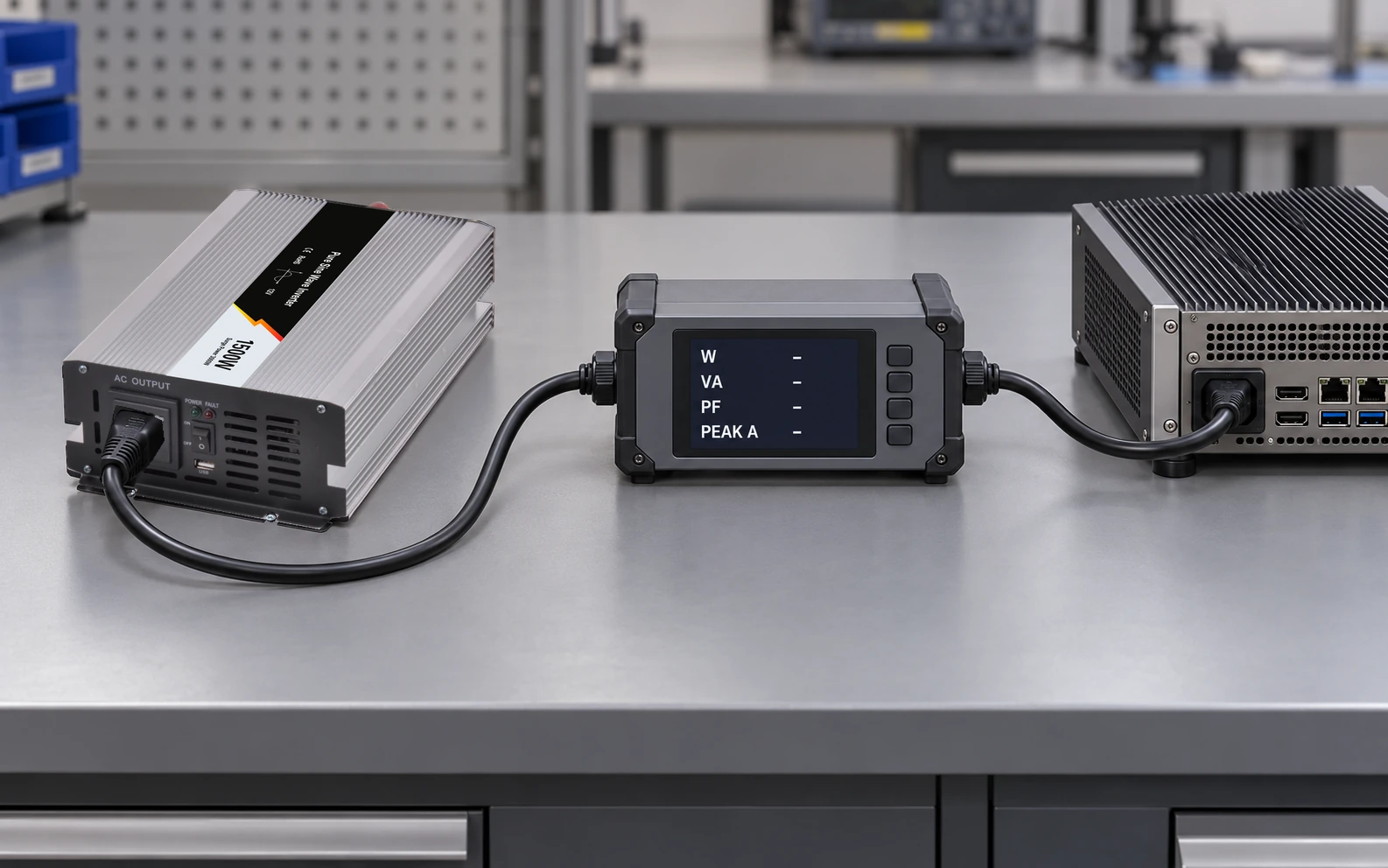
Request the current offered-variant documentation and discuss which sample conditions are representative. Keep any resulting supplier information separate from your own measured results. An illustrated measurement bay does not establish a factory test, certification or product efficiency.
Engineering FAQ
Can RMS volts multiplied by RMS amps give inverter efficiency?
Not by itself. On the AC side that product is apparent power; real power depends on the voltage-current relationship and waveform. Use appropriate real-power or integrated-energy measurements at the defined boundaries.
Should DC cable loss be counted as inverter loss?
Only if the reported metric explicitly includes that cable boundary. Converter efficiency measured at the inverter terminals and battery-to-load efficiency are different metrics. Name each result so procurement compares the same quantities.
Is the listed maximum efficiency the correct pass limit?
Not automatically. A maximum does not describe every operating point or condition. Agree on an application-specific acceptance plan and the documentation for the offered variant before treating any value as a pass criterion.
What should happen if efficiency exceeds 100%?
Review timing, sign, ranges, included paths and stored energy before interpreting the result. A ratio made from different intervals or boundaries is not a valid steady conversion-efficiency result.