- A joint that can be handled has not necessarily reached its required cured properties.
- Keep a standardized fixture-time result separate from an application-specific handling instruction.
- Record adhesive, fastener surfaces, gap, temperature and process history before releasing a batch.
- Apply any threadlocking process only to an approved external joint, with product fastening instructions kept separate.

Define which joint and which release decision matter
A threadlocked bracket can move to the next station before the adhesive has reached the condition required for service. That is acceptable only when the assembly process defines both decisions. A single stamp marked “cured” obscures whether the operator approved gentle handling, a subsequent fastening operation or the complete joint's intended loading.
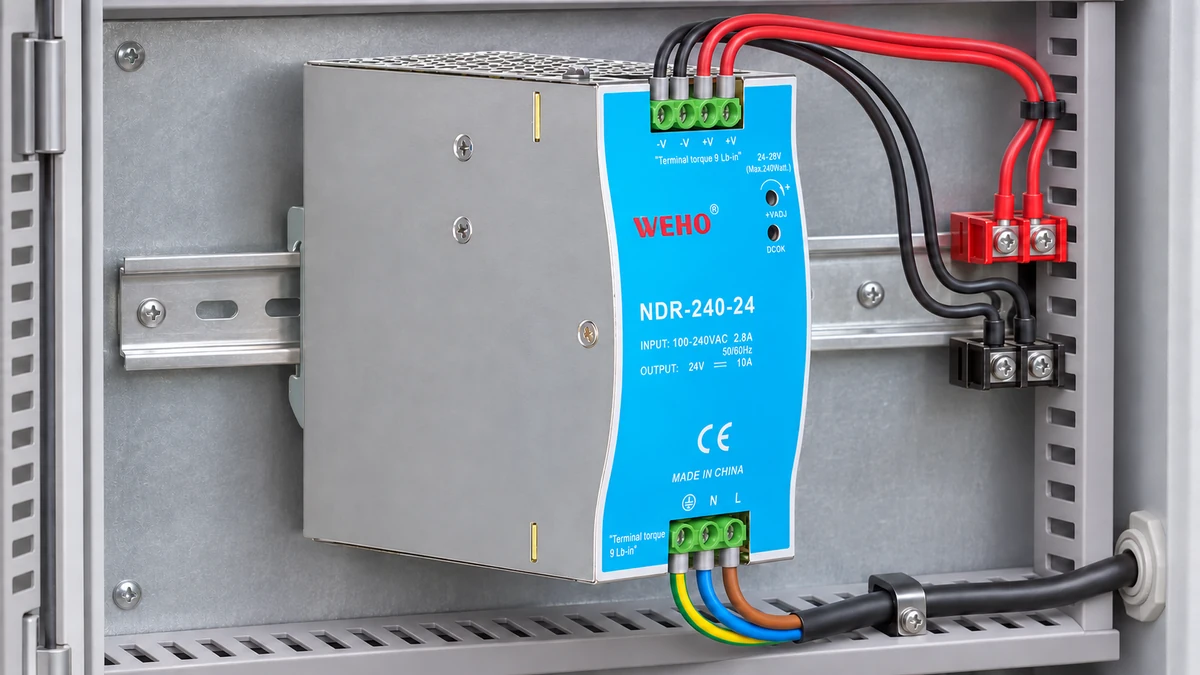
For a cabinet using the WEHO LRS-450-12 product reference, this discussion concerns a separately approved external bracket joint. It does not authorize adding threadlocker to the supply's terminal screws, mounting threads or internal components. The responsible equipment designer must first approve the actual joint, adhesive and tightening process.
Record what the next operation will do to the joint. Turning a fixture, loading a pallet and applying the service load are different demands. The handling instruction should identify the permitted operation and conditions; the final release should identify the properties and evidence needed for the completed assembly.
Distinguish the three time descriptions
Fixture time is a test-defined property rather than a universal permission to handle an assembly. Henkel's threadlocker manual, section 5.4.4, separates laboratory fixture-time descriptions from application-specific handling time. Its definitions help a process engineer ask which test and which assembly condition a quoted time actually represents.
A handling instruction answers a practical production question: can the specified assembly undergo the defined movement now? Its basis can include joint geometry, the mechanical support already present and the planned disturbance. It should not be expanded into approval for a higher load or a later environmental exposure without supporting qualification.
A cured-property record addresses another condition. The LOCTITE 243 technical data sheet reports properties under stated conditioning, including particular 24-hour and one-week conditions. Those entries are evidence for that adhesive and its specified specimens; they are not a universal waiting period that approves every threaded assembly.
| Record field | Question answered | Evidence needed | Invalid substitution |
|---|---|---|---|
| Fixture-time statement | When does the stated test reach its defined condition? | Product, method, specimen and conditions | A generic minute value with no test context |
| Handling release | Can this assembly undergo the permitted next operation? | Qualified application process and actual history | “Feels solid” or an unrelated laboratory value |
| Final joint release | Are the required cured properties and assembly conditions supported? | Applicable qualification and batch process records | Handling approval alone |
| Service suitability | Does the completed joint meet the equipment requirement? | Joint design, loading and environmental evidence | An adhesive strength class by itself |
Control the variables behind the waiting period
An anaerobic threadlocker's cure depends on its actual assembly conditions. The LOCTITE 243 data sheet distinguishes substrate, bond gap, temperature and activator effects. Preserve the conditions behind a curve or property instead of reading only the time axis and applying it to a different metal or clearance.
Henkel's LOCTITE 243 product information provides an identified product context for supplier documentation. Product grade, lot and applicable technical instructions belong in the process traveler. A different bottle, activator or fastener finish is a change requiring assessment, even if the resulting liquid looks familiar.
Record the relevant part temperature, not merely a convenient room reading. A cold fastener brought into a warm room does not instantly adopt the room temperature. Document the measurement approach and any qualification limits that matter to the process; do not apply a generic temperature multiplier to create an unvalidated accelerated cure schedule.

Surface preparation and the tightening sequence also belong in the instruction. Adhesive present between threads can change the friction conditions of assembly, and premature cure can affect later tightening operations. The selected adhesive supplier and joint designer must resolve that combination; the following record example supplies no substitute torque value.
Work a hypothetical two-gate traveler
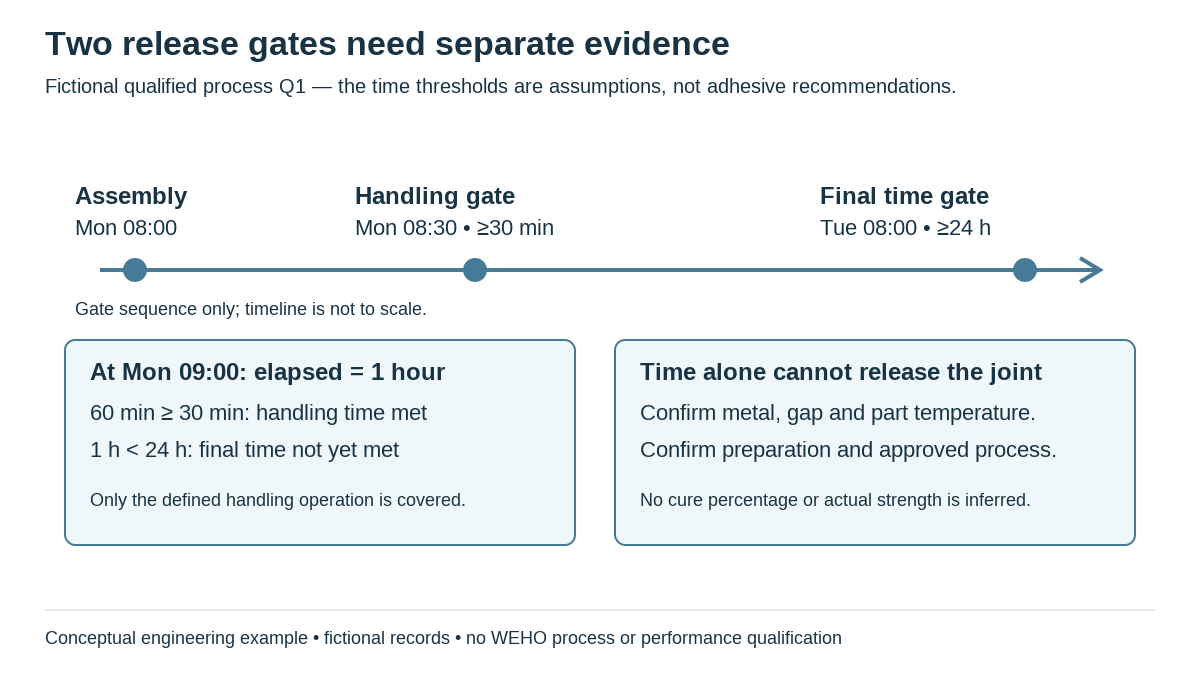
Assume a fictional OEM has qualified an external bracket process Q1. Under its explicitly approved conditions, Q1 permits one defined handling operation after 30 minutes and final joint release after at least 24 hours with the required evidence. These two limits are invented process inputs, not LOCTITE recommendations or WEHO assembly requirements.
Batch A is assembled at 08:00 on Monday and its required temperature and preparation records remain within Q1. At 09:00 Monday, elapsed time is 60 minutes. The time condition for handling is satisfied, but 60/60 = 1 hour is less than the assumed 24-hour final-release condition.
The earliest time condition for final release is 08:00 Tuesday, provided every other Q1 requirement is satisfied. The elapsed-time calculation does not measure chemical conversion or validate the process. It only evaluates one recorded gate in a fictional process whose qualification is an explicit assumption.
| Hypothetical case | Known record | Handling gate | Final-release gate |
|---|---|---|---|
| A at Monday 09:00 | 1 hour; other Q1 conditions recorded | Time condition satisfied for the specified movement | 24-hour time condition not satisfied |
| A at Tuesday 08:00 | 24 hours; other Q1 conditions require confirmation | Previously addressed | Evaluate complete Q1 evidence before release |
| B with missing part-temperature history | Clock time known; qualification coverage unresolved | Hold or obtain an authorized disposition | Hold; elapsed time cannot fill the missing condition |
| Changed fastener finish or activator | Different process configuration | Assess applicability of Q1 | Do not inherit Q1 automatically |
Swipe horizontally on a small screen, or open the full-size diagram.
Suppose a review of 12 travelers finds three without the required temperature record. The observed record gap is 3/12 × 100 = 25%. That percentage identifies the scope needing a quality decision; it is not a measured joint-failure rate or a reason to assume the other nine joints meet every requirement.
Keep an unresolved traveler visible. A subsequent satisfactory inspection can contribute evidence but should not be written as though the missing historical condition had been recorded. Identify the responsible disposition, its basis and the bounded assemblies it covers.
Release the adhesive process as an assembly instruction
- Identify the joint. Record its drawing, materials, finishes, adhesive system and assembly revision. Verify that the approval concerns the external joint being built, with product terminal and internal fastening instructions kept separate.
- Define each gate. Record permitted handling, subsequent operations and final service release. Verify that the acceptance basis answers each decision instead of using one unqualified cure-time field.
- Capture actual conditions. Record preparation, application, assembly time, relevant temperatures and any activator. Verify that the traveler establishes the conditions required by the qualified process.
- Evaluate discrepancies. Record missing data, substitutions or excursions and the affected batch. Verify an authorized disposition before an operator restarts the clock or assumes that extra waiting resolves every issue.
- Maintain the released process. Record changes and any required requalification. Verify that purchasing, assembly and quality use the same material and instruction revisions.
The existing terminal-torque record guide addresses evidence for a tightening operation. Keep that operation linked to the adhesive traveler where relevant, while preserving the separate questions of assembly friction, cure and later residual torque.
Prepare a bounded assembly enquiry
Send WEHO the LRS-450-12 installation identity, external bracket drawing and the exact product-interface question. Identify the adhesive proposal as a separate equipment-design decision. Request applicable mounting information without treating this article as permission to modify a delivered supply.
Before the next batch, name both release gates, confirm qualification coverage and provide a traveler that captures the required conditions. Purchasing can then control substitutions while quality can decide which assemblies have a complete release basis.
Engineering FAQ
Does fixture time mean every assembly can be handled immediately afterward?
No. Fixture time belongs to a stated test, while handling permission must match the actual assembly and intended movement. Use the application's approved handling instruction and retain its conditions.
Does waiting 24 hours automatically qualify a threadlocked joint?
No. Elapsed time alone cannot establish the adhesive, preparation, temperature history, joint geometry or required properties. A published 24-hour conditioning result applies to its identified test conditions, and the actual assembly needs its applicable process evidence.
Can warm room air establish the temperature of a cold bracket?
No. Room air and part temperature can differ during equilibration. Record the temperature boundary required by the process and use a suitable measurement method rather than assuming immediate thermal equality.
May the example be used on power-supply terminal screws?
No. The example concerns an invented process for an approved external bracket. Product terminals, mounting interfaces and internal joints require their own applicable instructions; no adhesive use or tightening value is authorized here.