














การแนะนำ
เมื่อระบบของคุณมีแหล่งจ่ายไฟ DC ที่ไม่ตรงกับแรงดันไฟฟ้าที่โหลดของคุณต้องการคุณจะไปหาตัวแปลง DC-DC การตัดสินใจที่พบบ่อยที่สุดที่ผู้ซื้อ B2B เผชิญนั้นง่ายต่อการระบุ แต่ง่ายต่อการเข้าใจผิด: คุณต้องการ Buck แปลง (ขั้นตอนลง) หรือ เพิ่มแปลง (ขั้นตอนขึ้น)? เลือกที่ไม่ถูกต้องและอุปกรณ์ของคุณจะเห็นแรงดันไฟฟ้าเกินที่ป้องกันการเดินทางหรือแรงดันไฟฟ้าต่ํากว่าที่จะไม่เริ่มต้น คู่มือนี้จะแบ่งความแตกต่างระหว่าง แปลง Step-Up และก แปลงขั้นตอนลง, อธิบายวิธีการทํางานของแต่ละคนและให้วิธีการห้าขั้นตอนในการเลือกโมดูลที่เหมาะสม ในฐานะผู้ผลิตอุปกรณ์จ่ายไฟ DC-DC แบบปิดและแบบบอร์ด WEHO สร้างทั้งสองทิศทาง - และ เจ้าชู้แปลงเพิ่ม สำหรับระบบที่อินพุตสามารถนั่งเหนือหรือต่ำกว่าเอาต์พุตที่ต้องการ.
ไม่แน่ใจว่าโหลดของคุณต้องการขั้นตอนขึ้นหรือขั้นตอนลง?
ส่ง WEHO แรงดันไฟฟ้าขาเข้าแรงดันขาออกและกระแสโหลดของคุณ วิศวกรของเราจะระบุ buck, boost หรือ buck boost converter ที่ถูกต้องและยืนยันกับวัฏจักรหน้าที่และสภาพแวดล้อมของคุณ.
ตัวแปลง DC-DC แบบ Step-Up และ Step-Down คืออะไร
เงื่อนไขเป็นคำอธิบาย A แปลงขั้นตอนลง - สากลเรียกว่า Buck แปลง - ผลิตแรงดันไฟฟ้าขาออกต่ำกว่าอินพุต A แปลง Step-Up - สากลเรียกว่า เพิ่มแปลง - ผลิตแรงดันไฟฟ้าขาออกสูงกว่าอินพุต เนื่องจากพลังงานถูกอนุรักษ์ไว้หน่วย step-down จะให้กระแสเอาต์พุตมากกว่าที่ดึงออกมาในขณะที่หน่วย step-up จะดึงกระแสอินพุตมากกว่าที่ให้.
ความแตกต่างเดียวนี้ไดรฟ์เกือบทุกการตัดสินใจซื้อ หากคุณมี 24V ในรถหรือตู้ควบคุมและจําเป็นต้องให้อาหาร 12V วิทยุเซ็นเซอร์หรือตัวควบคุมที่คุณต้องเจ้าชู้ หากคุณมีแบตเตอรี่ 12V และจําเป็นต้องขับรถ 24V อุปกรณ์อุตสาหกรรมที่คุณต้องการเพิ่ม เมื่อการป้อนข้อมูลสามารถแกว่งทั้งสองด้านของเป้าหมาย - ทั่วไปในระบบแบตเตอรี่ - a เจ้าชู้แปลงเพิ่ม ช่วยให้เอาท์พุทควบคุมไม่ว่าจะเป็นแหล่งที่มาสูงหรือต่ำ สำรวจช่วงเต็มของ ตัวแปลงไฟ DC-DC WEHO ให้บริการในทั้งสองทิศทาง.
ตัวแปลงบั๊กคืออะไร?
A Buck แปลง คือ แปลงขั้นตอนลง ที่ใช้อินพุต DC ที่สูงขึ้นและสลับไปที่เอาต์พุต DC ที่ต่ํากว่าและควบคุม ในแผงอุตสาหกรรมตัวอย่างคลาสสิกคือการแปลงบัส 24V เป็นราง 12V ที่สะอาดสําหรับเซ็นเซอร์ PLC I / O หรือโมดูลการสื่อสาร เนื่องจากเอาต์พุตต่ํากว่าอินพุตกระแสเอาต์พุตที่มีอยู่จะสูงกว่ากระแสอินพุต (อีกครั้งลบการสูญเสียการแปลง) ซึ่งทําให้ขั้นตอนเจ้าชู้เหมาะสําหรับการให้อาหารโหลดแรงดันต่ําจํานวนมากจากแหล่งจ่ายไฟแรงดันสูงเดียว.
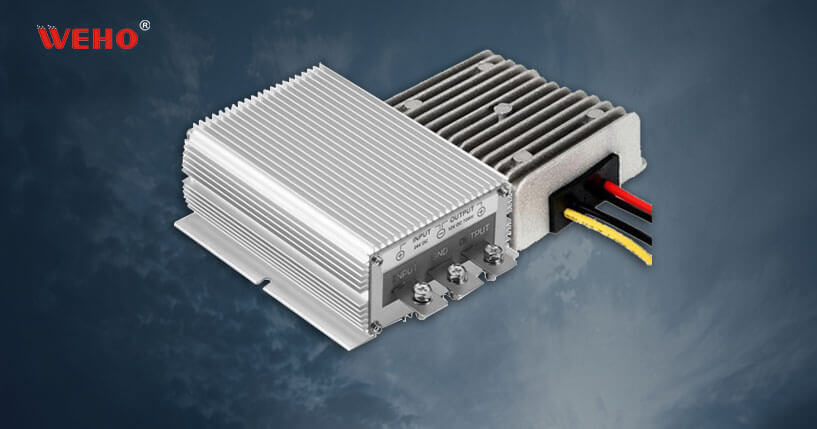
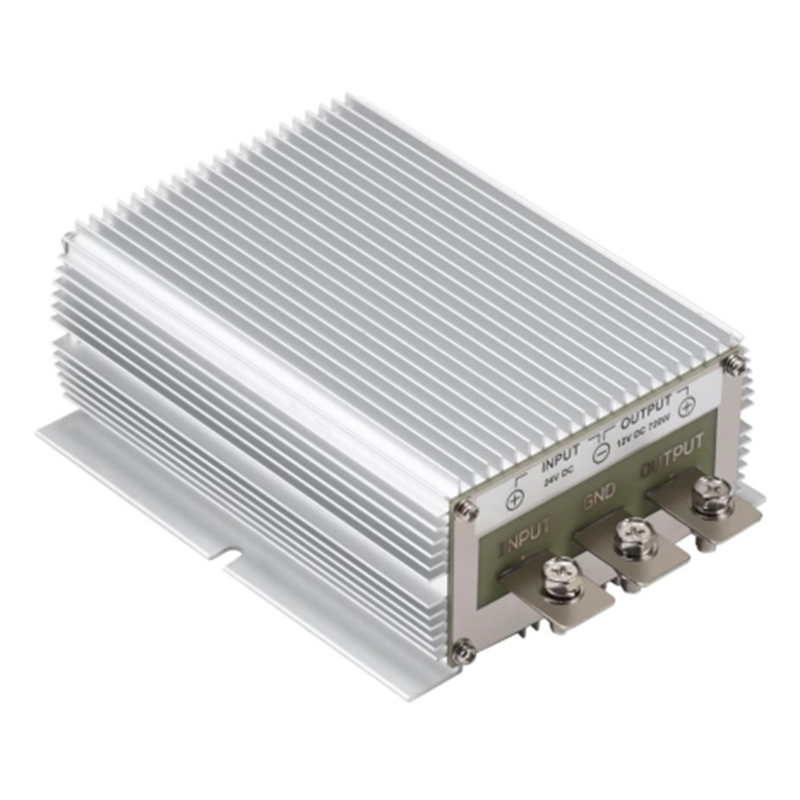
หน่วยขั้นตอนลงของ WEHO สําหรับงานนี้คือ 24V เพื่อ 12V เจ้าชู้แปลง: อินพุต 24V, เอาต์พุต 12V ที่ 50A (600W) สร้างขึ้นเพื่อการปฏิบัติหน้าที่ในอุตสาหกรรมอย่างต่อเนื่อง หน่วย WEHO DC-DC ทุกเครื่องผ่านการทดสอบการเผาไหม้เต็มรูปแบบที่อุณหภูมิสูง 100% ก่อนส่งดังนั้นข้อบังคับและการป้องกันที่คุณอ่านในแผ่นข้อมูลคือข้อบังคับที่คุณได้รับในสนาม.
Boost Converter คืออะไร?
A เพิ่มแปลง คือ แปลง Step-Up ที่ใช้อินพุต DC ที่ต่ํากว่าและสลับไปที่เอาต์พุต DC ที่สูงขึ้นและมีการควบคุม กรณีตําราเรียนเป็นแบตเตอรีแบตเตอรี 12V ที่ต้องใช้พลังงานจากอุปกรณ์ 24V เช่นเครื่องมือภาคสนามมอเตอร์หรือแสงสว่างโดยไม่ต้องเปลี่ยนการกําหนดค่าแบตเตอรี่ ขั้นตอนการเพิ่มกําลังจะดึงกระแสมากขึ้นในด้านอินพุทดังนั้นการเดินสายไฟและการหลอมรวมต้องมีขนาดสําหรับกระแสอินพุตที่เพิ่มขึ้น.
สําหรับสถานการณ์ที่แน่นอน WEHO เสนอ 12V เพื่อ 24V แปลงเพิ่ม: 12V input, 24V output at 30A (720W). It is a single-direction step-up module, not an energy-recovery or storage device. Knowing when to use a แปลง Step-Up versus a step-down one is the difference between a clean install and a rework order.
วิธีการทําบั๊กและเพิ่มแปลงทํางาน?
Both topologies are switched-mode regulators that share the same building blocks: a power switch (MOSFET), an inductor, a diode or synchronous rectifier, input and output capacitors, and a controller IC with a feedback loop. The controller pulses the switch on and off at a fixed frequency. During the “on” time, energy is stored in the inductor; during the “off” time, that energy is released to the output. By varying the ratio of on-time to total period — the duty cycle — the converter sets the output voltage.
The key mechanical difference is where the switch and inductor sit relative to the load. In a buck stage the high-side switch is in series with the input and the inductor feeds the output, so the output is always below the input. In a boost stage the switch sits on the ground return and the inductor sits on the input side, so the output is always above the input. The output capacitor smooths the switched waveform into a steady DC rail, and the feedback loop continuously trims the duty cycle to hold the setpoint. WEHO’s enclosed DC-DC modules integrate this entire stage into a sealed, DIN-rail- or chassis-mount package rated for industrial environments, with a catalog spanning 1000+ models and full OEM/ODM support.
บั๊ก VS Boost แปลง: ความแตกต่างที่สำคัญ
ทิศทางแรงดันไฟฟ้า
A Buck แปลง only steps down; a เพิ่มแปลง only steps up. A เจ้าชู้แปลงเพิ่ม (such as WEHO’s WH-D / SD-series wide-input modules) handles both, regulating a fixed output even when the input crosses above and below it.
สลับตําแหน่งในวงจร
In a buck stage the high-side switch sits between input and inductor; in a boost stage the switch sits between inductor and ground. This layout difference is why the two schematics look mirror-image and why the same controller IC is configured differently for each topology. It also dictates where the freewheeling path and the main current loop sit.
ช่วงรอบหน้าที่ทั่วไป
Buck output equals input times the duty cycle (Vout = Vin × D), so D must be less than 1 and is typically well under 50% for a large step-down. Boost output equals input divided by (1 minus duty cycle) (Vout = Vin / (1 − D)), so D stays below 1 but approaches it as you ask for more step-up. The math sets hard limits on how far each topology can move the voltage in one stage.
ลักษณะประสิทธิภาพ
Both are efficient switched regulators, well into the 90% range for modern designs. Buck stages tend to be marginally more efficient at modest step-down ratios; boost stages lose a little more as the step-up ratio grows because input current rises. Synchronous rectification and good thermal design — standard on WEHO’s SD series DC-DC — recover most of that margin.
กระแสไฟขาออก
Because power is conserved, a step-down converter delivers more output current than it draws, while a step-up converter draws more input current than it delivers. Size input wiring and fusing for the boost’s higher input current; size output wiring for the buck’s higher output current.
แอปพลิเคชันทั่วไป
Buck stages dominate 24V to 12V and 48V to 12V distribution in vehicles, cabinets, and telecom. Boost stages dominate 12V to 24V and similar low-to-high jumps for battery-fed equipment. The เจ้าชู้แปลงเพิ่ม earns its place in battery systems where state-of-charge pushes the source above and below the load’s requirement.
วิธีการเลือกระหว่าง Buck และ Boost Converter
ขั้นตอนที่ 1: ตรวจสอบแรงดันไฟฟ้าขาเข้า
Measure the real minimum and maximum DC voltage at the source under load and no-load, including cranking or brownout dips. A เจ้าชู้แปลงเพิ่ม is the safe choice when that range crosses your target output, because a plain buck or boost cannot regulate once the input passes to the wrong side.
ขั้นตอน 2: ตรวจสอบแรงดันขาออกที่จำเป็น
Write down the exact output voltage your load needs, with its tolerance. If the target is below your measured input, the answer is a step-down converter; if it is above, the answer is a step-up converter. Confirming output voltage before topology saves a redesign later.
ขั้นตอนที่ 3: คํานวณความต้องการกระแสไฟฟ้าและพลังงาน
Note the load’s continuous current plus inrush. For a step-down converter, size output current headroom; for a step-up converter, size input current and wiring for the higher draw. Multiply output voltage by output current to get the wattage, then add margin for efficiency loss.
ขั้นตอนที่ 4: พิจารณาข้อกําหนดด้านประสิทธิภาพ
Decide how much loss your system can tolerate. A buck is usually slightly more efficient at small ratios; a boost loses more as the ratio grows. If cooling is tight, favor a topology and a model with synchronous rectification and a wide operating temperature range.
ขั้นตอนที่ 5: ตรวจสอบคุณสมบัติการป้องกัน
Confirm over-voltage, over-current, over-temperature, and short-circuit protection, plus the sealing and temperature rating for your cabinet or vehicle bay. WEHO units carry ISO9001 / CE / RoHS / FCC / CCC certifications and a 100% high-temperature full-load burn-in. Our power modules and DC-DC lines support OEM/ODM customization across 1000+ models.
Use the selector below to map your voltage need to the right topology and a concrete WEHO model.
| Your voltage need | Choose | WEHO example |
|---|---|---|
| Output lower than input (e.g., 24V → 12V) | Step-Down (Buck Converter) | 24V to 12V 50A 600W DC-DC converter |
| Output higher than input (e.g., 12V → 24V) | Step-Up (Boost Converter) | 12V to 24V 30A 720W DC-DC converter |
| Input swings above and below output (battery) | Buck Boost Converter (WH-D) | SD series enclosed DC-DC |
A live topology calculator — enter V_in and V_out, get buck / boost / buck-boost — is the natural next step beyond this static table and is recommended as a calculator plugin on the product page.
Specify your buck, boost, or buck boost converter with WEHO
Share your input range, output, and load current and get a data-backed recommendation from a power-supply manufacturer with 1000+ models and full OEM/ODM support.
คำถามที่พบบ่อย
ความแตกต่างที่สำคัญระหว่างเจ้าชู้และเพิ่มแปลงคืออะไร?
A Buck แปลง (step-down) outputs a lower voltage than its input; a เพิ่มแปลง (step-up) outputs a higher voltage. The difference is the switch and inductor placement, which sets whether the duty cycle scales the voltage down or up. A เจ้าชู้แปลงเพิ่ม covers both directions in one module.
เป็นเจ้าชู้แปลงมีประสิทธิภาพมากขึ้นกว่าแปลงเพิ่ม?
Both are efficient switched regulators, typically in the 90%+ range. A Buck แปลง is usually marginally more efficient at small step-down ratios, while a เพิ่มแปลง loses a little more as the step-up ratio grows because input current rises. The gap is rarely the deciding factor.
สามารถแปลงเป็นทั้งเจ้าชู้และเพิ่ม?
Yes — but not by mixing a plain buck and a plain boost in one box. A เจ้าชู้แปลงเพิ่ม uses a single-direction topology that regulates a fixed output whether the input is above or below the target. WEHO’s WH-D / SD-series modules are single-direction buck boost converters built for exactly this, commonly in battery systems where state-of-charge shifts the source across the load voltage.
ซึ่งแปลงจะใช้สำหรับการชาร์จแบตเตอรี่?
For charging from a DC source, the converter must raise or lower the source to the battery’s charge profile. A 12V source feeding a 24V battery bank uses a แปลง Step-Up; a higher bus feeding a lower battery uses a แปลงขั้นตอนลง. When the source swings across the battery voltage, a เจ้าชู้แปลงเพิ่ม holds the correct charge voltage. WEHO’s DC-DC range and SC-series chargers cover these profiles.
บทสรุป
การเลือกระหว่างก Buck แปลง และก เพิ่มแปลง comes down to one question: is your output above or below your input? Step-down for 24V to 12V distribution, step-up for 12V to 24V battery feeds, and a เจ้าชู้แปลงเพิ่ม for inputs that cross the target. Match the topology to a real, tested module, confirm protection and environment, and validate with a sample before scale-up. WEHO’s DC-DC range is built, burned-in, and certified for industrial duty, with OEM/ODM support across 1000+ models. When you are ready, contact WEHO for a free quote matched to your exact application.