Telecom Backup Inverters: Separate AC Auxiliaries from the DC Plant
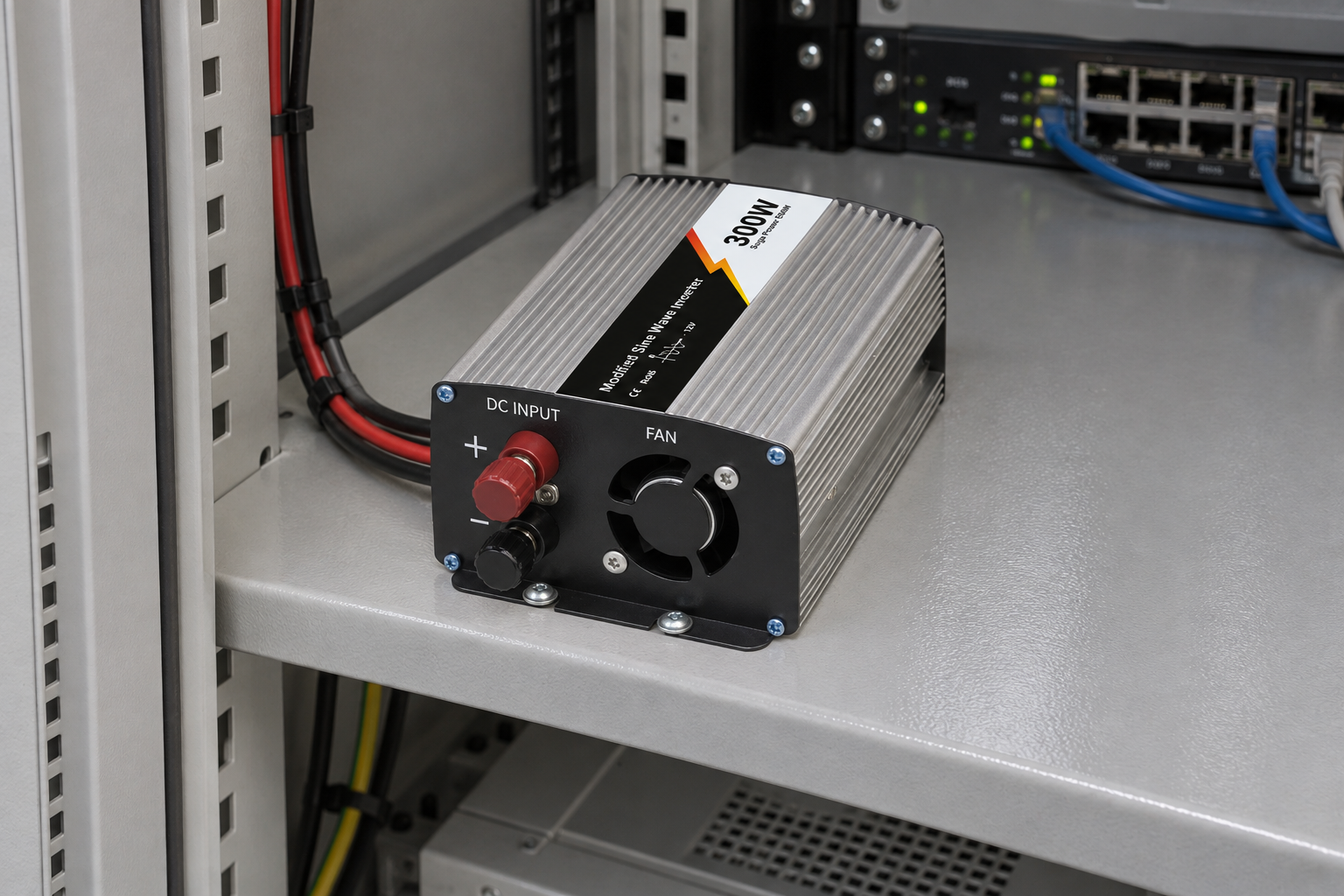
A telecom backup enquiry should distinguish the site’s DC network from the AC auxiliaries that actually need an inverter. Start with a load inventory and one-line architecture, not a single “base-station watts” figure. A small battery inverter may be evaluated for a defined auxiliary task; it does not automatically become a telecom DC plant, a rectifier, a UPS or a redundant site-power system.
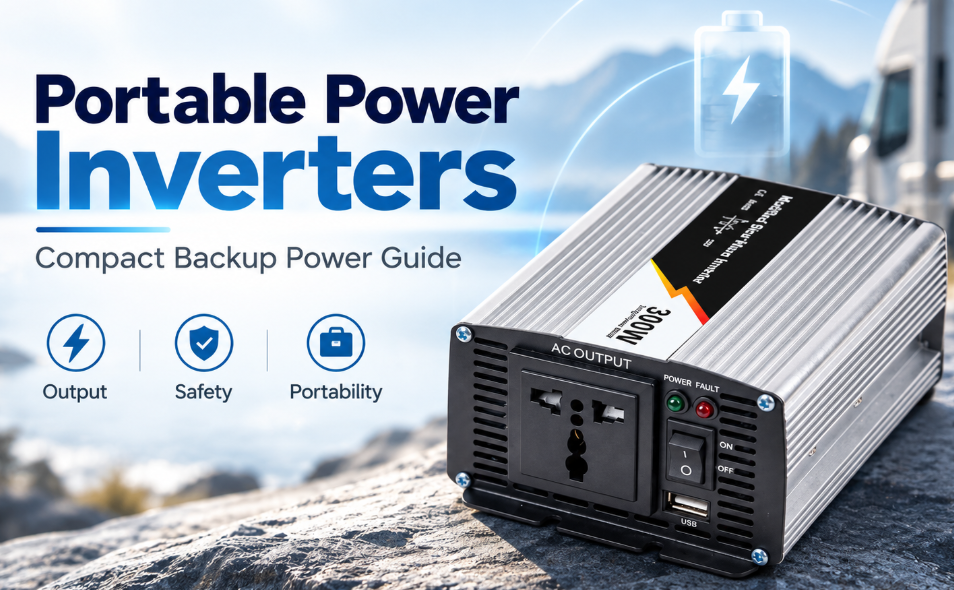
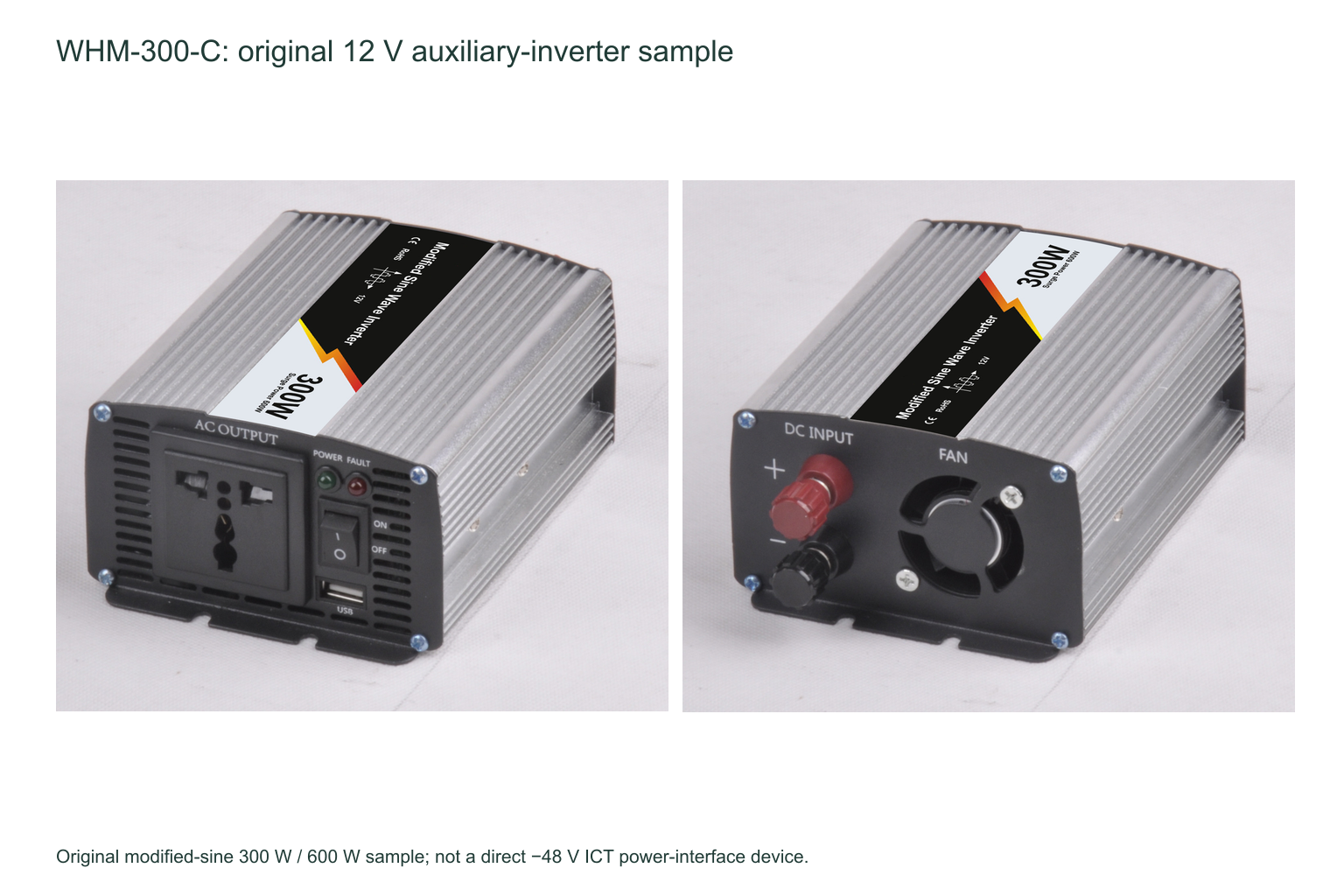
The WHM-300-C example makes that distinction concrete. The photographed unit is marked 12 V, “Modified Sine Wave Inverter,” 300 W and “Surge Power 600W.” Its source sheet gives a 10–15.5 V input range for the 12 V option. It is not a direct substitute for a −48 V telecom power interface, and this article does not claim telecom qualification for the sample.
Separate the three interfaces in the RFQ
| Interface | Information to obtain | Unacceptable assumption |
|---|---|---|
| Site DC source | Voltage range, polarity/reference, charging conditions and protective distribution | “48 V” and “12 V” products can share the same direct input |
| Required AC auxiliary | Exact equipment, voltage, frequency, waveform acceptance and startup demand | Every small AC load accepts modified sine wave |
| Continuity and supervision | Allowed interruption, restart behaviour, alarms and maintenance needs | An inverter socket implies UPS transfer or remote monitoring |
ETSI’s EN 300 132-2 record identifies a specific −48 V DC interface for ICT equipment. That scope illustrates why the reference and electrical interface belong in a telecom specification. It is not a compliance claim for this WHM unit, nor a reason to assume every device at the site uses that interface.
Identify the auxiliary load before selecting the waveform
List which loads need AC during an outage and which can remain on their specified DC supply. An AC service instrument, local maintenance appliance and network equipment power input can have very different requirements. Obtain the receiving equipment manufacturer’s permitted voltage, frequency and waveform, including any restrictions, before offering a modified-sine inverter.
The WHM sheet presents separate ordered AC-output and DC-input variants. The socket appearance does not identify the actual output voltage or frequency. Request the offered unit’s configuration record and label photograph. Do not replace the photographed 12 V sample with a 48 V option in a drawing while keeping the same physical evidence.
Turn the uptime target into an energy requirement
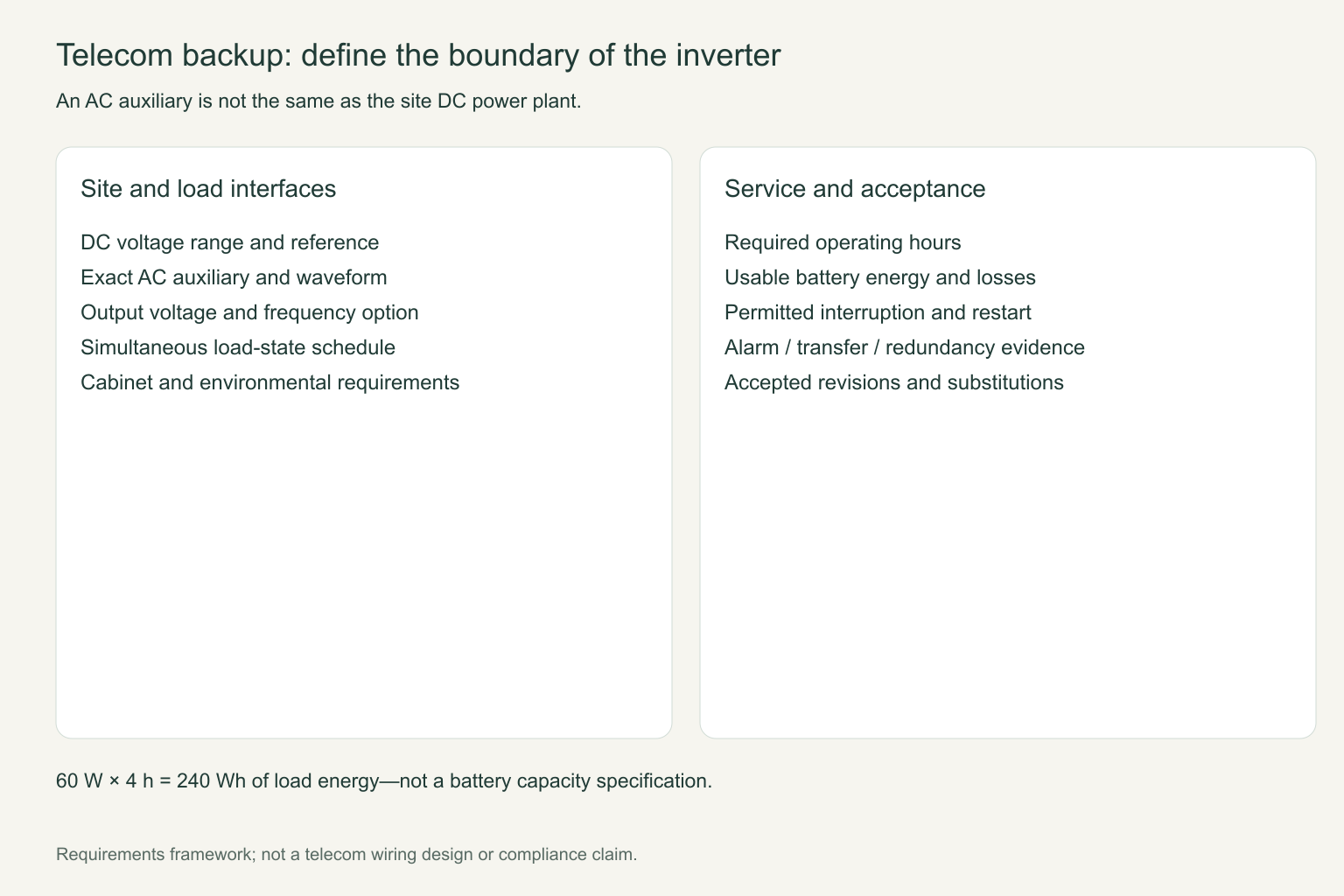
Define the essential loads, their simultaneous operating states and required duration. As a planning example, a constant 60 W auxiliary operating for four hours consumes 240 Wh at its input. That is load energy, not a battery capacity recommendation: inverter losses, idle demand, battery operating limits and reserve requirements still have to be included using the actual system data.
Use the load schedule to decide whether an inverter is even the appropriate path. Avoid adding an AC conversion step solely because the available unit has a familiar outlet. Any alternative DC path must be designed and qualified for the receiving equipment; it cannot be improvised from nominal voltage alone.
Specify interruption, fault and recovery behaviour
Ask how the auxiliary should behave when normal power disappears, the battery reaches its permitted limit or power returns. State the maximum interruption the load can tolerate and whether it restarts automatically. The available WHM source does not establish an automatic transfer time, charger function, remote alarm interface or N+1 operation.
If the project requires uninterrupted service or supervised redundancy, request a system explicitly designed for those functions. Do not bridge outputs or add an undocumented transfer arrangement during commissioning. The complete power path and protective measures need an approved design.
Control installation and repeat-order changes
The source identifies the compact C chassis as 162 × 106 × 63 mm, with a front AC interface and rear DC posts beside the fan. Keep the original mounting flanges, fan path and cable access in the equipment layout. The source does not establish an outdoor environmental rating or a completed telecom-cabinet thermal test.
For an auxiliary evaluation, agree checks of identity, load compatibility, startup, steady operation, low-input response and recovery in the intended cabinet. Record the actual AC output option, battery arrangement and receiving equipment revision. Retain the accepted sample and specify notification of substitutions that could affect waveform, protection, cooling or terminals.
Buyer FAQ
Can the photographed 12 V unit connect directly to a −48 V telecom bus?
No. The sample’s documented input range does not match that interface. Specify a suitable engineered architecture; neither the model family’s alternative options nor a connector change resolves the mismatch.
Does a 300 W rating establish four hours of backup?
No. Watts describe power, while duration depends on load energy and the usable storage and conversion system. Specify both the load profile and the required service period.
Send WEHO an auxiliary-power enquiry with the site DC interface, exact AC loads, waveform requirements, interruption target and required documentation. Ask whether an offered inverter is appropriate for that limited role before discussing a repeated supply order; no site-level reliability or delivery commitment follows from this example.