Key engineering takeaways
- An out-of-tolerance finding starts an impact assessment; it does not identify every affected unit.
- Match the failed function and range to actual earlier use.
- Preserve as-found data and distinguish conditional calculations from historical facts.
- Repairing the instrument does not close earlier product dispositions.
An out-of-tolerance calibration result requires a traceable review of earlier acceptance decisions that could depend on the affected measurement capability. Begin with the actual calibration finding, instrument use and applicable acceptance requirements. Do not assume that every prior unit failed, or that a current adjustment resolves the historical question.
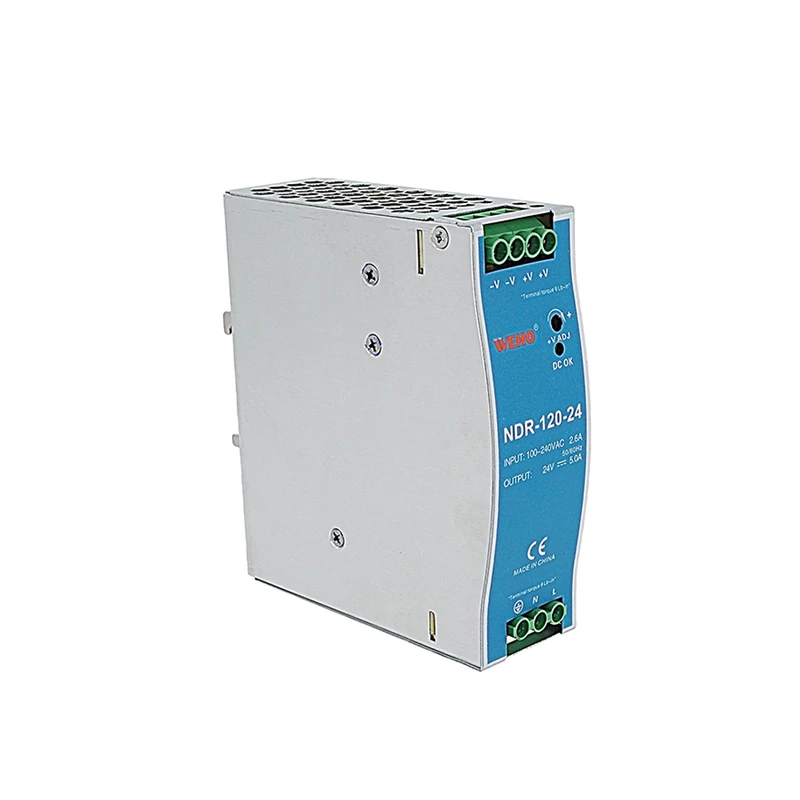
For an OEM inspecting the WEHO NDR-120-24, the relevant output is a bounded unit-and-decision impact record. The model provides an enquiry identity, not a claim that a WEHO instrument was out of tolerance. All voltages and lot counts below are fictional and do not define the product's specification.

Preserve the calibration finding before interpreting it
As-found data describe the observed condition before adjustment or repair. As-left data describe the condition after service under the reported calibration requirements. Request both where relevant, including function, range, test point, result, uncertainty and decision rule; a single overall status discards information needed for the review.
SIMCO's guidance on documenting OOT impact connects the finding to actual prior use and supporting records. A failed resistance function may have no direct relevance to an application that used only an unaffected voltage function. That exclusion still needs a documented identity and evidence chain.
A current as-found deviation does not establish when the condition began. The instrument may have drifted gradually, changed after an event or behaved intermittently. Avoid assigning a halfway date, a linear trend or a constant historical correction without evidence that supports that model.
The instrument's calibration tolerance and the product's acceptance requirement answer different questions. A calibration failure can matter greatly to one application and little to another. Compare the affected capability with the actual measurement process, including its range, uncertainty contributors and decision rule.
| Evidence | Question answered | Useful record | Remaining limit |
|---|---|---|---|
| As-found calibration | What was observed before service? | Function, point, deviation and uncertainty | Does not establish onset |
| Instrument usage | Which earlier work used that capability? | Station, time, range and unit identity | Missing links widen uncertainty |
| Application requirement | Could the decision be sensitive? | Limits and original decision rule | Not identical to calibration tolerance |
| As-left calibration | What condition followed service? | Post-service results and authorization | Does not close historical impact |
Bound the affected population with actual use
An initial search interval may extend from the last relevant documented acceptable condition to discovery. Treat that interval as a scope for investigation, not proof that the instrument was wrong throughout it. Intermediate checks or a documented damage event may help refine the review when their relevance is established.
Transcat's OOT evaluation discussion organizes the investigation around what, when, where and how the instrument was used. Connect each candidate measurement to the failed capability before performing detailed calculations. Record why a population was included or excluded rather than relying on a blanket date filter.
A serial-number trail is stronger than an unexplained production total. Identify which station used the instrument, which recipe selected its affected range and which units received the corresponding result. A shared instrument moved between lines may create several populations with different requirements and exposure to the finding.
Missing usage records do not justify a claim of no impact. State the missing link and choose a conservative investigation boundary under the responsible quality process. Independent measurements, retained units and reliable process evidence may support a disposition, but their relevance must be shown rather than assumed.
Use a conditional example without backdating certainty
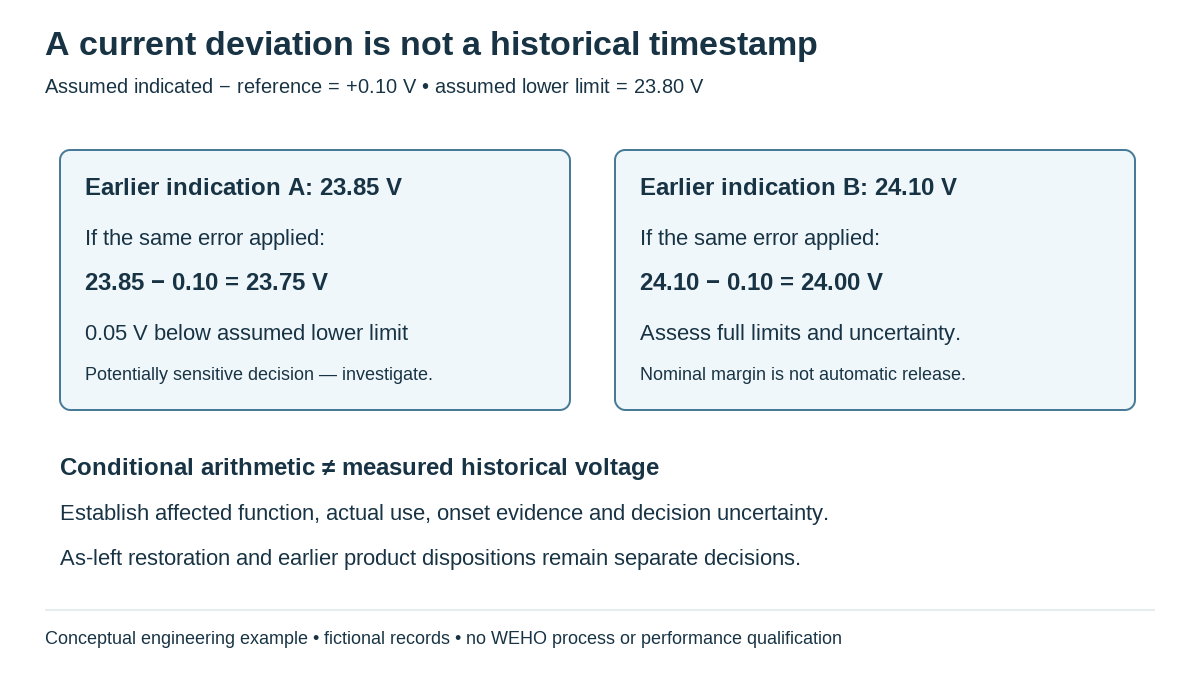
Assume a fictional meter is found to indicate 0.10 V high at a relevant calibration point. Define the sign as indicated value minus reference value, so a conditional corrected estimate is recorded indication minus 0.10 V. Assume, only for this arithmetic, that the same error applied to a particular earlier measurement.
Suppose the fictional application lower acceptance limit was 23.80 V and the earlier indication was 23.85 V. The conditional estimate is 23.85 − 0.10 = 23.75 V, which is 0.05 V below the assumed limit. The calculation identifies a potentially sensitive decision; it does not prove the historical unit actually had that voltage.
A second indication of 24.10 V gives 24.00 V under the same conditional assumption. That greater nominal margin can inform prioritization, but it is not an automatic release. Actual uncertainty, other limits, error applicability and independent evidence still belong in the disposition.
| Fictional record | Original indication | Conditional estimate | Review action |
|---|---|---|---|
| Unit A | 23.85 V | 23.75 V | Investigate lower-limit sensitivity |
| Unit B | 24.10 V | 24.00 V | Assess full margin and evidence |
| Unit C | Different unaffected function | No voltage correction applied | Document capability-based exclusion |
| Unit D | Instrument identity missing | Not defensibly calculable | Resolve traceability or widen scope |
The calibration laboratory's uncertainty is not automatically the uncertainty of the earlier production measurement. Probe connections, environment, method and instrument behavior may add contributions. A numerical adjustment without the applicable uncertainty and decision rule can create a misleading appearance of precision.
Swipe horizontally on a small screen, or open the full-size diagram.
SIMCO's detailed previous-use guide explicitly separates current calibration evidence from earlier measurement impact. Retain the original reading, the conditional assumptions and the resulting investigation decision as separate fields. Never overwrite the original result with a calculated historical value presented as a new measurement.
Make a disposition record that can be reviewed
A useful impact record links the instrument finding to identified populations, applicable requirements and the evidence used for each disposition. Use distinct outcomes such as excluded with evidence, potentially affected pending review, and disposition approved by the accountable function. Avoid marking an entire list closed merely because the instrument returned from calibration.
Retesting can provide important new evidence, but its timing and conditions matter. A product may have changed through storage, adjustment, repair or service use. Record what a retest establishes now and explain how that evidence supports the earlier acceptance question rather than treating the two measurements as interchangeable.
The existing WEHO first-article approval checklist helps organize product and assembly records. OOT review adds a reverse trace from a measurement asset to the decisions it supported. Keep that asset-use connection available even when a delivery report summarizes results at lot level.
- Secure the evidence. Preserve the instrument identity, as-found report and original records before adjustment data are lost. Record service actions; verify that the failed capability and error sign are unambiguous.
- Map actual use. Link dates, stations, functions and ranges to product records. Record exclusions and missing traceability; verify that every excluded group has a relevant evidence basis.
- Assess decision sensitivity. Compare application requirements with supported error scenarios and measurement uncertainty. Record assumptions; verify the arithmetic independently without declaring unobserved historical values as fact.
- Choose the disposition. Obtain appropriate technical and quality review of independent evidence, retest or other actions. Record affected unit identities and approvals; verify that pending cases cannot be released by a generic closure flag.
- Restore controlled use. Confirm current suitability, configuration and authorization after service. Record future checks or recordkeeping changes; verify that instrument restoration and historical closure remain separately visible.
Prepare a traceability-evidence enquiry
Send WEHO the exact NDR-120-24 enquiry identity, unit or lot references, original acceptance requirement and the specific evidence you need. Identify whether the affected instrument belongs to your incoming process or another party. Agree the available records and review responsibilities without assuming an actual OOT event or a standard supplier recall outcome.
Frequently asked questions
Does an OOT meter mean every earlier product failed?
No. Relevance depends on the failed capability, actual use, requirements and supporting history. An OOT label alone cannot identify which earlier acceptance decisions changed.
Can the latest deviation be subtracted from every old reading?
Not automatically. The deviation was observed at calibration and may not have existed unchanged during earlier use. Any retrospective correction needs justified applicability and appropriate uncertainty treatment.
Does an acceptable as-left certificate close the investigation?
No. It supports the instrument's post-service condition under the calibration requirements. Earlier measurement impact and product dispositions require their own documented review.
Is a current retest identical to the original acceptance test?
No. A retest produces evidence at a new time and under recorded conditions. Explain how product history and method comparability support its use in the historical disposition.