- Two wires may share a power supply terminal only when the applicable connection instructions permit that conductor combination.
- A twin ferrule joins two conductors; its existence does not establish compatibility with a particular power supply clamp.
- Check conductor count, construction, size, termination, preparation and tightening as one connection recipe.
- Adding branches never increases the supply’s total output capacity or removes branch-protection requirements.
Why physical fit does not settle the connection decision
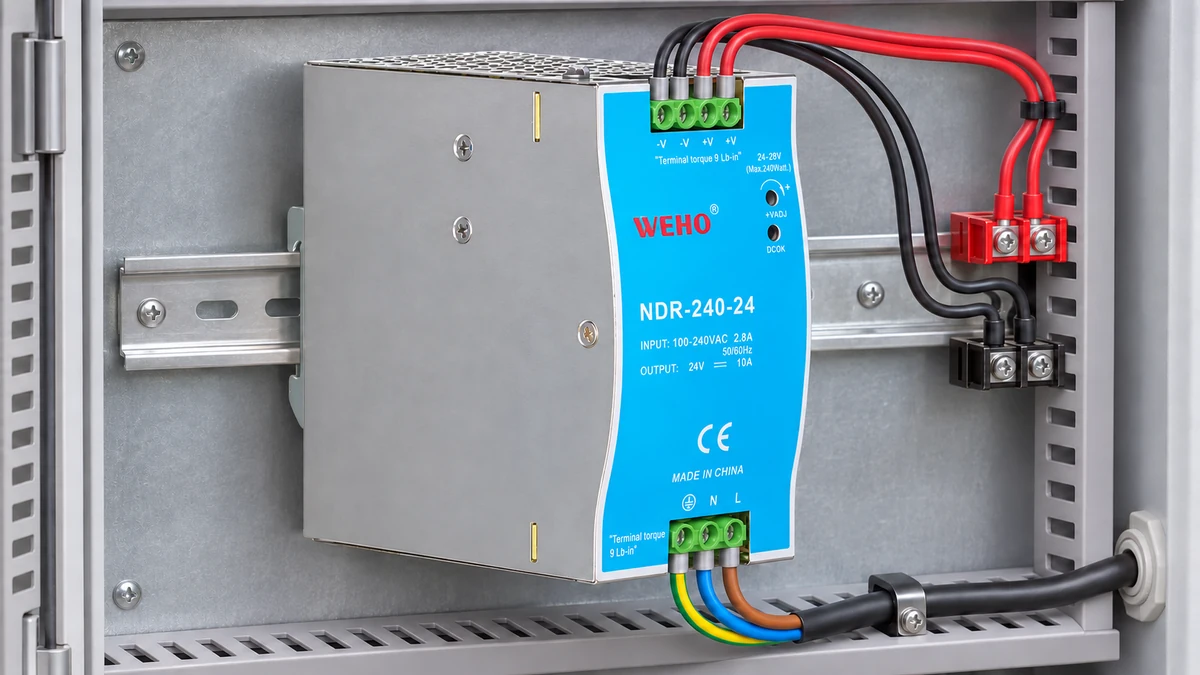
A cabinet revision adds a small sensor branch beside an existing DC conductor. Both wires fit under the screw, and the total load remains below the supply rating. The unresolved question is whether that specific clamp is approved to retain and contact both conductors in that arrangement.
The NDR-240-24 output terminal reference identifies a 24 V, 10 A model with multiple output positions. Those facts describe the supply and its interface; they do not establish permission to insert two wires into one clamping point. Keep conductor-combination approval separate from available output amperes.
Read the complete terminal connection recipe
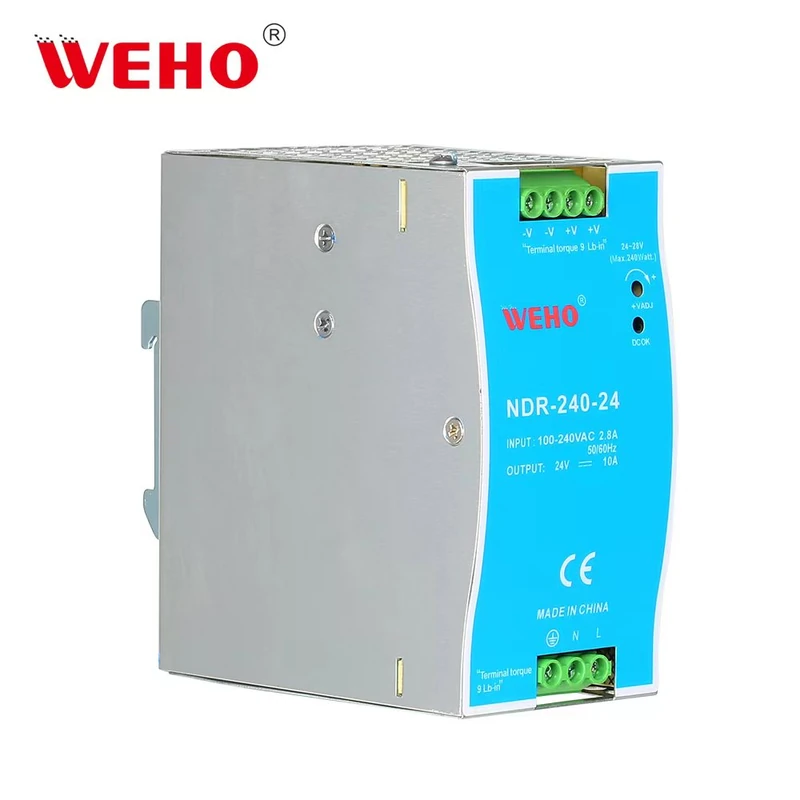
The connection recipe should identify the number of conductors, cross section of each conductor, solid or stranded construction, ferrule or lug arrangement, preparation length and applicable tightening instructions. The ordered power supply revision must use the terminal to which those instructions apply.
A general single-conductor range is not a two-conductor approval. Two smaller wires can have the same combined copper area as one larger wire while presenting a different shape to the clamp. Equal arithmetic area therefore does not establish equal contact pressure, retention or acceptable preparation.
An official component example shows why the distinctions matter. Phoenix Contact's MKDSN 1,5/5-5,08 BK connection data lists separate ranges for single flexible conductors, two flexible conductors, and two conductors with a twin ferrule. Those are that component's data, not an identification of the terminal fitted to a WEHO supply.
A twin ferrule addresses only part of the interface
A twin ferrule can make two prepared conductors into one crimped assembly. Its sleeve dimensions, conductor combination and crimp tooling still need to match both the ferrule instructions and the receiving terminal. The plastic collar must not prevent the conductive sleeve from reaching the intended contact zone.
For example, Phoenix Contact AI-TWIN ferrules are expressly made for crimping two conductors. That establishes the accessory's purpose. It does not authorize using that accessory, a particular crimp profile or two unequal wires in an unspecified WEHO terminal.
Do not treat a successful insertion or a firm manual tug as a substitute for the specified connection data. Those observations can reveal an assembly problem, but they cannot create a missing approval. Equally, missing public detail does not prove that every two-conductor arrangement is prohibited; it identifies a question to resolve before release.
Work a hypothetical branch-change record
Consider a hypothetical 24 V cabinet in which an existing branch draws 3.2 A and a proposed branch draws 0.6 A. Their combined steady current is 3.8 A, corresponding to 24 × 3.8 = 91.2 W. These are assumed loads, not measured NDR-240-24 test results.
The total is below the model's nominal 10 A output current, but that comparison answers only one question. The cabinet still needs checks for operating conditions, starting current, upstream distribution and protection. Most directly, the designer must establish how the new conductor will be terminated.
Suppose the existing conductor is 0.75 mm² and the proposed conductor is also 0.75 mm². The combined copper area is 1.50 mm². A single-conductor allowance of 1.50 mm², if that were the only available instruction, would not answer whether the pair is permitted. The number of conductors and their preparation remain unresolved.
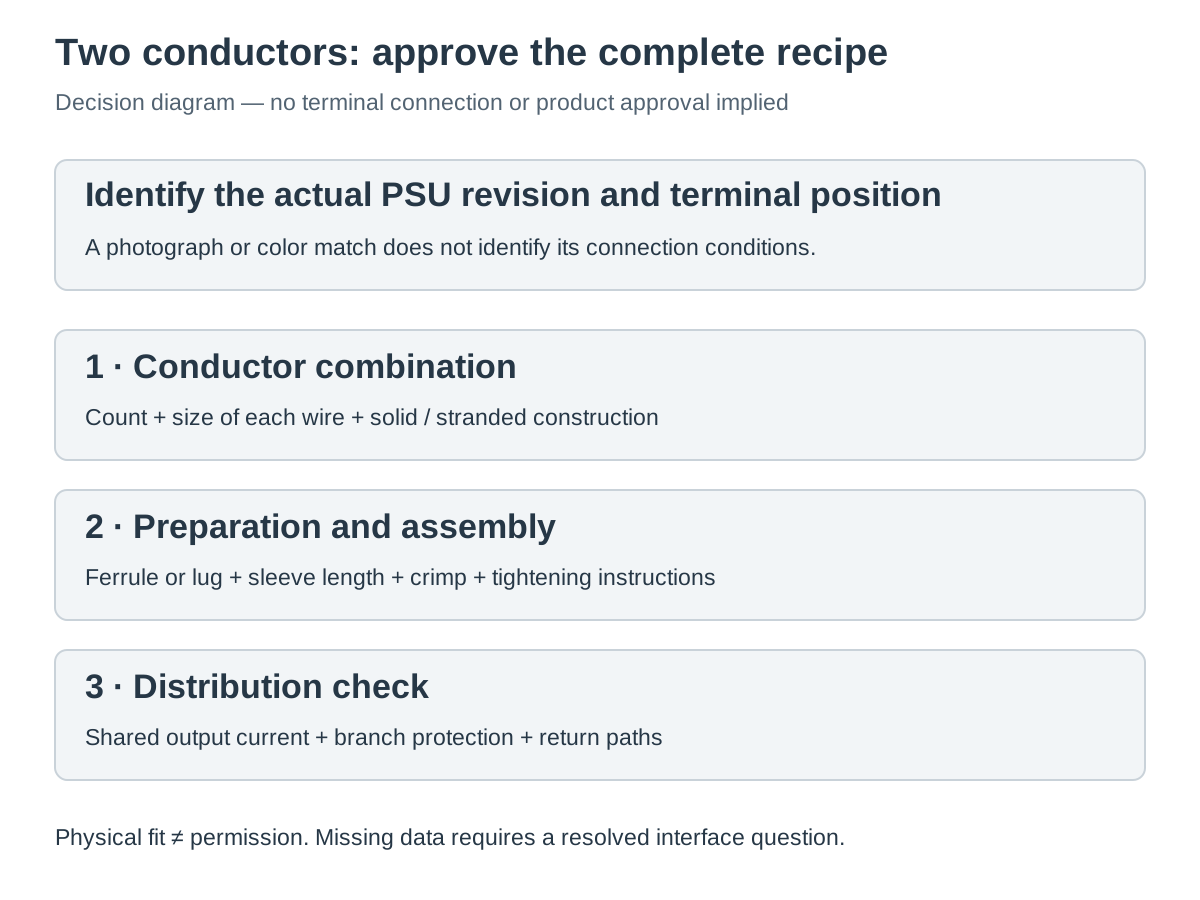
Swipe horizontally on a small screen, or open the full-size diagram.
| Proposed arrangement | Required evidence | Release decision |
|---|---|---|
| Two loose 0.75 mm² conductors in one clamp | Exact two-conductor allowance and preparation method | Hold until the applicable instructions confirm the combination |
| Two 0.75 mm² conductors in one twin ferrule | Terminal allowance plus matching ferrule and crimp instructions | Evaluate the complete recipe; sleeve fit alone is insufficient |
| Separate approved output positions | Permitted use, individual connection data and shared output budget | Accept only after the interface and load checks close |
| External distribution terminal | Feed conductor, terminal ratings, branch wiring and protection design | Review as a separate distribution assembly |
The practical output is a closed decision record, not a universal instruction to choose one row. A compact layout may favor a permitted twin termination. Service access or independent branch removal may favor separate positions or an external distribution block, provided their requirements are met.
Include the negative return path
The added positive conductor is only half the branch. Record where the return conductor lands, which upstream path carries the sum of branch currents, and whether any shared connection changes when one branch is serviced. Keep DC return and protective earth identified separately.
A branch label should identify both endpoints. When a drawing shows two wires leaving a supply, an assembler should be able to determine whether they occupy separate clamps, share one approved termination, or connect through a distribution component. A line intersection in a schematic cannot specify the physical clamp arrangement.
Freeze the recipe so purchasing can reproduce it
A usable BOM records the terminal arrangement and preparation parts together. “Ferrule as required” leaves the sleeve length, conductor pairing and crimp process undecided. “Same wire size” also fails to control strand class, insulation diameter and the construction on which the connection instruction relies.
| Field | Record | Verification basis |
|---|---|---|
| Interface identity | Supply model, revision and terminal position | Applicable product or terminal documentation |
| Conductor combination | Count, size and construction of each wire | Explicit combination allowance |
| Preparation | Strip length, accessory and crimp method | Matching connection and accessory instructions |
| Assembly | Tool and tightening procedure where specified | Controlled work instruction |
| Inspection and service | Acceptance checks and replacement recipe | Approved assembly and maintenance plan |
Do not transplant a torque or conductor range from a look-alike green connector. Visual similarity does not identify the component or its approval conditions. If a supplier changes the fitted terminal, review the connection recipe even when the power supply model name and rated output remain the same.
Verify the proposed connection before assembly release
- Identify the exact clamp. Record the power supply revision and terminal location. Verify that the connection document applies to the supplied configuration rather than a similar enclosure photograph.
- Describe every conductor. Record count, cross section, strand construction and preparation. Compare the whole combination with an explicit permitted arrangement, including any same-size requirement.
- Check preparation compatibility. Record ferrule or lug identity, sleeve dimensions and crimp method. Verify against both terminal and accessory instructions; do not select parts solely by insulation color.
- Inspect an isolated sample. Record seating, exposed conductor, strain and the specified tightening process under the equipment's isolation procedure. Apply only documented inspection or retention criteria rather than inventing a pull-force limit.
- Recheck the distribution. Record branch loads, shared feed current and both return paths. Verify the installed wiring and protection against the approved cabinet design before energization and functional testing.
Send WEHO a specific terminal question
Use the NDR-240-24 connection reference page alongside your proposed conductor recipe. Ask WEHO about the exact connection combination, including model revision, terminal position, two wire sizes and intended ferrule or lug, before freezing the assembly instruction.
Frequently asked questions
Can I put two smaller wires in a terminal rated for one larger wire?
Only if the applicable terminal instructions permit that specific two-conductor arrangement. Adding the copper areas does not establish contact geometry or retention, even when the resulting number falls inside a single-wire range.
Does using a twin ferrule automatically make the connection acceptable?
No. A twin ferrule must be suitable for the two conductors, the crimp process and the receiving terminal. Check the complete connection recipe rather than treating the ferrule as a general exemption.
Do multiple output terminals provide separate 10 A outputs?
No. Multiple positions on this single-output supply do not multiply its total rated output current. Keep the combined load within the applicable supply limits and check each connection's documented conditions separately.
Can a sample pull check replace missing connection data?
No. A sample inspection can verify assembly against a specified recipe, but it cannot establish an undocumented conductor combination. Obtain the applicable connection conditions before approving the production arrangement.