














Last Updated: 2026-08-31
what is a switching power supply? It is an electronic power converter that rapidly switches semiconductor devices, transfers energy through magnetic and storage components, and uses feedback to regulate the output. This method can convert AC or DC input into a controlled DC output with compact components and practical efficiency.
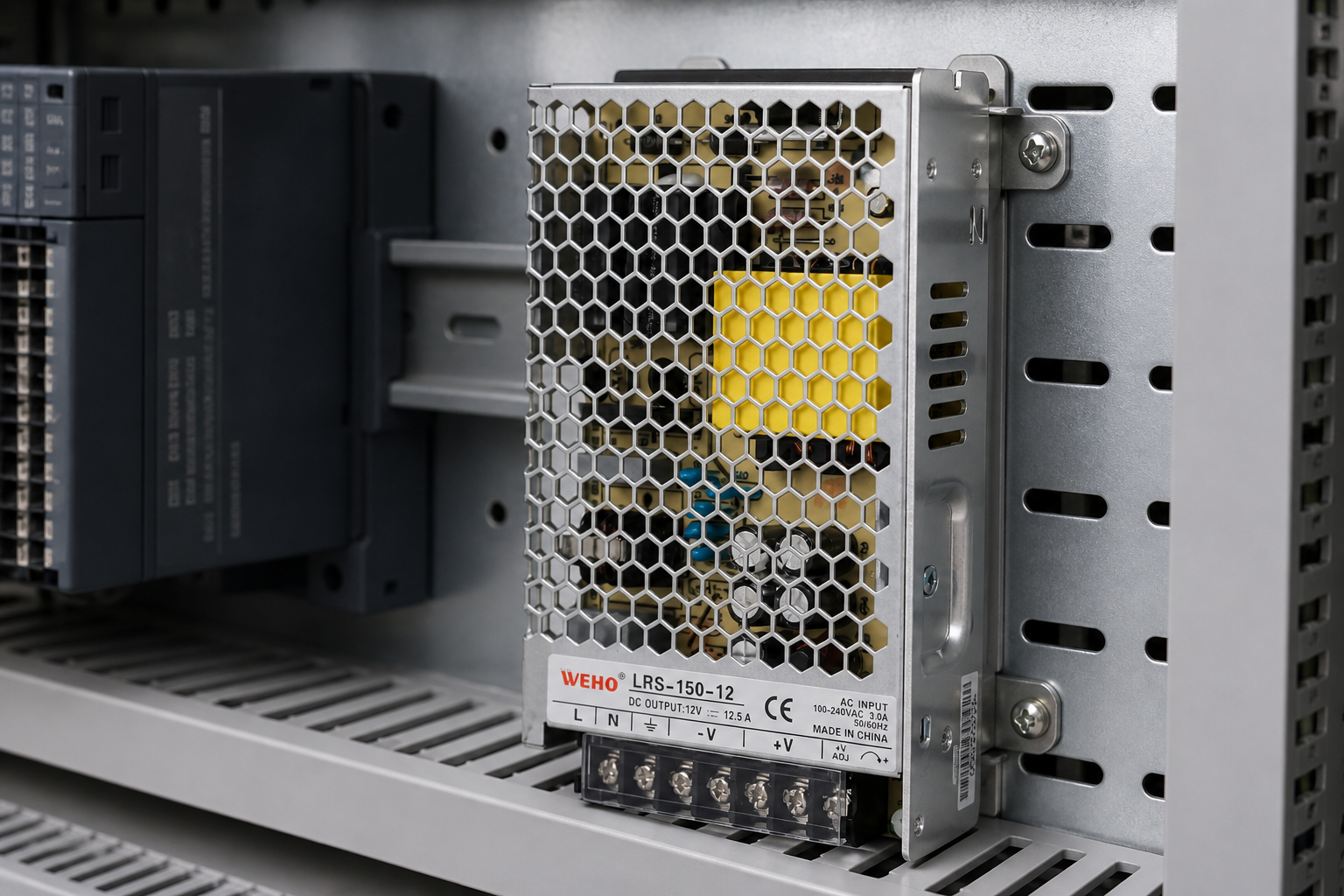
what is a switching power supply in practical terms?
To answer what is a switching power supply, start with its job: convert an available electrical input into a regulated output required by a load. Instead of continuously dropping excess voltage across a control element, a switch-mode power supply turns semiconductor devices on and off at high frequency and controls the transferred energy with feedback.
The abbreviation SMPS means switch-mode power supply. Depending on the topology, the unit may convert AC to DC, DC to DC, or another controlled form. Industrial enclosed AC-DC supplies commonly accept mains input and provide an isolated low-voltage DC output, but the exact input range, isolation, output, and protection functions must be confirmed for each model.
High-frequency operation allows transformers, inductors, and capacitors to be smaller than comparable line-frequency components. The result can be a compact converter, but the design must also manage switching loss, heat, electromagnetic noise, insulation, control stability, and fault behavior.
The main energy-conversion stages

An AC-DC SMPS typically begins with input protection and electromagnetic-interference filtering. The incoming AC is rectified to a high-voltage DC bus. A controller drives one or more semiconductor switches, which pulse energy into a transformer or inductor according to the selected circuit topology.
On the secondary side, rectification and filtering convert the pulsed waveform into DC. A feedback circuit compares the output with a reference and adjusts switching duty, frequency, or another control variable. If the load increases and the output starts to fall, the controller transfers more energy within its designed operating limits. If the load decreases, it transfers less.
Isolation is provided only when the topology and construction include an appropriate transformer and insulation system. Never assume isolation from the enclosure shape. The product documentation should state the input, output, isolation, grounding, and installation requirements.
How feedback keeps the output regulated
Regulation is a closed-loop process. The output is sensed, compared with a target, and returned to the primary controller through an isolated or non-isolated feedback path. Compensation components shape the loop response so the converter can react to load and input changes without unstable oscillation.
The output still has ripple and transient deviation. Their acceptable levels depend on the load and the confirmed product specification. Sensitive measurement, communication, audio, or control circuits may require additional filtering, careful grounding, or a power supply selected for tighter performance.
Dynamic load behavior matters. A motor controller, LED controller, computer, radio, or capacitive load can demand current differently from a simple resistor. A supply should be checked for startup, peak load, minimum-load behavior where relevant, recovery time, and protection response.
Common SMPS protection functions
Switching power supplies may include overcurrent, short-circuit, overvoltage, and overtemperature protection, but the available functions and recovery method vary by model. Some units limit current, some cycle on and off, and some latch until input power is reset. Only the exact documentation should be used for a system safety decision.
Protection inside the supply does not replace upstream protection, branch protection, grounding, conductor sizing, enclosure design, or safe installation. The complete equipment must be evaluated as a system. Qualified personnel should work with mains wiring and should isolate and verify incoming power before installation.
Choose an enclosed switching power supply by application

The approved WEHO Enclosed Switching Power Supply category is the appropriate starting point for comparing this product family. The WEHO LRS-150 product page provides a representative enclosed SMPS reference. Confirm the exact output-voltage version, rated load, input range, terminal layout, cooling, derating, installation clearance, and documentation before selection.
Select voltage first, then calculate the real load current and power. Check startup and peak behavior, ambient temperature, airflow, mounting orientation, enclosure heat, conductor capacity, cable drop, and the load’s acceptable ripple and transient range. A supply with enough nameplate wattage can still be unsuitable if one of these conditions is ignored.
For application-specific context, the existing WEHO article on enclosed switching power supplies for outdoor signage and displays explains environmental and installation questions that are beyond this basic operating-principle guide.
Efficiency, heat, and electromagnetic compatibility

Efficiency describes how much input power becomes useful output rather than heat. It changes with input voltage, output load, topology, and operating conditions. Use a confirmed efficiency curve or data point from the selected model rather than a generic SMPS value.
Even an efficient supply generates heat. Ventilation openings must remain clear, and the unit should not be packed against heat-producing components. The enclosure design should consider the power supply, load, ambient temperature, dust, airflow, and service access together.
Fast switching creates high-frequency current paths. Good layout, filtering, shielding, grounding, and cable routing help control conducted and radiated noise. Keep mains and low-voltage signal wiring appropriately separated, minimize unnecessary loop area, and follow the equipment’s installation guidance.
Commissioning an SMPS safely

Before energizing, confirm input selection where applicable, protective earth, polarity, terminal torque, conductor size, fusing, branch protection, and load compatibility. Start with a controlled load when practical, then verify output voltage at the supply and at the connected equipment.
Record input voltage, output voltage, load current, ambient temperature, case temperature if required, and behavior during startup and peak load. Investigate abnormal sound, odor, cycling, voltage collapse, or unexpected heating before placing the system into service.
Câu hỏi thường gặp
Một nguồn cung cấp năng lượng chuyển đổi được sử dụng cho là gì?
Nó chuyển đổi nguồn AC hoặc DC có sẵn thành đầu ra được điều khiển cho các thiết bị điện tử như điều khiển, thiết bị liên lạc, hệ thống chiếu sáng, máy tính và tải công nghiệp.
Làm thế nào để một SMPS điều chỉnh đầu ra của nó?
Một mạch phản hồi cảm nhận đầu ra, so sánh nó với một tham chiếu và điều chỉnh quá trình chuyển đổi để năng lượng được truyền theo sau những thay đổi về đầu vào và tải trong giới hạn thiết kế.
Có phải tất cả các nguồn cung cấp năng lượng chuyển mạch đều cách điện?
Không. Cách ly phụ thuộc vào cấu trúc liên kết, máy biến áp, hệ thống cách nhiệt và xây dựng. Xác nhận các yêu cầu cách ly và nối đất trong tài liệu sản phẩm chính xác.
Tại sao SMPS có thể nhỏ hơn nguồn cung tuyến tính?
Chuyển mạch tần số cao cho phép máy biến áp, cuộn cảm và tụ điện nhỏ hơn các thành phần tần số dòng tương đương, mặc dù thiết kế nhiệt và điện từ vẫn quan trọng.
What protection functions should I check?
Check the exact model for overcurrent, short-circuit, overvoltage, and overtemperature behavior, including whether recovery is automatic, cycling, or latched. Do not assume every model behaves the same way.
What information is needed to choose an enclosed SMPS?
Provide input voltage, output voltage, continuous and peak current, startup behavior, ambient temperature, enclosure and airflow, cable distance, load sensitivity, mounting limits, and required protection behavior.
Bài học chính
- What is a switching power supply is answered by its method: high-frequency switching, energy storage or transformation, output rectification, and closed-loop feedback.
- An SMPS is not automatically isolated; isolation depends on the topology and construction.
- Select by voltage, current, startup behavior, derating, cooling, ripple, protection, and installation conditions together.
- Internal protection does not replace system grounding, branch protection, wiring, or enclosure design.
- Verify output at the load and record commissioning measurements.
Phần kết luận
Understanding what is a switching power supply makes selection easier: it is a controlled energy converter whose performance depends on the switching stage, magnetic components, output filter, feedback loop, thermal design, and protection behavior. The right unit is the one whose confirmed operating limits match the real load and installation.
Review lại cái The WEHO Enclosed Switching Power Supply category hoặc liên hệ với WEHO with the input source, output voltage, continuous and peak load, ambient temperature, enclosure, cooling, and application requirements. You can also email [email protected] for product matching.
Review lại cái The Danh mục sản phẩm WEHO có liên quan, email, điện thoại [email protected], hoặc liên hệ với WEHO với điện áp đầu vào, tải đầu ra, nhiệt độ môi trường xung quanh và chi tiết lắp đặt.