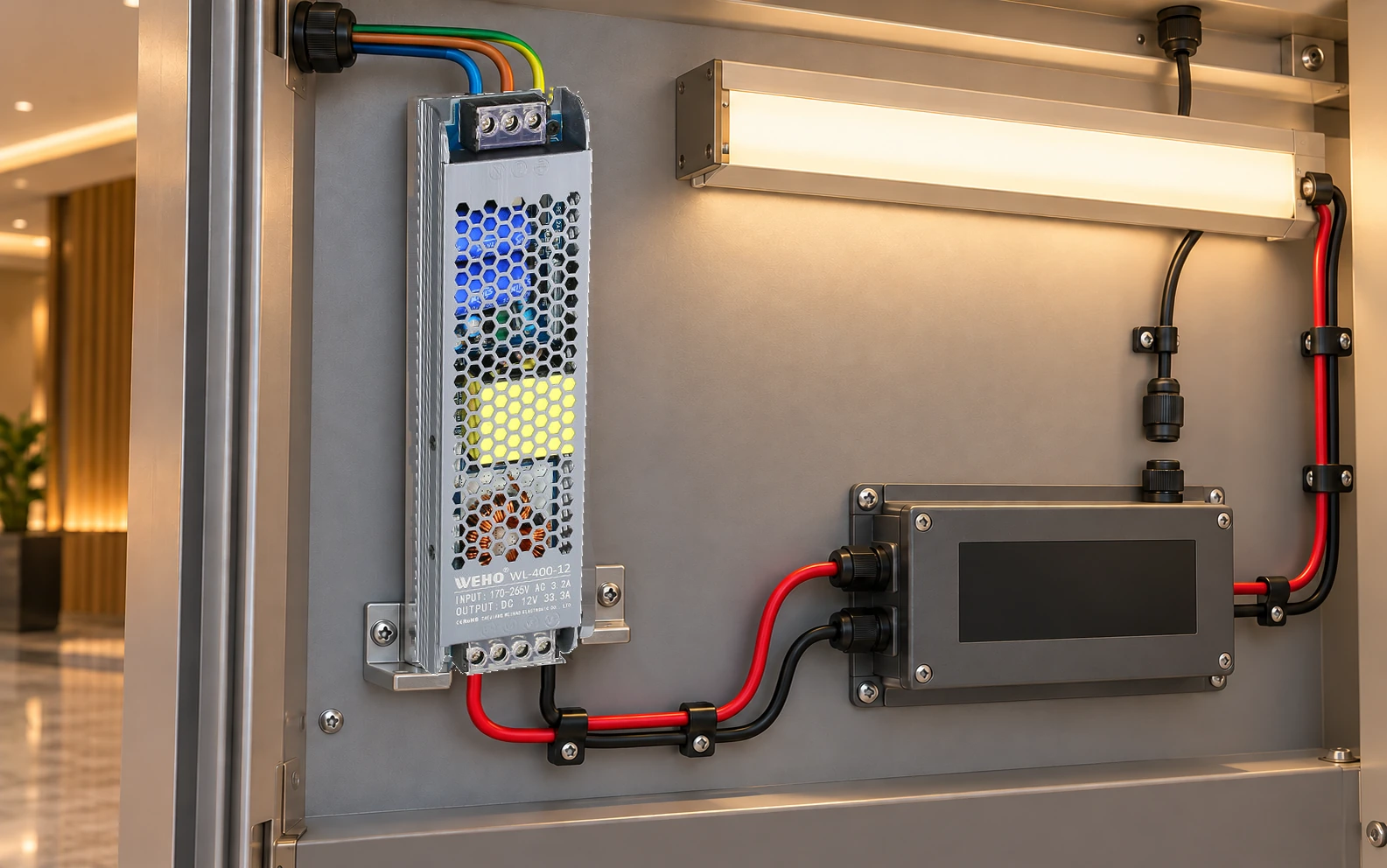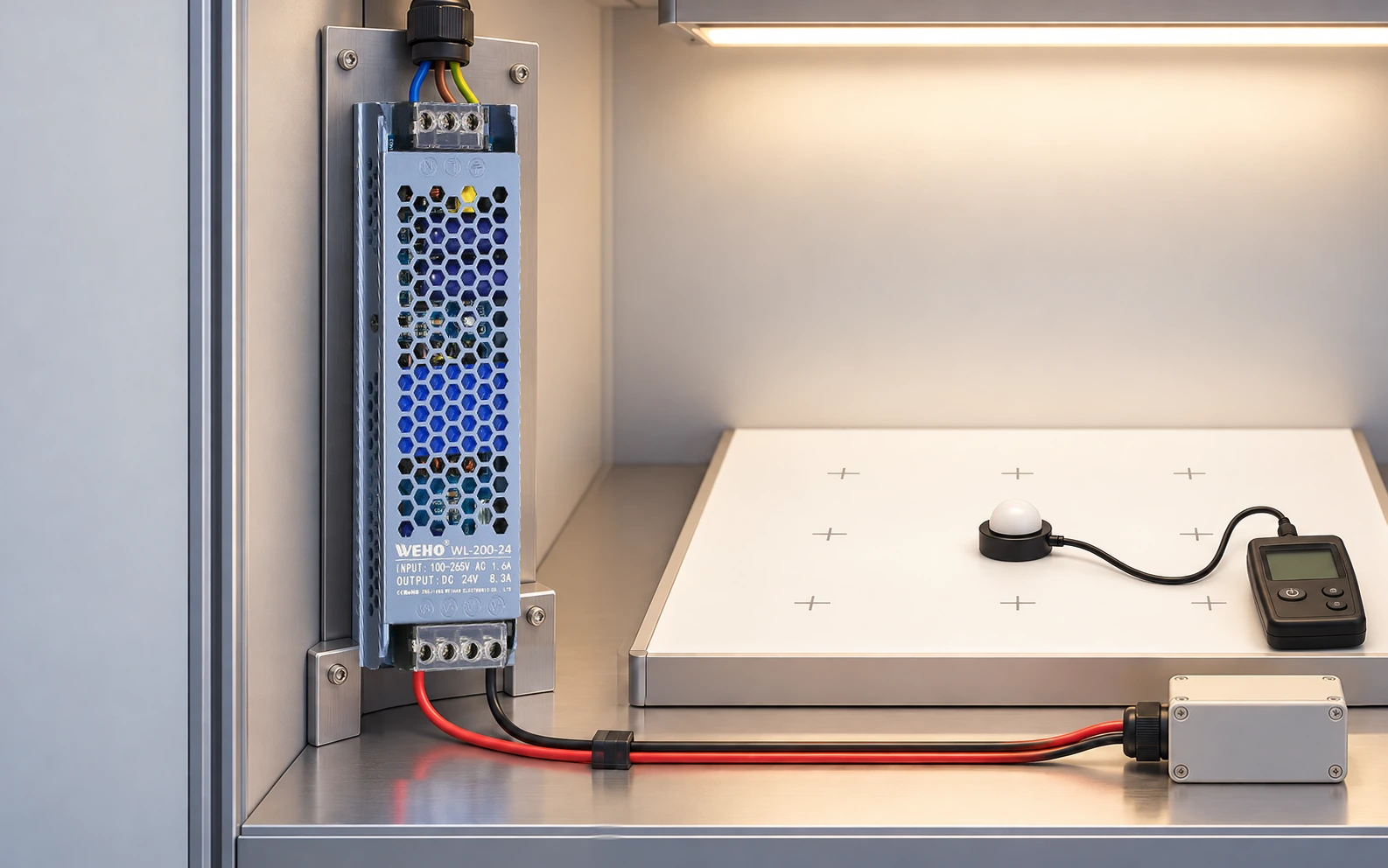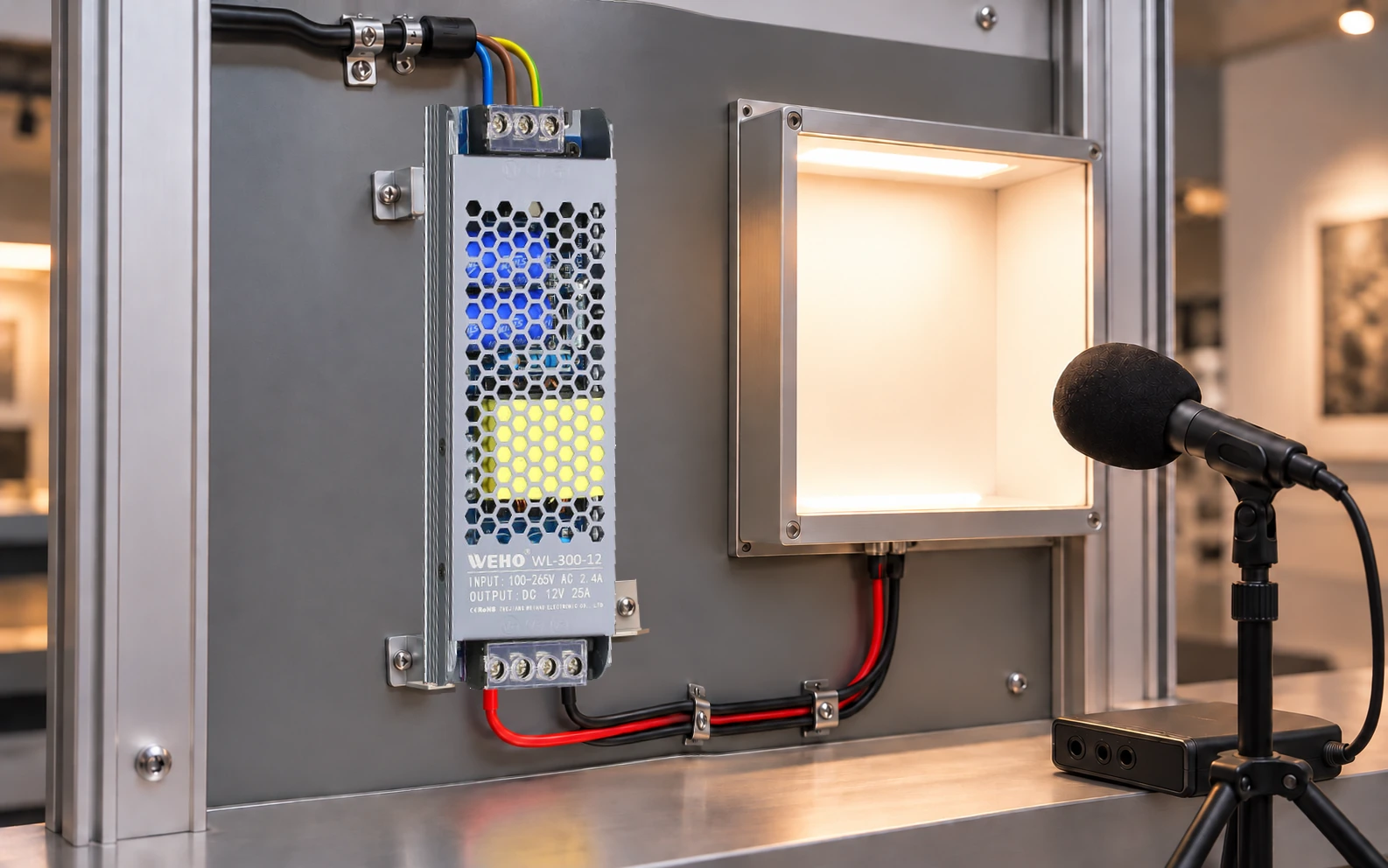
To compare LED power supplies for a quiet interior, define an acoustic test condition rather than ordering a “silent” unit. Record microphone position, surrounding surfaces, background sound, load state and the quantity reported. A sound level taken beside an open prototype cannot be compared directly with another sample measured inside a finished lightbox.
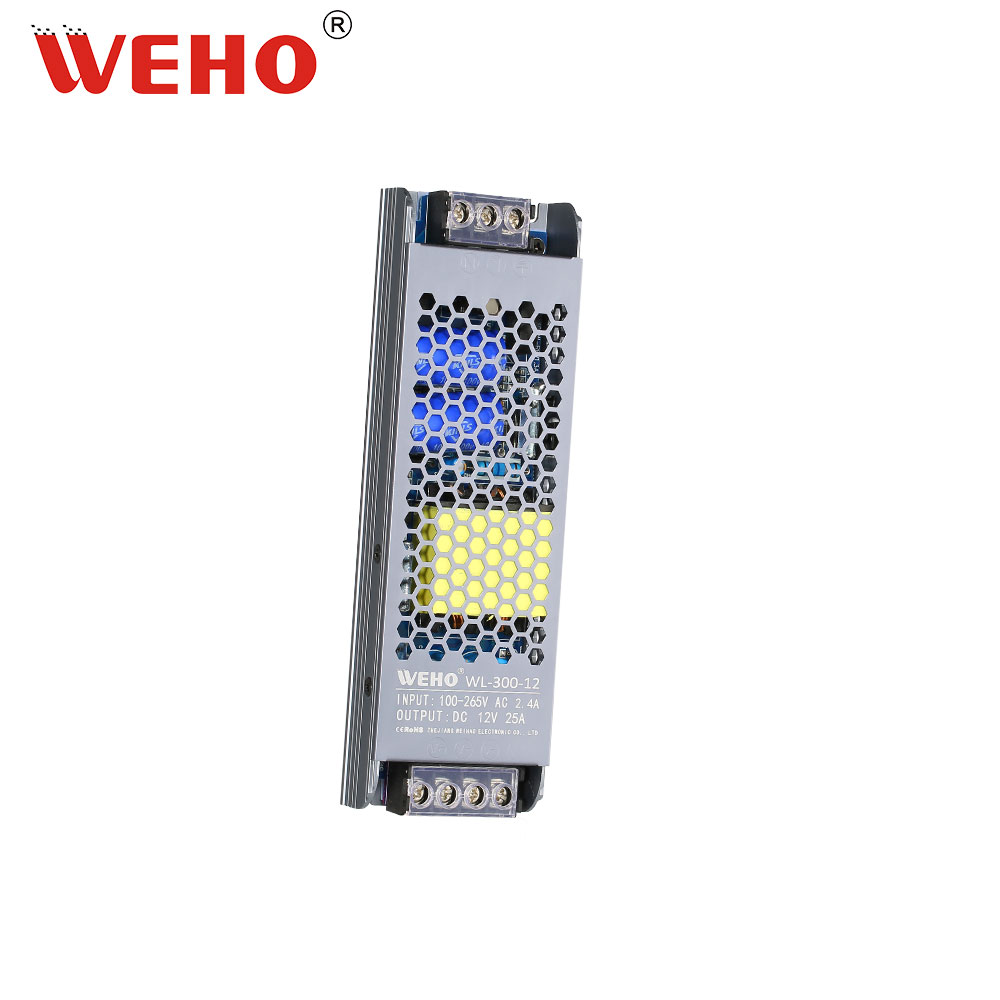
The WEHO WL-300-12 original photograph identifies a slim 12 V supply. It does not establish an acoustic limit, a sound-power rating or a completed noise test. This guide helps lighting OEMs prepare a repeatable sample comparison for places where tonal sound can become noticeable.
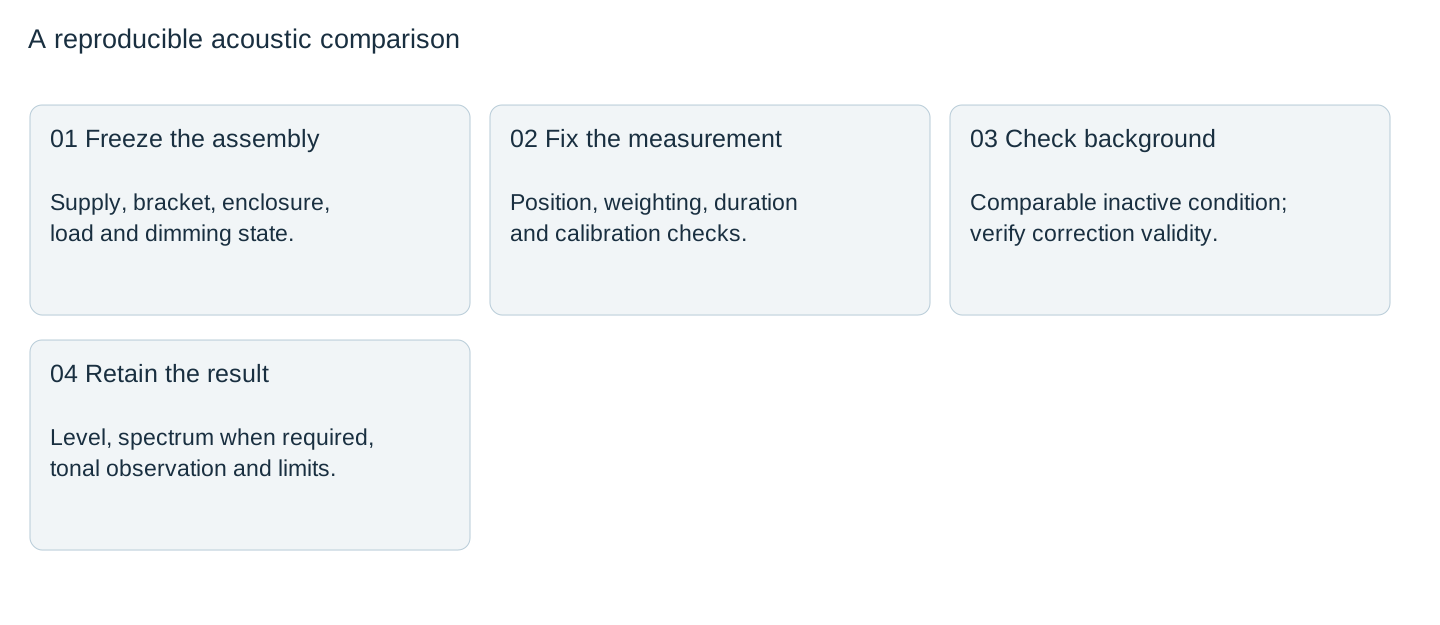
Name the quantity and the listening position
Sound pressure at a specified position and sound power of a source are different quantities. For a practical prototype comparison, define the sound-pressure measurement location and method. If the customer needs a declared sound-power value under a standard, commission the appropriate method instead of relabelling a nearby sound-pressure reading.
Keep frequency weighting, averaging period, time weighting where applicable, instrument range and calibration checks in the record. “35 dB” without those conditions is incomplete. A phone recording can help communicate a tone to a supplier but does not automatically supply a calibrated sound-level measurement.
Treat the enclosure as part of the test article
Record supply revision, installation support, surrounding panel material and cover state. A panel can transmit or radiate vibration differently after a bracket or fastener arrangement changes. Do not compare a loose unit on a bench with a rigidly installed unit and attribute the whole difference to the electrical design.
Fix microphone coordinates and orientation relative to the assembly. Keep reflections, nearby machinery, ventilation equipment and operator position attributable. Test the required lighting states, including relevant dimming and warm-up states, because one full-output condition may miss the audible condition the customer actually notices.

Measure the background separately
Take an appropriate background measurement with the tested assembly inactive under otherwise comparable conditions. Brüel & Kjær’s environmental-noise booklet explains background correction and its limitations. A background close to the total can make the source contribution unreliable; subtracting the two dB numbers directly is not the correction.
For illustration only, assume independent, stationary sound contributions evaluated using the same weighting and integration conditions. If the total is 50 dB and the background is 40 dB, logarithmic subtraction gives about 49.54 dB for the source contribution. The equation is Lsource = 10 × log10(10(Ltotal/10) − 10(Lbackground/10)).
This is an arithmetic example, not a WL-300 measurement or permission to correct an invalid test. When source and background are nearly indistinguishable, improve the test environment or report the limit of the method. Do not publish a precise quietness claim from unstable subtraction.
Keep tonal observations beside the overall level
Two samples can have similar overall levels while one has a conspicuous narrow-band tone. Preserve the audio observation and, where the agreed procedure requires it, suitable spectral information. Do not assume that one A-weighted number captures every aspect of perceived sound quality.
| Record item | Why it matters |
|---|---|
| Required operating mode | A tone may appear only in a particular load or dimming state |
| Background and unrelated sources | The room can dominate a quiet sample |
| Microphone coordinates and enclosure state | Geometry changes the measured pressure |
| Overall level plus tonal observation | A single total may hide an objectionable spectral feature |
| Repeat condition and sample identity | A comparison must be reproducible after production changes |
Do not put a microphone through ventilation openings, touch energized internal components, or modify the unit to locate a sound. If the sound coincides with electrical malfunction, stop treating it as merely an acoustic preference and use the appropriate technical service process.
Compare samples under one controlled protocol
Use the same complete assembly, load programme and measurement setup where the comparison permits it. Repeat the critical state after replacing only the intended component. Keep the raw records and the measurement uncertainty or limitations with the summary, particularly when the difference is small.
Brüel & Kjær’s product-noise measurement documentation distinguishes background records, device measurements and calculated quantities. That separation is useful in a supplier comparison even when the specific instrument is different. Its settings, standard-dependent corrections and instrument features are not assigned to a WEHO product.
Write an acceptance line someone can reproduce
A useful RFQ describes the intended room, complete enclosure, microphone positions, modes, chosen quantities and agreed limits or comparison criteria. Include a recording of the objectionable condition when available, with the operating state and sample identity. Agree who evaluates tonal character and how a borderline result is handled.
The WL-300-12 photograph reads 12 V, 25 A; the public table lists a different 12 V current. Those conflicting source figures are not reconciled by an acoustic test and are not used here to approve load capability. Request the applicable offered-revision documents separately. The output of this process is an attributable acoustic acceptance record, not an unqualified promise that a ventilated metal supply will be inaudible in every installation.
For a WL-300-12 sample comparison, provide the enclosure drawing, microphone coordinates, load programme, background record and the objectionable tonal condition. Agree a reproducible acoustic criterion and separately request resolution of the published output-current discrepancy.
Lighting assembly acoustic acceptance record
| State | Total level and quantity | Background level | Correction validity | Tone / spectrum reference | Decision |
|---|---|---|---|---|---|
Blank project worksheet. Enter verified project data; example calculations above are not measurements.