A radiated-emission result needs the search conditions that produced its maximum, not just one favorable antenna position. An equipment buyer should request frequency, polarization, antenna height, equipment azimuth and the applicable measurement configuration together.
- A single position does not demonstrate a searched maximum.
- Keep spatial search separate from detector and correction settings.
- Reproduce the same configuration when comparing design changes.
- Use the governing method for final compliance measurements.
1. Ask which assembly and geometry were searched
Radiated emissions concern the assembled equipment and its attached paths. A controller, enclosure opening or external cable can affect the observed field. Record operating mode, load, cable arrangement and installed accessories so that a lower measurement can be traced to an intentional design change rather than a different setup.
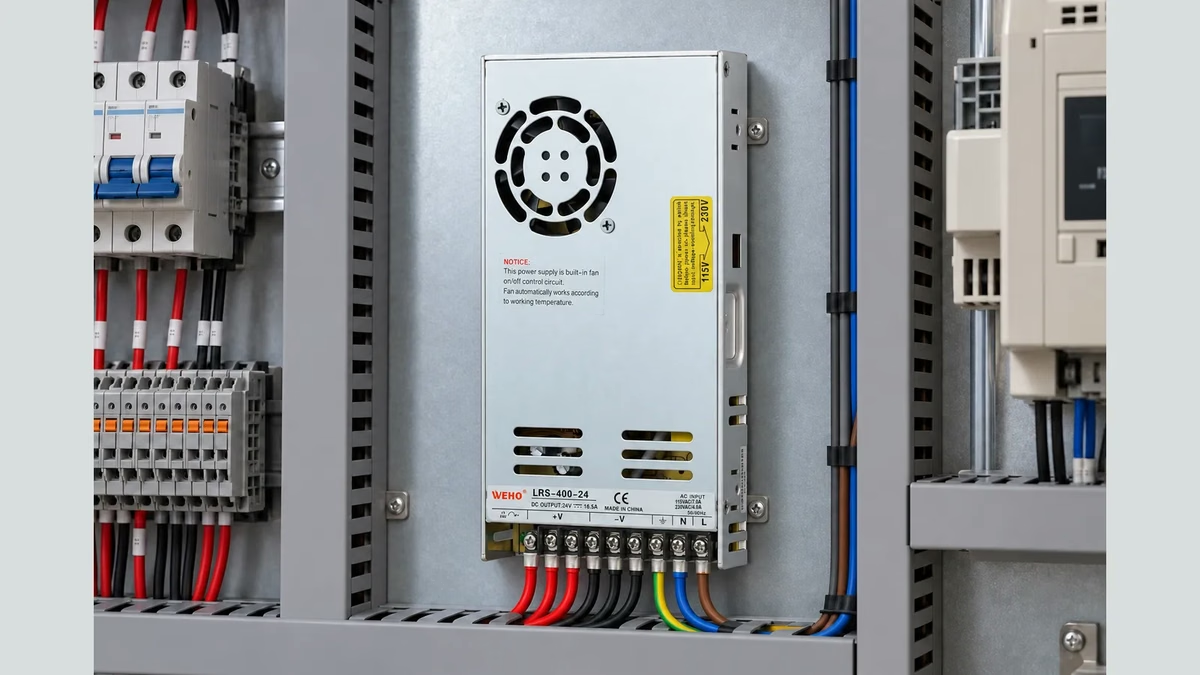
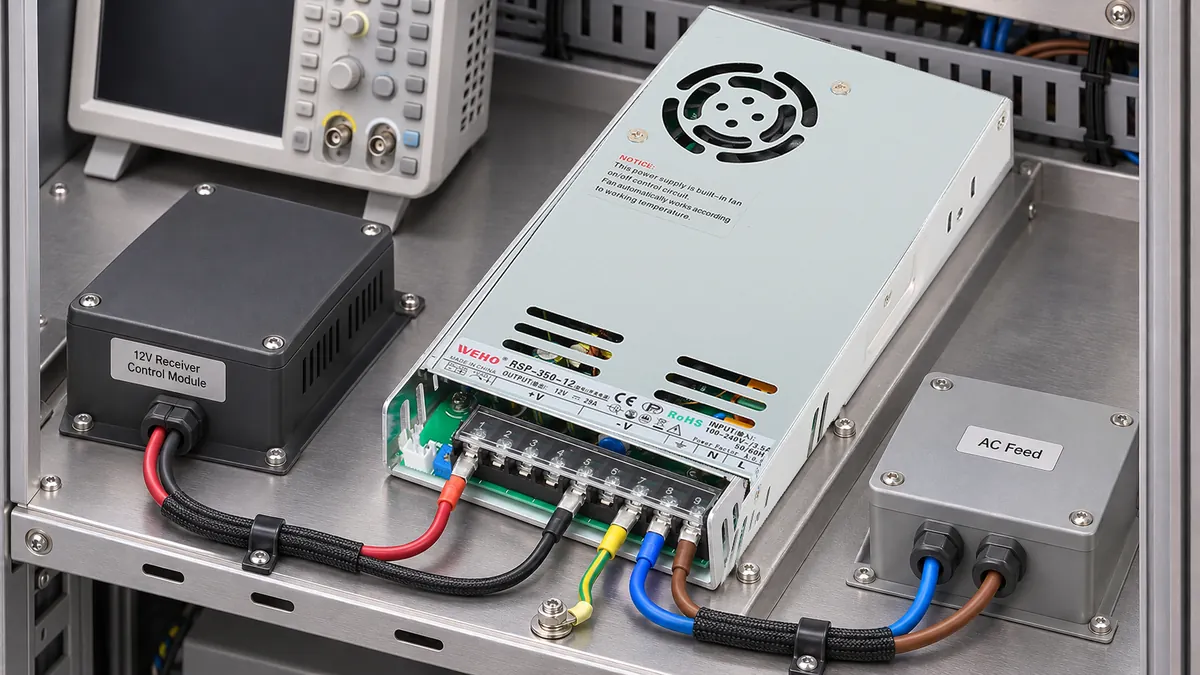
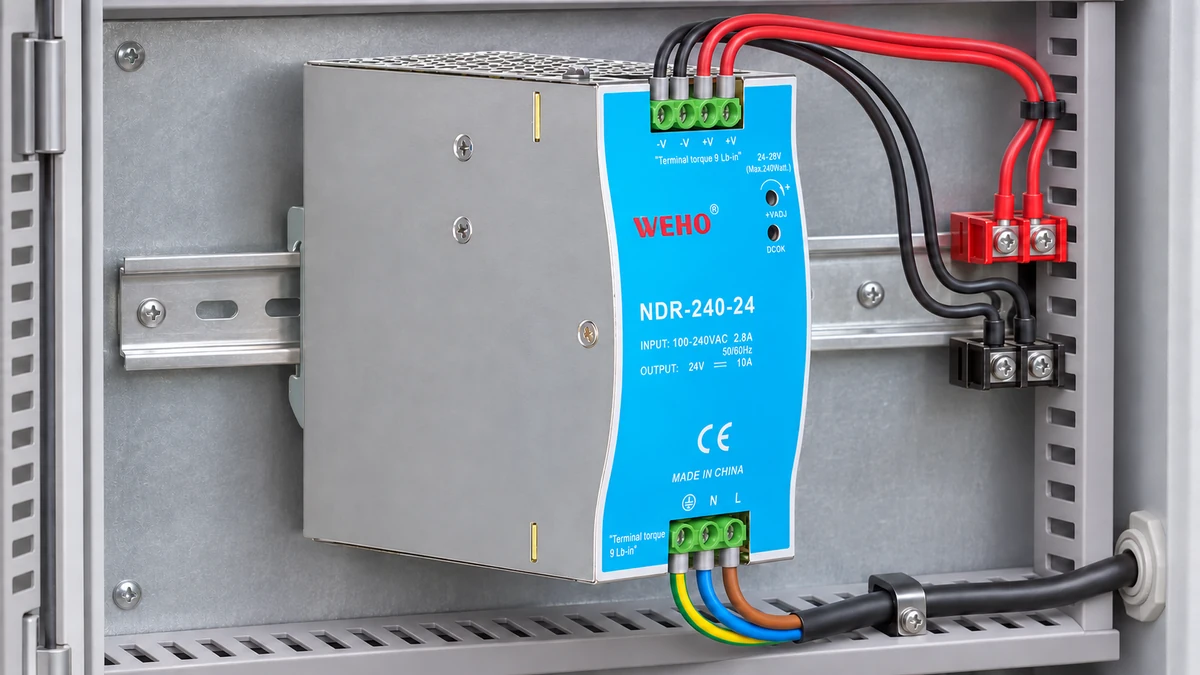
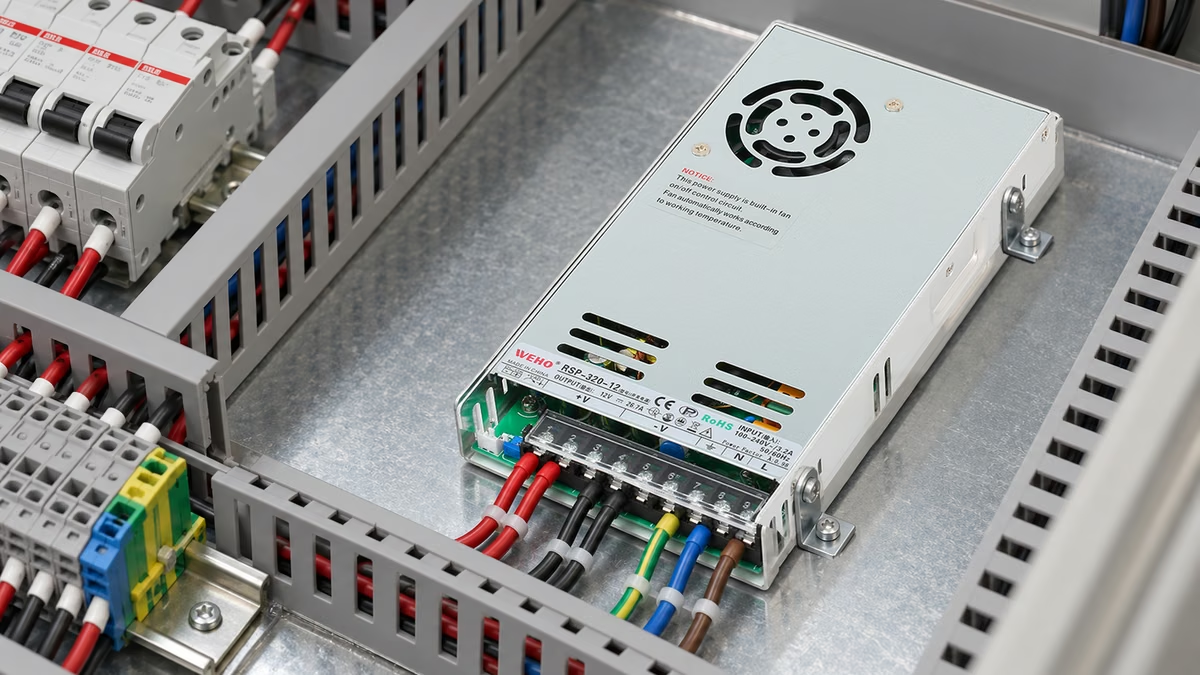
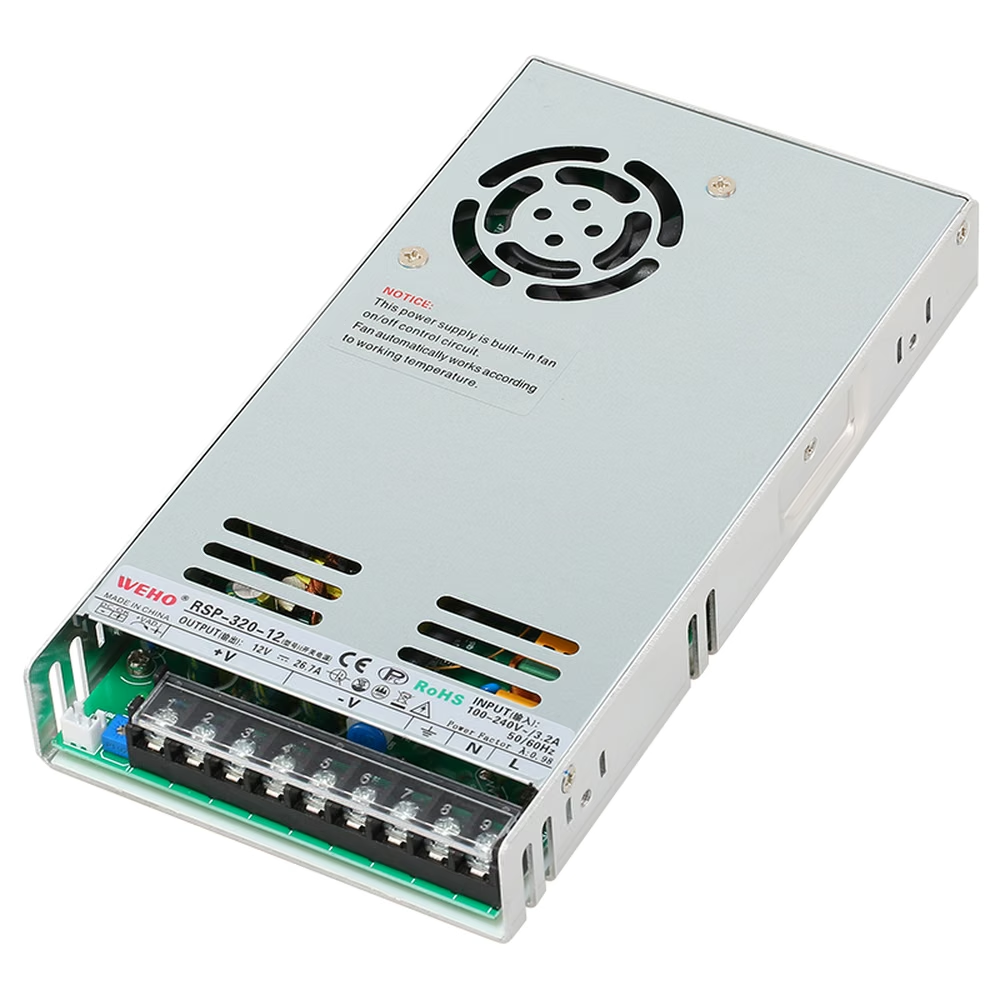
các WEHO RSP-320-12 product reference identifies one power-source component within a possible assembly. Neither its photograph nor an equipment-level example establishes that model's radiated-emission performance. Ask for exact-model documentation while defining the complete equipment under test separately.
The official CISPR 16-2-3 consolidated overview identifies radiated-disturbance measurement methods. The applicable product standard, edition and laboratory plan determine the actual test conditions. This worksheet does not replace those requirements or assign a universal distance, height range, limit or detector.
2. Separate a preview scan from the retained result
A preview scan can help identify frequencies that deserve further investigation. A final retained measurement must use the required detector, observation conditions and search procedure. A peak found during a fast exploratory sweep is useful evidence, but its status should remain explicit rather than being silently presented as a final compliance result.
các Rohde & Schwarz ES-K1 manual documents antenna-height, turntable-azimuth and polarization controls in its radiated-measurement workflows. The relevant principle is that these are independent search coordinates. The software's example defaults are not instructions for every equipment class or current test method.
For a critical frequency, retain the coordinates of the selected maximum and enough search history to explain how it was found. Several frequencies can have different maximizing positions. A single orientation selected at one frequency cannot automatically represent the worst case across the entire required measurement range.
| Record field | Retain | Comparison risk | Verification |
|---|---|---|---|
| Equipment configuration | Mode, enclosure, load and cable routing | A different radiator was measured | Match configuration revision |
| Spatial search | Polarization, height and azimuth coverage | A favorable direction hides the maximum | Review search history |
| Receiver setup | Detector, bandwidth and observation conditions | Unlike signal processing is compared | Match applicable method |
| Retained result | Frequency, field level and maximizing coordinates | Maximum cannot be reproduced | Revisit the recorded position |
3. Recalculate a small illustrative search
Assume an invented exploratory measurement at one frequency, one equipment mode and one fixed test distance. All listed values are already corrected field levels measured with the same receiver settings. They are not RSP-320-12 results, formal limits or a sufficient search grid for a real compliance test.
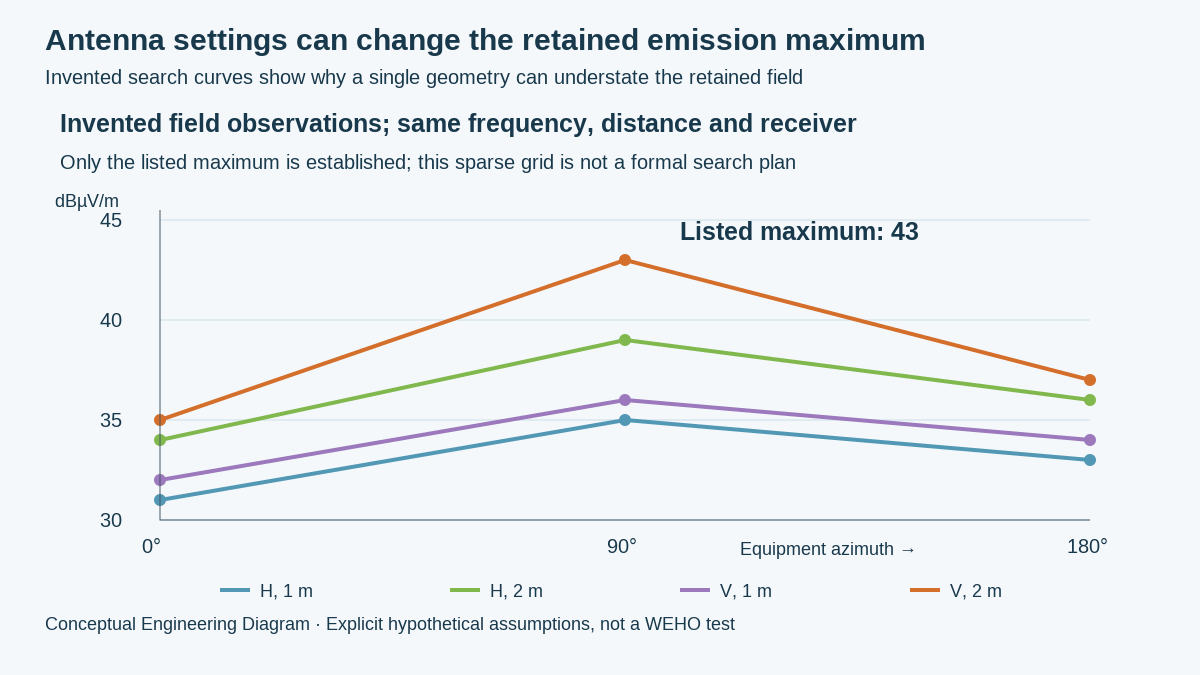
At an assumed antenna height of 1 m, horizontal polarization gives 31, 35 and 33 dBµV/m at equipment azimuths of 0°, 90° and 180°. At 2 m, the same positions give 34, 39 and 36 dBµV/m. The highest of these six horizontal observations is 39 dBµV/m.
For vertical polarization, assume corresponding 1 m readings of 32, 36 and 34 dBµV/m, and 2 m readings of 35, 43 and 37 dBµV/m. The highest listed observation is therefore 43 dBµV/m at 90°, 2 m and vertical polarization. This is the maximum of the invented observations only.
Swipe horizontally on a small screen, or open the full-size diagram.
Selecting the first position would report 31 dBµV/m instead of the listed maximum of 43 dBµV/m, a difference of 12 dB. The corresponding field-amplitude ratio is 10^(12/20) ≈ 3.98. That ratio compares the example's field amplitudes; it is not a difference in radiated power or a claim about test uncertainty.
If an entirely hypothetical screening target were 40 dBµV/m at that same frequency and configuration, the first point would appear 9 dB below it. The listed maximum would be 3 dB above it. That target is invented to illustrate the decision risk and is not a regulatory limit.
| Antenna condition | 0° | 90° | 180° |
|---|---|---|---|
| Horizontal, 1 m | 31 dBµV/m | 35 dBµV/m | 33 dBµV/m |
| Horizontal, 2 m | 34 dBµV/m | 39 dBµV/m | 36 dBµV/m |
| Vertical, 1 m | 32 dBµV/m | 36 dBµV/m | 34 dBµV/m |
| Vertical, 2 m | 35 dBµV/m | 43 dBµV/m | 37 dBµV/m |
The sparse observations do not prove that another angle or height could not be higher. In a real plan, search ranges, motion, dwell and final measurement requirements must be appropriate to the governing method. Retain the distinction between a demonstrated observation and a claim of complete required coverage.
4. Compare design changes without moving the goalposts
For a before-and-after comparison, keep the complete assembly and receiver settings controlled. Search the modified assembly again rather than measuring only at the old maximum. A cable change can reduce one orientation while shifting the strongest coupling path to another position or polarization.
Tektronix's EMI pre-compliance application note distinguishes relative troubleshooting from pre-compliance arrangements that attempt to reproduce a compliance setup. A bench scan can guide mitigation without carrying the same conclusion as a qualified formal measurement. State which kind of evidence the report contains.
Measurement distance is also part of the configuration. Do not convert a result at one distance into a final result at another using an unexplained subtraction. Site behavior, geometry and the applicable rules matter; any permitted normalization needs its stated method and conditions rather than an assumed universal correction.
An emission result also addresses a different question from the existing RF immunity acceptance guide. Emission measures disturbance leaving the assembly; immunity evaluates response to an applied disturbance. One record cannot substitute for the other even when both use an antenna.
5. Release a reproducible search record
- Define the assembly. Record hardware revisions, loads, operating mode and cable placement. Verify that the setup represents the configuration being released.
- Choose the applicable method. Record standard edition, distance, receiver settings and planned spatial coverage. Verify the plan with the responsible EMC laboratory.
- Search the critical frequencies. Record the tested coordinates and observation history. Verify that the required polarizations and geometry were included rather than inferred.
- Retain the maximum. Record frequency, level, coordinates and final measurement status. Verify the selected result by revisiting its position with the required settings.
- Compare the revised assembly. Record both configuration changes and a renewed search. Verify that an apparent improvement survives the required coverage instead of appearing only at the original position.
A useful report should let the receiving team recreate the configuration without guessing how the cable bundle was arranged. Photographs support that record, while coordinate logs explain the search. Neither should be treated as optional when a small margin is driving an equipment-release decision.
6. Request the right component and equipment evidence
For an RSP-320-12 integration review, provide the equipment configuration, load, cable routing, intended market and applicable report requirement. Include the critical frequencies and search record when available. Request matching product documentation while reserving the final equipment-emission decision for the complete tested assembly.
Câu hỏi thường gặp
Does a low reading at one antenna position show the equipment passes?
No. A favorable position does not establish the maximum required by the applicable method. Keep the search coordinates and final measurement status with the reported level.
Must every frequency have the same maximizing orientation?
No. Different sources and coupling paths can produce different spatial maxima. Retain the relevant coordinates for each critical result rather than copying one position across the report.
Can a pre-compliance scan replace the final laboratory report?
No. Its usefulness depends on its setup and purpose. A relative troubleshooting result can guide a design change while the formal compliance decision remains subject to the required method and evidence.
Does the power-supply photograph establish radiated-emission performance?
No. The photograph identifies the illustrated component or application context. The assembled equipment's measured result requires its own controlled configuration, search and applicable test record.