Check 50 Hz and 60 Hz compatibility against the exact power supply’s documented AC input-frequency range, separately from its voltage range. A wide-voltage description does not establish an unlimited frequency range, and an acceptable power supply input does not prove that every other part of an export machine is compatible with the destination supply.
The decision is a requirements match: identify the real source conditions, compare them with the ordered model’s input specification, and close any missing conditions before releasing the equipment. Do not substitute the internal switching frequency of an SMPS for the mains-frequency rating.
On this page
- Identify which frequency the document describes
- Read voltage selection and frequency in the same model record
- Make a destination-supply record for the whole machine
- Treat variable-frequency and generated sources as their own case
- Close the record before releasing the export variant
- Share the actual input conditions
Identify which frequency the document describes
An AC input-frequency entry describes the source feeding the power supply. The switching frequency refers to internal conversion activity. Output ripple or noise is another characteristic with its own measurement conditions. A DC output rating such as 24 V does not make those terms interchangeable.
COSEL’s input-frequency FAQ treats input-frequency limits as a specified operating condition. Its model guidance is not permission to extend the allowed range of another manufacturer’s product. For procurement, retain the exact input-voltage and frequency fields from the relevant model document rather than a generic explanation about switching supplies.
Read voltage selection and frequency in the same model record
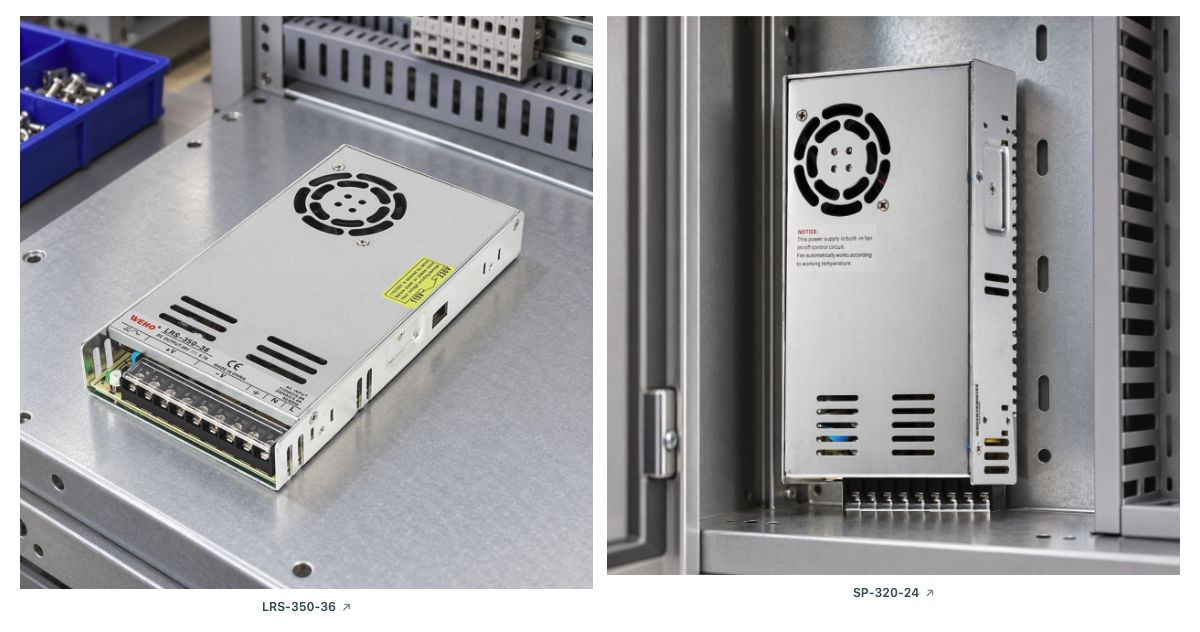
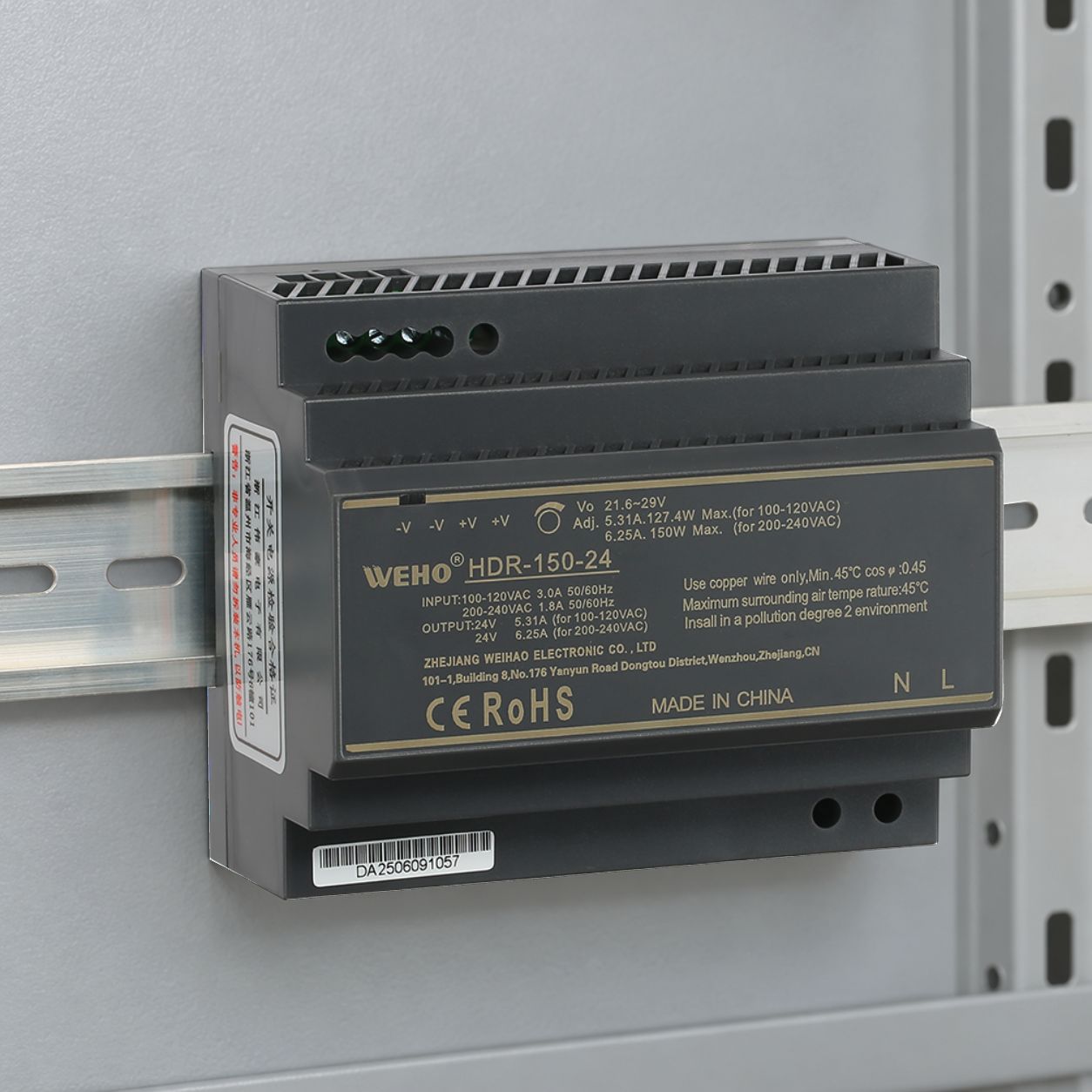
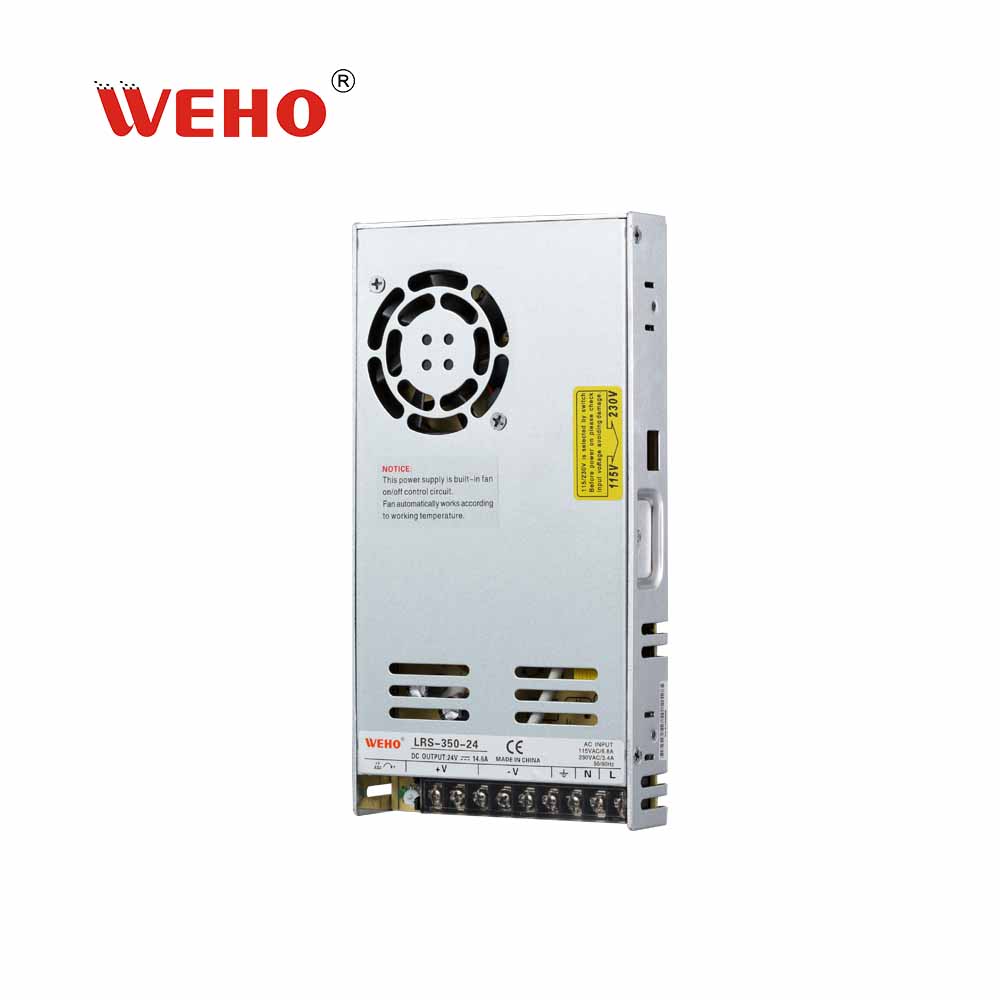
The published WEHO LRS-350 specification lists 90–132 VAC / 180–264 VAC by switch و 47–63 Hz in its input information. The pictured WEHO LRS-350-24 is the 24 V reference example for this family document. Confirm that the exact ordered unit and revision are covered.

These voltage windows are not one uninterrupted 90–264 V range. They also do not say that the selector changes frequency. Keep the documented input configuration, source voltage and source frequency as separate fields. Use the supplier’s applicable installation instructions for the actual configuration.
The following table is a document-screening exercise using those published AC boundaries. It is not a test record, installation approval or a claim that a delivered unit has been configured correctly.
| Proposed source | Voltage screen | Frequency screen and next step |
|---|---|---|
| 230 VAC, 50 Hz | Inside the stated high-voltage window | 50 Hz is within 47–63 Hz; confirm the required input configuration and remaining conditions |
| 120 VAC, 60 Hz | Inside the stated low-voltage window | 60 Hz is within 47–63 Hz; confirm the required input configuration and remaining conditions |
| 160 VAC, 50 Hz | Between the two stated AC windows | Acceptable frequency does not close the voltage mismatch |
| 230 VAC, 400 Hz | Inside the stated high-voltage window | 400 Hz is outside the stated frequency window; obtain an applicable specification rather than extrapolating |
A passing screen establishes only that the proposed nominal point falls inside the cited fields. It does not close source tolerance, output loading, thermal use, protection, EMC or complete-machine requirements. If the source can vary, compare its full specified envelope rather than one nominal reading.
Make a destination-supply record for the whole machine
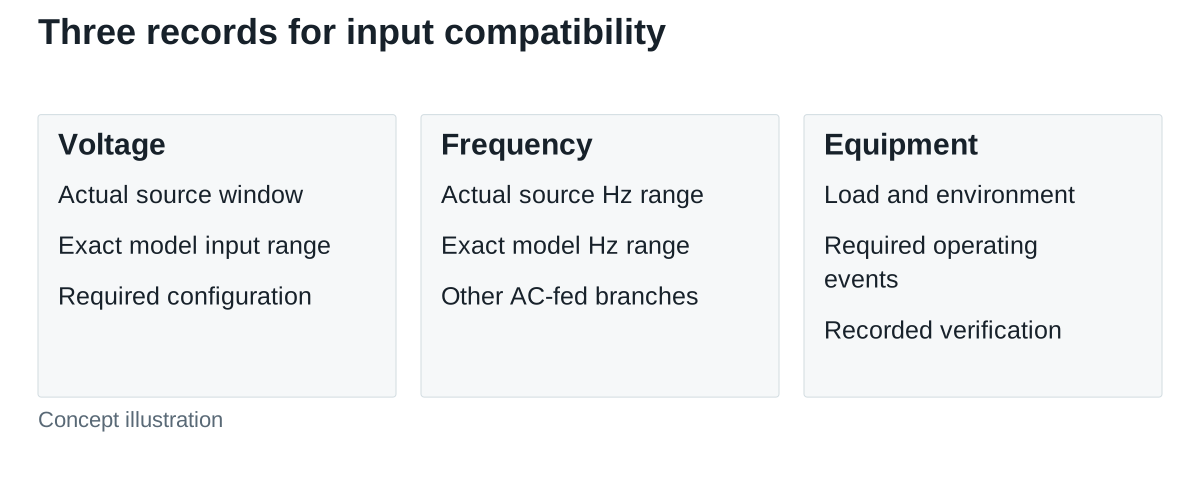
For an export project, record the destination supply at the equipment boundary: nominal voltage, permitted variation, nominal frequency, expected frequency range and the relevant connection arrangement. Obtain those conditions from the customer or controlled site specification. A country name alone is an incomplete electrical requirement.
List the equipment items that receive AC directly. Motors, fans, contactor coils, transformers and auxiliary devices can have their own source requirements. Do not assume that a compatible AC-DC supply converts the frequency for those parallel AC-fed branches. It provides its documented output, not an approval of every load in the cabinet.
For DC-fed equipment, identify the actual upstream AC-DC source and keep the DC receiver requirements separate. A downstream controller’s 24 V requirement does not answer which mains sources its upstream power supply accepts.
Treat variable-frequency and generated sources as their own case
If the equipment will be supplied by a generator, inverter or another controlled source, obtain its operating limits and expected events. Ask for the voltage and frequency ranges, waveform information and any interruption or transfer cases relevant to the equipment. Compatibility should be based on the defined source, not on the source’s nominal label alone.
Being inside a frequency window does not prove acceptable behavior during a voltage sag, rapid interruption or distorted waveform. Those are separate input conditions. Equally, a generic claim that a switching supply can operate beyond its published frequency range should not override an exact-model limit or replace written clarification.
Close the record before releasing the export variant
Use one row per AC-fed item and record its model, revision, voltage window, frequency window, configuration requirement, applicable operating conditions and evidence source. Mark a row as matched, mismatched or unresolved. Assign an owner to every unresolved field.
After the document screen, agree the necessary equipment checks with the responsible engineering team. Preserve the actual source, power-supply configuration, load states and environment. A successful power-on at one point should not be reported as verification of the entire declared input envelope.
Carry the accepted configuration into the purchase description and assembly record. If a replacement supply has different voltage selection or frequency limits, reopen the affected checks rather than assuming an equal output rating makes it interchangeable.
Share the actual input conditions
Send WEHO the proposed model, destination voltage and frequency ranges, source type, input configuration, DC load and installation conditions. Include any out-of-range or missing requirement so the applicable model documentation can be reviewed before selection.