Review a power supply REACH/SVHC declaration by matching the exact supplied product to the statement’s scope, construction coverage and Candidate List basis. Check the issuer, document revision and date, then obtain the substance information or clarification needed for the responsible supply-chain party’s assessment. A generic compliance sentence, a RoHS logo or a recent signature alone does not close those questions.
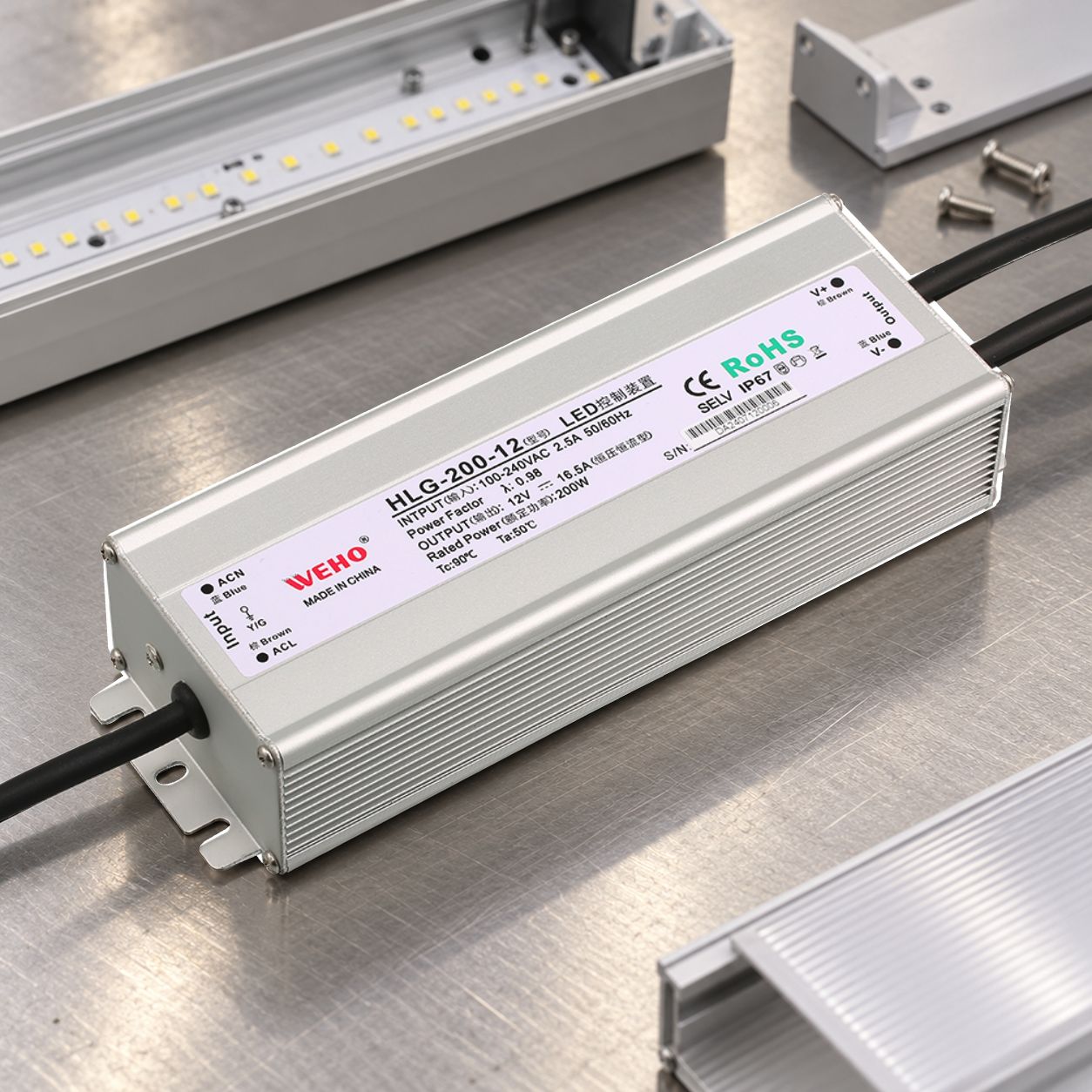
This purchasing guide is for OEM, importer and supplier-quality teams preparing an evidence file for an EU-market project. It gives a document-review method. The pictured WEHO model’s REACH/SVHC declaration has not been verified for this article, and the illustrations do not establish its material status.
Identify what is actually being supplied
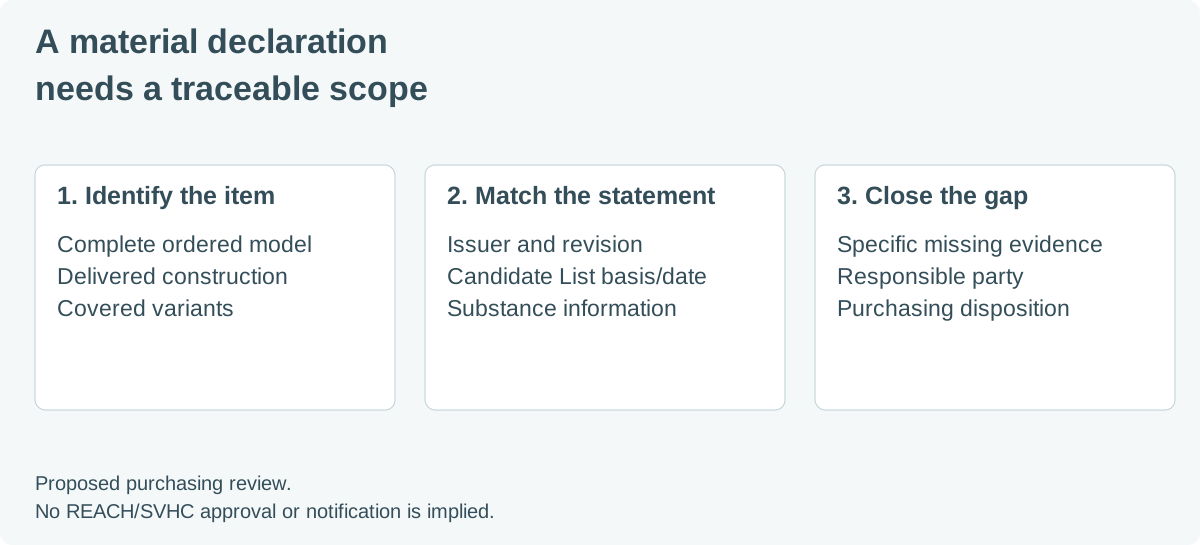
Begin with the quotation or purchase order: manufacturer, complete model suffix, supplied options and the revision or other controlled construction reference used by the supplier. Compare that identity with the declaration and any annex listing covered products. If the document names a family, ask how the ordered variant is included rather than assuming identical material content across every output or option.
Include separately supplied items when relevant to the request, such as a cable assembly or accessory. Ask which items the statement covers and which require their own evidence. Do not silently extend a declaration for the bare supply to a complete luminaire, control cabinet or shipping package.
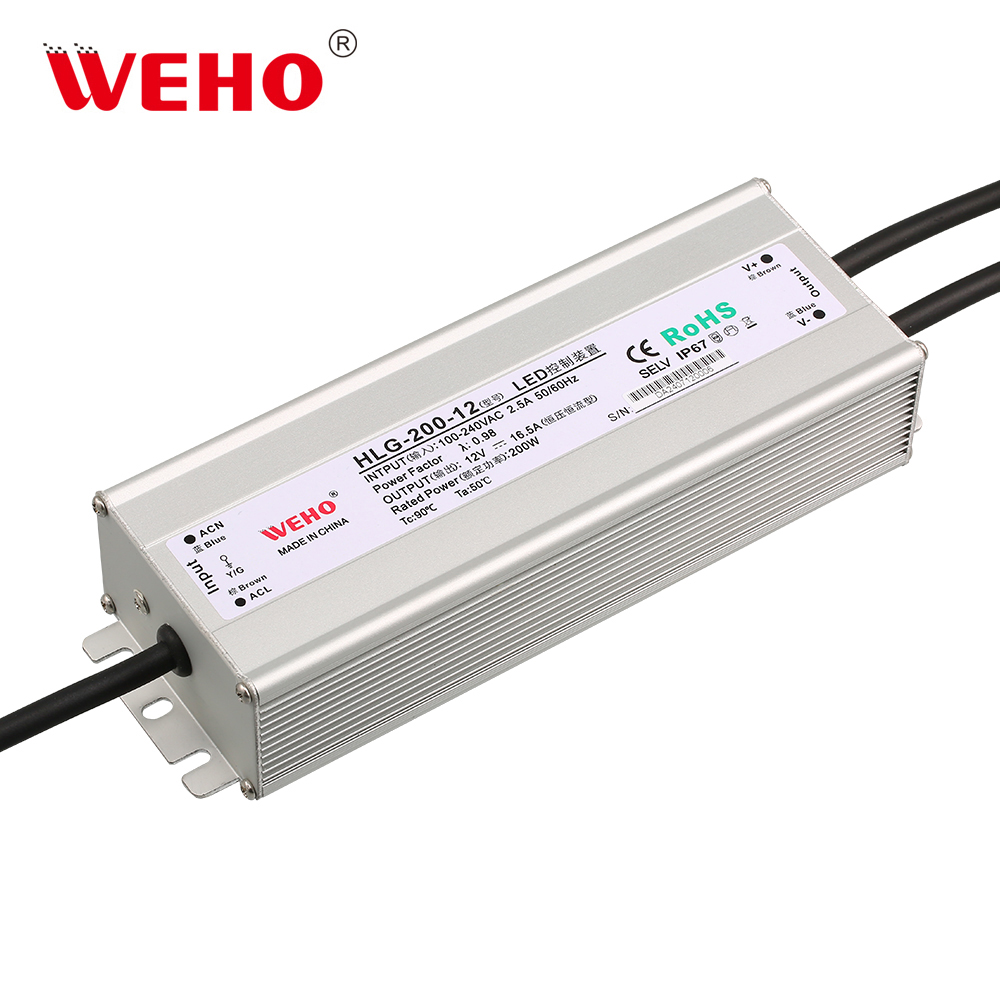
ال HLG-200 specification is a route to product identity and electrical documentation. A datasheet is not the missing product-specific material declaration. This review complements the broader CE, RoHS and FCC evidence guide; it does not treat those different requirements as interchangeable with the Candidate List review.
Read the declaration’s basis, not just its date
Record the document identifier, issue date, revision, issuer and the exact statement being made. Ask which ECHA Candidate List version or publication date was assessed and which delivered construction it covers. Verify that basis against ECHA’s current information when carrying out the project review. This article deliberately does not give a fixed substance count that would become an unreliable checklist after an update.
A newly signed letter can still rely on an older assessment. Conversely, age alone does not establish that a statement is legally invalid or that the material content changed. Ask the supplier to explain continued coverage, any new assessment and the procedure for handling list or construction changes. The responsible reviewer should decide whether the evidence answers the current purchasing requirement.
Distinguish the declaration’s scope from a broader “REACH compliant” phrase. Determine which requirement the supplier is addressing and what supporting information is available. A statement about Candidate List substances is not automatically a complete assessment of every REACH restriction or other environmental obligation.
Check substance information and article scope
ECHA’s Article 33 communication guidance explains that, when its conditions apply to a Candidate List substance above 0.1% by weight in an article, recipients must receive sufficient information for safe use, including at least the substance name. The legal trigger and applicable role should be checked for the actual supply chain; a buyer should not infer the required response from a green symbol.
For an assembled product, do not automatically dilute a substance’s concentration over the mass of the entire power supply. The ECHA guidance published by the EU Publications Office discusses constituent articles in complex objects. Ask how the supplier’s assessment treats the relevant articles and construction. Do not substitute a whole-unit screening result for an explanation of what was assessed.
Where a substance is identified, request its unambiguous identity and the location, concentration information and safe-use information relevant to the applicable obligation and customer request. Where a supplier states that no reportable Candidate List substance was found, ask for the defined scope and assessment basis. Silence or an unanswered form is not evidence of absence.
Build a declaration review worksheet
Keep the material file short enough to use, but specific enough to audit. The following worksheet is a proposed purchasing control, not a mandatory legal form.
On small screens, scroll sideways to compare the document fields and release questions.
| Field | Evidence to retain | Question before closing the review |
|---|---|---|
| Product identity | Complete model, variants, supplied accessories and coverage annex. | Does the statement identify the item actually being purchased? |
| Construction coverage | Revision, controlled BOM reference or supplier’s traceable coverage explanation. | Does it cover the delivered construction, including relevant changes? |
| Issuer and statement | Supplier identity, document ID, issue date and defined requirement addressed. | Who stands behind the statement, and what exactly is being declared? |
| Candidate List basis | Assessed list/date and the reviewer’s check of the current reference. | Are additions or a changed assessment basis accounted for? |
| Substance information | Applicable substance identity, affected article/location and relevant safe-use information. | Can the responsible party use the information for its actual duty or customer request? |
| Outstanding action | Specific question, evidence owner, purchasing disposition and follow-up record. | Has a real gap been closed rather than replaced by an assumption? |
Separate supplier information from SCIP responsibility
REACH supply-chain communication and a SCIP notification are related information tasks with different legal bases. ECHA describes SCIP as the articles-information database established under the Waste Framework Directive. Its supplier guidance identifies affected EU producers, assemblers, importers and other specified supply-chain actors, subject to the stated conditions and exclusions.
Have the responsible EU-market party determine whether an obligation applies and which information it needs from the manufacturer. Do not assume every non-EU power-supply factory has the same notification duty, or that a supplier’s declaration replaces the importer’s assessment. A database identifier, where applicable, should be traceable to the relevant product and supplied information; it is not a general product-safety certificate.
TDK-Lambda’s environment page provides a REACH/SVHC product-search entry, illustrating a product-document route a buyer can request. That supplier’s information does not establish a WEHO product’s status. Keep REACH, RoHS and conflict-minerals requests separately identified even if the supplier returns them in one file.
Resolve gaps and control changes
Consider a hypothetical purchase file for an HLG-200-12 variant. The supplier letter names only “HLG series,” cites an old list basis and does not explain the supplied construction. None of those observations establishes a prohibited substance or a compliance failure by itself. They identify three bounded questions: variant coverage, the current assessment basis and construction traceability.
Return those questions to the supplier with the intended market and customer data requirements. Record the answer, supporting document and responsible review decision. If the evidence remains incomplete, identify the unresolved point and its effect on purchasing release rather than marking the entire file approved.
Agree how product substitutions, material changes and Candidate List updates will be reviewed. Keep the accepted declaration with the model/revision mapping and relevant correspondence so the next order does not inherit an unexplained approval. The useful outcome is a traceable material-information file for the exact supply, not a larger collection of unrelated logos.