Choose between an RSP series power supply and an SP series power supply by comparing the exact offered models—not by the presence of PFC alone. Output capability, input conditions, cabinet space, cooling and control interfaces all remain relevant. A shared family power label does not establish interchangeability.
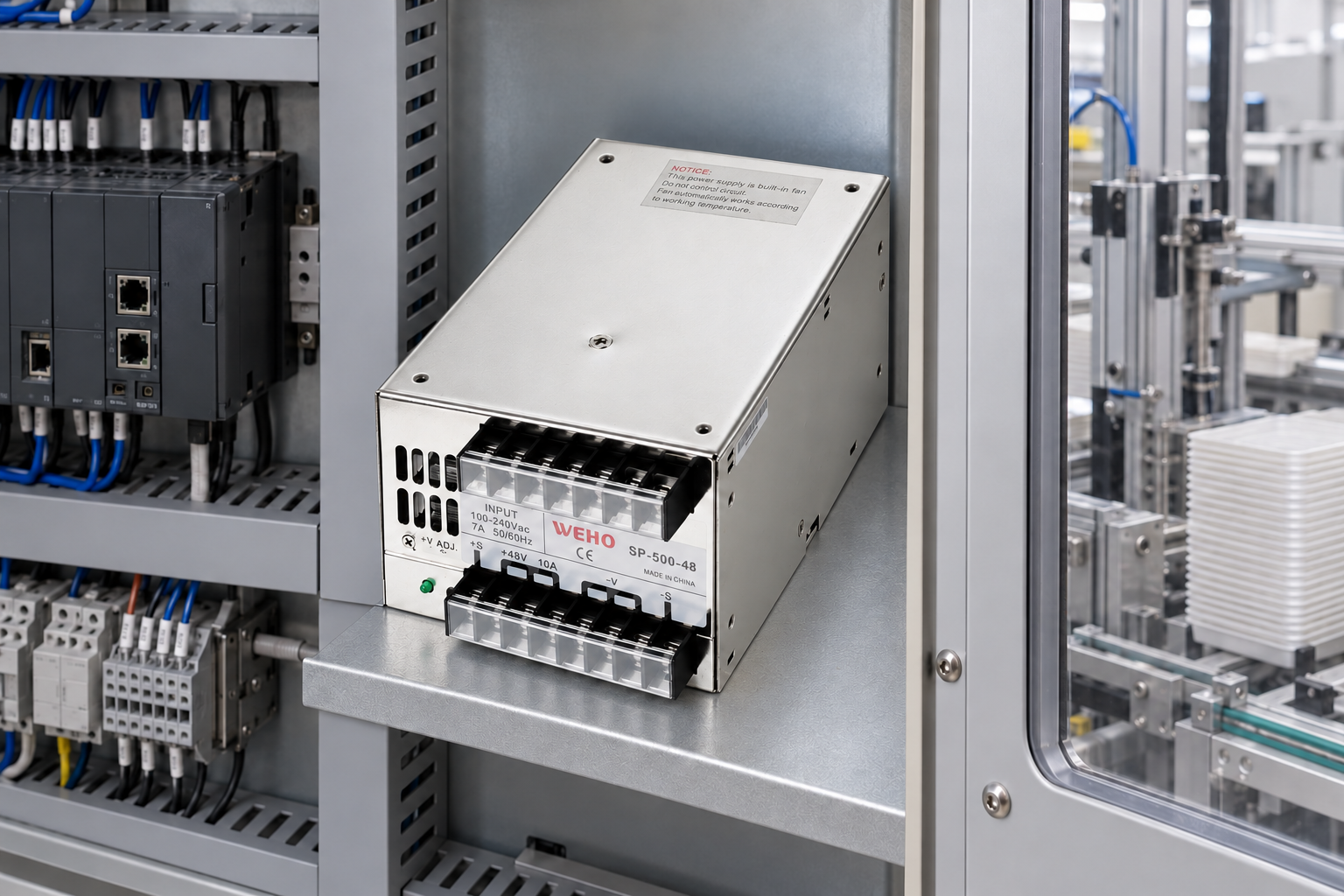
Hold the required output voltage constant
Start with the receiver’s approved voltage range, continuous demand and transient behaviour. Then compare candidate supplies at that voltage. A high-current 12 V unit and a lower-current 48 V unit can belong to similar power classes while serving entirely different loads.
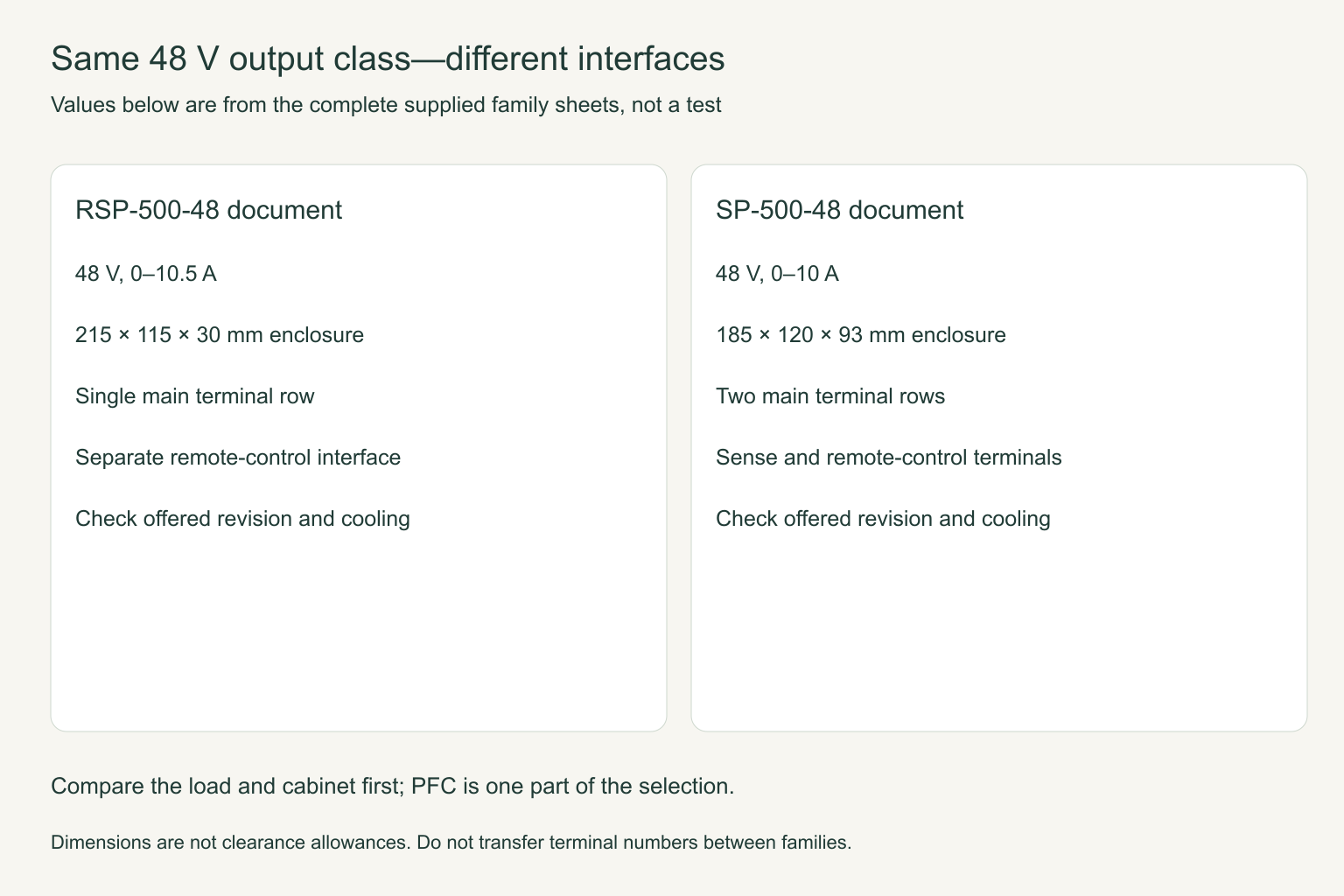
For a document-level example, the supplied RSP-500 sheet lists the 48 V variant at 0–10.5 A; the supplied SP-500 sheet lists its 48 V variant at 0–10 A. Their nominal voltage-current products are 504 W and 480 W respectively. These calculations explain why the series label alone is insufficient; they are not permission to exceed the delivered unit’s rating or its applicable derating limits.
Compare PFC conditions, not just the letters
Power factor concerns the relationship between real input power and apparent input power. Conversion efficiency concerns how much input power reaches the output. A power-factor figure is not an efficiency percentage, and PFC does not eliminate input inrush or settle the receiver’s voltage-ripple requirement.
The RSP-500 sheet states PF≥0.99 at 115 VAC and PF≥0.95 at 230 VAC at full load. The SP-500 sheet summary states PF>0.96 at 115 VAC and PF>0.93 at 230 VAC, but does not provide the same explicit full-load qualification in that summary. Request same-condition data for the actual operating point before drawing a performance ranking from those entries.
The cabinet difference is substantial
| Supplied-sheet item | RSP-500 | س-500 |
|---|---|---|
| Enclosure dimensions | 215×115×30 mm | 185×120×93 mm |
| Main terminal arrangement | One row | Two rows |
| Documented control interface | Separate remote-control connection | Remote-control and sense terminals within the terminal layout |
| Selection consequence | Check low-profile layout, ventilation and connector access | Check greater height and access to both terminal rows |
Do not treat the case dimensions as required installation clearances. Airflow, bend space, tool access and the mounting instructions still need review. A cabinet that accepts one outline may obstruct the other supply’s terminals or ventilation.
Do not migrate the old terminal map
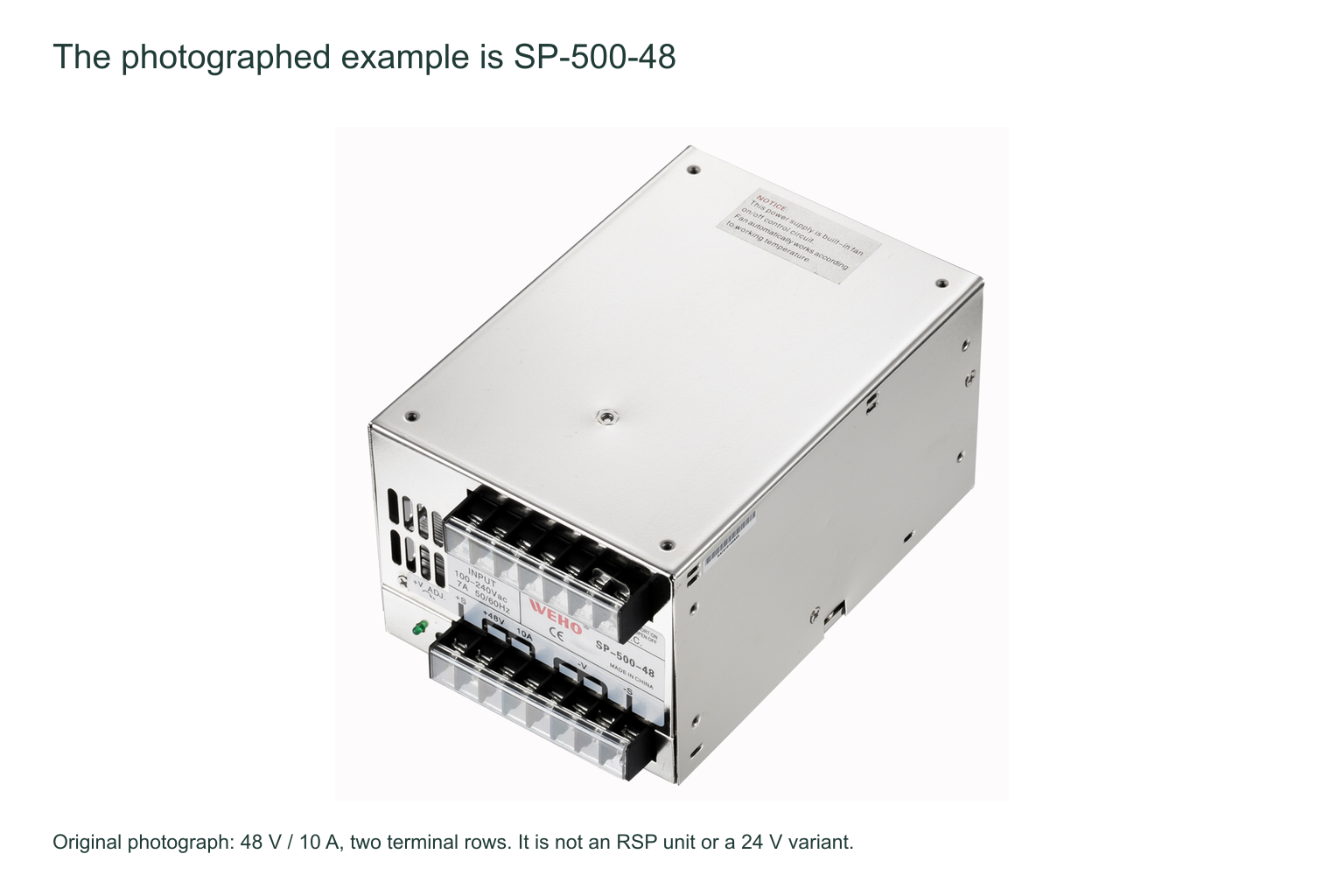
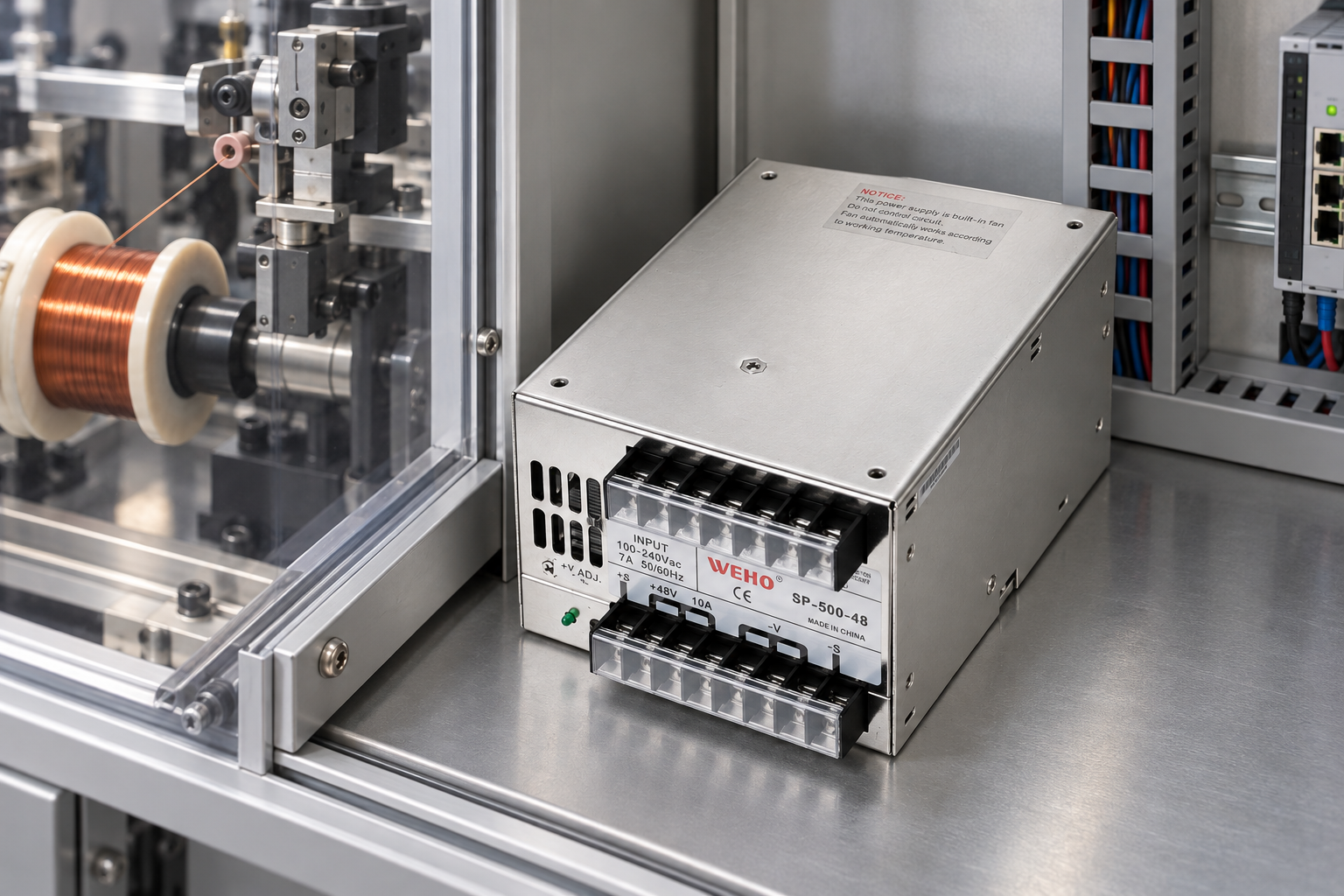
The SP-500-48 photograph has two genuine rows: seven upper terminals and eight lower terminals. Its documentation includes functions beyond the main AC input and DC output. Those interfaces are not extra load outputs merely because they appear beside them.
If replacing an existing unit, compare the exact terminal assignments, sense arrangement, remote-control behaviour and unused terminals in the current instructions. Do not transfer wiring by physical position or by an assumed numbering direction. The application illustrations deliberately leave the supply terminals empty and are not termination guides.
Resolve input and revision differences before purchase
The photographed SP-500-48 label states 100–240 VAC. Its archived supplied sheet and the current product-page input information have different boundaries and descriptions. Preserve those records and ask which specification applies to the offered hardware. A family name cannot resolve a revision difference.
For a meaningful quotation comparison, submit the same requirement to each candidate: nominal and allowed output voltage, continuous and peak load profile, actual AC input, ambient conditions, cabinet envelope, airflow constraints and required control functions. Ask for the exact model revision and applicable electrical and mechanical documents.
Which family should be shortlisted?
If a low-height chassis is important, inspect the RSP-500 information against the available space. If the documented SP interfaces and envelope match an existing design, review the SP-500 information. Neither observation makes a model a drop-in replacement. Send WEHO the same load and cabinet requirement to confirm a supported option.
Common buyer questions
Does the higher PF number identify the better supply?
Not by itself. Compare at matching conditions and include output, efficiency, thermal and integration requirements.
Can a 500 W family name guarantee 500 W at every voltage?
No. Use the exact voltage-current row and the delivered unit’s limits.
Can I keep the existing wiring when changing families?
Only after the exact interfaces and approved circuit design have been reviewed. Similar-looking terminal positions are not evidence of identical functions.