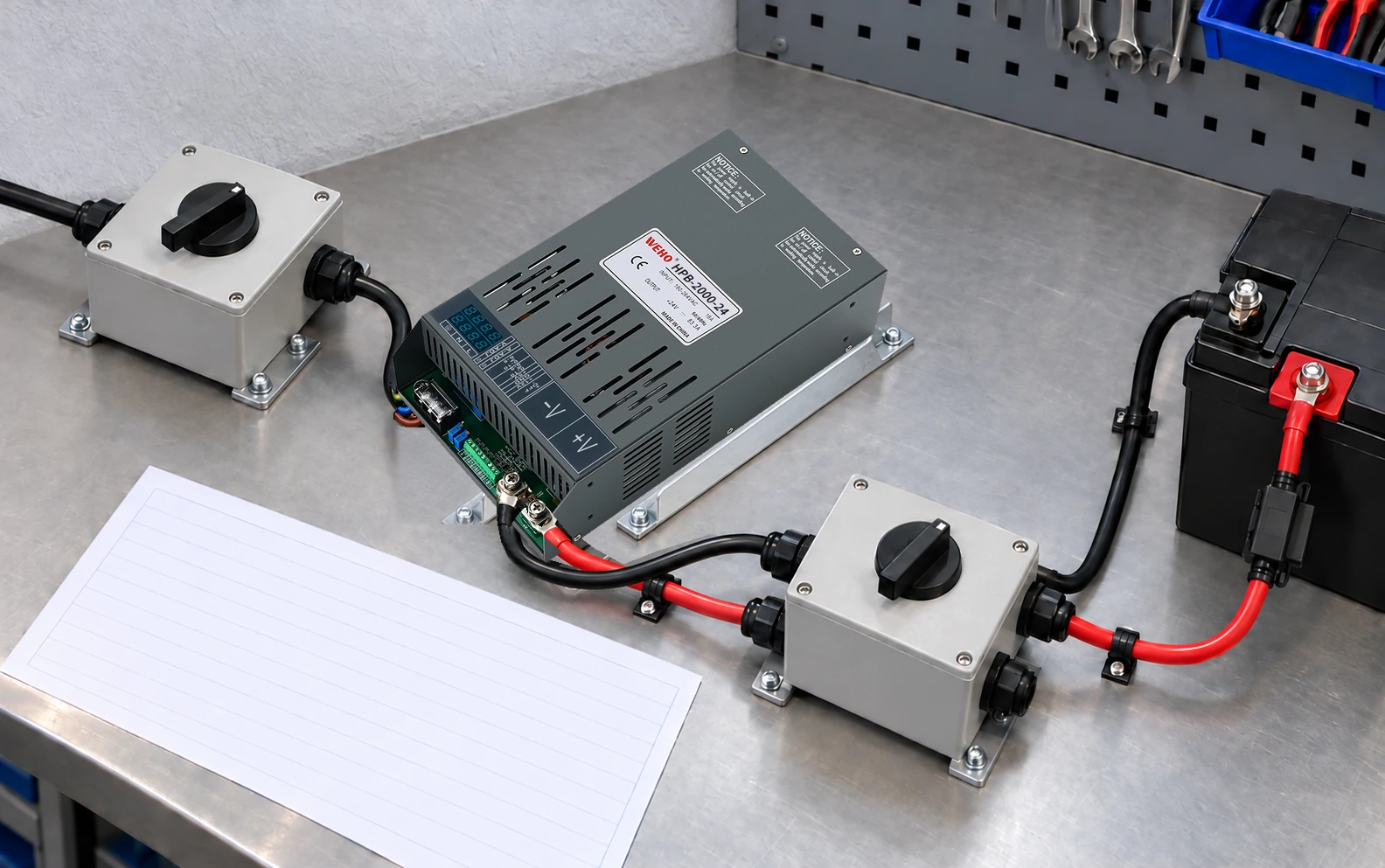
Cold start means starting an eligible UPS from its battery when the normal AC input is unavailable. It is a separate capability from switching an already-running load to battery. Before specifying it for a critical system, confirm the exact equipment and battery configuration, the available starting capacity, and the behavior on restoration of the normal source.
Why a battery transfer test is not a cold-start test
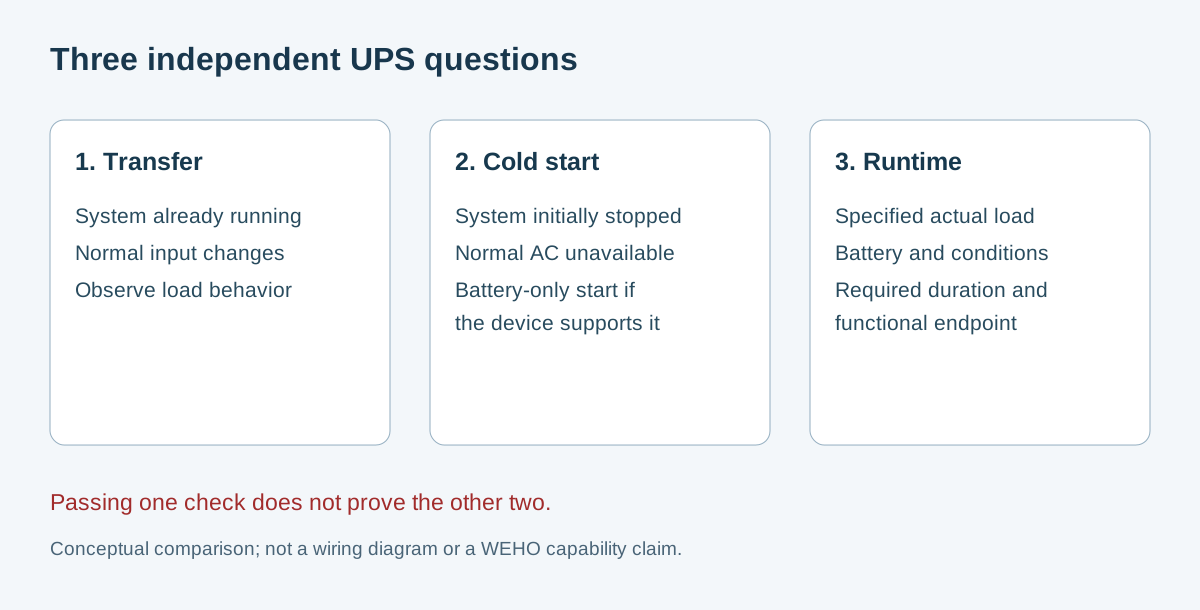
A transfer test begins with a system already running from its normal source and observes its behavior after that source changes. A cold-start requirement begins with the UPS and load stopped, with the normal input absent. Depending on the design, the equipment may need enough battery energy to energize its own controls, create its output and start the connected load. A successful transfer therefore does not, by itself, establish that the same system can start from a battery.
Schneider Electric describes a cold-start procedure for its Easy-UPS equipment and a separate procedure for specified Symmetra models. The steps, controls and expected indications belong to those models; they are not instructions or capability evidence for a WEHO product. Ask the actual manufacturer for the applicable documentation and revision.
Separate the three questions
| Question | What the evidence should address | What it does not establish |
|---|---|---|
| Can it transfer? | The existing load and supply state during the documented source change. | Start from battery with the system initially off. |
| Can it cold start? | Battery-only startup of the exact equipment and specified load, if supported. | The complete required runtime or every later restart. |
| Can it run long enough? | Usable backup at the required load, state of charge, environment and acceptance conditions. | That a device can start when no normal input is present. |
The architecture matters. An AC-output UPS supplying an AC load is not interchangeable with a battery-backed DC supply feeding a control circuit. Define the output, the energy source, the connected load and the controlled operating state before comparing documents.
Specify the startup event
For each proposed configuration, record the exact equipment model and revision, battery chemistry and approved configuration, battery condition and state of charge, output voltage, environmental conditions and the source state. Obtain the manufacturer’s permission for battery-only startup, any required minimum battery condition, and the indication that the output is ready.
List the load at startup as well as its steady operating state. A motor, power supply or capacitive input can demand a different current during startup. Do not use a steady wattage value as proof of the startup envelope. Ask whether the output’s documented starting capability and load behavior are compatible, and assess the complete installation under the applicable equipment instructions.
Make an evidence record, not a shortcut
- Document the initial state. Identify which input is unavailable, whether the backup equipment and load are already off, and the intended purpose of startup.
- Confirm the equipment capability. Obtain the exact model’s instructions for battery-only starting and any restrictions. An unspecified capability remains unknown.
- Account for battery and load conditions. Record the accepted battery configuration and state, the startup load profile and the minimum operating conditions defined for the project.
- Plan the change in service. Have the responsible team assess critical-load continuity and the effect of consuming backup energy before any controlled verification.
- Record the outcome. Capture the equipment revision, initial conditions, load configuration, observed behavior and recovery conditions. Compare the result with the project acceptance criteria.
Do not disconnect batteries, bypass protection or reproduce another manufacturer’s button sequence based on a generic article. A test can interrupt a load or reduce the energy available for an actual outage. The responsible personnel should use the instructions for the installed product and a site-approved procedure.
What happens when the normal source returns?
The project also needs an agreed return-to-service behavior. Some systems may return to normal input, recharge, or require a user action, but the actual sequence and allowed load depend on the equipment. Ask whether a battery-only started load continues operating through restoration, how charging is indicated, and what records must be kept. Do not assume automatic transfer or charging from the AI-assisted application illustration.
Where a WEHO product fits
ال WEHO AD-155 family page describes a power-supply family with battery-charger functionality. The lead image provides an AI-assisted application context, not evidence that a particular suffix supports battery-only startup, the AC-output UPS behavior discussed above, a specific battery chemistry or a proven transfer result. Obtain current documents for the exact unit and intended arrangement.
Questions buyers ask
Does a successful battery self-test prove cold start?
No. A self-test has its own defined starting state, load and duration. Verify whether it actually covers starting the complete system from its battery with normal input unavailable.
Does cold start prove the required backup time?
No. Starting is one event. Runtime depends on the approved battery, its condition, load and project acceptance conditions.
Can I use a procedure for a different UPS?
No. Controls, battery arrangements and operating modes differ. Use the exact model and revision’s current instructions and the site’s approved plan.
Send WEHO the exact supply model and suffix, required output, battery configuration, startup and normal load profile, and the intended behavior when the normal source returns. Ask for model-specific capability and installation documentation. تواصل مع ويهو.