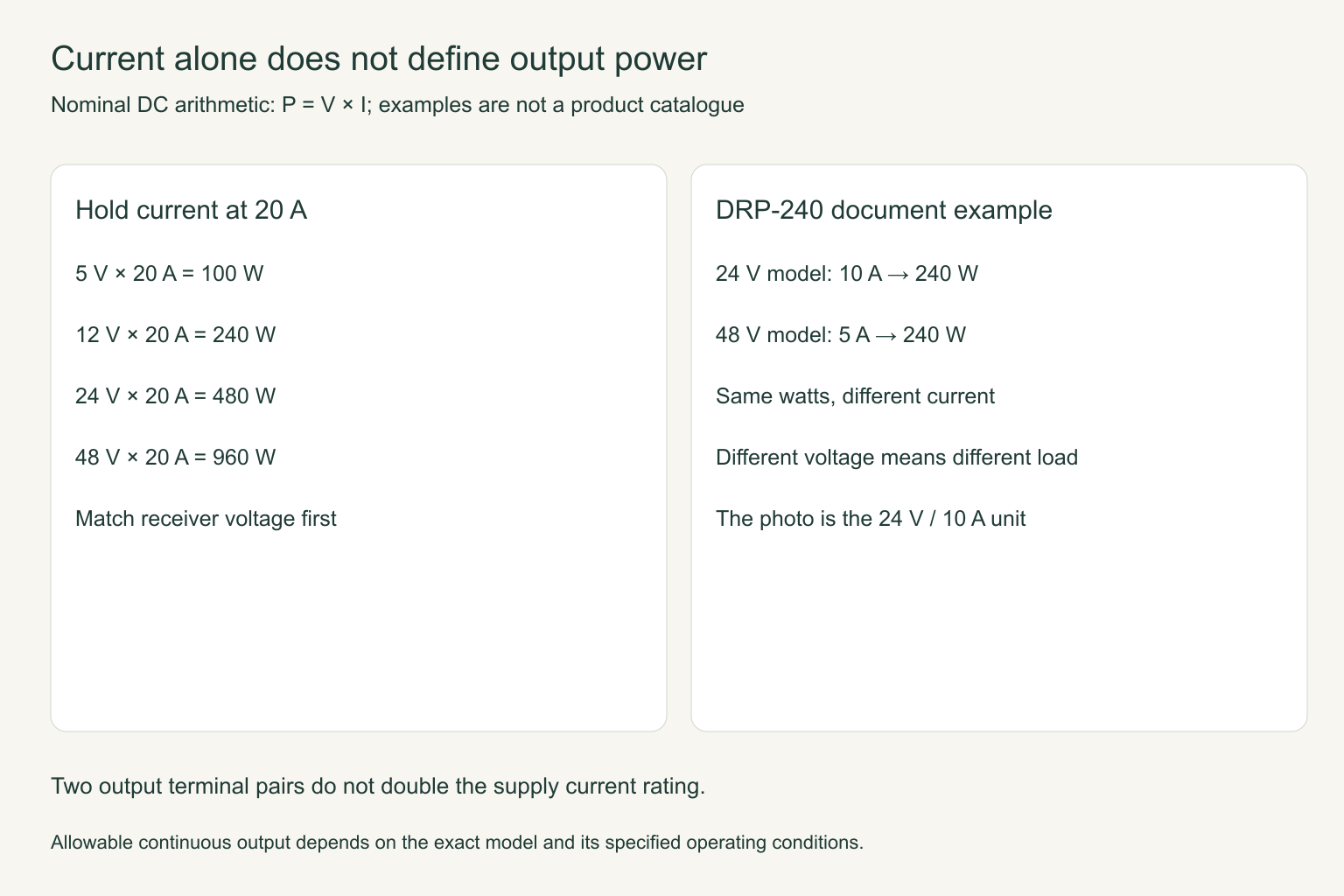
A 20 A power supply is not a complete specification. At 5 V,20 A corresponds to 100 W; at 48 V, the same current corresponds to 960 W. Select the receiver’s required voltage first, then evaluate current,power and operating conditions for an exact model.
Read voltage and current as a pair
For nominal DC output, power is voltage multiplied by current: P=V×I. This gives a simple comparison, but it does not say that a particular supply can provide every combination or that its output can be adjusted across all four voltages.
| Nominal output | কারেন্ট | Calculated power |
|---|---|---|
| 5 V | 20 A | 100 W |
| 12 V | 20 A | 240 W |
| 24 V | 20 A | 480 W |
| 48 V | 20 A | 960 W |
This table is arithmetic, not a list of four verified WEHO models. Product availability, voltage adjustment and continuous output limits must be confirmed separately. A 5 V load must not be connected to a 24 V supply merely because both labels contain 20 A.
The opposite comparison: equal watts, different amps
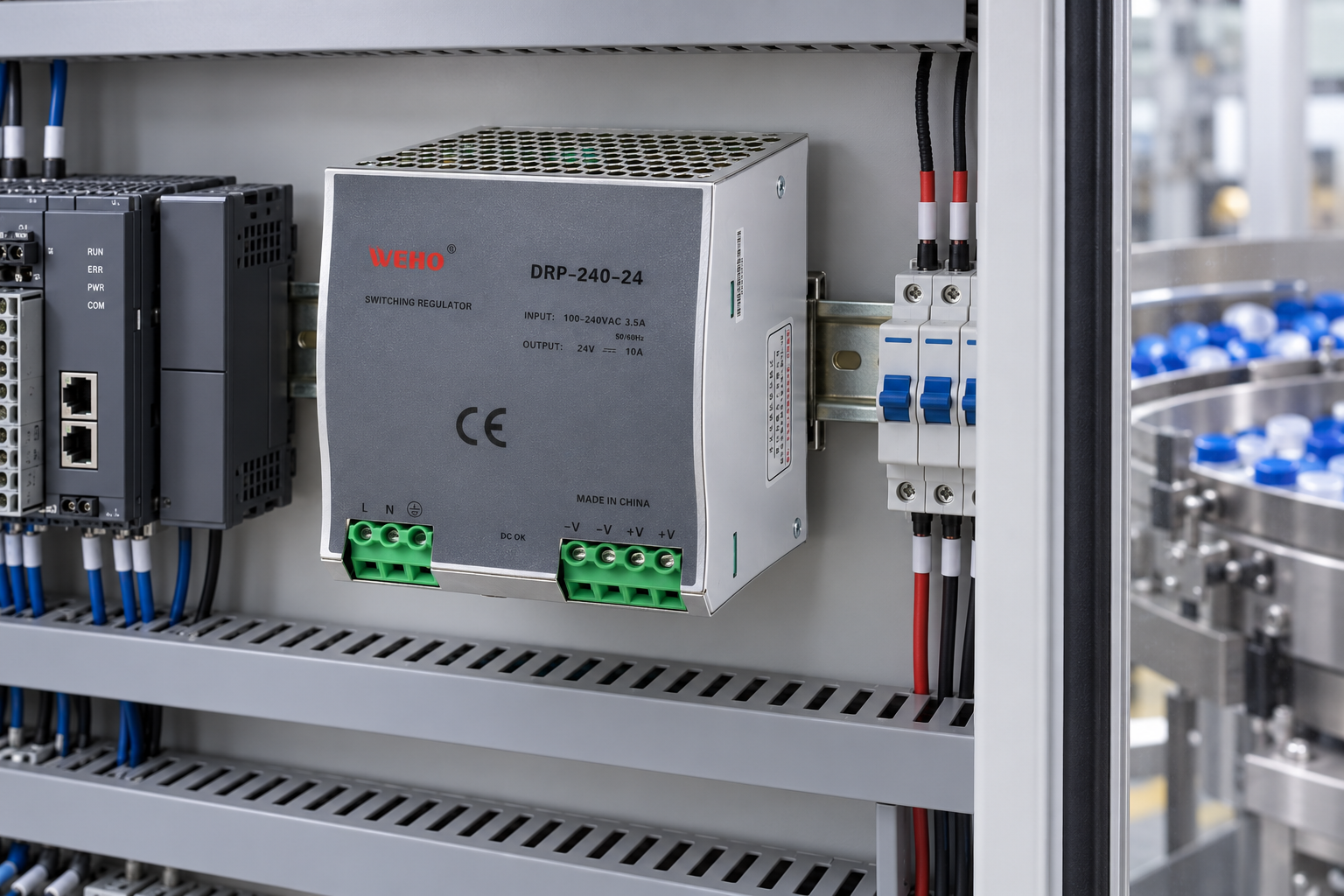
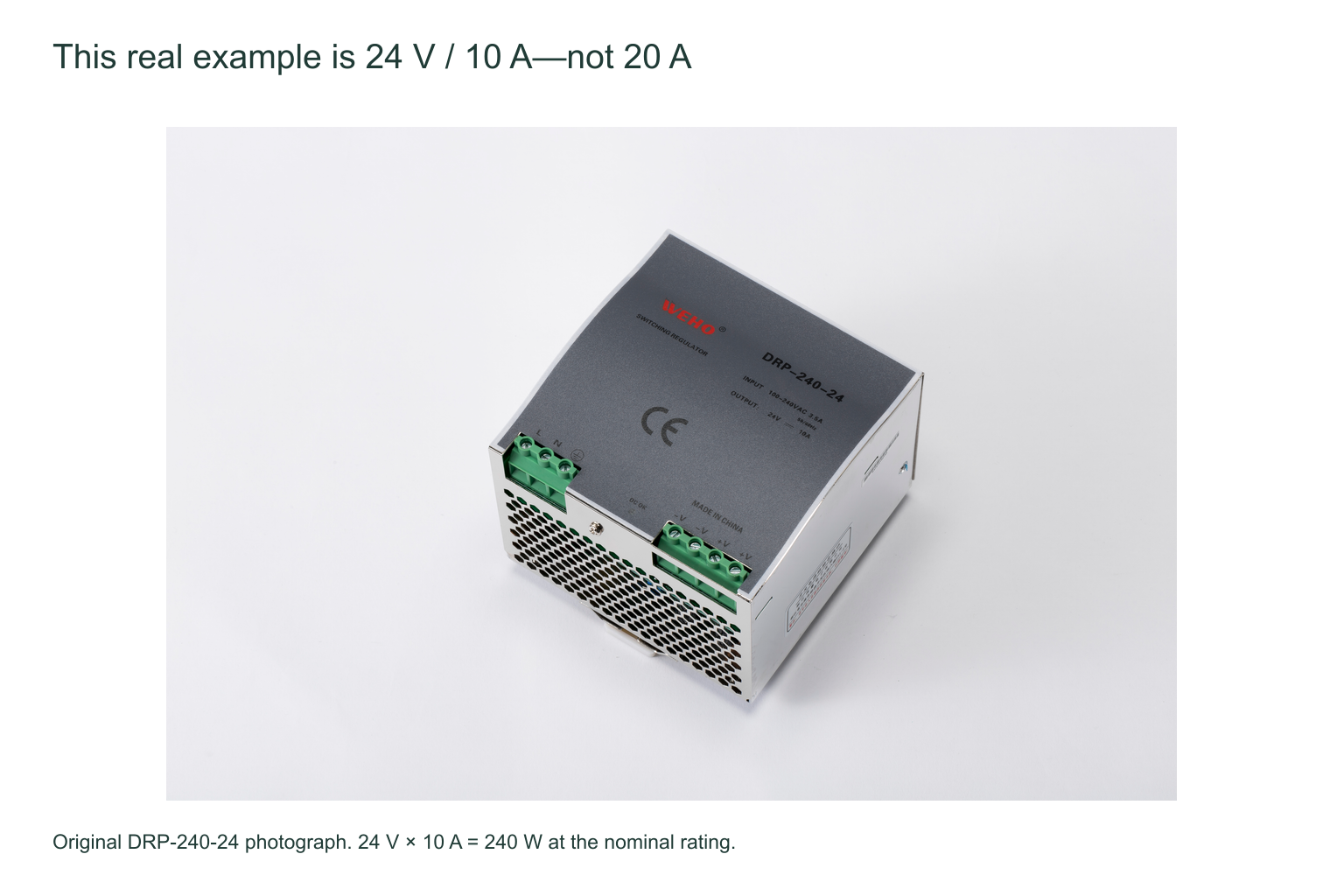
The supplied DRP-240 sheet provides a useful real example. It lists DRP-240-24 at 24 V,0–10 A and DRP-240-48 at 48 V,0–5 A. Both nominal voltage-current products are 240 W. The 48 V version has half the current rating, not half the nominal power.
The photographed unit is the DRP-240-24. Its actual label says 24 V,10 A and remains unchanged in this article. It is not presented as a 20 A supply. Use the exact model column and delivered nameplate; a family wattage or a photograph of another voltage version is insufficient.
“Up to 20 A” does not force 20 A through the load
With a suitable regulated constant-voltage supply, the connected load determines its operating current within the supply’s capabilities. The current rating describes an available limit under stated conditions, not a current that every receiver must draw.
That does not make unlimited oversizing automatically appropriate. Startup behaviour, protection response, branch wiring and fault-energy considerations still matter. A larger supply does not replace the required protection for smaller wires or individual receivers.
Build the load schedule at the correct voltage
List each receiver’s required voltage, normal current, peak or startup demand and duty. Keep simultaneous events separate from loads that cannot operate together. Use documented receiver values and measurements from the intended equipment rather than inferring demand from a motor’s size or an LED strip’s appearance.
For a hypothetical 24 V control branch, continuous loads totalling 8 A require 192 W at the load before allowing for other documented demands or losses. If a startup event raises demand to 11 A, the continuous 8 A total alone cannot establish that a 10 A supply will start the system. Obtain the applicable peak capability and protection behaviour instead of treating a fixed percentage of spare current as a universal rule.
Multiple terminals are not multiple ratings
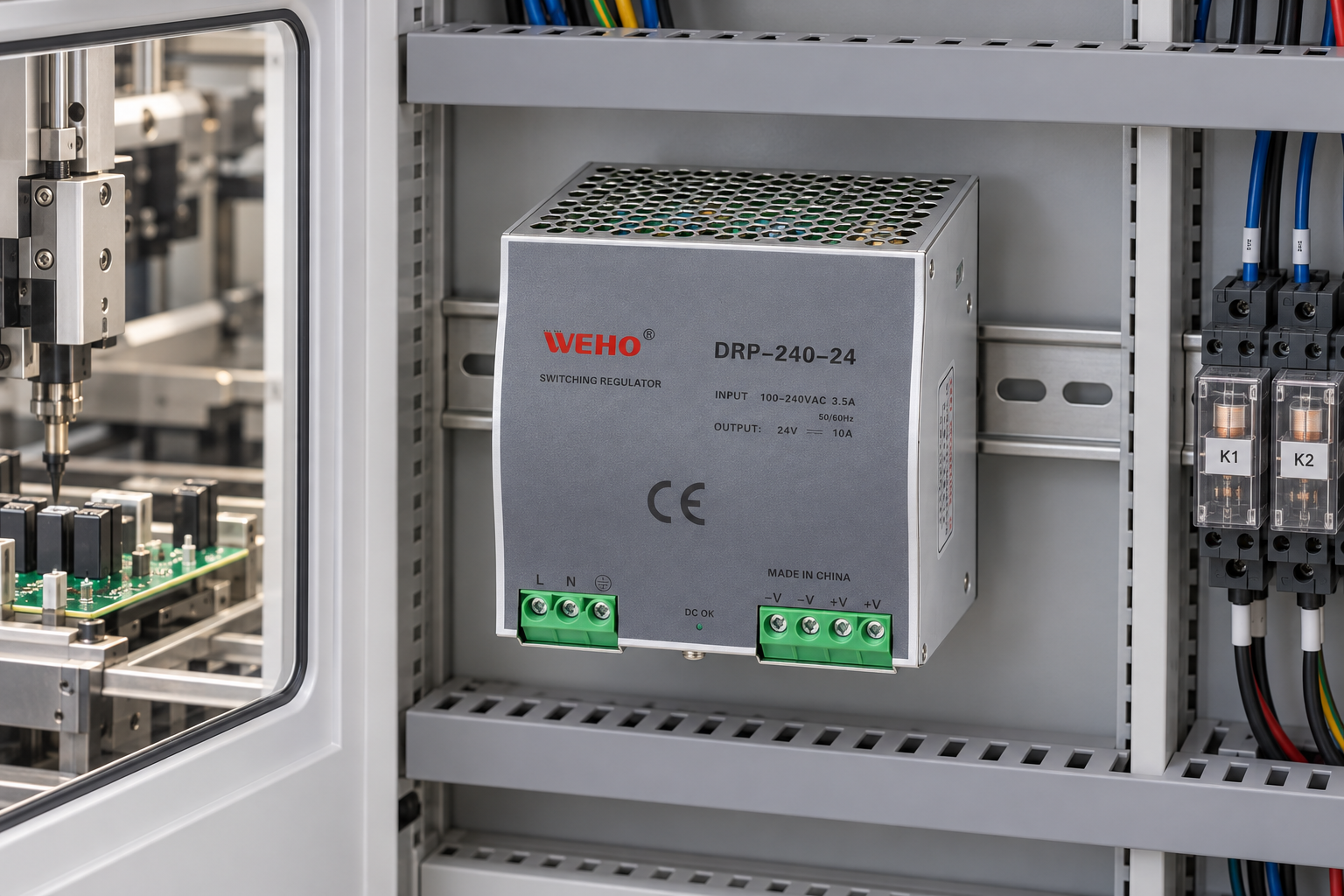
The DRP-240-24 has two negative and two positive DC terminals. They provide connection points for the supply’s output; they do not turn its 10 A nameplate into two independent 10 A channels. Follow the exact terminal and conductor instructions when distributing that output.
Current sharing between conductors, acceptable conductor size, terminal capability and branch protection must be designed for the installation. Do not double a rating by counting screws, and do not assume that joining two independent supplies is an approved way to reach 20 A.
Ask for a supply using a complete requirement
A useful enquiry states the required output voltage and tolerance, continuous current, peak demand and duration, input source, ambient conditions, cooling and installation constraints. Include the receiver data and branch arrangement. Then compare an offered model’s ratings with those same conditions.
দ DRP-240 product information illustrates the difference between 24 V/10 A and 48 V/5 A. For another voltage or current requirement, send WEHO the complete load schedule rather than requesting only “a 20 A power supply”.
Common buyer questions
Is 48 V always better because the same current gives more power?
No. The load must be designed for that voltage, and the complete distribution and safety requirements still apply.
Can I adjust a 24 V model down to 5 V?
Not unless the exact model documents that range. A trim adjustment is not a general-purpose voltage converter.
Does the calculated wattage guarantee continuous operation?
No. It is nominal arithmetic. Use the exact supply’s specified conditions, derating and load behaviour to establish the allowed duty.