Estimate inverter runtime from the energy consumed over the actual operating profile, including load-dependent losses. Do not average the runtimes calculated for separate load states or substitute average output power into an unsupported efficiency value.
- Add energy over each defined operating interval.
- Apply efficiency consistently at the relevant load state.
- Keep startup capability and usable battery energy as separate checks.
Why is a duty profile more useful than one average wattage?
An intermittent load can spend substantial time in idle, active and transition states. Those states may have different electrical demands and conversion losses. A single average output wattage can hide that structure, especially when an inverter's own consumption is significant at light load.
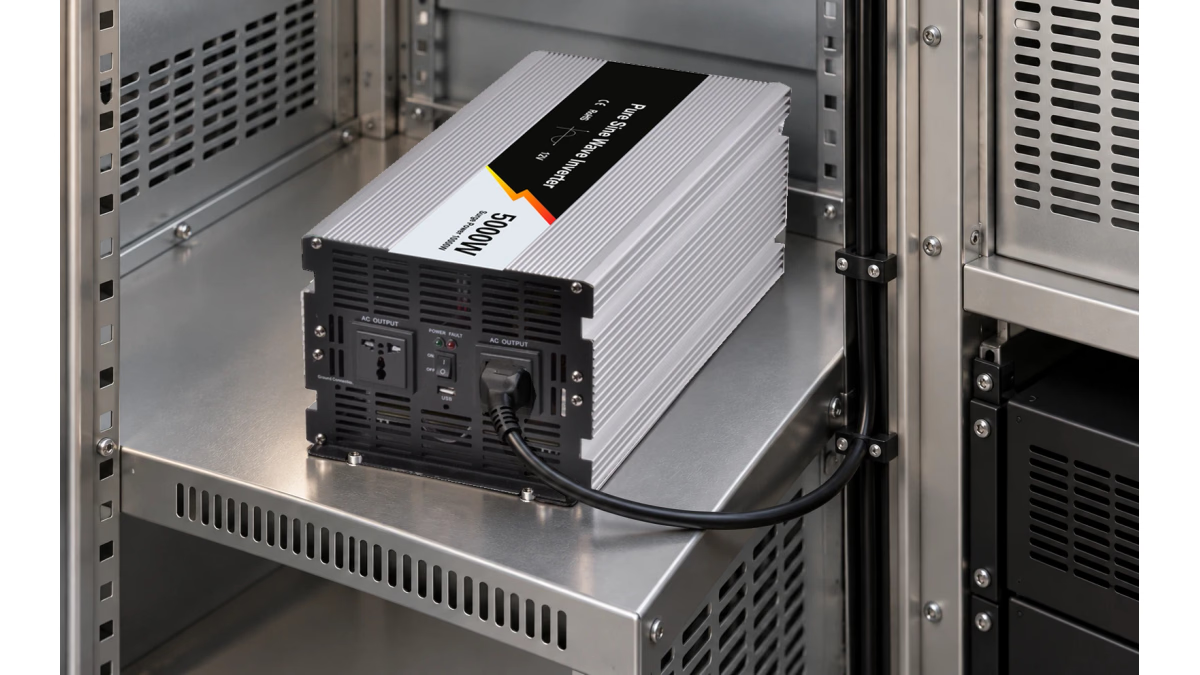
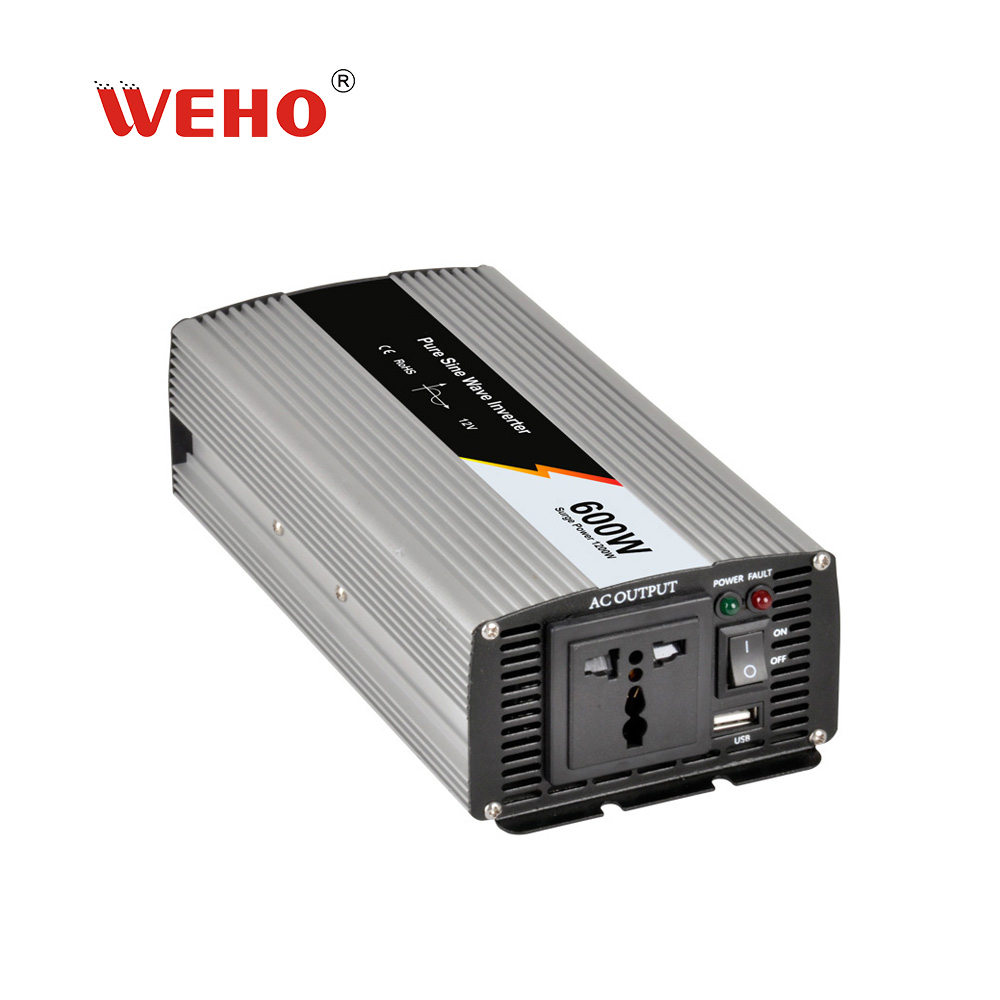
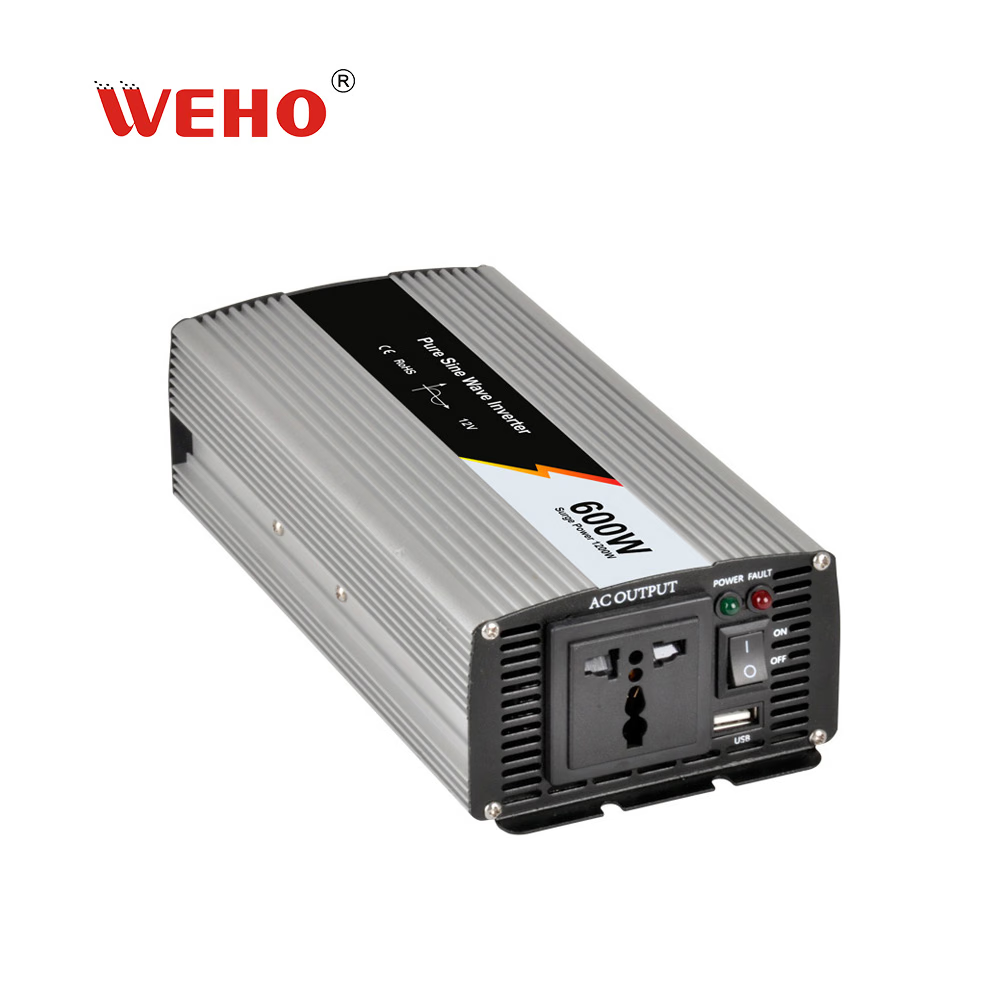
For a WHP-600 inverter project, identify the ordered DC input and AC output variant. The family page lists multiple options; the source photograph does not mean the same unit accepts every listed battery voltage or provides every output voltage.
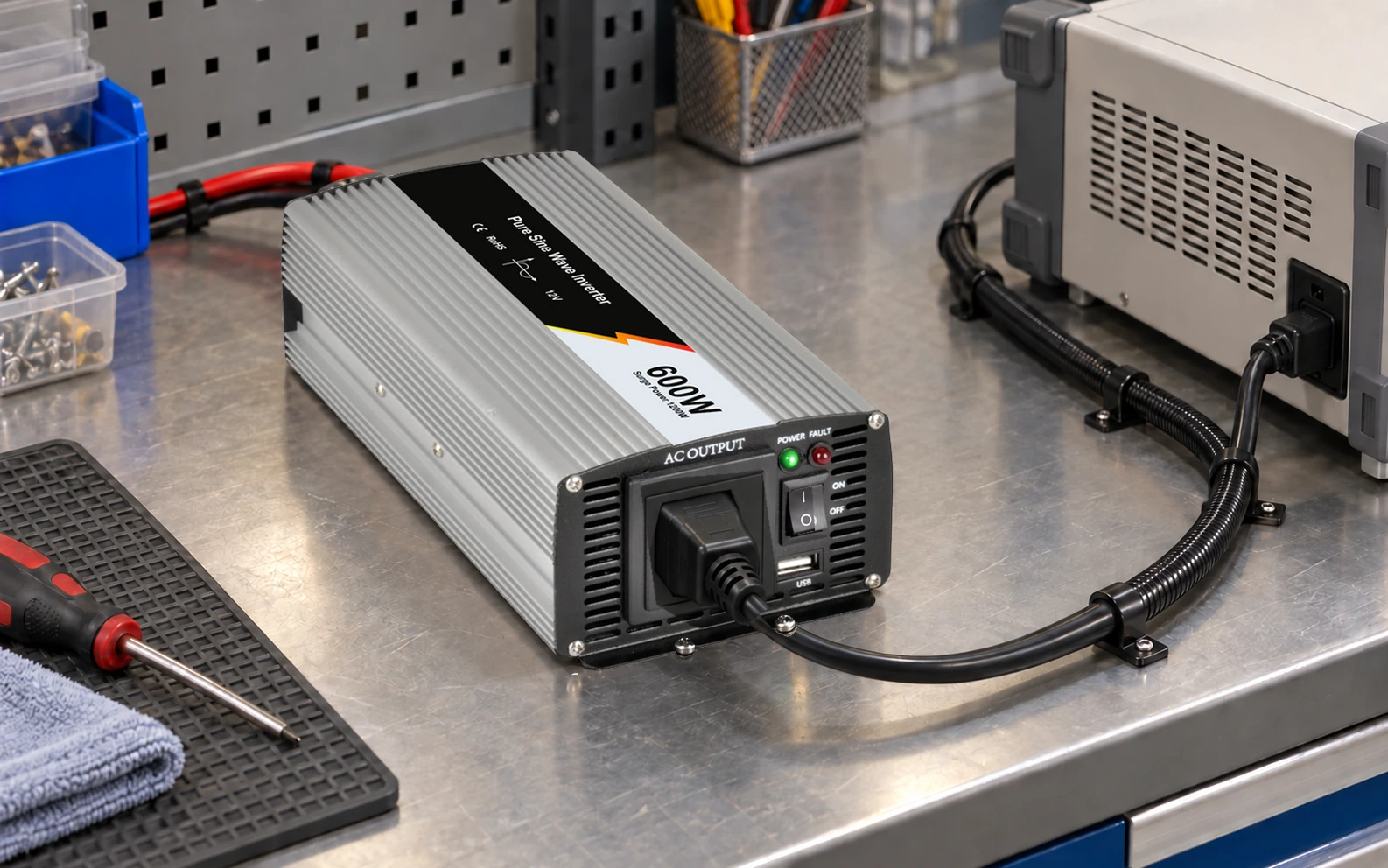
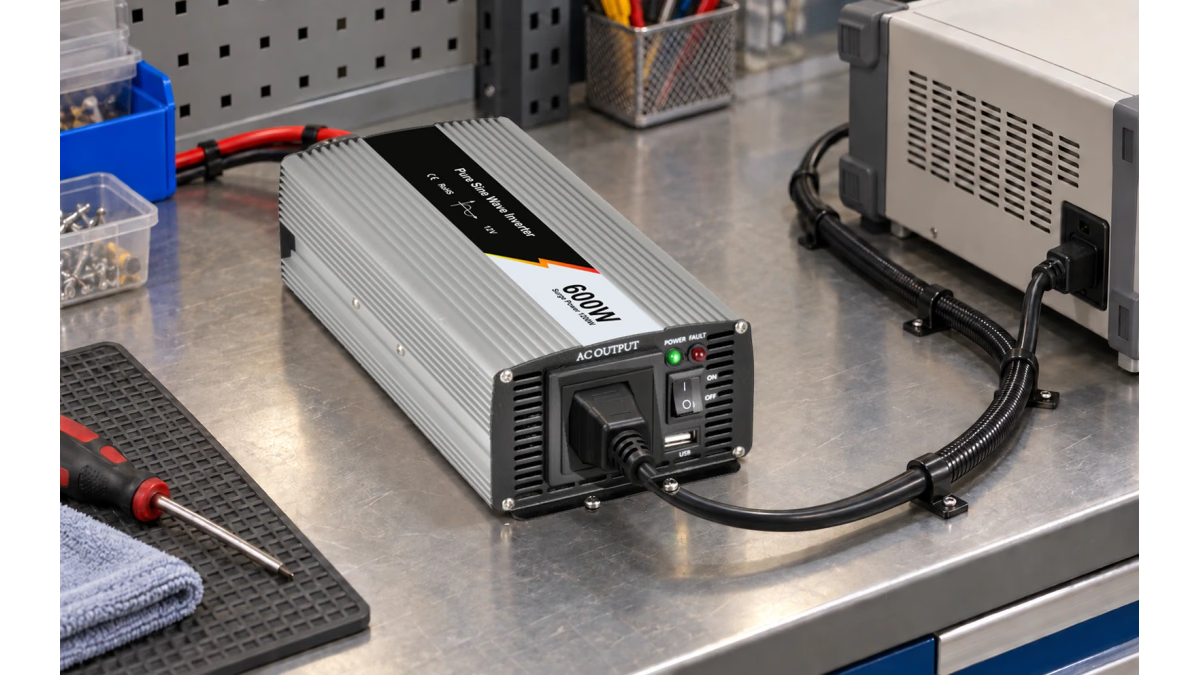
The application scene establishes an inverter installation context. It does not show a measured duty profile or a runtime test. The calculations below use hypothetical loads and efficiencies to demonstrate the energy method, not to claim WHP-600 performance.
The main decision is how much battery-side energy the defined operating cycle requires. After that calculation, compare it with usable energy under the battery's actual conditions. A separate capability check must establish that the inverter and battery path can support startup and peak demands, even when their duration contributes little to total energy.
How should cycle energy be calculated?
Divide the profile into intervals with known or justified power. For each interval, battery-side energy is input power multiplied by time. If only AC load power and a valid efficiency estimate are available, input power can be estimated as PAC/η, provided the efficiency already represents the complete conversion losses at that state.
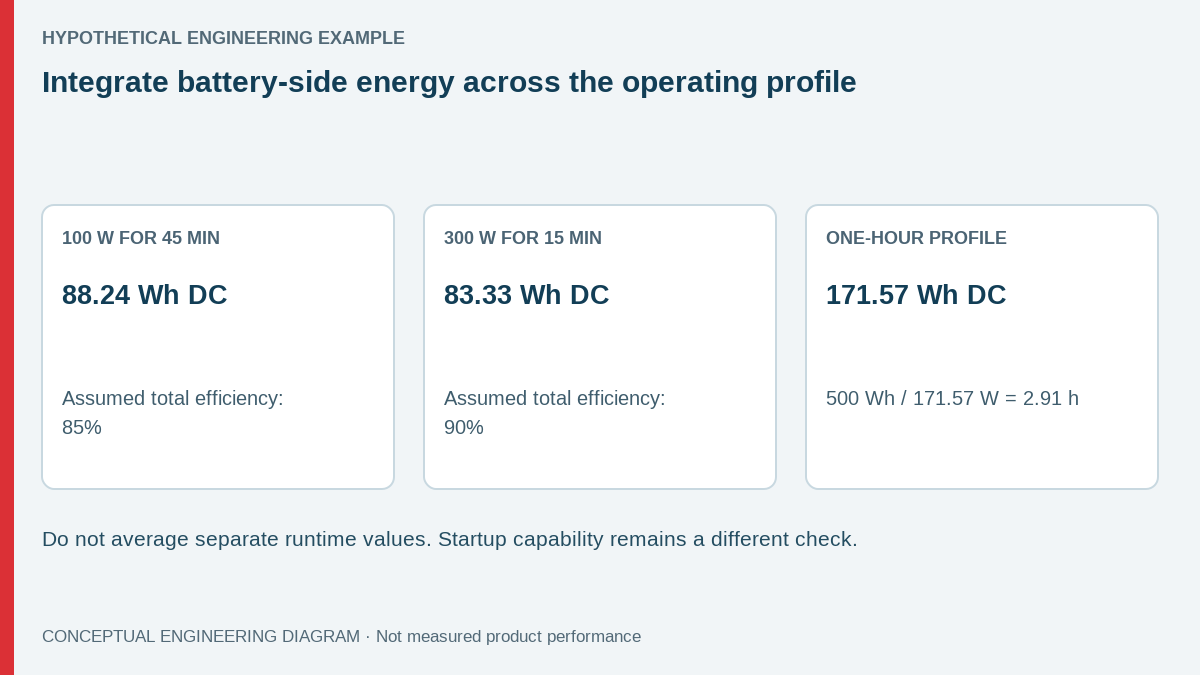
Consider a hypothetical one-hour cycle: 100 W AC for 45 minutes and 300 W AC for 15 minutes. AC energy is 100 × 0.75 + 300 × 0.25 = 150 Wh. The average AC power is therefore 150 W over the hour.
Assume illustrative total efficiencies of 85% at 100 W and 90% at 300 W. Estimated battery-side energy is (100/0.85) × 0.75 + (300/0.90) × 0.25 = 171.57 Wh. Average battery-side power is 171.57 W for this repeating profile.
If an assumed usable battery energy is 500 Wh under the relevant conditions, a simple repeating-cycle estimate gives 500/171.57 = 2.91 hours. This is not a WHP-600 runtime specification. Real battery behavior, changing voltage, efficiency and the exact final partial cycle require a more complete evaluation.
| Hypothetical state | Duration per hour | AC energy | Assumed efficiency | Estimated DC energy |
|---|---|---|---|---|
| 100 W operation | 45 minutes | 75 Wh | 85% | 88.24 Wh |
| 300 W operation | 15 minutes | 75 Wh | 90% | 83.33 Wh |
| Complete cycle | 60 minutes | 150 Wh | Not an arithmetic average | 171.57 Wh |
| 500 Wh usable DC energy | Repeating-profile estimate | Subject to actual profile | Example assumptions only | Approximately 2.91 hours |
Why should separate runtime values not be averaged?
Runtime is energy divided by power. Because the relationship is reciprocal, averaging two runtime values does not generally give the runtime for a mixed load profile. The correct weighting concerns energy use over time, not a direct average of the final hour figures.
Using the example's 500 Wh, constant operation at the first state's estimated DC demand gives 4.25 hours, while constant operation at the second gives 1.50 hours. Weighting those runtimes by 75% and 25% yields 3.56 hours, which is not the 2.91-hour energy-based estimate.
That incorrect method overstates the example result because it averages reciprocals. Keep power, time and energy visible in the worksheet so the reviewer can see which quantity is being weighted. The same caution applies when a spreadsheet combines several production recipes with different durations.
An average-power estimate can still be useful if it is derived from the correct battery-side energy profile. The problem is not averaging itself; it is averaging the wrong quantity or applying an efficiency that does not represent the actual operating states.
How should idle consumption and startup be included?
Add idle periods explicitly when the inverter remains energized without an AC load. Use a measured or applicable documented battery-side idle demand. If a state efficiency already includes the inverter's internal losses, do not add the same loss again as a separate constant term.
Startup energy and startup capability are different checks. A brief motor or capacitive startup can demand high power without using much total watt-hour energy. A favorable runtime estimate therefore does not prove the inverter can start that load or that the battery path can maintain adequate input voltage during the event.
- Define operating states and their durations from the actual equipment cycle.
- Measure or justify AC and preferably DC power at each relevant state.
- Include idle and transition energy without double-counting losses.
- Evaluate starting and peak capability separately using applicable evidence.
- Validate runtime with a defined battery condition and end criterion.
Qualified personnel should establish the battery and AC test arrangement using the equipment procedure. Battery circuits can deliver substantial fault current, and inverter AC output requires appropriate electrical precautions. The worksheet is a planning tool, not a wiring instruction or approval of an installation.
What evidence is needed for a purchasing decision?
Record usable battery energy under the intended temperature, age, discharge rate and cutoff conditions. Nominal capacity is not automatically usable energy at the required load. A battery manufacturer's applicable discharge information and a suitable system test provide a stronger basis than a nameplate multiplication alone.
দ WHP-600 product information is the entry for identifying the ordered variant and requesting relevant data. Do not fill a missing efficiency curve with the hypothetical values above or apply one peak-efficiency statement to every state.
Keep the actual sequence if interruptions matter. Two profiles can have the same total energy while imposing different startup counts, cooling intervals or low-voltage events. An energy estimate supports runtime planning, but the operating sequence can still determine whether the equipment completes its required task.
For a repeatable validation, define the initial battery state, ambient conditions, load program and stopping condition. Record why the run ended. A cutoff, an external stop and an operator-ended test do not establish the same available-runtime result, even when their elapsed times happen to match.
For irregular cycles, use the actual sequence or a justified distribution of operating states rather than assuming every hour repeats. A long inactive interval followed by several starts can have the same average energy as a regular cycle while creating different practical demands. State which model the estimate represents.
When a test stops partway through a cycle, preserve the final state and elapsed interval. Reporting only complete cycles can omit usable operation or hide an early cutoff during a demanding state. The accepted runtime definition should explain how the final partial interval is counted.
Prepare a WHP-600 energy-profile review
Send WEHO the ordered variant, battery details and a state-by-state load table. Include measured DC energy when available and identify every assumed efficiency. State the required operating duration and peak-load behavior so the technical discussion can separate a runtime estimate from startup capability and an actual validated system result.
Frequently asked questions
Can runtimes at two loads be averaged?
Not as a substitute for a duty-profile energy calculation. Calculate energy consumed in each interval, sum it and compare with usable battery energy under consistent conditions.
Is efficiency at average output power sufficient?
Only if it is a justified representation of the actual profile. When losses vary materially by load, state-by-state input-power measurements or applicable efficiency data provide a better basis.
Should no-load loss be added after applying efficiency?
Only when the chosen efficiency model excludes that loss. A total efficiency measured at the actual state already includes its internal losses, so adding them again would double-count consumption.
Does the calculated runtime prove the load will start?
No. Starting current, duration, input sag and inverter capability need separate checks. A short event can determine successful operation while contributing little to the overall energy budget.