Key Engineering Takeaways
- Build an energy budget from real input power and time in each equipment state.
- A rated-load specification does not specify idle watts or the assembled cabinet’s standby energy.
- Distinguish supply no-load, powered-controller idle and active operation before comparing results.
- Keep measured consumption, hypothetical calculations and purchasing requirements clearly separate.
Why can a long idle period matter more than expected?
A modest input-power demand can accumulate significant energy when equipment spends many hours waiting. An OEM engineer therefore needs the actual operating-state profile, rather than choosing a supply from its family wattage or treating a power-factor figure as a standby-energy rating.
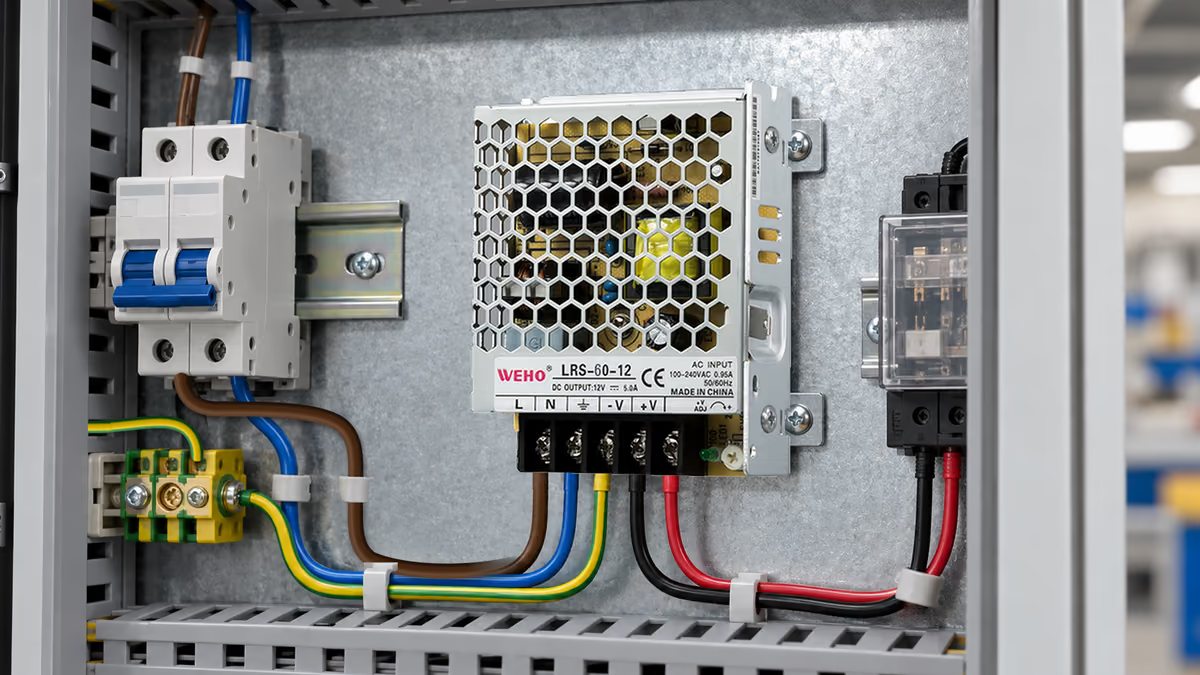
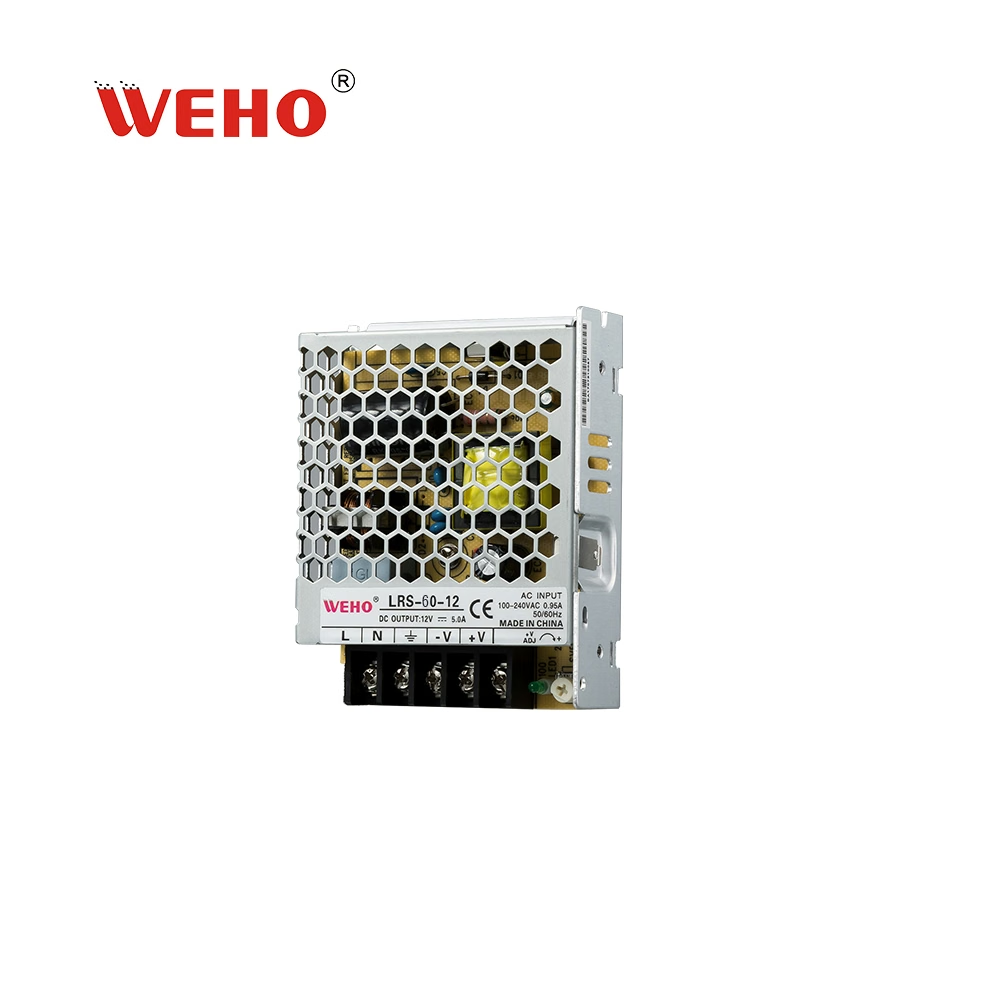
দ LRS-60-12 power supply reference anchors this discussion. Its nominal output rating does not establish the real input power of an idle control cabinet. This article provides an operating-state worksheet and an energy calculation; it does not report measured idle consumption for an LRS-60-12 or promise savings from replacing an existing supply.
Which operating states should the energy budget distinguish?
Define each state by what remains connected and operating. A supply with its DC output unloaded, a controller waiting for a command and a machine performing work are different configurations, even if someone labels all three “standby.”
For a useful comparison, record the supply, receiver population, control state and any other loads inside the measurement boundary. A separately powered fan, communications interface or auxiliary supply can change the complete equipment result. State whether it is included instead of silently assigning its consumption to the LRS supply.
Also distinguish an input measurement from a DC-load estimate. Output voltage multiplied by load current describes a DC output-power term under the stated conditions. It does not include all input-side losses, and an assumed efficiency cannot replace an actual input measurement when the purchasing requirement concerns standby watts.
The referenced LRS-60 model specification sheet provides rated operating data. A rated-load efficiency figure describes a different operating point from an idle cabinet. Request relevant low-load information and verify the intended equipment state rather than extending a rated-load figure across the whole operating cycle.
| রাজ্য | Define the boundary | Record for comparison |
|---|---|---|
| Supply no-load | Exact supply configuration without a DC receiver load | Input condition, measurement method and real input power |
| Controller idle | Connected controller, interfaces and waiting-state functions | Receiver population, software state and average input power |
| Active equipment | Defined operating task and relevant connected loads | Cycle description, duration and representative input energy |
| Transition | Startup, wake, communication burst or shutdown event | Frequency, energy contribution and capture method |
| Disconnected | Actual disconnected measurement boundary | Whether zero input energy is justified for that boundary |
A controller may keep network communications or monitoring active while its main mechanism is stopped. That is useful functionality, not automatically waste. The procurement decision should state which waiting-state functions must remain available before assigning an energy target or proposing a shutdown strategy.
How should power factor, watts and energy be separated?
Use real input power for the energy calculation and retain power factor as a separate measurement or documented condition. Do not substitute apparent power or an input-current rating for measured real watts.
Fluke’s power-factor explanation distinguishes real power from apparent power and defines their ratio. A favorable PF can be relevant to the source and distribution assessment, but it does not directly state how many watts the idle equipment consumes.
For example, two hypothetical idle configurations could both have favorable PF while drawing different real input powers. Conversely, two configurations could consume similar real watts with different apparent-power demands. Compare the quantities the project actually requires; do not turn either observation into an unsupported efficiency or energy-bill claim.
Energy depends on time as well as power. A device drawing a low power for a long interval can contribute more energy than a higher-power event that occurs briefly. The intended operating schedule is therefore part of the purchasing requirement, not a detail to add after selecting the product.
What does an operating-state calculation show?
A state-based calculation makes the consumption assumptions visible. It can support planning and identify which state deserves measurement effort, but it does not prove a particular supply’s consumption.
Hypothetical Equipment Energy Example
Assume an equipment planning period contains 2,000 active hours and 6,000 controller-idle hours. Assume average real input powers of 40 W and 4 W respectively at the defined equipment input boundary. These are illustrative inputs, not LRS-60-12 measurements or datasheet values.
Calculate energy as E = P × t, then divide watt-hours by 1,000 to obtain kilowatt-hours. The active-state contribution is 40 W × 2,000 h ÷ 1,000 = 80 kWh. The idle contribution is 4 W × 6,000 h ÷ 1,000 = 24 kWh. Total energy for the defined 8,000-hour period is 104 kWh.
| Assumed state | Average real input | Time | Calculated energy |
|---|---|---|---|
| Active | 40 W | 2,000 h | 80 kWh |
| Controller idle | 4 W | 6,000 h | 24 kWh |
| Defined period | State-dependent | 8,000 h | 104 kWh total |
| Alternative idle assumption | 2 W | 6,000 h | 12 kWh for that state |
The idle state accounts for 24 ÷ 104 × 100 = approximately 23.1% of the example’s energy, although its assumed power is one-tenth of the active-state power. The calculation covers only the stated period; it should not be described as a complete calendar-year result without accounting for the remaining hours and their states.
Changing the idle assumption from 4 W to 2 W produces a calculated difference of 12 kWh over 6,000 hours. That is a sensitivity example, not an available WEHO product improvement. Any actual equipment change must preserve its required functions and be measured under matched conditions before a saving is claimed.
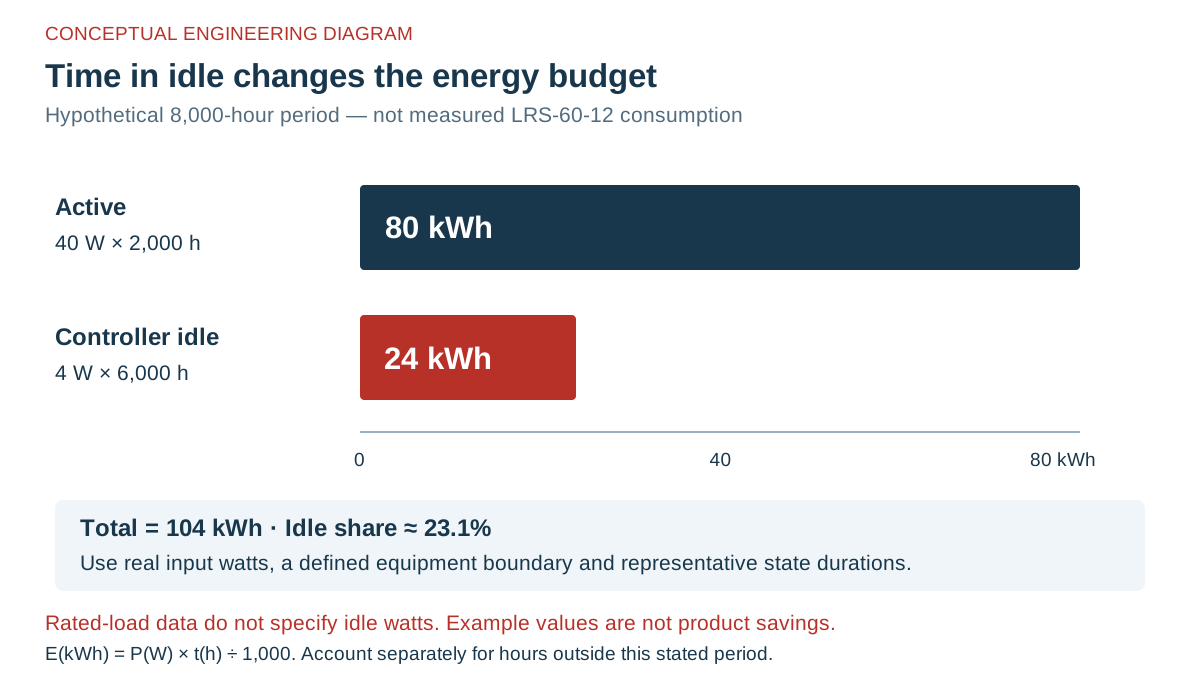
Swipe horizontally on a small screen, or open the full-size diagram.
How should an OEM verify an idle-power requirement?
Verify the complete defined state with an appropriate input-power or energy measurement method. Keep the receiver configuration and observation interval repeatable, especially when the controller periodically wakes or communicates.
- Set the requirement boundary. State whether the target applies to the supply alone, the DC branch or the complete cabinet input. Define the required waiting-state functions and applicable input and environmental conditions.
- Identify the exact configuration. Record the LRS-60-12 unit, relevant revision, receivers, firmware and enabled interfaces. Use the LRS-60-12 product and documentation reference to request the information for the intended unit, rather than inferring consumption from the family name.
- Choose a suitable method. Qualified personnel should use equipment and a connection procedure appropriate to the electrical installation. Check low-power resolution, uncertainty and the quantity being recorded. This article is not a mains connection or probing instruction.
- Capture a representative interval. Allow for the actual state behavior and include relevant complete cycles. Record whether periodic tasks, startup or communications bursts were included. A convenient instantaneous display is not necessarily a representative average.
- Retain the raw record. Preserve the power or energy data, interval, state definition, input conditions and method. For changing demand, use accumulated energy over the interval or a suitable time-based record rather than multiplying an arbitrary reading by all operating hours.
- Compare matched configurations. Check the result against the project requirement using the method’s uncertainty and agreed acceptance rule. When comparing alternatives, retain equivalent required functions, boundaries and operating conditions. Repeat after a change that affects idle behavior.
Fluke’s watt-hour measurement guidance explains the relationship between average power, observation time and energy, and the importance of observing representative load behavior. The applicable instrument instructions still determine the method for a specific measurement setup.
A failed target does not identify the supply as the cause. Review the connected controller’s functions, additional loads and state transitions inside the boundary. Keep any required engineering change separate from the measurement result so the equipment’s functional requirements remain traceable.
What belongs in a standby-energy technical enquiry?
Send WEHO your idle-power requirement with the exact model, input source, connected receiver demand, required functions and operating-state hours. Include the measurement boundary and acceptance method when available, and ask which relevant low-load data can be provided for the intended configuration.
For procurement, retain the accepted state definitions and documentation with the order specification. Neither a rated-output label nor a calculated saving substitutes for a verified equipment result under that specification.
Engineering FAQ
Does a rated-load efficiency figure specify idle input watts?
A rated-load efficiency figure does not specify idle input watts. It describes a different operating point and requires its stated conditions. Obtain relevant low-load information and measure the defined waiting-state configuration when the project has an idle-energy requirement.
Is an unloaded supply the same as an idle control cabinet?
An unloaded supply is not the same configuration as a powered idle cabinet. Connected controllers, communication interfaces and auxiliary functions can consume power. State which loads and functions remain connected before comparing the results.
Can I estimate standby energy from an input-current nameplate?
A nameplate input-current value alone does not establish standby energy. The calculation requires representative real input power or measured energy over a defined interval. Current, voltage and apparent-power information must not be silently substituted for that quantity.
Can the 12 kWh example be quoted as a product saving?
The hypothetical 12 kWh difference cannot be quoted as a product saving. It follows from changing an assumed idle input from 4 W to 2 W for 6,000 hours. Actual savings require matched equipment measurements and preservation of the required functions.