When an SSR controls a switching power supply, specify what the system must do after the OFF command and verify the exact SSR, supply and load together. A semiconductor switch can pass off-state leakage current, while a supply can also retain stored charge. Those effects need different evidence.
For an OEM selecting the WEHO S-145-24, the useful deliverable is an inactive-state acceptance record: what is commanded off, what remains energized, what the load is allowed to do, and how the result is verified by the qualified test team.
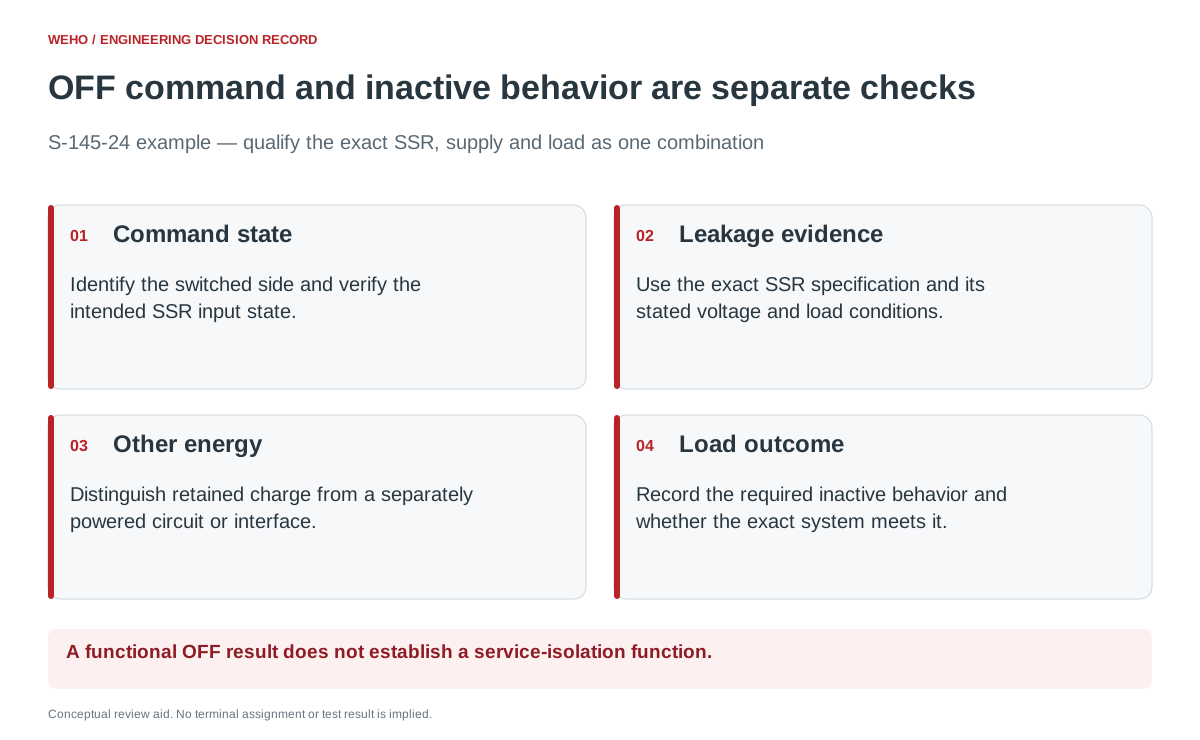
Identify which side of the supply the SSR switches
Start with the released circuit description. An AC-output SSR controlling the supply’s AC input and a DC-output SSR switching a DC load are different applications. Do not transfer the leakage figure, minimum-load requirement or switching behavior from one SSR type to the other.
দ WEHO S-145-24 product information এবং S-145 specification sheet identify a 24 V switching-supply option. They do not establish compatibility with an unspecified SSR, an off-state load-release limit or a guaranteed output-discharge interval.
Record the SSR manufacturer and exact suffix, the switched side, the permitted input source and the downstream load. For the S-145 family, the published selectable input range also means that input configuration must be checked against the supplied version; an SSR cannot correct an incorrect input selection.
Separate three explanations for an apparently live output
OMRON’s SSR guide defines off-state leakage as current through the SSR output while the output is off and a specified load voltage is applied. Its OFF-state troubleshooting guidance also distinguishes input-side causes from output-side leakage that may prevent a load from releasing.
That evidence explains why an OFF command needs a system-level check. It does not prove the cause of a particular reading in your panel. Have the test engineer classify the observation using the actual circuit and appropriate instrumentation.
| Possible condition | Question for the qualified test team | Evidence that helps separate it |
|---|---|---|
| SSR off-state leakage | Does the specified SSR leakage interact with this supply input or load? | SSR leakage conditions, minimum-load data and controlled comparison approved by the test team. |
| Retained charge | Is the observed condition a time-dependent effect after source removal? | Applicable discharge information and a recorded observation interval. |
| Another energy path | Can a separate supply or powered interface maintain the observed circuit? | Released schematic and interface-source inventory. |
| Command or configuration issue | Did the intended OFF state actually reach the correct SSR input? | Controller state and SSR input specification, recorded independently of the load result. |
A voltage reported by one instrument does not, on its own, quantify the current available to operate a load. Record the measurement method with the result; avoid treating a high-impedance reading as either proof of useful power or proof of a harmless condition.
Write the inactive-state requirement before the test
Describe a functional outcome that the equipment owner can accept. A controller may need to remain powered while an actuator must stop. A status lamp that glows faintly can be a different issue from a device that periodically restarts. These observations should not share a single checkbox labeled “OFF works.”
For each required mode, record the command state, source condition, connected load, observation period and required load behavior. The test team should define the suitable instrument, measurement point and interpretation. Keep personnel-safety isolation requirements separate from this functional acceptance record.
Check the least-loaded permitted configuration as well as normal operation when the SSR documentation makes minimum load relevant. Include authorized standby modes and the intended restart sequence. Do not create a test condition outside the supply, SSR or equipment ratings simply to make the symptom disappear.
The S-145 sheet’s hold-up-time entry concerns functional output continuity under stated conditions. It is not a maximum time to safe touch, nor an assurance that every connected load has discharged.
Turn a symptom into a procurement decision
In a hypothetical cabinet, a switched supply feeds a small controller. The requirement says that the controller must remain inactive after the OFF command until a deliberate restart. During qualification, the team would record whether the controller stays off, remains partially active or cycles through startup. No measurement or outcome is assumed here.
If the system does not meet the requirement, first preserve the configuration and trace the relevant cause. Request the SSR’s off-state specification and the supply/load behavior needed to evaluate alternatives. A different switching device or architecture may be appropriate, but its selection requires the actual circuit evidence.
Do not select a bleeder resistor by copying a value from another installation. Any proposed remedy needs its own voltage, power, thermal, insulation and failure review, plus confirmation that it does not defeat the intended inactive state. Manufacturer advice for one SSR and load is not a universal add-on instruction.
Keep functional OFF and service isolation as separate release items
OMRON’s SSR guide discusses semiconductor short-circuit failure and the need for an appropriate fail-safe design. Accordingly, a functional OFF test cannot establish that an SSR is a service disconnect or a safety-rated isolation function.
Release the combination only when the specified inactive behavior is met, the record identifies the tested versions, and any remedy is incorporated into the approved design. Preserve unresolved observations as engineering actions, rather than approving the assembly because the supply’s output-current rating is adequate.
Use the project record
Open the blank SSR and Switching Supply — Inactive-State Record to record your conditions, evidence and decisions. The worksheet contains no pre-approved result.
Discuss the S-145-24 application boundary
Send WEHO the exact SSR model, whether it switches the AC input or a DC load, the load’s standby behavior and your required inactive state. Request the applicable S-145-24 documents before qualifying the complete circuit.