Direct answer: After a UPS battery has supplied a load, record the discharge and arrange recharge and any subsequent storage according to the exact battery and UPS manufacturer’s instructions. A system that has returned to utility power may not yet have its required backup reserve. Identify battery chemistry, charge status and operating conditions before declaring it ready for another outage.
Why does time spent discharged matter?
For valve-regulated lead-acid (VRLA) batteries, Schneider Electric explains that prolonged low charge can contribute to sulfation and damage in its battery discharge FAQ. The FAQ includes timelines for its described battery context; do not apply them automatically to another battery, chemistry, temperature, UPS or manufacturer. Lithium battery storage and charging require the appropriate battery management and manufacturer documentation rather than a borrowed VRLA rule.
Where outages are frequent, a battery may not have sufficient time to recharge before the next interruption. Schneider’s BVX1200LI-IN troubleshooting FAQ lists recent outages and recharge time among the checks for its specific model. That is a diagnostic example, not a WEHO product claim or a universal guarantee of runtime.
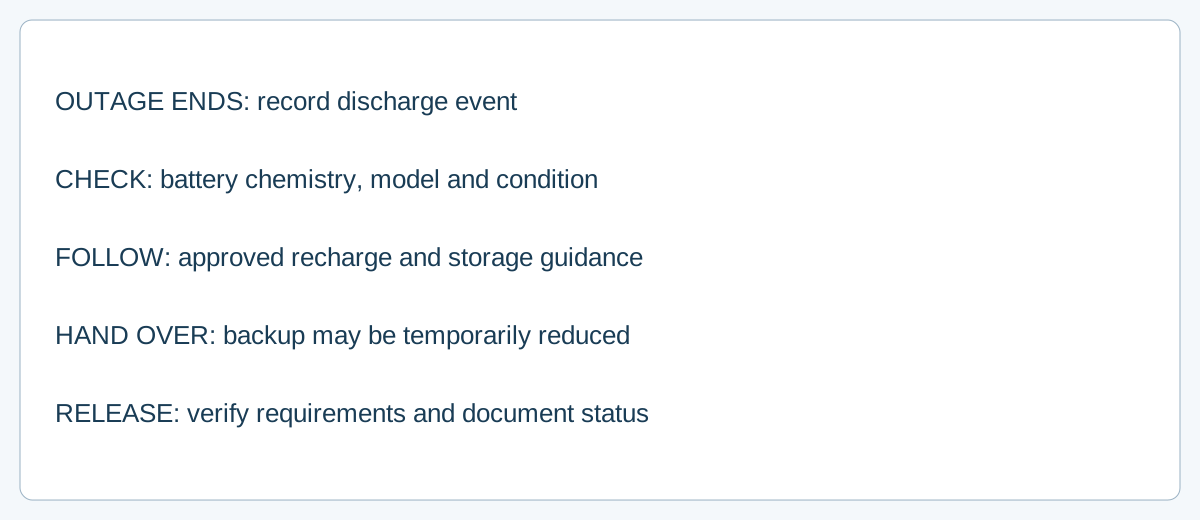
What should the operations handover record contain?
| Record | What to capture | Why it matters |
|---|---|---|
| Battery identity | Manufacturer, model, chemistry, age and approved connected equipment | Charging and storage rules are product-specific. |
| Discharge event | Time, duration, observed load, alarms and any automatic shutdown | Establishes what happened without guessing state of charge. |
| Recovery | When utility returned, charging indication and interruptions | Shows whether the available recharge interval is known. |
| Readiness disposition | Required reserve, current limitations and person responsible | Prevents a restored mains supply being mistaken for restored backup capability. |
| Storage instructions | Applicable battery instructions, location and next review date | Supports traceable follow-up if equipment will be stored. |
A practical recovery and storage sequence
- Record the event and notify the responsible maintenance team that reserve may be reduced. Protect critical loads through the organization’s approved continuity procedure.
- Identify the actual battery, UPS or charger and documentation. Check whether alarms, abnormal temperature, physical damage or a suspected fault require the manufacturer’s service process.
- Use the specified charge and storage procedure for that exact battery and installation. Do not improvise a charger setting or assume that a voltage reading alone establishes health or usable capacity.
- Record when charging began, its interruptions and the manufacturer’s conditions for readiness. If the equipment is to be stored, follow the permitted storage configuration and maintenance schedule for that combination.
- Before handing back service, compare the required reserve with the evidence actually available. A complete recharge indicator is not the same as a documented full-load runtime test; arrange any test only under the approved maintenance plan.
Battery terminals can remain energized when mains power is absent. Isolation, inspection, disconnection, charging and testing must follow the equipment and battery instructions and be performed by appropriately qualified personnel. Do not assume every unit has the same access procedure or protection.
Where a WEHO charging supply belongs
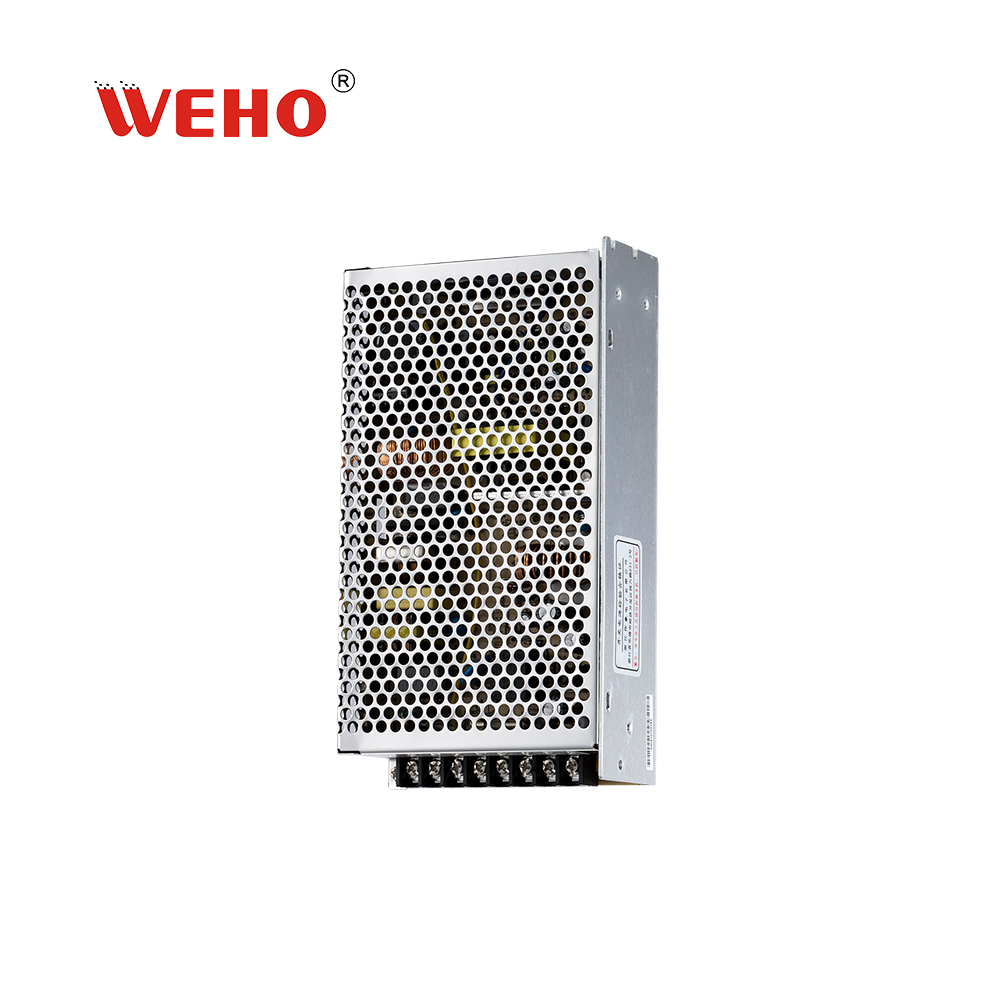
দ WEHO AD-155 family page describes a power supply with a battery-charging function. The product image identifies the AD-155 family, not the battery chemistry, a proven backup duration, an approved pairing, or a stored battery’s condition. Request the exact ordered variant and compatible battery requirements before creating a site procedure.
Frequently asked questions
Can I assume full backup as soon as mains returns?
No. Recent discharge, recharge time, load and battery condition affect available reserve. Follow the installed equipment’s readiness procedure.
Does a passing indicator prove battery runtime?
No. It is one indication defined by the particular system. Compare the actual evidence and any approved test with the required duty.
Send WEHO the AD-155 variant under consideration, battery model and chemistry, expected load and requested autonomy. Ask for the applicable charging and pairing documents, and keep the battery maker’s storage instructions with the maintenance record. WEHO এর সাথে যোগাযোগ করুন.