schnelle Antwort: Eine Hutschienen-Stromversorgung wird hauptsächlich nach Ausgangsspannung, Dauerleistung und Formfaktor gewählt. Für die meisten industriellen Automationspaneele ist eine 24V-Gleichstromeinheit mit 20 - 30%-Leistungshöhe über Spitzenlast die zuverlässige Wahl. Kompakte Lasten passen zu einer schlanken HDR-Einheit; größere 24V-Lasten passen zu einer NDR-Einheit mit höherer Leistung.
Was ist eine DIN Rail Stromversorgung?
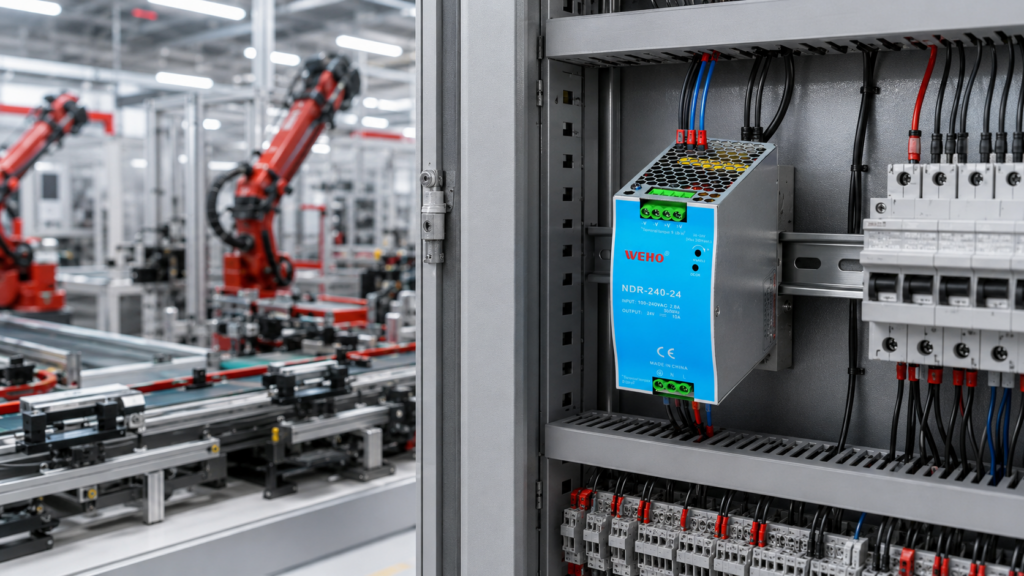
Ein DIN-Schienen-Netzteil ist ein AC-zu-DC-Schaltnetzteil, das an einer Standard-35-mm-DIN-Schiene (TS-35) in einem Schaltschrank befestigt wird. Es wandelt Wechselstromnetze in einen geregelten, isolierten DC-Ausgang um-meistens 24 V-, um SPS, Sensoren, Relais und Aktoren zu versorgen.
Der Formfaktor der DIN-Schiene macht sie “ industriell ”: Sie lässt sich neben Leistungsschaltern und Klemmen montieren, spart Platz und ist schnell wartbar. Die 35-mm-Schiene selbst ist nach EN 60715 standardisiert.
Wie wählt man eine DIN Rail Stromversorgung?
Passen Sie das Angebot an die Ladung und das Panel an, nicht nur an den Preis. Sieben Faktoren entscheiden über die richtige Einheit:
- Ausgang Voltage. 24V DC ist der Automatisierungsstandard; 12V und 48V sind auch für bestimmte Geräte üblich.
- Laufende Leistung/Watt. Fügen Sie jedes Gerät auf der Schiene hinzu und fügen Sie dann Headroom hinzu (siehe Größe unten).
- Formfaktor und Panelbreite. Ein schlankes Gehäuse spart Platz auf der Schiene in einem überfüllten Schrank.
- Input-Phase ein. Einphasig für die meisten Platten; dreiphasig für große Maschinen und höhere Leistung.
- Betriebstemperatur und Derating. Schränke werden heiß; Überprüfen Sie die Derating-Kurve bei Ihrer Umgebungstemperatur.
- Schutz. Überspannungs-, Überstrom-, Kurzschluss-und Übertemperaturschutz sind für unbeaufsichtigte Geräte unerlässlich.
- Zertifizierungen. Bestätigen Sie die Zertifizierungen, die Ihr Zielmarkt benötigt, bevor Sie kaufen.
Welche WEHO DIN Rail Serie passt zu Ihrem Panel?
WEHOs DIN-Schienen-Sortiment deckt wirtschaftliche, schlanke und leistungsstarke Anforderungen ab. Verwenden Sie diesen Vergleich, um eine Serie in die engere Auswahl zu nehmen, und öffnen Sie dann die Serienseite für genaue Modellspezifikationen.
| Serie | Profil | Beispiel Power | Am besten für |
|---|---|---|---|
| Dr. | Wirtschaftlicher, grundlegender Einzeloutput | DR-30/45/60 (30 - 60W) für den PC | Einfache, Low-Power-oder Budget-Panels |
| EDR | Wirtschaftlich, schlank, höhere Macht | bis zu 150W | Kostensensitive Builds, die mehr Power benötigen |
| Der MDR | Standardmäßig Mid-Range | Mittlere Macht | Generelle Automatisierung |
| HDR | Ultra-schlank/kompakt | bis zu 150 W (HDR-150) | Space-Constrained-Büroräume |
| ndr | High-power workhorse | NDR-240 / 480 / 960 (240–960W) | Larger 24V loads, whole-panel supply |
For a compact machine panel, a slim HDR unit saves rail width. For a full cabinet driving many 24V devices, an NDR unit gives the current headroom you need.

Wie viel Leistung (Watt) benötigen Sie?
Total the continuous draw of every device on the rail — PLC, I/O, sensors, relays, HMI — then size above it. The common rule is 20–30% headroom over peak load.
Headroom covers inrush current at startup, future additions, and derating in a hot cabinet. A supply running at 100% load all day runs hotter and ages faster.
Example: if your devices draw 8A continuously at 24V (about 192W), a 240W unit such as an NDR-240 leaves sensible margin rather than running at the edge.
Warum ist 24V der Standard für die Automatisierung?
A 24V DIN rail power supply is the default because most industrial controls — PLCs, I/O modules, proximity sensors, solenoid valves — are built around 24V DC. Standardizing on 24V simplifies wiring and spares.
12V appears in some sensor and communication devices, and 48V in higher-power or long-distance runs, but 24V remains the backbone of the control panel.
Einphasige oder dreiphasige Eingabe?
Most panels run on single-phase AC, which every standard DIN rail series covers. Three-phase input becomes worthwhile at higher power, where it balances load across phases and suits large machinery.
If your system needs several hundred watts or more of stable 24V, ask about higher-power and three-phase options rather than paralleling many small units.
Montage, Schutz und Sicherheit
- Rail and spacing. Use a 35 mm (TS-35) rail and leave clearance above and below for airflow.
- Derating. Reduce expected load in hot cabinets per the datasheet curve.
- Protection. Confirm over-voltage, over-current, short-circuit, and over-temperature protection.
- Wiring. Use correct wire gauge and torque terminals to spec; keep DC and AC wiring tidy and separated.
Welche Zertifizierungen sollte es haben?
Check that the supply carries the marks your market and application require. WEHO DIN rail power supplies are manufactured under ISO9001 and carry CE, RoHS, FCC, and CCC. Every unit is 100% high-temperature full-load tested, with a 99.7% qualified rate.
Häufig gestellte Fragen
What is a DIN rail power supply used for?
It converts AC mains into a regulated DC output (usually 24V) to power PLCs, sensors, relays, and actuators inside an industrial control cabinet, mounted on a 35 mm DIN rail.
What voltage does a DIN rail power supply output?
Most commonly 24V DC, the automation standard. 12V and 48V versions are also available for specific devices.
How do I size a DIN rail power supply?
Add the continuous draw of all connected devices, then add 20–30% headroom for inrush, future load, and heat. Avoid running continuously at 100%.
What is the difference between the DR, HDR, and NDR series?
DR is the economical low-power option, HDR is ultra-slim for tight panels, and NDR is the high-power workhorse (240–960W) for larger 24V loads.
Can a DIN rail power supply run on three-phase power?
Single-phase covers most panels. Three-phase input is used at higher power to balance load and suit large machinery.
What certifications should an industrial DIN rail power supply have?
Look for the marks your market requires. WEHO units are built under ISO9001 and carry CE, RoHS, FCC, and CCC.
Wichtige Erkenntnisse
- Choose a DIN rail power supply by output voltage, wattage, and form factor — 24V is the automation default.
- Size with 20–30% headroom over peak load; don’t run at 100% continuously.
- Use a slim HDR unit for tight panels and a high-power NDR unit for larger 24V loads.
- Confirm protections and the certifications your market requires (CE, RoHS, FCC, CCC, ISO9001).
- Mount on a 35 mm (TS-35) rail with airflow clearance and derate for hot cabinets.
Specifying DIN rail power for an automation project? Compare WEHO’s DIN rail power supply range (DR, HDR, MDR, EDR, NDR), or contact the WEHO team at [email protected] or via the contact page for OEM/ODM support.