















| Προσδιορισμός | S-600-12 | S-600-24 | S-600-36 | S-600-48 |
| DC τάση εξόδου, ρεύμα | 12V 0 ~ 50A | 24V 0 ~ 25A | 36V 0 ~ 16.7A | 48V 0 ~ 12.5A |
| Κύμα και θόρυβος | 100mVp-p | 150mVp-p | 150mVp-p | 150mVp-p |
| Σταθερότητα καλωδίου εισόδου | ±0,5% | ±0,5% | ±0,5% | ±0,5% |
| Σταθερότητα φορτίου | ±0,5% | ±0,5% | ±0,5% | ±0,5% |
| Αποδοτικότητα | 83% | 85% | 86% | 87% |
| Ρυθμιζόμενο εύρος για τάση DC | ±10% | ±10% | ±10% | ±10% |
| Εύρος τάσης εισόδου | 90 ~ 132VAC/180 ~ 264VAC by switch 254 ~ 370VDC 47 ~ 63Hz | |||
| Ρεύμα κρούσης | Cold start current 25A/115VAC 50A/230VAC | |||
| Προστασία υπερφόρτωσης | 105% ~ 300% cut off the output, automatic recovery | |||
| Προστασία από υπέρταση | 115% ~ 140% shut down O/P voltage, re-power on to recover | |||
| Ρύθμιση, άνοδος, χρόνος αναμονής | 800ms, 20ms, 36ms/230VAC at full load | |||
| Αντοχή στην τάση | I/P-O/P: 1.5kV; I/P-FG: 1.5kV; O/P-FG: 0.5kV; 1 minute | |||
| Αντοχή στην απομόνωση | I/P-O/P, I/P-FG, O/P-FG: 500VDC/100MΩ | |||
| Θερμοκρασία εργασίας | -10°C ~ +50°C | |||
| Διάσταση | 238 × 124 × 65mm | |||
| Βάρος | 1.5kg | |||
| Συσκευασία | 44 × 26 × 27CM/12PCS/18kg | |||

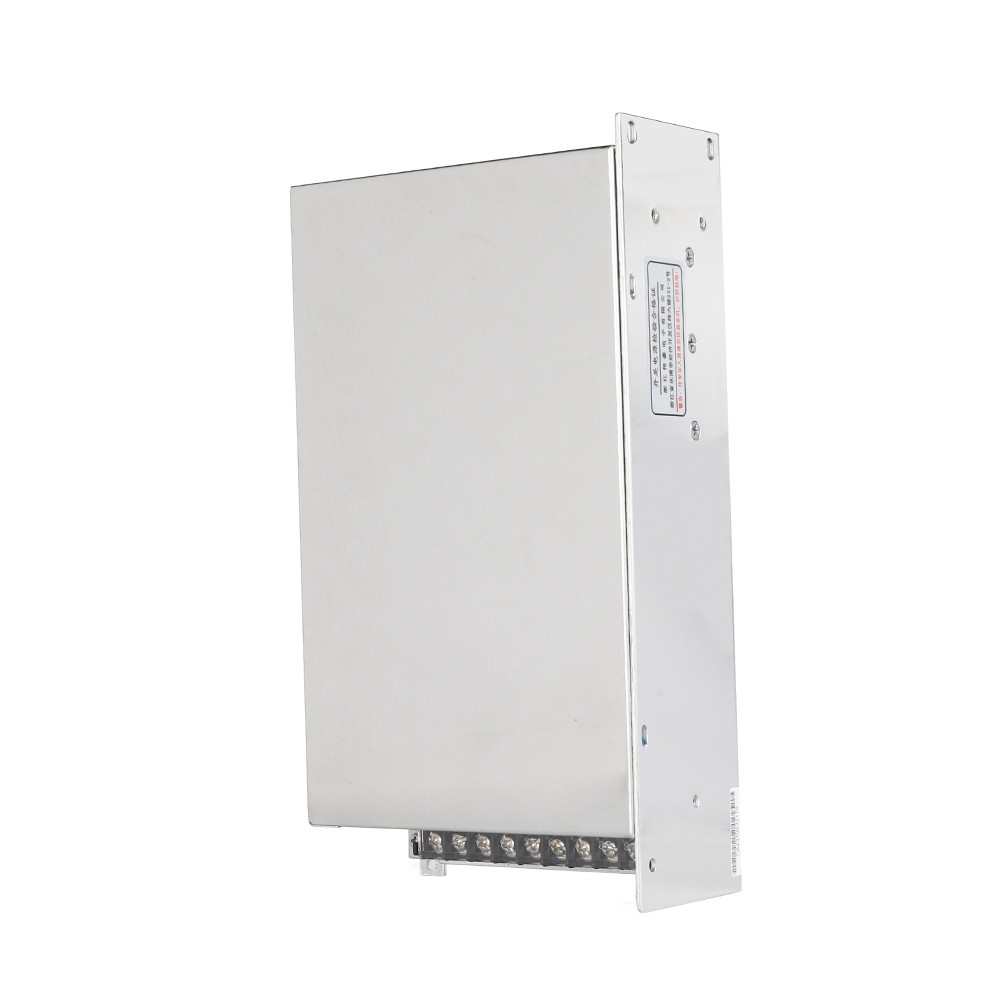
S-600W series normal single switching power supply
WEHO S-600 is a single-output switching power supply with 12V, 24V, 36V and 48V variants. The output columns give an equipment builder a defined starting point for compatible work-order, communication and local status electronics, for example in a cable-extrusion gauging station. Documented regulation, adjustment and recovery behavior support a suffix-specific electronic-branch review. Submit the receiving board requirements, startup demand and actual electrical-bay conditions with the enquiry; process power and calibrated measurement remain separate.
Εάν έχετε οποιεσδήποτε ερωτήσεις, μη διστάσετε να επικοινωνήσετε μαζί μας στο email: [email protected]
Στείλτε μας email [email protected]
- Περιγραφή
Why Choose S-600
Select the high-current output by suffix
The S-600-12 column specifies 12V at 0 ~ 50A. The other S-600 columns have different voltage and current limits. Naming the exact output avoids a series-only order that omits the electronic branch requirement. Size conductors, distribution and protection from the chosen output and real load, not from the family heading alone.
Control the delivered input configuration
AC input is 90 ~ 132VAC or 180 ~ 264VAC by switch; the input row also lists 254 ~ 370VDC and 47 ~ 63Hz. The switch-selected AC bands make configuration a commissioning decision rather than an assumed automatic function. Record the intended input and verify the actual delivered unit; the separately printed DC range is not a battery-system or installation approval.
Plan cabinet support from documented dimensions
The dimension row is 238 × 124 × 65mm and the weight row is 1.5kg. The body-size and weight rows provide a concrete mechanical starting point for an equipment electrical bay. Confirm the actual fixings, access and enclosure arrangement before release. Sharing dimensions with another model does not establish electrical or thermal interchangeability.
Match voltage trim to the receiving electronics
DC voltage adjustment is ± 10% for each listed output. Use the documented adjustment provision only after checking the board input range and the installed setting. An adjusted output remains subject to the exact variant and engineering assessment; it is not an undocumented multi-voltage, constant-current or charging function.
S-600 Features and Selection Value
Check output-specific regulation
Inlet wire stability is ± 0.5% for each listed output. Load stability is S-600-12: ± 0.5%; S-600-24: ± 0.5%; S-600-36: ± 0.5%; S-600-48: ± 0.5%. These are regulation figures for the listed outputs, not a statement of voltage accuracy or a replacement for the receiving board supply tolerance. Voltage adjustment is specified separately.
Match the printed noise limit to the electronics
Wave-and-noise values are S-600-12: 100mVp-p; S-600-24: 150mVp-p; S-600-36: 150mVp-p; S-600-48: 150mVp-p. Compare the chosen suffix’s noise limit with the receiving electronics during component selection. Wiring, grounding and the load noise requirement still need to be assessed in the complete equipment.
Use the selected output efficiency
Listed efficiencies are S-600-12: 83%; S-600-24: 85%; S-600-36: 86%; S-600-48: 87%. Use the selected column rather than a series-wide maximum in the equipment thermal review. No minimum-load condition, test point or all-temperature efficiency guarantee is added here.
Distinguish fault recovery actions
Overload protection is 105% ~ 300%; it cuts off the output with automatic recovery. Overvoltage protection is 115% ~ 140%; it shuts down the output voltage and requires re-powering to recover. The supply recovery behavior must be reconciled with the equipment reset sequence. Overload protection does not make the supply a controlled actuator drive or a safety-rated shutdown device.
Typical Service Conditions
Isolate solvent exposure in a coding line
The printed working-temperature range is -10°C ~ +50°C. An industrial inkjet coding conveyor may assess a selected S-600 output for compatible job-selection and communication boards in a protected electrical bay. Separate ink and cleaning-solvent handling from the supply, check local temperature and evaluate the intended electronic load. Printhead-specific power, conveyor drives and solvent-handling safety are independently engineered.
Support wiring at a coil-winding workcell
A coil-winding workcell may evaluate an exact S-600 suffix for compatible recipe-entry and cycle-status boards. Verify conductor support, enclosure mounting and the electronics demand over repeated winding cycles. Spindle drives, tension actuators and protective controls are not assigned to this supply; the output must be selected by the actual board requirement.
Exclude abrasive dust at tile sorting
A ceramic-tile sorting cell may consider a qualified S-600 output for compatible recipe-interface and count-display boards. Design the electrical enclosure to control abrasive dust and confirm the real thermal conditions without assuming an ingress rating for the supply. Conveyor drives, sorting actuation, optical metrology and protective systems remain separately validated.
Separate coolant at a glass-edging line
For a sheet-glass edging line, evaluate a selected S-600 variant only for compatible job-interface and maintenance-status electronics. Keep coolant mist and conductive residues outside the electrical compartment, and test electronic restart behavior. Grinding spindles, coolant pumps and protective circuits need independent power and engineering; a hidden supply is not evidence of a safe wet-process installation.
Potential S-600 Equipment Applications
Cable-extrusion gauging station
A cable-extrusion gauging station may assess an exact S-600 output for compatible product-record and communication electronics. Match the board voltage, ripple tolerance and startup demand before selecting the suffix. Calibrated gauges, extrusion heaters and haul-off drives remain independently powered; the supply choice does not establish measurement accuracy or process capability.
Tube-bending cell
A tube-bending cell may evaluate a qualified S-600 variant for compatible bend-recipe and local status boards. Validate the electronic branches, actual cabinet temperature and the response to interrupted input power. Hydraulic pumps, bending drives, tooling protection and safety controls remain separate systems, even when the electronics share a common equipment enclosure.
Flexible-pouch inspection conveyor
A flexible-pouch inspection conveyor may consider an exact S-600 output for compatible job-interface and non-measurement status boards. Check voltage, transient demand and permitted supply noise for those boards. Camera-specific power, illumination and rejection mechanisms require independent selection; defect-detection performance and food-production suitability are not established by this proposal.
Optical-lens assembly bench
An optical-lens assembly bench may assess a selected S-600 suffix for compatible work-order and communication boards. Verify their electrical input and the enclosure arrangement without treating a supply efficiency figure as a precision-performance specification. Optical references, fine-motion actuators, calibrated measurement and assembly accuracy remain separately qualified.
S-600 Technical FAQs
Which output variants and current ranges are listed for S-600?
S-600-12: 12V, 0 ~ 50A; S-600-24: 24V, 0 ~ 25A; S-600-36: 36V, 0 ~ 16.7A; S-600-48: 48V, 0 ~ 12.5A. The summary describes a single-output 600W series. Select one exact output rather than combining column maxima. The printed current range is not a separate continuous power rating, a constant-current function or proof of load-free behavior. The final continuous load, startup margin and thermal conditions require a variant-specific engineering decision; multiplying voltage and current does not replace that decision.
What input ranges and selection method are specified for S-600?
AC input is 90 ~ 132VAC or 180 ~ 264VAC by switch; the input row also lists 254 ~ 370VDC and 47 ~ 63Hz. Verify the actual input source and the delivered selector setting before energizing. The AC bands are switch-selected, not a continuous automatic input range. A printed DC range alone does not approve DC wiring, source protection or a battery installation.
How should the S-600 cold-start current figures be interpreted?
Cold-start current is 25A at 115VAC and 50A at 230VAC. These are input inrush figures at the two printed AC conditions, not the normal input current or the available DC output current. Check upstream switching and protection against the actual equipment startup sequence; no new breaker or fuse rating is inferred.
What setup, rise and hold-up times are printed for S-600?
Setup, rise and hold-up times are 800ms, 20ms, 36ms, respectively, at 230VAC at full load. The values follow the printed label order and belong to that stated input/load condition. Hold-up time is not stored-energy backup, a UPS function or proof that the connected controller will ride through every interruption. The timing-only full-load condition does not approve full-load operation throughout the temperature range.
What wave-and-noise value applies to each S-600 output?
S-600-12: 100mVp-p; S-600-24: 150mVp-p; S-600-36: 150mVp-p; S-600-48: 150mVp-p. Apply the value specified for the selected output. The sheet does not turn these figures into a guarantee for every cable, load waveform or measurement setup. Check the receiving electronics and the complete grounding and wiring arrangement before accepting a noise-sensitive load.
How do S-600 regulation and voltage adjustment differ?
Inlet wire stability is ± 0.5% for all listed outputs. Load stability is S-600-12: ± 0.5%; S-600-24: ± 0.5%; S-600-36: ± 0.5%; S-600-48: ± 0.5%. DC voltage adjustment is ± 10% for each listed output. Inlet regulation, load regulation and output adjustment describe different selection questions. Do not reinterpret a regulation figure as voltage accuracy, or use the adjustment range as permission to exceed the receiving board input limit or the selected variant load boundary.
Which efficiency figure belongs to each S-600 variant?
S-600-12: 83%; S-600-24: 85%; S-600-36: 86%; S-600-48: 87%. Each percentage belongs to its own output column. The sheet does not state a common efficiency for every variant or all operating points. Use the actual equipment operating conditions for the thermal design rather than selecting a column maximum for the entire series.
What overload action and recovery behavior are specified for S-600?
Overload protection is 105% ~ 300%; it cuts off the output with automatic recovery. Confirm this broad printed interval with the manufacturer before protection coordination. The printed percentage interval is a protection threshold range, not a normal constant-current control range. Coordinate the electronic branch protection and load-reset behavior so that automatic supply recovery cannot initiate an unintended machine cycle.
What overvoltage action and recovery behavior are specified for S-600?
Overvoltage protection is 115% ~ 140%; it shuts down the output voltage and requires re-powering to recover. The recovery action differs from the overload row. Resolve the cause of the event and the equipment restart procedure before re-energizing; this is not an automatic overvoltage-reset claim, a redundant protective system or a safety-rated shutdown.
What temperature and moisture boundaries are documented for S-600?
The printed working-temperature range is -10°C ~ +50°C. Storage temperature, working humidity and storage humidity are not specified on this sheet. The sheet provides no load-versus-temperature curve or full-load approval across that entire range. Establish the actual electrical-bay temperature, airflow and electronic demand for the installed equipment. Confirm storage and moisture limits separately with the manufacturer.
What dimensions and terminal legend are printed for S-600?
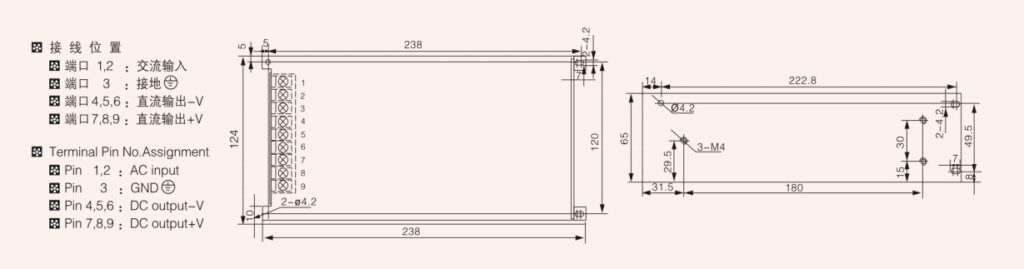
The dimension row is 238 × 124 × 65mm and the weight row is 1.5kg. The drawing assigns AC input to pins 1 and 2, GND to pin 3, DC output -V to pins 4, 5 and 6, and DC output +V to pins 7, 8 and 9. This is the generic source drawing legend, not a delivered-variant wiring instruction. Confirm the actual terminal order, ratings, conductor requirements, bonding, permitted links and fixing geometry on the selected unit before connection. No series/parallel interconnection, clearance or drop-in replacement fit is established.
What insulation tests are listed, and what approvals do they not establish for S-600?
Withstand values are I/P-O/P: 1.5kV, I/P-FG: 1.5kV and O/P-FG: 0.5kV for 1minute, without a printed AC/DC qualification. Isolation resistance is listed as 500VDC/100MΩ for I/P-O/P, I/P-FG and O/P-FG. These printed test entries are not a product certification, an ingress-protection rating or proof of system safety. PFC, an IP rating and certification scope are not documented on this sheet; any such procurement requirement needs separate exact-model evidence. No warranty term is inferred.
ΣΧΕΤΙΚΑ ΠΡΟΪΟΝΤΑ


Ποια είναι τα καλύτερα προϊόντα Power Supply για την επιχείρησή σας;
Ενισχύστε την επιχείρησή σας με ποιοτικά προϊόντα τροφοδοσίας WEHO.
Ρωτήστε έναν ειδικό