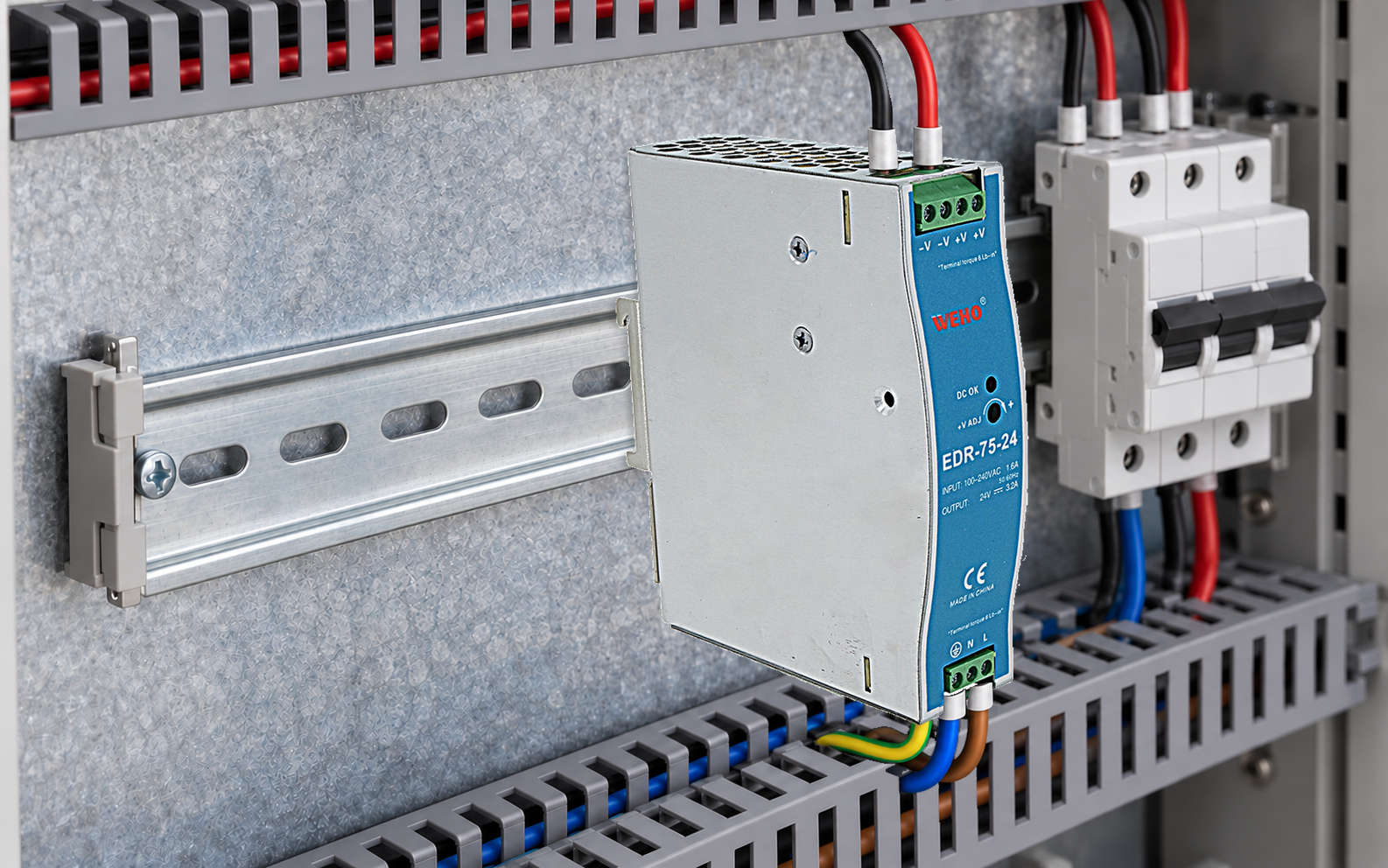
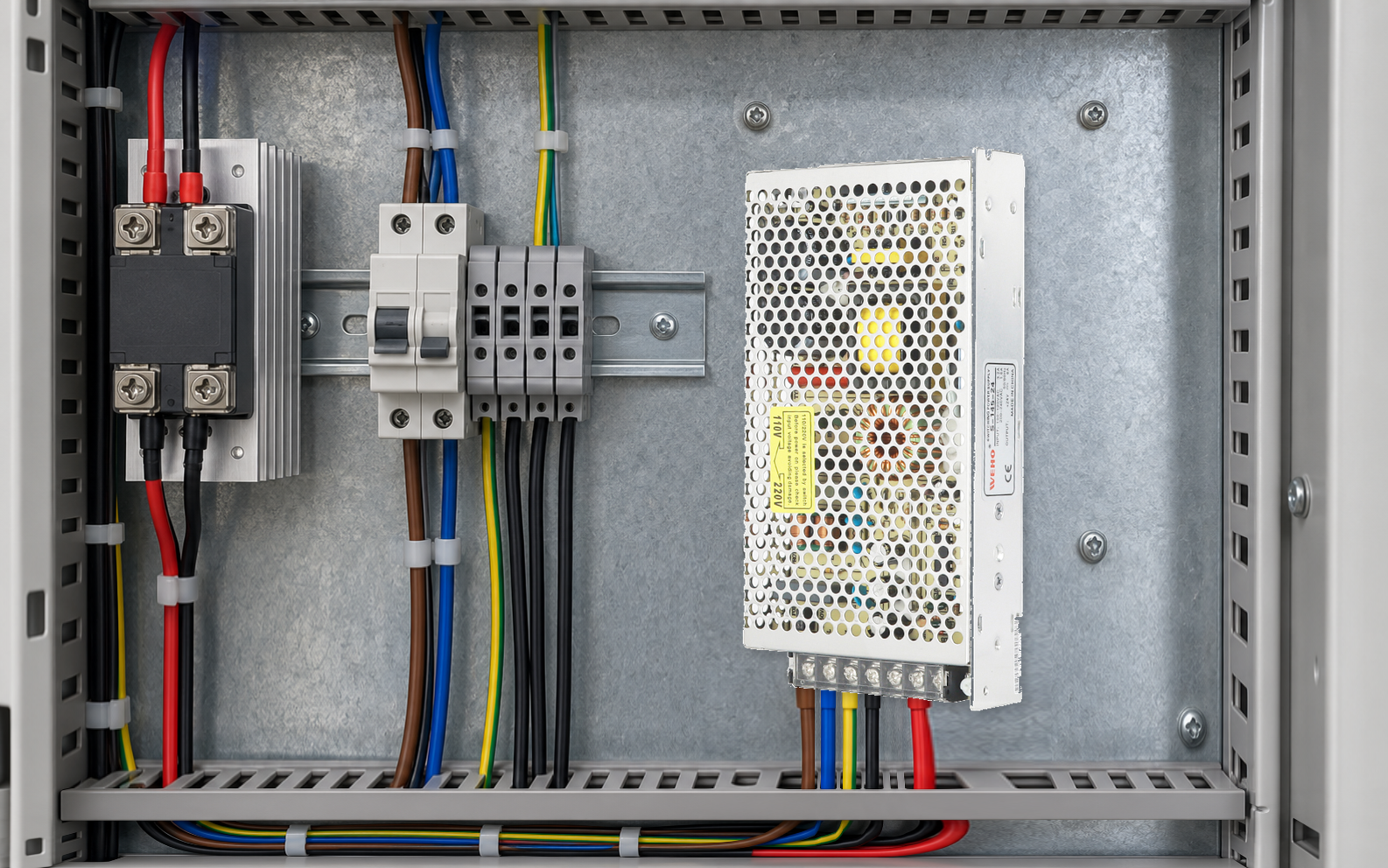
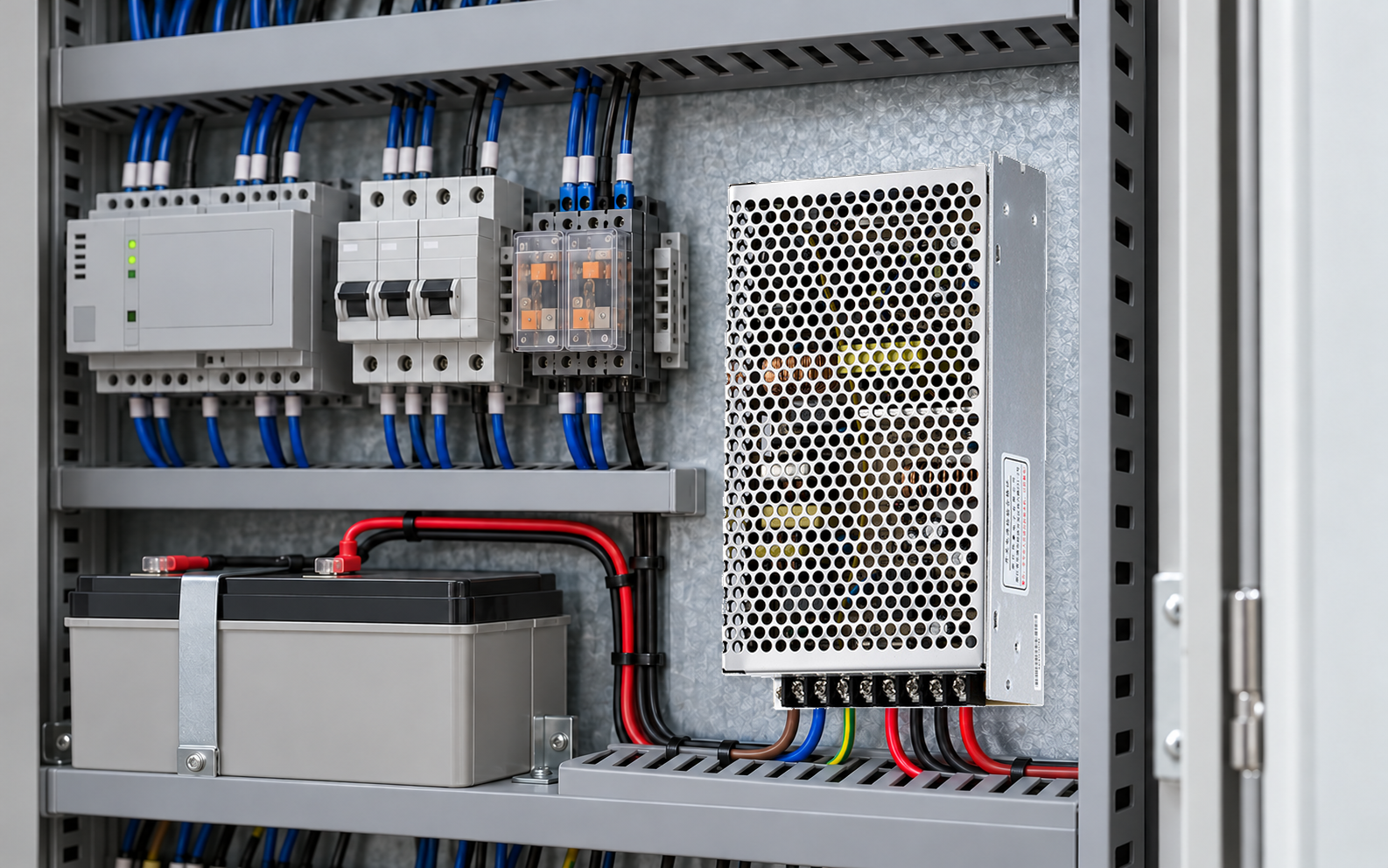
Choose between OVC II and OVC III by reviewing the actual supply interface and applicable equipment requirements, then matching them to exact-model insulation and installation evidence. A DIN rail, metal enclosure or input-voltage range does not make that decision. If the installation conditions exceed the documented basis, obtain an accepted integration solution before releasing the power supply.
For OEM electrical and procurement teams, the useful output is a qualification record: where the supply connects, which conditions apply, what the candidate’s evidence covers and which gaps remain. This article does not assign an OVC to a WEHO model or replace the responsible safety engineer’s assessment.
What II and III describe
Overvoltage categories characterize expected transient conditions at an electrical interface. TDK-Lambda’s OVC explanation describes Category III in the context of fixed installations and Category II in the context of energy-consuming equipment supplied from the fixed installation. These examples help frame the question; they do not classify every control cabinet or hard-wired device without further review.
Read the category together with the supply-system voltage and applicable standard. “OVC III” without its associated conditions is incomplete purchasing information. Categories also should not be used as a general quality ranking: the task is to satisfy the actual installation requirement, not to choose the largest Roman numeral appearing in a brochure.
The IEC catalogue now lists IEC 60664-1:2020+AMD1:2025 as an insulation-coordination publication addressing clearance, creepage and solid-insulation criteria within its stated scope. Check which edition and amendments the project actually requires. A newer catalogue entry does not automatically change a product’s existing assessment or the contractual basis of an installation.
Define the source and input interface
Begin with a system drawing or controlled installation description, not a photograph of the cabinet. Identify the source feeding the candidate, the point of connection, the system voltage and the relevant circuit classification. State whether the question concerns an AC-mains interface, a DC distribution interface or an isolated external circuit.
This distinction matters when apparently similar questions arise. In its IEC 62368-1 engineering FAQ, UL discusses an outdoor DC/PoE case by first identifying the circuit under IEC 62368-1:2023. The discussion also distinguishes an external-circuit transient assessment from an assumed mains category. It is a specific product-standard example, not an exemption for every DC-powered industrial product.
Have the responsible project reviewer establish the required classification and its basis. Record any installation restrictions, environmental assumptions and conditions on upstream protection. The terms “industrial,” “outdoor” and “panel-mounted” do not provide that complete record.
Read a category claim with its conditions
Ask the supplier to identify the complete model and revision, the applicable assessment or report, the input interface and the conditions under which the claimed suitability applies. Keep installation instructions with the assessment. A family-level statement may be useful, but it needs a traceable explanation of coverage for the ordered suffix and construction.
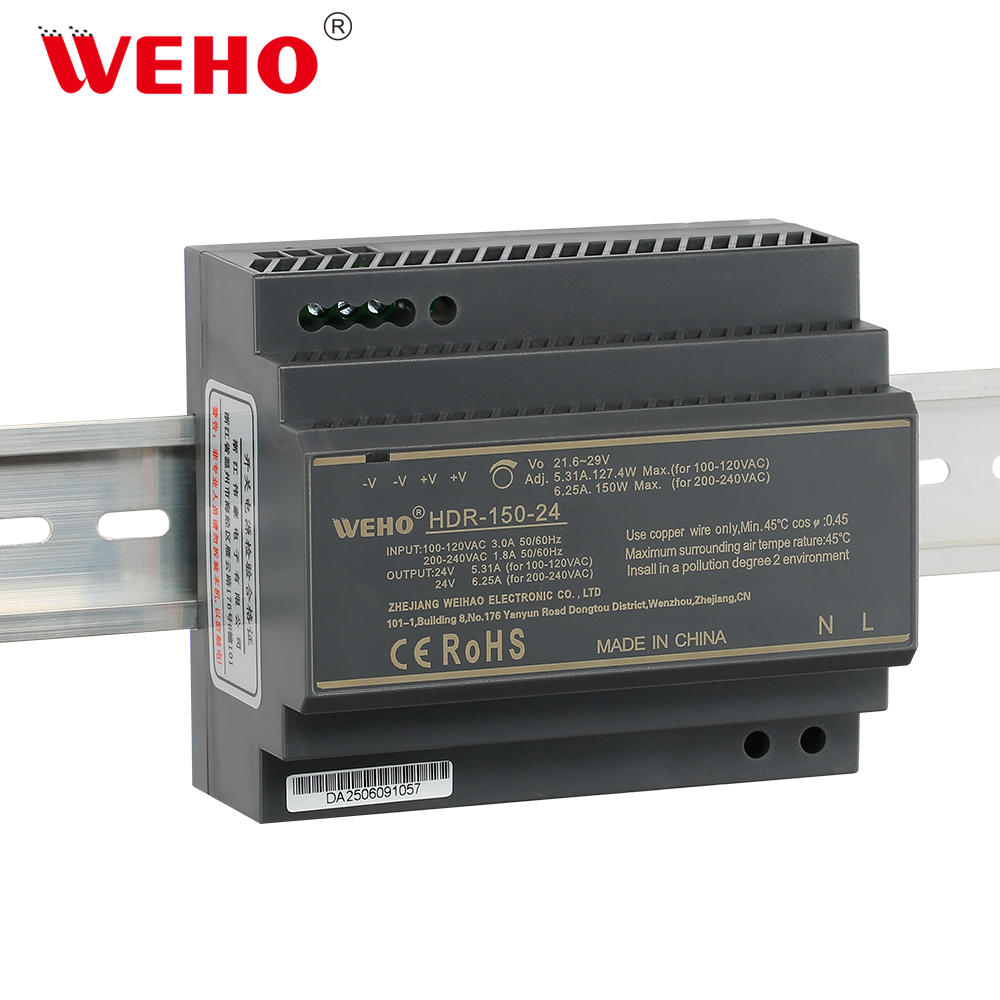
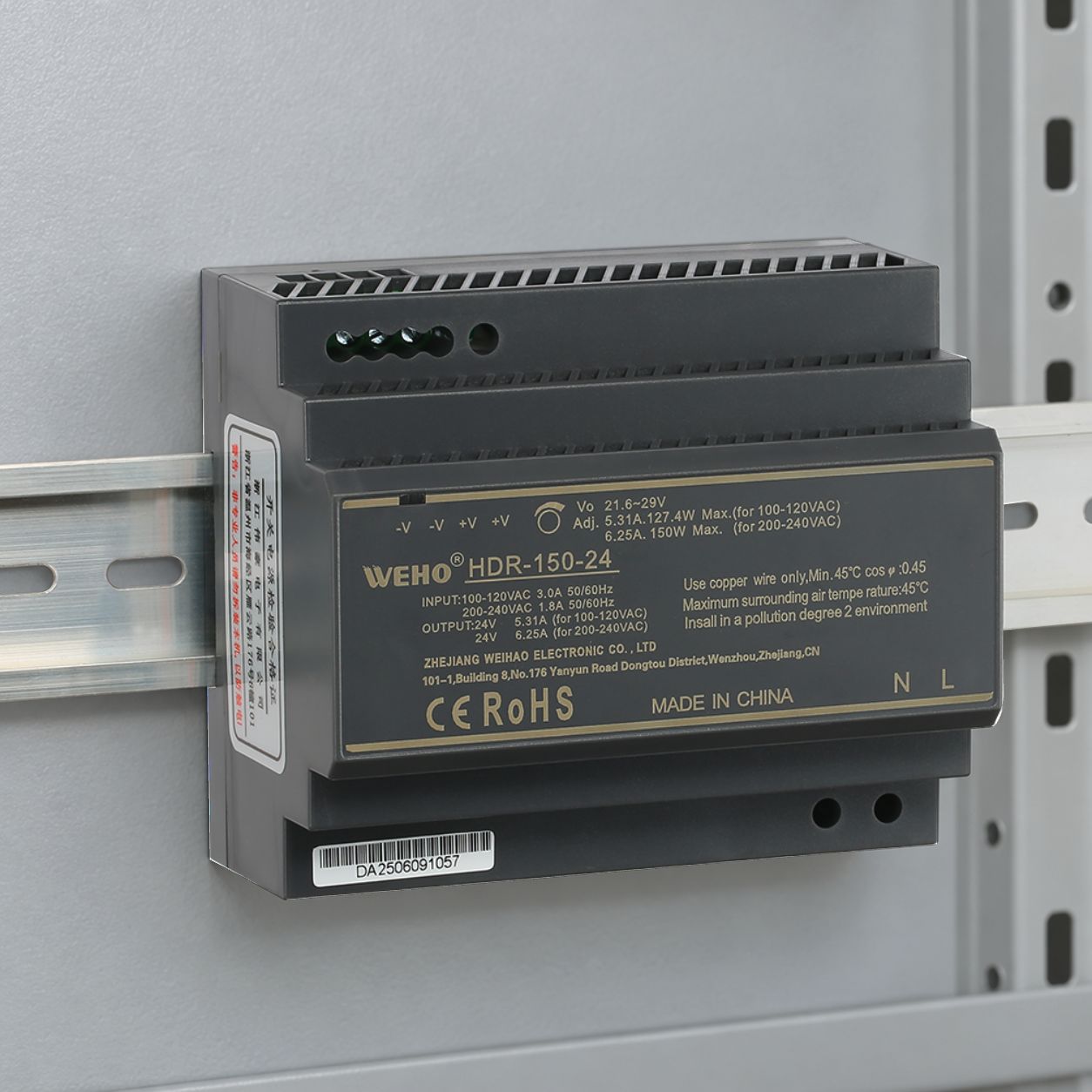
The HDR-150-24 shown here is an accurate identity reference. Its WEHO specification helps identify the model and physical arrangement. No model-specific OVC assessment has been established for this article. A listed withstand-voltage value, output-protection entry or a visible mark cannot be substituted for that missing evidence.
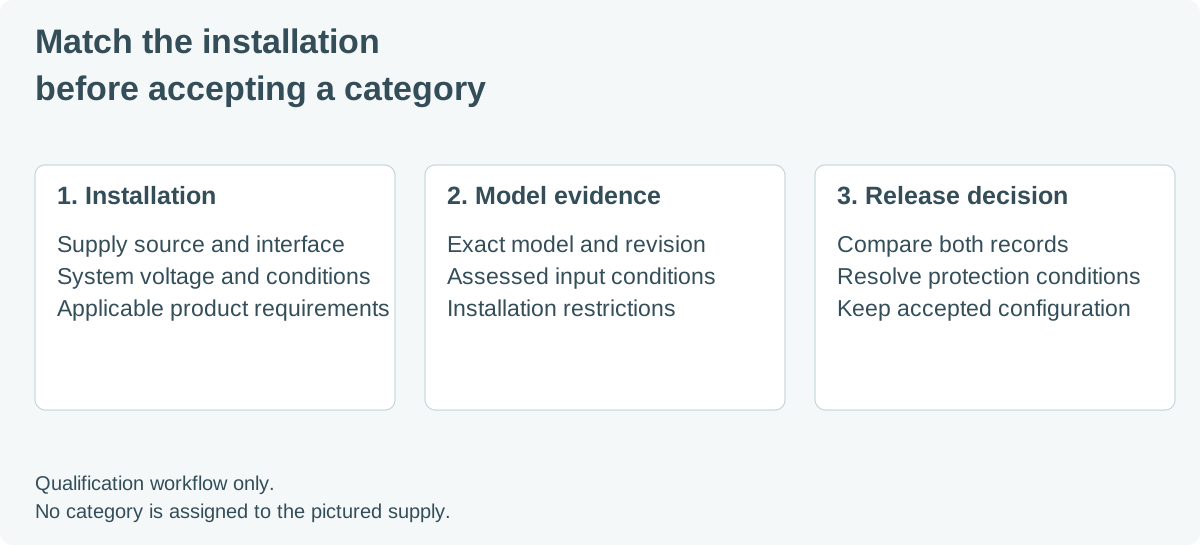
Compare the installation and candidate file
Use a side-by-side qualification worksheet. Each unresolved difference should produce a bounded question for the supplier and the equipment reviewer, rather than an automatic “approved” or a guessed category.
On small screens, scroll sideways to compare each qualification field.
| Field | Installation record | Evidence to obtain from the candidate file |
|---|---|---|
| Source and interface | Actual AC or DC source, circuit role and connection point. | Assessed input interface and the model’s permitted use conditions. |
| Voltage basis | Applicable system-voltage information, including the reference needed by the chosen method. | Corresponding assessment basis, not only a broad operating-input range. |
| Category or transient requirement | Requirement selected under the applicable product and installation rules. | Explicit model coverage and the conditions attached to that statement. |
| Ambiente | Relevant altitude, pollution and enclosure conditions established for the equipment. | Matching limits and restrictions from the applicable insulation and installation record. |
| Additional protection | Specified protective arrangement and its controlled configuration, if needed. | Evidence that the exact arrangement satisfies the relevant assessment, including installation requirements. |
| Release and change control | Named responsible reviewer and accepted equipment configuration. | Model/revision mapping, resolved questions and rules for later substitutions. |
For example, a hypothetical buyer receives an OVC II statement for a supply while the project reviewer has specified conditions associated with OVC III at the intended connection. Matching output voltage and mechanical fit does not close the gap. The buyer should request a documented suitable candidate or a reviewed integration arrangement, then retain the resulting decision. This is a document-review example, not a category assignment to the pictured HDR unit.
Resolve external-protection conditions explicitly
If additional transient protection is proposed, define the actual arrangement and ask what evidence demonstrates its suitability under the governing requirements. An arbitrary surge-protective device added to a drawing does not automatically change the accepted category or prove the necessary insulation conditions at the supply interface.
Check the protection’s documented coordination, connection and installation conditions with the responsible designer. Preserve any restrictions in the equipment instructions and BOM. The details depend on the project and assessment method; this article does not provide a universal SPD selection or wiring modification.
A supplier’s recommendation should identify what it covers and which equipment-level review remains. If the proposed configuration relies on an unspecified device, an undocumented source or an unreviewed construction change, keep the relevant qualification question open.
Keep OVC separate from other test claims
Output overvoltage protection concerns the regulated output’s protective response. It is not the input-interface overvoltage-category assessment. Similarly, a dielectric-withstand result or an EMC surge-immunity result answers a different question; do not translate one of those numbers into an OVC without the applicable assessment.
The separate creepage and clearance evidence guide explains how to request construction-specific insulation records. Here, the purchasing decision comes first: establish the installation’s conditions, then identify which candidate evidence applies. Do not estimate internal spacing from the product photograph or assume that changing the enclosure closes the assessment.
Before approving a substitute, compare its exact model, construction and installation conditions with the accepted file. Preserve the reviewer’s disposition and any outstanding restriction. A different supply with the same DC output needs its own coverage check.