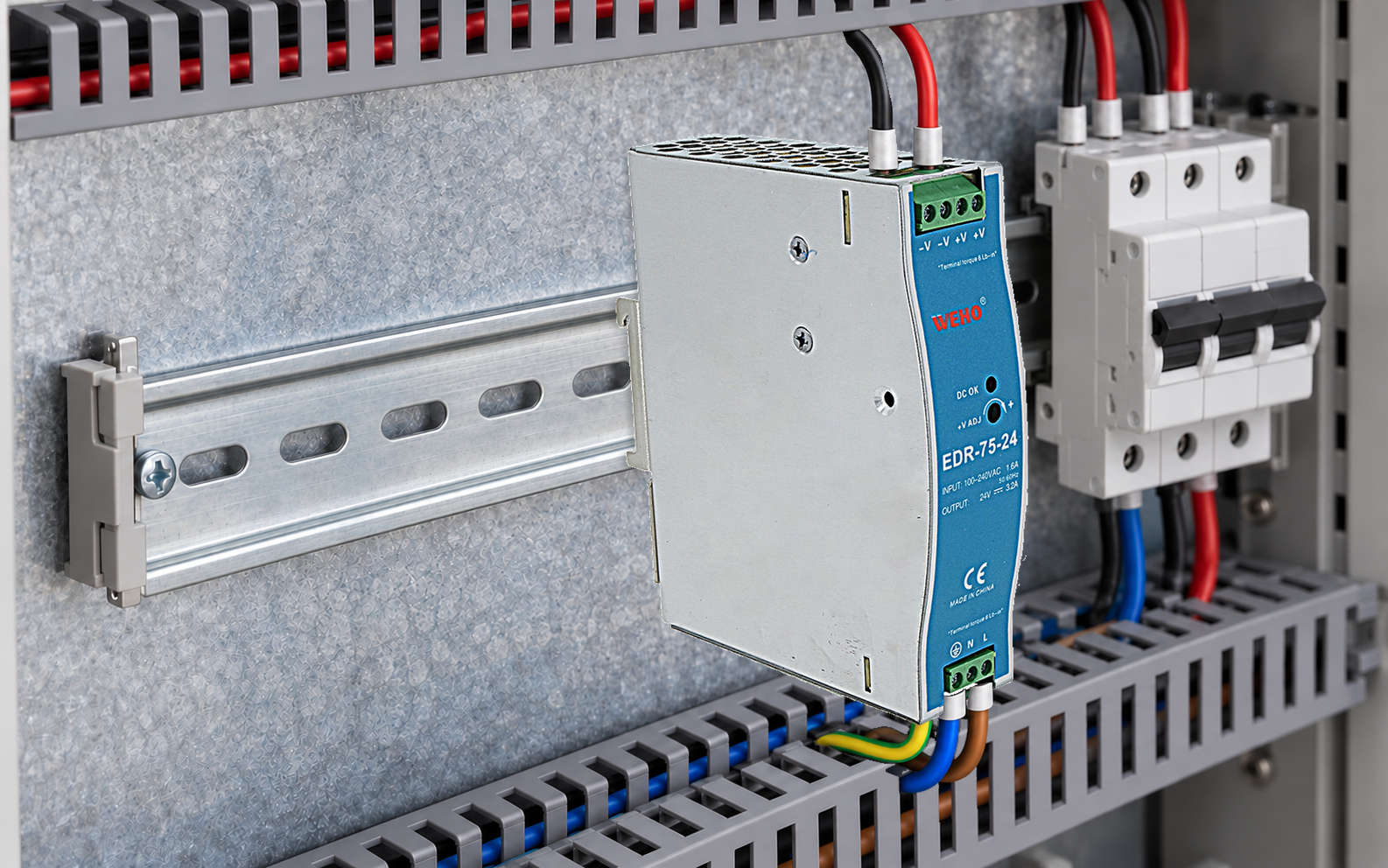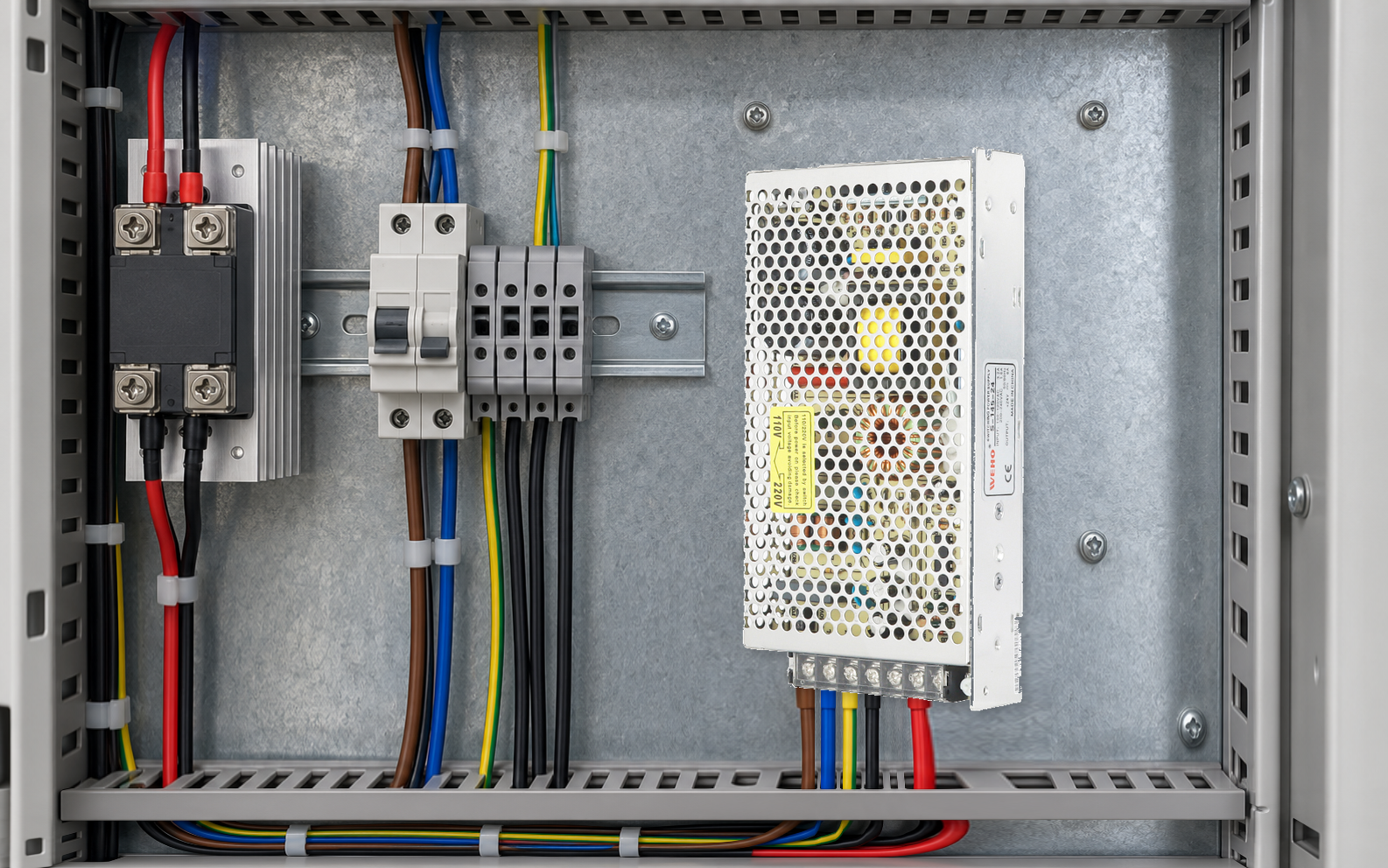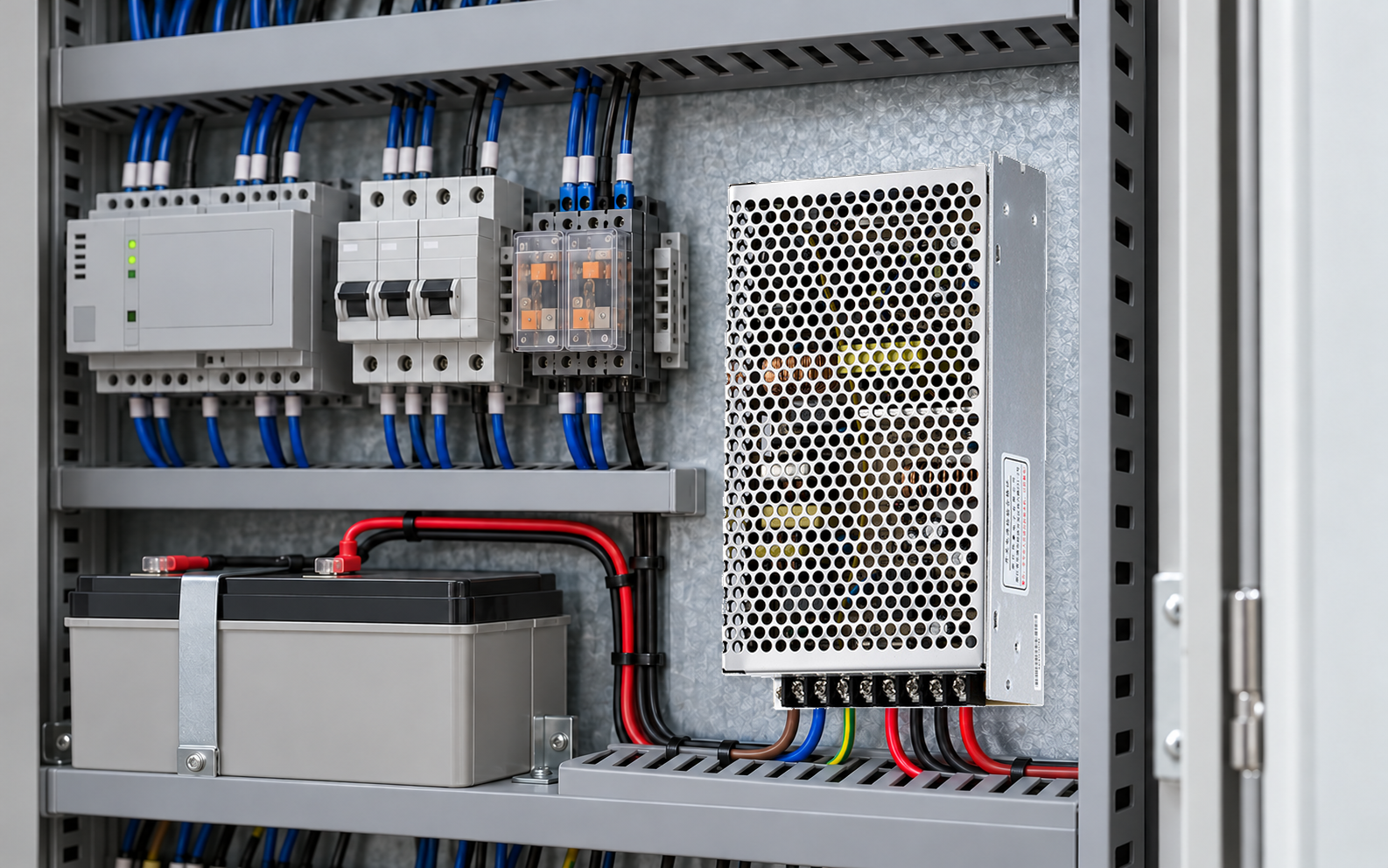
Before servicing a battery-backed control panel, identify every energy source that can reach the work area and link each source to the equipment’s approved service procedure. Turning off mains power describes one operating condition; it does not establish that battery-supported circuits are deenergized.
This article gives panel builders a document handoff method using the WEHO AD-155B as the product example. The output is a source inventory and service-boundary record. Battery runtime, charging capacity and transfer performance require separate design checks.
Start with the battery function, then define the work boundary
El WEHO AD-155B product page presents the AD-155 family as an AC-to-DC supply with a battery-charging function. That makes the battery an explicit part of the system review. The public page does not provide a complete panel isolation procedure or prove how every external circuit is disconnected.
Define the proposed maintenance task before drawing the map: replacing the supply, inspecting a terminal compartment and servicing an unrelated controller expose different parts of a panel. Record the physical area and equipment covered by the task, rather than using a single phrase such as “panel off.”
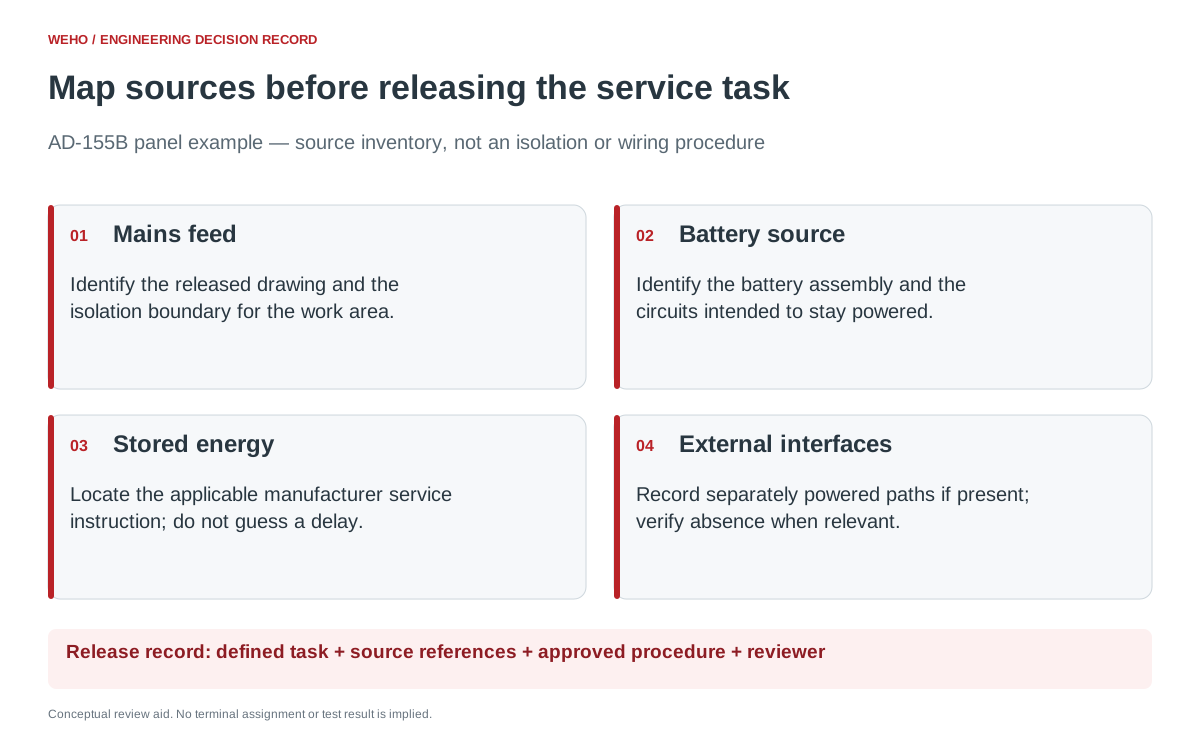
The source map below is a document-control aid. Its boxes identify questions for the approved design; they do not show AD-155B internal circuitry or a wiring arrangement.
Create one source inventory for the defined task
Use the released schematic, battery assembly documentation and equipment service instructions as the starting set. Assign a drawing reference to every identified source. A photo can help locate an item, but it cannot establish an internal disconnection path.
| Source or condition | What the record must identify | Evidence to retain |
|---|---|---|
| Mains supply | The actual supply feed and documented isolation boundary serving the work area. | Released drawing and applicable service-procedure reference. |
| Battery assembly | Battery location, battery-side protective arrangement and circuits intended to remain powered. | Exact battery assembly and equipment instructions. |
| Stored electrical energy | Equipment that requires a documented discharge or waiting condition. | Manufacturer’s service instruction; no guessed waiting time. |
| External interfaces | Any separately powered interface or connected equipment that can energize the task boundary, if present. | Interface drawing and confirmation from the responsible equipment owner. |
Include an “absent, verified” entry where a potential source is not present. Leaving a cell empty does not show whether it was examined. If a drawing cannot explain where a source ends, assign an owner to resolve that boundary before the task is released.
Give operating states names that cannot be confused with isolation
For U.S. workplace electrical service, OSHA 1910.333(b) distinguishes disconnection from all electrical sources, control devices and verification of the deenergized condition. It also addresses hazardous stored energy and possible backfeed. Apply the rules relevant to the project’s jurisdiction through the responsible qualified personnel.
Translate that distinction into the project record. “Mains unavailable” describes a supply event. “Battery operation” describes a continuity mode. “Controller stopped” describes a control state. None, by itself, defines a service boundary that has been established and verified.
Do not use an extinguished display, an inactive output or a software stop command as the record’s evidence of electrical isolation. Likewise, a supply’s hold-up specification describes functional output behavior under stated conditions; it is not a personnel-safety discharge instruction.
A hypothetical handoff that reveals a missing document
Consider a panel intended to keep its controller operating during a mains outage. The service request is to replace the supply. The drawing identifies the incoming mains feed and battery assembly, but the draft maintenance sheet mentions only the incoming mains switch.
The document review outcome is “procedure incomplete.” It is not a finding that the AD-155B is unsuitable. The panel owner must provide an approved task-specific procedure that addresses the battery and any other applicable sources, with the required verification and restoration controls.
A separate continuity test may intentionally demonstrate operation from the battery. Keep its report separate from the service authorization record: successful backup operation shows that the source can remain effective when mains is absent. It does not authorize a person to work inside that energized boundary.
This is a planning example, not a WEHO customer installation or a measured test. Its useful result is the missing-document decision made before maintenance begins.
Release the source map with the equipment revision
The completed handoff should let a qualified reviewer trace each source to a drawing, each service task to an approved procedure, and each open item to a named owner. The source map supplements those procedures; it does not replace their required sequence or verification method.
Retain the panel identifier, schematic revision, supply model, battery assembly revision, task boundary, procedure identifiers and reviewer date. Include the actual records required by the equipment owner rather than inventing a universal acceptance voltage or waiting interval.
Revisit the map when adding remote I/O, a second supply, a battery extension or another powered interface. A small functional change can alter which parts remain energized even when the original maintenance sheet still appears correct.
For procurement, ask who supplies the final panel-level service documentation and who approves changes. That responsibility should be clear before a supply substitution or battery revision enters production.
Use the project record
Open the blank Battery-Backed Panel — Service Source Record to record your conditions, evidence and decisions. The worksheet contains no pre-approved result.
Request AD-155B documentation for your panel review
Send WEHO the exact supply version, battery assembly information and panel schematic references. Identify the service-document questions you need answered so the product information can be reviewed alongside the panel builder’s approved procedures.