Running a Refrigerator on an Inverter: Check Restart Conditions and Daily Energy

To run a refrigerator from an inverter, check three different requirements: the correct AC supply, the compressor’s starting and restarting demand, and enough stored energy for the intended operating period. A low running wattage does not prove that the compressor will start, and a large peak-power number does not tell you how many hours the refrigerator will run.
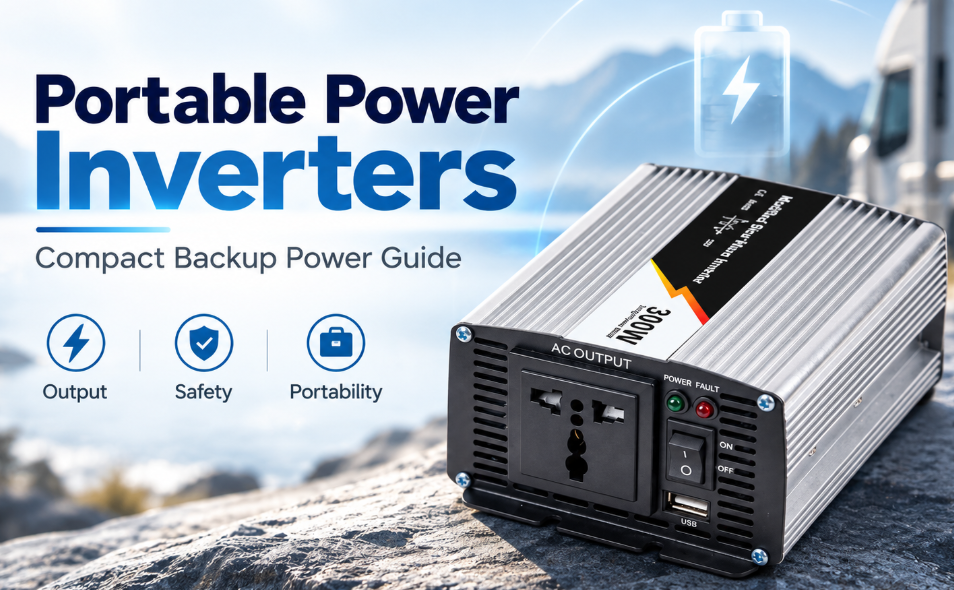
The WHP-1000W-B sample shown here is a 12 V pure sine wave inverter with a 1000 W rating and a 2000 W peak marking. Its matched sheet does not give a peak-duration curve. Those figures are useful starting points for a specification review, not a blanket refrigerator-compatibility claim.
Start with the refrigerator, not an inverter multiplier
Record the refrigerator model, rated AC voltage and frequency, compressor or electronic-drive type, normal running demand and any starting information supplied by its manufacturer. Include other loads such as fans, controls and defrost heaters where fitted. A refrigerator with an electronic variable-speed compressor need not behave like a conventional fixed-speed compressor.
Then identify the exact inverter version. The WHP B-series sheet lists different DC inputs and AC output options. The photographed 12 V unit does not establish the output voltage of every order, nor does a universal-looking socket establish that the connected appliance receives its required voltage and frequency. Confirm the delivered specification and plug arrangement.
Normal starts and restarts are different questions
A thermostat-controlled refrigerator repeatedly stops and starts. A successful first start from a settled condition is therefore only one part of a useful acceptance check. Ask the appliance supplier how it behaves after a brief supply interruption and what restart conditions or protective delay its compressor and starter require.
El referenced technical catalogue on compressor starting arrangements distinguishes starting arrangements that require pressure equalization from arrangements intended for different starting conditions. The relevant lesson is that restart requirements belong to the specific compressor and starting device; there is no single waiting time to copy into every inverter application.
Do not repeatedly interrupt power to force a restart outside the appliance instructions. Define an approved test sequence with the appliance supplier and a qualified installer. Record whether the compressor starts, whether the inverter remains within its operating limits and whether the battery-side voltage remains adequate during that event.
A peak rating needs a time and load condition
The WHP-1000W-B’s 2000 W peak marking does not state, by itself, how long that demand can be sustained or what voltage is maintained during a particular compressor start. Ask for the applicable overload information and assess the actual refrigerator combination. Do not replace that evidence with a generic rule such as “twice the running watts is always enough.”
| Requirement | Useful evidence | Common mistake |
|---|---|---|
| Running load | Demand during compressor operation and any coincident auxiliary or defrost load. | Using only the inverter’s peak figure for continuous operation. |
| Starting event | Actual starting profile and the applicable inverter overload capability. | Treating peak watts without duration as a guaranteed start. |
| Restart after interruption | Appliance or compressor instructions and the approved restart sequence. | Assuming every compressor needs the same delay. |
| Energy over time | Measured AC energy over representative duty and usable battery energy. | Multiplying running watts by 24 without considering actual cycling. |

Use daily energy to estimate autonomy
Runtime is an energy question. Prefer an energy measurement covering representative ambient temperature, loading, door openings and operating cycles. A product energy label is useful for comparison under its defined conditions, but it may not describe a hot utility compartment or a frequently opened refrigerator.
For a transparent arithmetic example, suppose the appliance uses 0.90 kWh of AC energy during the intended period and an assumed average conversion efficiency is 85%. The corresponding conversion input is approximately 0.90 ÷ 0.85 = 1.06 kWh. This is not a WHP efficiency test or a battery-size recommendation. Add the appropriate allowance for inverter standby consumption, other DC loads, battery limits and the required reserve without double-counting losses already included in a measured total.
Use usable energy, not only nominal battery ampere-hours. The permitted discharge window, temperature, aging and battery-management limits affect how much energy can be delivered. The sheet’s maximum efficiency value should not be assumed across all loads or substituted for a measured daily-system result.

Include the DC supply and installation
A refrigerator may have sufficient running-power margin and still fail to start if the DC supply drops excessively. Battery condition, interconnections, protective devices and the complete cable circuit all contribute. Have the DC path and protection selected for the actual installation; the photograph is not a wire-gauge or fuse-rating specification.
Keep the inverter dry, securely supported and clear of obstructed ventilation. Do not place it where refrigerator heat, condensate or stored items block its cooling path. The refrigerator also needs its own ventilation. A compact enclosure must satisfy both products’ installation requirements rather than relying on an open-air catalogue rating.

What to include in a supplier inquiry
Send the appliance and compressor details, AC requirements, running and starting information, battery voltage range, intended operating period and available installation space. Explain whether this is stand-alone operation or an engineered backup system. A stand-alone inverter does not automatically provide transfer switching, battery charging or permission to backfeed premises wiring.
Ask WEHO to review the proposed inverter specification against that information. Select the exact voltage and output option from the WEHO product range, then qualify the complete appliance, inverter and battery combination before relying on it for the intended duty.
Frequently asked questions
Will the 2000 W peak marking guarantee my refrigerator starts?
No. The matched WHP sheet does not give a peak-duration curve, and the appliance’s starting profile and DC supply must also be assessed.
Can a 1000 W inverter run a refrigerator for 24 hours?
The power rating does not establish runtime. Runtime depends on refrigerator energy use, losses and usable battery energy over the required period.
Should I use the same restart delay for every compressor?
No. Follow the instructions for the actual compressor, starter and appliance. Do not infer a universal delay from a different refrigeration system.