Key Engineering Takeaways
- Define a stabilization criterion before comparing cabinet temperature results.
- Record local ambient temperature, load, enclosure state and measurement position.
- Separate absolute temperature limits from temperature-rise comparisons.
- A cooler surface reading alone does not prove a better thermal design.

Why are two cabinet temperature readings often incomparable?
Two temperature readings can describe different stages of warm-up, different local air temperatures or different equipment loads. Comparing only their displayed values can therefore produce a false design conclusion. The decision is whether the proposed cabinet arrangement meets its applicable limits under a repeatable, representative thermal condition.
El LRS-60-12 product reference provides an enclosed supply example for this method. The article does not publish a measured LRS-60 temperature, a new derating curve or an approved installation clearance. Product operation still needs the applicable version's documented conditions.
The immediate output is a usable comparison protocol: define the measurement locations, operating state and point at which the result becomes eligible for comparison. This is more informative than taking whichever photograph happens to show the lowest temperature.
How do you separate absolute temperature from temperature rise?
Absolute temperature and rise above local ambient answer different questions. Absolute temperature is relevant when comparing a point with an applicable temperature limit. Temperature rise can help compare thermal behavior under controlled conditions, but it does not remove the absolute limit.
Hypothetical Cabinet Comparison Example
Assume test A records a selected surface point at 48°C with local air at 25°C after the defined stabilization criterion is met. Its rise is 48 − 25 = 23 K. Assume test B records the same defined point at 52°C with local air at 30°C, also after stabilization. Its rise is 22 K.
Test B has the higher surface temperature but the slightly lower rise. That does not prove test B is superior: load, airflow, measurement uncertainty and the definition of local ambient must also match. The example only demonstrates why subtracting the appropriate reference temperature changes the comparison.
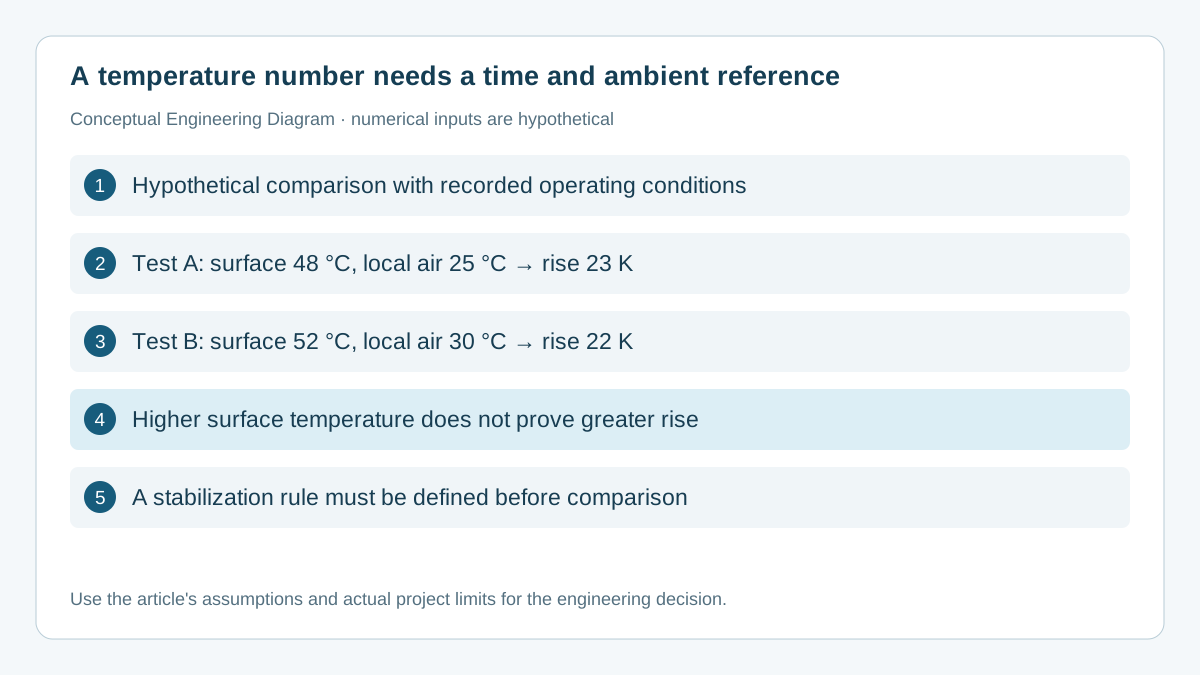
If the equipment imposes an absolute limit at the measured point, compare each absolute temperature with that limit. Do not use a smaller rise to excuse an excessive absolute value. Conversely, a higher absolute temperature in a warmer room is not enough by itself to conclude that a cabinet modification increased thermal resistance.
The values above are hypothetical, not manufacturer acceptance limits or customer results. The 1 K difference between the rises may be insignificant relative to uncertainty and repeatability. Define the decision rule before claiming a change based on a small difference.
What belongs in a thermal comparison record?
Control the variables that influence heat generation and heat removal. An unchanged output voltage does not prove an unchanged output load. An open cabinet door can alter airflow and make an earlier closed-door result unsuitable for direct comparison.
| Record item | Required definition | Comparison risk | Keep with result |
|---|---|---|---|
| Operating state | Load, duty cycle and input | Different heat generation | Measured electrical conditions |
| Enclosure state | Door, filters and adjacent equipment | Different cooling path | Assembly revision and photographs |
| Measurement point | Repeatable physical location | Different surface or air region | Sensor placement method |
| Stabilization | Trend rule and observation interval | Warm-up mistaken for steady state | Time-stamped trend |
Use the applicable product, equipment or test procedure to establish a stabilization criterion. If the project needs its own comparison method, have the responsible engineer define and document it. This article does not impose a universal warm-up time or an invented allowable temperature-change rate.
For equipment with a repeating duty cycle, a constant temperature may never occur. Define a repeatable cyclic condition instead: for example, compare equivalent cycle phases after the temperature pattern has become repeatable under the approved criterion. Retain the cycle maximum and minimum when they affect the requirement.
How should you run a useful comparison?
Run the baseline and proposed arrangement using the same defined procedure. Record the complete time trend, not only the final selected value. A modification can change warm-up speed without changing the eventual maximum, or alter a cyclic peak that an average value hides.
- Identify the exact supply, load arrangement, enclosure revision and applicable operating limits. Select measurement points that address the actual design question.
- Install the sensors using the qualified method. Record local-air and surface positions, attachment and measurement-system settings.
- Establish the specified input, output load and enclosure condition. Log the temperature trend and any relevant changes in equipment state.
- Apply the documented stabilization or cyclic-repeatability rule. Retain the evidence showing when it was met.
- Compare the intended quantities using the uncertainty and acceptance rule. Record both absolute values and rises where each is relevant.
Surface measurement method matters. A contact sensor can be influenced by attachment and lead conduction. An infrared reading depends on the surface and instrument setup; shiny metal can produce misleading results if emissivity and reflections are not addressed. Use an appropriate method and retain its configuration.
Do not open the supply to place a sensor on an internal component unless an approved procedure and qualified personnel require that measurement. Keep sensors and leads clear of terminals and moving parts. Apply the equipment's isolation and energized-test controls to installation and measurement work.
Which results should not be described as stabilized?
Do not describe a result as stabilized merely because a fixed amount of time has elapsed. An arbitrary delay can be too short for one assembly and unnecessarily long for another. A supply in isolation and the same supply inside a loaded cabinet can have different thermal time behavior.

El LRS-60-12 operating documentation remains the reference for product limits. The enclosure comparison adds equipment-level evidence; it does not replace the manufacturer's conditions with a single observed enclosure-surface temperature.
Record interruptions to the test, including a door opening, load change, room-temperature shift or sensor relocation. Decide from the approved method whether the affected segment remains comparable or must be repeated. Keeping the entire trend makes that decision auditable and avoids silently restarting the time axis at a convenient point.
If the result approaches an applicable limit, investigate the complete design rather than reporting a rounded value that hides the proximity. Check the uncertainty, hottest required location, source variation and representative operating states. A passing result under one favorable condition does not establish the full equipment operating envelope.
What should an OEM send WEHO for a thermal discussion?
Send the exact model, input and output conditions, enclosure photographs, local ambient trend, sensor locations and stabilization rule when discussing the LRS-60-12 supply reference. Include the applicable limit and raw time history. Ask which product documentation applies to the proposed operating condition before interpreting the result as product acceptance.
Engineering FAQ
How many minutes should a power supply warm up before a thermal test?
Use the applicable procedure and a defined stabilization criterion. There is no universal time that proves every supply and enclosure has stabilized. The assembly's thermal behavior, load cycle and measurement purpose determine the required evidence.
Is temperature rise the same as maximum operating temperature?
No. Temperature rise is a difference between a measured point and a specified reference. Maximum operating temperature is an applicable absolute boundary under stated conditions. Record and assess each quantity for its own purpose.
Can I compare a thermal-camera reading with a contact-probe result?
Only when the methods, locations and uncertainty support the intended comparison. Different surface properties and sensor effects can produce different results. Validate the measurement approach rather than assuming both displayed temperatures are interchangeable.
Does a stable enclosure temperature prove internal components are within limits?
No. A stable external point does not establish every internal temperature. Use the measurement points and criteria required by the relevant product or equipment evaluation. Avoid inferring an internal hotspot from an unrelated surface reading.
Can a repeating machine cycle have a valid thermal comparison?
Yes. Define a repeatable cyclic condition and compare equivalent phases, peaks or other required quantities under the approved method. A constant temperature is not necessary when the actual acceptance question concerns cyclic operation.