











Introducción
Cuando dos partes de una máquina funcionan con diferentes voltajes de CC, se necesita una forma de conectarlos sin reconstruir toda la arquitectura de potencia. Convertidor CC-CC Hace exactamente eso: toma una entrada de corriente continua a un voltaje y proporciona una salida de CC estable y regulada a un voltaje diferente.Si está especificando potencia para controles industriales, nodos de telecomunicaciones, cargas auxiliares de vehículos, sistemas de baterías o pantallas LED, comprender Qué es un convertidor DC-DC y Cómo funciona un convertidor DC-DC Es la diferencia entre una instalación limpia y confiable y un rack de ruido, calor y retornos de campo.
Como fabricante de fuentes de alimentación de conmutación, WEHO construye estos convertidores como módulos cerrados y unidades de montaje en placa, y cada unidad pasa una prueba de quemado a plena carga de alta temperatura 100% antes de su envío. Convertidores DC-DC WEHO para ver las carcasas, clasificaciones actuales y opciones de montaje que ofrecemos en más de 1000 modelos con certificaciones ISO9001, CE, RoHS, FCC y CCC.
¿ Qué es un convertidor DC-DC?
A Convertidor CC-CC es una etapa de potencia electrónica que convierte una fuente de corriente continua de un nivel de voltaje a otro.A diferencia de un regulador lineal, que desperdicia la diferencia de voltaje en forma de calor, un convertidor de conmutación almacena energía en un inductor o transformador y la libera al nivel deseado, logrando una eficiencia mucho más alta.La salida está regulada, lo que significa que mantiene el voltaje objetivo incluso cuando la entrada se hunde, sube, baja o baja. o la corriente de carga cambia. En resumen, la respuesta más clara a Qué es un convertidor DC-DC Es un bloque de construcción compacto y eficiente que permite que los sistemas de voltaje mixto compartan una fuente de energía.
En términos prácticos, se encontrará con dos direcciones básicas. Estaciones-abajo El convertidor (buck) reduce una entrada más alta a una salida más baja, por ejemplo, tomando 24V y entregando 12V. El step-up El convertidor (boost) eleva una entrada más baja a una salida más alta, por ejemplo, tomando 12V y entregando 24V. Buck Boost Convertidor en Español módulos de la familia WH-D que pueden subir o bajar dependiendo de la entrada, cubriendo sistemas de batería mixta y bus mixto sin necesidad de dos dispositivos separados.
¿ Por qué es necesario un convertidor DC-DC?
La mayoría de los sistemas no están construidos en un solo voltaje ordenado. Un gabinete de control de 24V puede necesitar alimentar sensores y controladores de 12V. Un bus auxiliar de vehículo de 12V puede necesitar ejecutar radios o iluminación de 24V. Un banco de baterías se descarga a través de un amplio rango mientras que la carga exige un riel fijo. Un convertidor DC-DC resuelve cuatro problemas recurrentes:
- Voltaje Matching - Los diferentes subsistemas simplemente no comparten un voltaje nominal, y volver a cablear toda la máquina rara vez vale la pena.
- Rails estables bajo entrada variable - Las baterías se hunden y los buses del alternador se ondulan; la regulación mantiene feliz al dispositivo descendente.
- Aislamiento Ruido - Una salida limpia y bien filtrada protege la electrónica sensible de medición y comunicación.
- Una sola fuente, múltiples salidas - Una batería o suministro puede alimentar muchas ramas aisladas y protegidas.
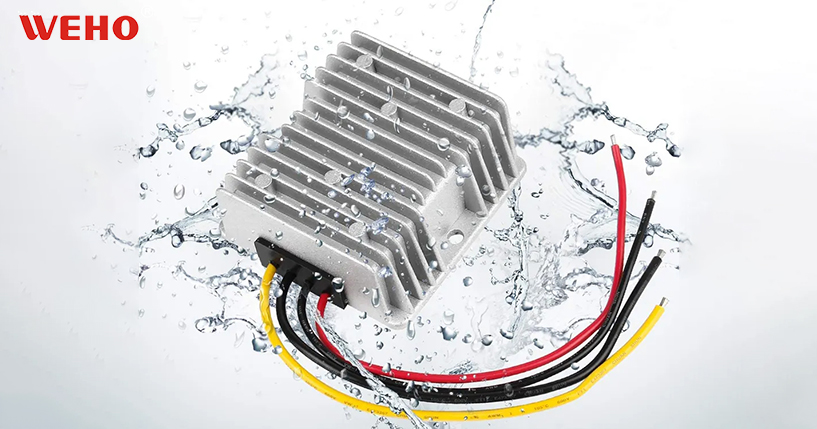
Para un ejemplo de reducción, nuestro 24V a 12V Convertidor DC-DC de 600W Permite que un sistema de 24V alimente de forma fiable dispositivos auxiliares de 12V hasta 50A sin sobrecargar la fuente principal o perder voltaje en el extremo más alejado de un recorrido de cable.
Step-up vs Step-down
| Si su carga necesita… | Topología | Ejemplo de WEHO |
|---|---|---|
| Tensión más baja que la fuente (24V → 12V) | Bajando (buck) | 24V a 12V Convertidor DC-DC de 600W |
| Mayor voltaje que la fuente (12V → 24V) | El impulso (boost) | 12V a 24V Convertidor DC-DC de 720W |
| En cualquier dirección desde un autobús mixto | Single-direction buck boost converter | WH-D series (enclosed) |
Specifying a Converter for Your System?
Send WEHO your input/output voltage, current, and mounting requirements and get a matched, burn-in-tested DC-DC module from our 1000+ model lineup with OEM/ODM support.
¿ Cómo funciona un convertidor DC-DC?
Principio básico de trabajo
The core idea behind Cómo funciona un convertidor DC-DC is switching conversion. Rather than dissipating excess voltage as heat, the converter chops the input into high-frequency pulses, shapes that energy with an inductor or transformer, and filters it back into a smooth DC output. Because the pass element is either fully on or fully off, it dissipates very little power, which is why efficiencies of 85–95% are typical for a well-designed switching stage.
Switching y transferencia de energía
An internal switch (usually a MOSFET) turns on and off thousands of times per second. When it is on, current builds up in the inductor and stores energy in its magnetic field. When it is off, the inductor releases that stored energy to the output through a diode or a synchronous rectifier. In an isolated design a transformer performs the energy transfer and provides galvanic isolation between input and output. The ratio of on-time to total cycle time — the Ciclo de deber — sets the output voltage. A step-up example from our catalog is the 12V a 24V Convertidor DC-DC de 720W, which raises a 12V source to a regulated 24V rail at up to 30A for equipment that needs the higher bus.
Control de retroalimentación y regulación de voltaje
To keep the output steady, a feedback loop continuously samples the output voltage and compares it to an internal reference. If the output drifts — because the input moved or the load changed — the controller adjusts the duty cycle to correct it. This closed loop is what makes a converter “regulated” rather than just a fixed ratio, and it is why a good converter holds its voltage across the full input and load range. That regulation is the practical payoff of understanding how a DC-DC converter works.
Componentes principales de un convertidor DC-DC
Whether enclosed or board-mount, a switching converter is built from a small set of roles. Knowing them helps you read a datasheet and judge build quality.
Semiconductor Switch
The high-frequency switching element (typically a MOSFET) that interrupts the input current. Its on-resistance and switching speed largely determine efficiency and heat.
El inductor
Stores energy in a magnetic field during the on-phase and releases it during the off-phase. Core material and winding quality affect ripple and EMI.
capacitor
Smooths the chopped waveform into a clean DC rail and absorbs transient load steps. Input and output capacitors are sized for low ESR to keep ripple low.
Controlador IC
The brain that drives the switch, runs the feedback loop, and implements protections such as over-current, over-temperature, and short-circuit shutdown.
Transformador
In isolated converters the transformer transfers energy and provides galvanic isolation, which is valuable for breaking ground loops and meeting safety spacing in industrial and communication equipment.
WEHO’s Serie SD cerrada DC-DC modules package these roles into a sealed, DIN-rail-friendly enclosure with the controller, magnetics, and protection already validated together — a practical choice when you want a finished, field-ready block rather than a board-level design.
Donde se utilizan los convertidores DC-DC
DC-DC converters appear wherever mixed voltages must coexist on one machine or vehicle. The applications below stay strictly within WEHO’s industrial and vehicle-auxiliary scope.
Aplicaciones automotrices
In work trucks, service vans, and specialty vehicles, the 12V/24V/48V auxiliary bus powers in-cab electronics, lighting, and equipment that differ from the chassis voltage. WEHO supplies 12V/24V/48V-to-AC inverters and 24V/48V-to-12V DC-DC for these auxiliary loads — not automotive main traction packs, onboard chargers, or vehicle-OEM BMS.
Automatización industrial
PLCs, sensors, contactors, and HMIs in a control cabinet often run at 12V or 24V while the backbone is 24V or 48V. Converters deliver clean, isolated rails and let you power mixed-voltage subsystems from one supply.
Sistemas de energía renovable
In battery-storage and off-grid renewable systems, many distributed power setups rely on stored DC energy and an off-grid DC bus that must be conditioned for the load. A DC-DC converter stabilizes a battery-storage bank as its cells discharge across a wide voltage window, holding a fixed, clean rail for downstream controllers, chargers, and DC bus equipment. This off-grid DC bus conditioning protects sensitive loads and extends usable capacity without rebuilding the storage architecture.
Telecomunicaciones
Telecom sites run on -48V distribution but need 12V or 24V for radios, routers, and monitoring. A regulated DC-DC stage provides the local rail and isolates sensitive comms gear from bus noise.
Electrónica de Consumo
Portable devices, adapters, and desktop peripherals step internal battery or adapter voltages down to the low rails their chips need. A small, efficient converter keeps those rails steady as the source varies, which is why the same switching principle scales from industrial cabinets down to handheld gadgets.
Preguntas frecuentes
¿ Son eficientes los convertidores DC-DC?
Yes. A switching Convertidor CC-CC typically reaches 85–95% efficiency because it transfers energy through an inductor or transformer instead of dissipating the voltage difference as heat. WEHO validates every unit with a 100% high-temperature full-load burn-in test, and our DC-DC range carries ISO9001, CE, RoHS, FCC, and CCC certifications across 1000+ models, so the efficiency you see on the datasheet is backed by production testing rather than just a claim.
¿ Los convertidores DC-DC proporcionan aislamiento eléctrico?
They can. Non-isolated converters share a ground between input and output, while isolated types use a transformer to provide galvanic isolation that breaks ground loops and meets safety spacing. For industrial and telecom equipment where noise and safety spacing matter, an isolated design is often the right choice. WEHO’s Serie SD cerrada DC-DC modules package the magnetics and protection into a sealed, field-ready enclosure, available with OEM/ODM customization for qualified projects.
Conclusión
A Convertidor CC-CC is the quiet workhorse that lets mixed-voltage systems run on one power source with clean, regulated rails. Once you know the direction you need — step-down, step-up, or a single-direction buck boost converter — the rest is sizing current, picking the enclosure, and verifying protection. WEHO validates every unit with a 100% high-temperature full-load burn-in test and backs the lineup with ISO9001, CE, RoHS, FCC, and CCC certifications across 1000+ models, so you can specify with confidence from prototype through production.
Need a Matched DC-DC Module?
Tell WEHO your input/output voltage and current, and we will recommend a burn-in-tested converter from our DC-DC range with OEM/ODM options.