Choose a 12V, 24V or 48V WHP inverter to match the battery system’s actual voltage window. Those entries describe different ordered input versions; they do not mean one inverter automatically accepts all three battery voltages. A higher-voltage system can reduce current for the same AC load, but the battery, charging system, protection and every connected DC device must belong to that architecture.
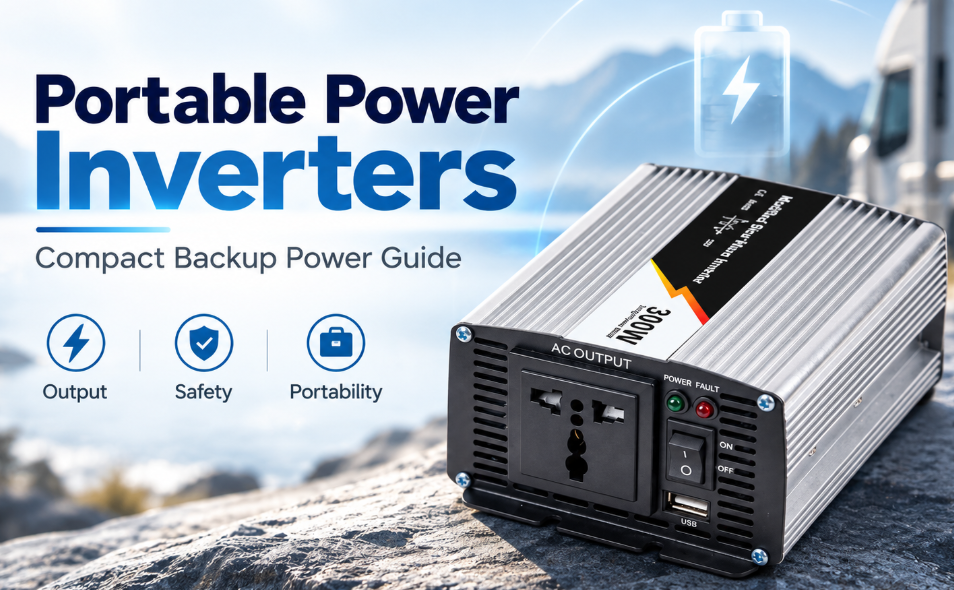
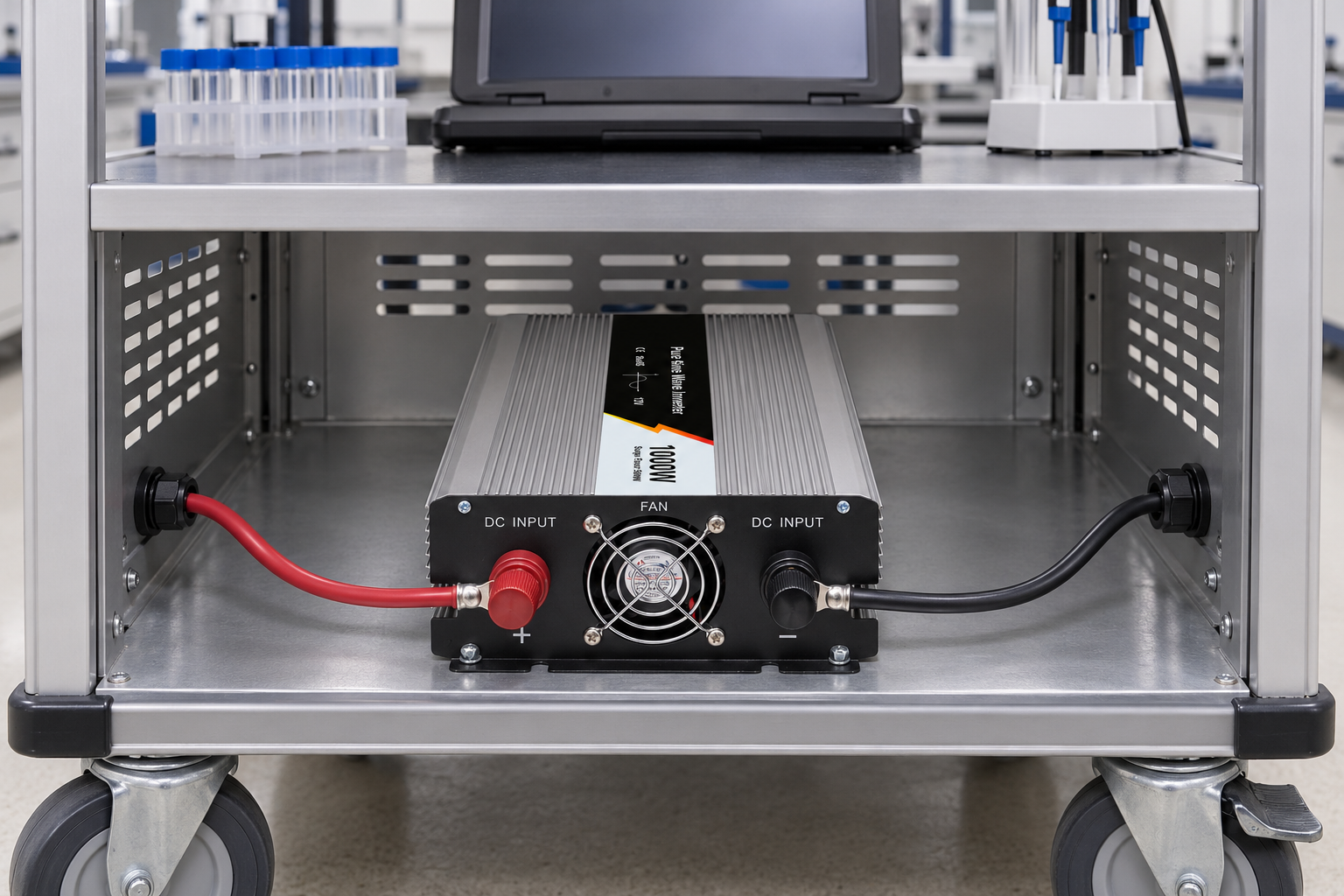
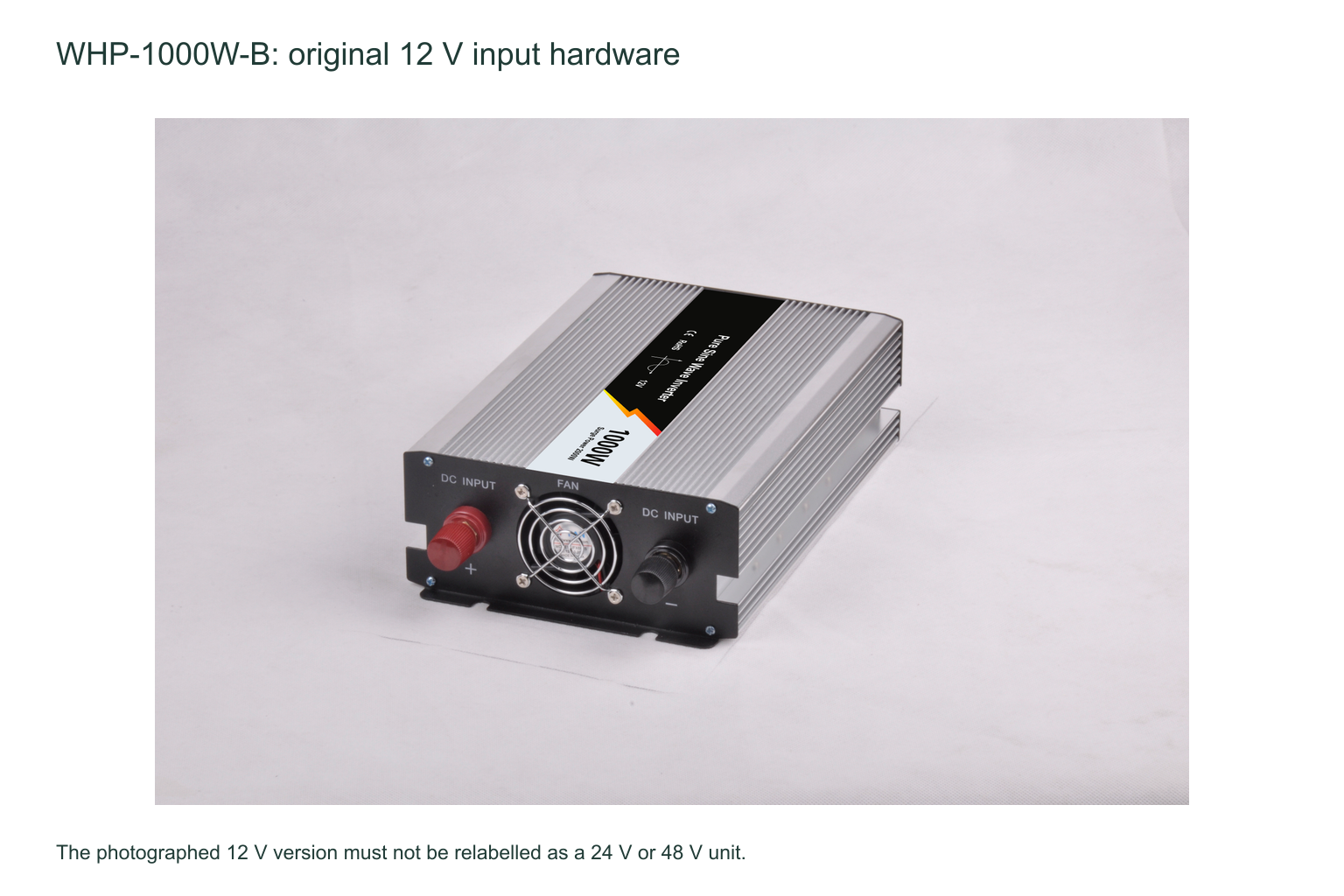
The illustrated WHP-1000W-B sample is marked 12V. Its matching B-series specification lists 1000W rated power and 2000W peak power. This article compares the listed input options while keeping that photographed unit’s identity unchanged.
Compare operating windows, not just nominal labels
A nominal battery voltage is a system description, not a constant terminal voltage. State of charge, charging conditions and the load all affect the voltage arriving at the inverter. Start with the battery supplier’s minimum and maximum operating values, then include wiring losses and the intended shutdown strategy.
| WHP-1000-B input option | Listed input range | Procurement implication |
|---|---|---|
| 12V DC | 10–15.5V | The photographed sample belongs to this option. |
| 24V DC | 20–31V | Order the matching 24V hardware; do not connect a 24V bank to the 12V sample. |
| 48V DC | 40–61V | Check the bank’s full charging voltage and suitably rated DC components. |
These ranges come from the matching WHP-800/1000/1200-B sheet. They are not interchangeable with a newer WHP brochure or another hardware suffix. The chosen version must cover the intended battery operation without relying on its protection threshold as the normal control point.
Understand the current advantage of higher voltage
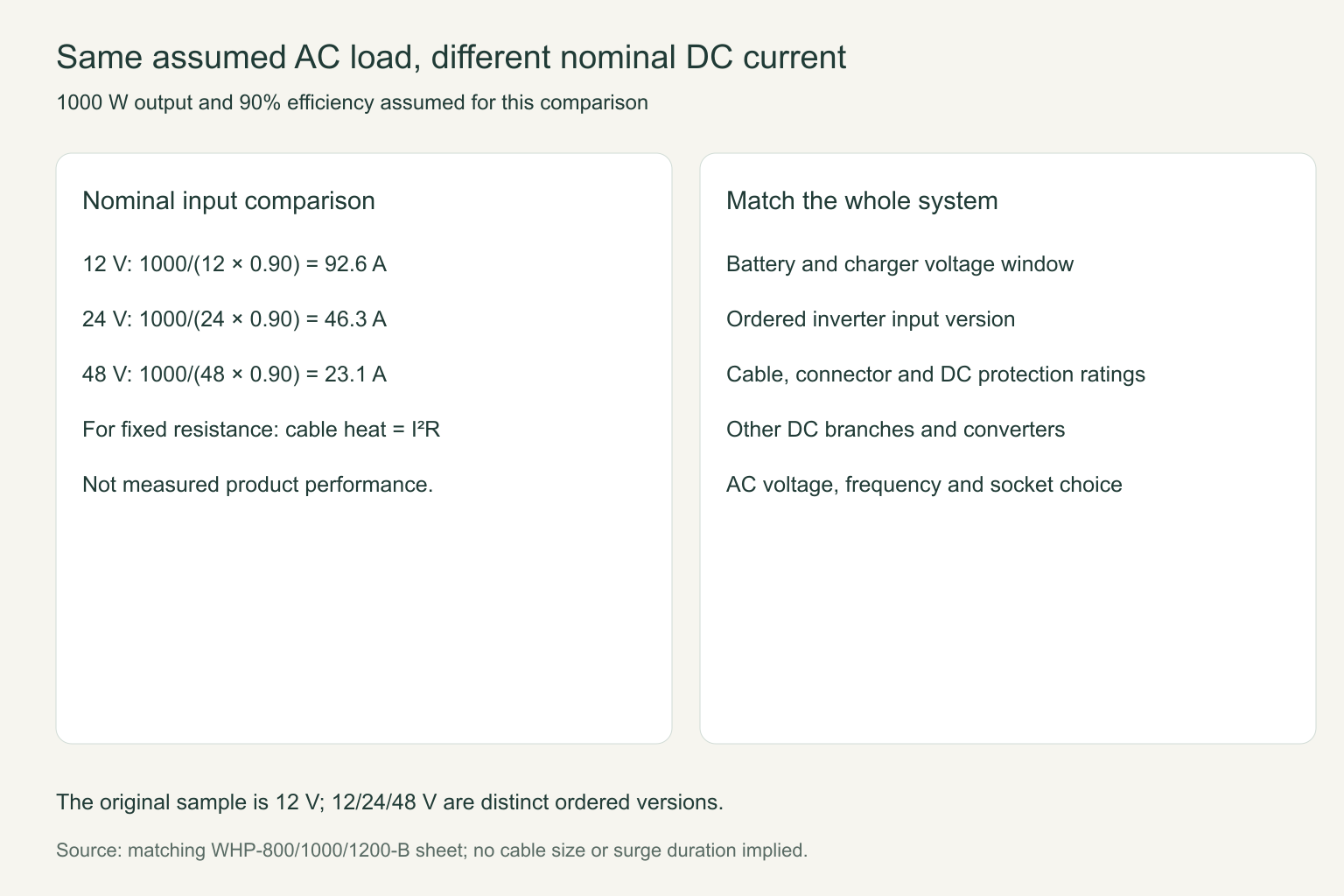
For equal output power and efficiency, doubling DC voltage halves approximate DC current. At an assumed 90% efficiency and a 1000W AC load, the nominal-voltage estimates are 92.6A at 12V, 46.3A at 24V and 23.1A at 48V. The calculation is P ÷ (V × efficiency); it is not a measured efficiency curve or a cable-size recommendation.
The same electrical resistance dissipates heat according to I²R. Halving current would reduce that particular resistive loss to one quarter. This can make a higher-voltage architecture attractive for a longer distribution route, but it does not remove the need to check insulation, protection, connectors and switching equipment at the higher voltage.
Keep the complete battery system consistent
For an existing 12V service vehicle, a correctly sized 12V inverter may fit the established charging system and auxiliary battery more simply than rebuilding the vehicle around 24V. For a new battery cabinet, a designer can compare 24V and 48V early, before selecting chargers and lower-voltage control branches.
Do not create a higher-voltage bank by adding batteries in series without checking the battery manufacturer’s series-connection permission, management system, charging method and protection. Likewise, do not tap only part of a series bank to supply a lower-voltage accessory unless the system design specifically supports it; use a suitable conversion arrangement where required.
| Existing condition | Selection question |
|---|---|
| Fixed battery and charger | Which inverter input version covers that system’s complete operating window? |
| New battery architecture | What voltage suits current demand, cable route, available components and other DC loads? |
| Multiple DC voltage branches | Which loads need separate DC-DC conversion rather than a direct battery connection? |
| Low-battery recovery | How do battery management, inverter shutdown and restart interact? |
Specify the AC side separately
A 24V input order does not automatically define a 230V AC output. The B-series sheet separately lists AC voltage choices and 50Hz or 60Hz options. Select the required output voltage, frequency and socket arrangement for the actual loads and destination.
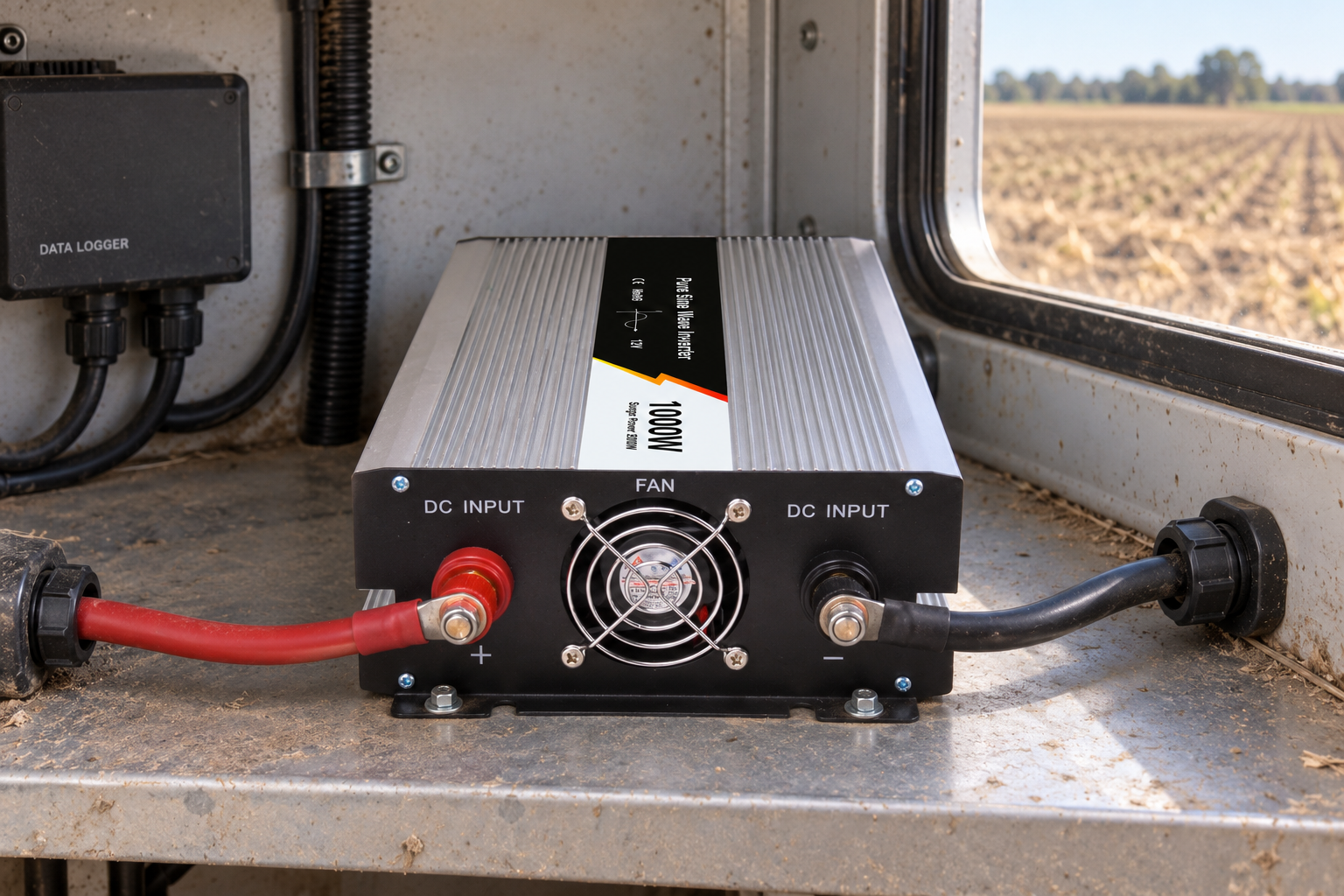
The real sample’s silver ribbed case, universal-style outlet, switch, USB connection and rear posts establish its physical configuration. They do not prove which AC voltage option was ordered. The 2000W peak marking also does not state how long that peak is available.
Make the RFQ usable
Send the battery chemistry and configuration, minimum/maximum operating voltages, charging voltage, continuous load and starting demand, DC cable route and required AC voltage/frequency to WEHO’s enquiry team. Request the full input/output version and matching installation information. The WEHO product overview provides the inverter family starting point; final selection should identify the complete ordered unit.
Frequently asked questions
Can one inverter switch between 12V and 24V batteries?
Not on the evidence for this B-series sample. The specification presents separate input options, and the pictured unit is marked 12V.
Will a 48V inverter always be more efficient?
Lower current can reduce a particular cable’s resistive loss, but system efficiency also depends on the inverter operating point, other conversion stages and actual loads. The current calculation is not a complete efficiency comparison.
Should the low-voltage trip point decide my normal battery discharge limit?
No. Choose the operating limit from the battery and system requirements, then coordinate it with the inverter’s documented protection and recovery behaviour.